
Comprehensive School Playground Maintenance: A Guide to Safety and Longevity

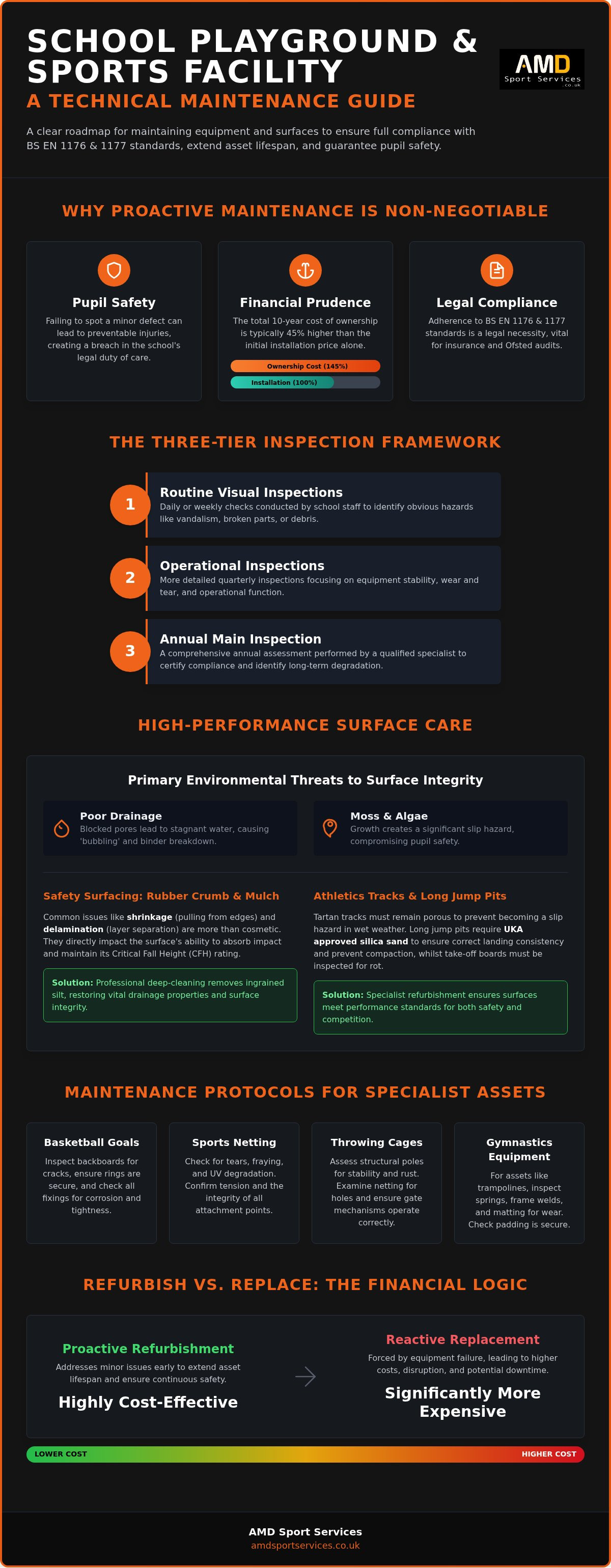
The total 10-year cost of owning a school playground is typically 45% higher than the initial installation price. For site managers and headteachers, the pressure to maintain these assets isn't just about protecting a financial investment; it's about the daily responsibility of pupil safety. Effective school playground maintenance requires more than just a quick visual check. It demands a technical understanding of how equipment wears and how safety surfaces like rubber mulch or crumb degrade over time. Failing to spot a minor defect today can lead to a failed health and safety audit tomorrow, or worse, a preventable injury.
We know that managing deteriorating surfaces and bespoke sports equipment repairs can feel like a constant battle against the elements and heavy footfall. This guide provides a clear roadmap for maintaining your equipment and surfaces to ensure full compliance with current BS EN 1176 and 1177 standards whilst significantly extending the lifespan of your facility. We will examine the technical requirements for safety inspections, the specific needs of different surfacing materials, and how to address often-overlooked repairs for specialised assets like throwing cages or basketball goals.
Table of Contents
School Playground Maintenance: Why is it Essential?
School playground maintenance is the systematic inspection, repair, and preservation of both recreational play assets and competitive sports infrastructure. It isn't just about aesthetics or basic cleaning. It's a technical discipline designed to ensure every swing, slide, and basketball goal remains structurally sound and safe for use. By adopting a holistic approach to facility care, schools can manage their play zones and sports areas as a single, compliant environment. This proactive strategy prevents the gradual decay that leads to equipment failure.
The financial argument for this approach is clear. Preventative care is always more cost-effective than reactive emergency repairs. For instance, addressing a small tear in a rubber mulch surface or tightening a loose bolt on a climbing frame prevents the rapid acceleration of wear. Without this intervention, minor issues quickly become major hazards that require expensive full-system replacements. Consistent service and maintenance ensures that school assets reach their full intended lifespan rather than deteriorating prematurely.
The Legal Framework: BS EN 1176 and 1177
Adhering to established playground safety standards is a legal necessity for any educational institution. BS EN 1176 specifies the requirements for playground equipment, whilst BS EN 1177 focuses on impact attenuating surfacing. These standards dictate how equipment is designed and how surfaces must perform during a fall to mitigate head injuries. Compliance requires a formal inspection regime including routine visual checks, quarterly operational inspections, and an annual main inspection by a qualified specialist. Maintaining an official log of these activities is vital for insurance purposes and provides a clear audit trail.
The Role of the School Business Manager
School Business Managers and site staff are the primary duty holders for managing playground risks. Professional maintenance provides the technical evidence needed to support Ofsted and health and safety audits, proving that the school is managing its estate effectively. It removes the guesswork from health and safety compliance. The duty of care schools have towards playground safety is a legal obligation to take all reasonable steps to ensure children are protected from foreseeable harm whilst using school facilities. By outsourcing technical repairs to seasoned practitioners, schools can discharge this duty with confidence and focus on their core educational objectives.
Maintaining High-Performance Sports and Play Surfaces
High-traffic school environments place immense strain on surfacing. In the UK, drainage issues and moss growth are the two primary threats to surface integrity. Stagnant water can lead to "bubbling" in wetpour, whilst moss creates a slip hazard that compromises safety. Regular school playground maintenance must address these environmental factors to prevent premature failure. When silt and organic matter build up, they block the porous gaps in the surface, leading to standing water that accelerates the breakdown of the binder.
Safety Surfacing: Rubber Crumb and Mulch
Wetpour rubber crumb and rubber mulch are durable, but they aren't maintenance-free. Over time, you might notice "shrinkage" where the surface pulls away from the edges, or "delamination" where layers begin to separate. These aren't just cosmetic issues; they directly impact the surface's ability to absorb impact. Technical guidance, such as the Public Playground Safety Handbook, emphasises that Critical Fall Height (CFH) ratings are only valid if the surface is maintained at its original thickness and density. Basic sweeping is helpful, but professional deep-cleaning is necessary to remove ingrained silt and restore the drainage properties of the rubber.
Athletics Tracks and Long Jump Refurbishment
Athletics infrastructure requires a higher level of precision than standard play areas. Tartan tracks must maintain their porosity to allow water to drain through the surface, preserving grip during wet weather. If the track becomes "sealed" with dirt, it becomes a slip hazard for pupils. Similarly, long jump facilities need specific attention. Refurbishing sand pits involves more than just raking; it requires the use of UKA approved silica sand to ensure the correct landing consistency and prevent compaction. Take-off boards must also be inspected for rot or instability. For schools looking to upgrade their facilities, our guide on long jump runway installation details the technical requirements for a compliant setup.
Court Marking Renewal and Line Painting
Faded markings are a frequent oversight in school playground maintenance. When lines for netball, basketball, or football overlap and become indistinct, it increases the risk of pupil collisions. Renewing these with professional-grade polyurethane or thermoplastic markings restores clarity and slip resistance. This is especially vital in multi-use games areas (MUGAs) where space is at a premium and multiple sports share the same surface. If you are planning a wider project, consider how external sport equipment installation can be integrated with your surfacing renewal to maximise the utility of your outdoor space. If your surfaces are showing signs of wear, our team can provide a technical assessment to determine if repair or full refurbishment is required.
Specialist Equipment: Basketball Goals and Netting Systems
Whilst surfacing provides the foundation for safe play, the mechanical and structural integrity of sports equipment requires a different set of technical skills. Specialist school playground maintenance must include a rigorous assessment of all fixed and portable sports assets. Neglecting these items often leads to catastrophic failure, such as a wall-mounted goal collapsing or a motorised winch failing in a sports hall. A seasoned practitioner knows that the safety of these facilities relies on the smallest details, from the tension of a wire to the torque of a mounting bolt.
Basketball Goal Safety and Inspections
Basketball systems are subject to intense vibration and physical force during play. For wall-mounted units, inspections must focus on the mounting brackets and the integrity of the masonry or timber fixings. Portable units require checks on the ballast weights and the stability of the folding mechanism. A critical area is the "slam-dunk" rim; these spring-loaded hoops must be checked to ensure:
The spring tension is correct for safe release during a dunk.
No sharp edges or burrs have formed on the net attachments.
The backboard is free from stress fractures or loose mounting bolts.
If you are considering upgrading your facility, our basketball goal installation services ensure that new systems are fitted to the highest safety standards from day one.
Sport Netting and Partition Maintenance
Netting systems are frequently overlooked until a tear occurs. In sports halls, division netting must be inspected for proper tension and the security of the weight-line at the base. A loose weight-line can become a trip hazard or fail to contain a ball, leading to pupil injury. Outdoor cricket and football netting face additional environmental stress; UV degradation and high winds can make the mesh brittle. Frayed edges are a sign of structural weakness that requires immediate repair to prevent the net from failing during use. Detailed inspections of these sports hall netting systems help identify these risks before they result in an accident.
Roof-mounted or motorised equipment in sports halls presents unique hazards. These systems involve complex cables, pulleys, and motors that must be serviced regularly to prevent "free-fall" incidents. Beyond standard gear, bespoke items like throwing cages or cricket netting also require specialist attention. Repairing a hammer cage or a cricket lane involves more than just patching a hole; it requires an understanding of the impact forces involved to ensure the repair is fit for purpose. Comprehensive school playground maintenance ensures these high-risk assets remain operational and, most importantly, safe for every pupil.
Developing a School Playground Maintenance Schedule
A structured approach to school playground maintenance transforms safety from a reactive concern into a manageable administrative process. It's not enough to fix things when they break; you need a system that identifies failure points before they become hazards. This requires a three-tier inspection regime that balances the daily observations of site staff with the technical expertise of external specialists. By documenting every check, you create a robust audit trail that protects the school during insurance claims or health and safety reviews.
Routine Visual vs. Operational Inspections
Routine visual inspections are your first line of defence. Site staff should carry these out daily or weekly, looking for obvious issues such as vandalism, broken glass, or missing components. It's a surface-level check designed to keep the environment tidy and safe for immediate use. Operational inspections are more intensive and should occur every one to three months. These checks focus on the stability of equipment and the rate of wear on moving parts, such as the hinges on a gate or the bearings on a swing. The primary goal of an operational inspection is to identify structural instability and internal component wear that a standard visual check cannot detect.
Organising the Annual Safety Audit
The annual main inspection is the most critical element of your schedule and must be performed by an RPII-certified inspector or a seasoned specialist contractor. To manage this effectively, follow these steps:
Step 1: Identify all assets. Create a full inventory that includes not just play equipment, but also safety surfaces, basketball goals, and netting systems.
Step 2: Schedule during school holidays. This allows the inspector full access to the site without disrupting pupils and gives you time to action repairs before the new term starts.
Step 3: Review and categorise. Once you receive the professional report, categorise repairs by risk level. High-risk items must be decommissioned or repaired immediately, whilst low-risk items can be scheduled for future maintenance.
Consistency is the key to longevity. While your site team handles the basics, complex mechanical systems and specialised surfacing require a deeper level of scrutiny. If you haven't reviewed your current school playground maintenance regime recently, you can learn more about our service and maintenance protocols to see how they align with your school's needs. We recommend booking your professional technical audit today to ensure your facility remains fully compliant with UK safety standards.
Professional Remediation: Repairing and Refurbishing Assets
The "repair versus replace" dilemma is a frequent challenge for school business managers. When a high-value asset like a gymnastics trampoline or a wetpour surface begins to show its age, the immediate assumption is often that a costly full replacement is the only solution. However, professional refurbishment is frequently a more pragmatic and cost-effective route. Effective school playground maintenance isn't just about spotting faults; it's about applying technical expertise to restore equipment to its original safety specifications. By focusing on structural integrity and replacing only the wear components, you can significantly extend the lifespan of your facility whilst managing limited budgets.
Specialist Sports Equipment Repairs
Standard play equipment is often modular, but sports-specific assets require bespoke craftsmanship and precise parts. At AMD Sport Services, we specialise in technical repairs that many general contractors overlook. For gymnastics trampolines, this involves more than just a visual check; we provide full bed replacements and frame servicing to ensure the equipment handles the high forces of competitive use. Our technicians also handle the mechanical refurbishment of fitness equipment, including the replacement of treadmill belts and decks, renewing gym cables, and fitness equipment upholstery.
Bespoke sports apparatus requires an expert who understands the original engineering. We provide specialised maintenance for athletics infrastructure, such as refurbishing pole vault troughs and repairing throwing cage nets. These items are often subject to unique structural stresses. Using the correct, high-specification materials for hammer cage netting or cricket lanes ensures the repair is durable enough to withstand repeated impact. This technical honesty prevents schools from overspending on new equipment when a professional restoration is the better choice.
Surface Refurbishment and Patching
Surface degradation often occurs in concentrated high-traffic areas, such as under swings or at the start of a long jump runway. Full resurfacing is rarely necessary if the underlying base remains stable. Professional patching of wetpour rubber crumb or mulch requires a technical approach to ensure a seamless, trip-free finish. The new material must be correctly bonded to the existing surface to prevent "lipping" at the edges. This precision ensures the area remains compliant with BS EN 1177 and eliminates the risk of pupil injury.
For athletics tracks, the focus is often on restoring performance rather than just fixing holes. Over time, tartan tracks lose their slip-resistance as silt and moss fill the porous gaps. Professional deep-cleaning and chemical treatments restore the original grip and drainage properties without the need for a full relay. This methodical approach to refurbishment keeps your sports and play areas operational for years beyond their expected lifecycle. If you have concerns about the condition of your equipment or surfaces, contact AMD Sport Services for a professional site inspection to determine the most effective remediation strategy.
Securing the Future of Your School Facilities
Effective school playground maintenance is a continuous commitment to pupil safety and asset preservation. By moving from reactive repairs to a structured inspection regime, schools can ensure full compliance with British Standards whilst avoiding the high costs of premature equipment replacement. The technical integrity of your facility depends on spotting subtle wear in safety surfaces and specialist sports equipment before they become hazardous.
With over 20 years of technical expertise and national UK coverage for schools and leisure centres, AMD Sport Services provides the professional oversight needed to protect your institutional assets. Our team specialises in RPII-standard sports equipment repairs, ensuring that every basketball goal, gymnastics trampoline, and athletics track remains structurally sound and fit for purpose. Book a Professional Sports Equipment Safety Inspection with AMD Sport Services to ensure your facility meets the highest safety standards. Taking these proactive steps today creates a safer, more durable environment where children can play and compete with confidence.
Frequently Asked Questions
How often should school playground equipment be inspected in the UK?
In the UK, a three-tier inspection regime is recommended to ensure compliance with BS EN 1176. This includes daily or weekly routine visual checks by site staff, quarterly operational inspections focusing on wear and stability, and a comprehensive annual main inspection. Effective school playground maintenance relies on this structured approach. The annual audit must be conducted by a specialist or RPII-qualified inspector to identify structural issues before they become safety hazards.
Can school site staff perform their own playground safety checks?
School site staff can and should perform routine visual checks on a daily or weekly basis. These inspections focus on obvious hazards like vandalism, litter, or loose components. However, operational and annual main inspections require a deeper technical understanding of equipment mechanics and surfacing integrity. For these more complex audits, it's essential to hire a seasoned practitioner who can provide a formal report and maintain a compliant audit trail for insurance purposes.
What are the most common playground maintenance problems for schools?
Common issues include the shrinkage or delamination of wetpour rubber crumb, loose structural fixings on climbing frames, and the accumulation of moss on safety surfaces. In sports areas, schools frequently encounter frayed cricket or football netting and indistinct court markings. Environmental factors like poor drainage also lead to standing water, which accelerates the decay of wooden equipment and the binder used in rubber mulch. Addressing these minor defects early prevents major safety failures.
Is rubber crumb surfacing maintenance-free?
Rubber crumb surfacing is durable but not maintenance-free. It requires regular sweeping to remove organic debris and periodic deep-cleaning to maintain its porous nature. Without this care, silt blocks drainage, leading to standing water and moss growth that creates a significant slip hazard. Additionally, schools must check that the surface hasn't thinned or hardened over time, as this compromises the Critical Fall Height protection required by established safety standards.
What happens if a school fails to maintain its playground equipment?
Failure to prioritise school playground maintenance can lead to preventable pupil injuries and significant legal liability for the institution. From an administrative perspective, neglected facilities often result in failed health and safety or Ofsted audits. Furthermore, insurance providers may refuse to cover claims if a school cannot demonstrate a consistent audit trail of inspections and repairs. Ultimately, reactive maintenance is more expensive than a proactive regime that identifies risks early.
How much does a professional playground safety inspection cost?
The cost of a professional safety inspection varies depending on the size of the school site and the volume of equipment being audited. Factors such as the number of play zones, the presence of specialised sports infrastructure like athletics tracks, and the complexity of motorised equipment all influence the final requirement. Schools should request a bespoke quote that encompasses both play and sports assets to ensure a comprehensive assessment of their legal compliance.
Can basketball goals be repaired or must they be replaced?
Basketball goals can often be repaired by replacing specific wear components rather than the entire system. Common remediations include renewing "slam-dunk" rims, replacing damaged backboards, or servicing the motorised winches in sports halls. Provided the main structural mounting or post remains sound, technical refurbishment is a cost-effective way to restore safety. A specialist can assess the structural integrity of the goal to determine if a repair meets current safety specifications.
What is the lifespan of a typical school athletics track?
A typical school athletics track, such as a tartan track, has a lifespan of 10 to 15 years when maintained correctly. Longevity depends heavily on the quality of the initial installation and the frequency of professional cleaning. Regular moss removal and the restoration of drainage properties prevent the surface from hardening or delaminating. Without consistent care, the binder can break down prematurely, leading to a loss of grip and the need for a full resurfacing.


Comments