
Professional Treadmill Deck Replacement UK: A Facility Manager’s Guide

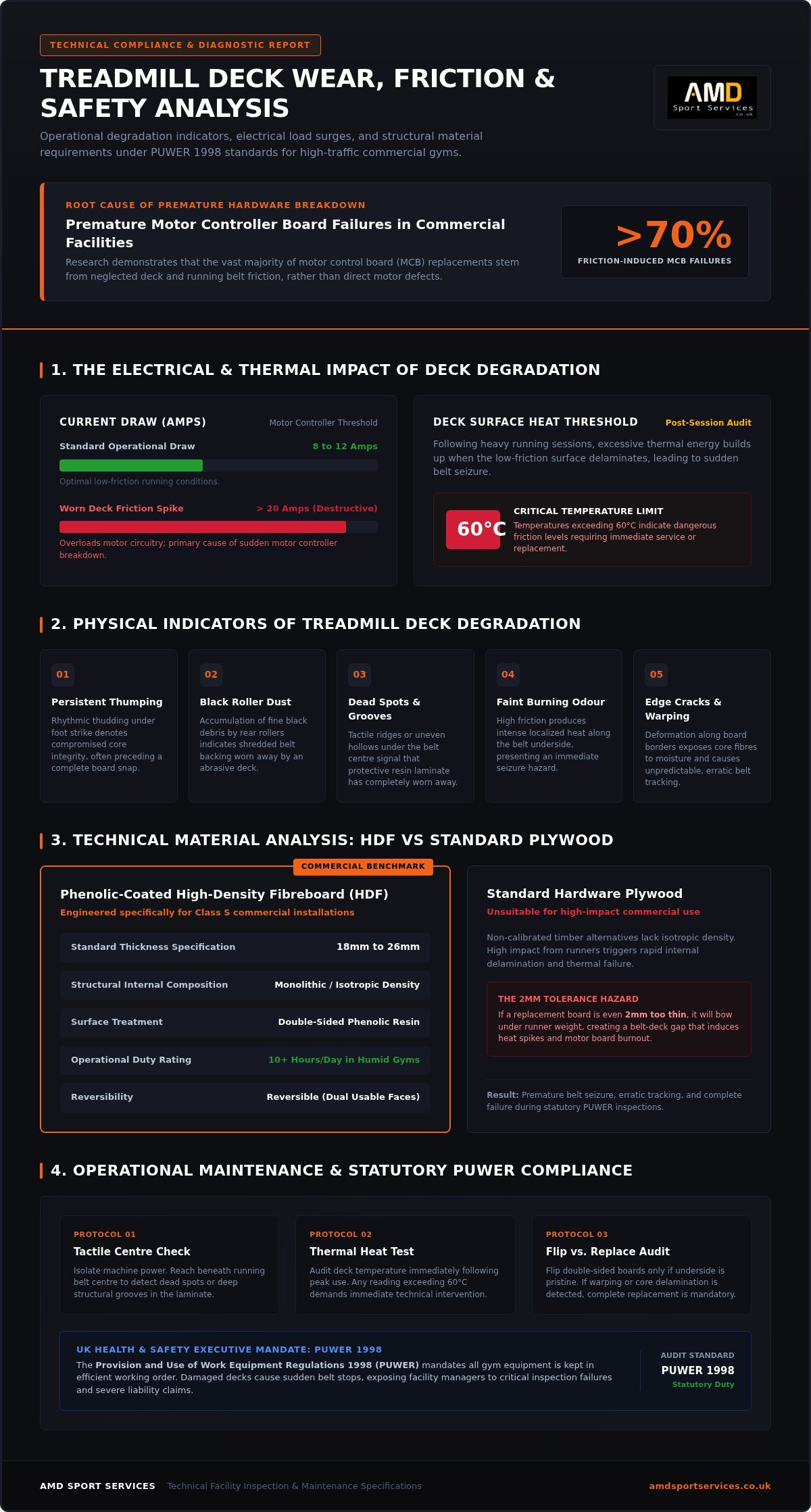
Did you know that over 70% of premature motor controller failures in commercial gyms stem from ignored belt and deck friction rather than motor defects? You've likely seen the "Out of Order" signs multiply as your equipment ages, causing frustration for members and students alike. It's a common headache for facility managers who face the high cost of replacing entire units or the fear of liability if a DIY repair goes wrong. Investing in a professional treadmill deck replacement UK service doesn't just fix a machine; it restores safety compliance and significantly extends the lifespan of your existing fleet.
We understand that maintaining a high-traffic sports facility requires a pragmatic approach to equipment health. This guide details how to identify critical wear, the importance of adhering to PUWER regulations, and the technical process of fitting bespoke, phenolic-coated boards. By the end, you'll know how to reduce friction, lower noise levels, and ensure your gym remains a safe environment for every user.
Table of Contents
Identifying the Signs of Treadmill Deck Wear and Safety Risks
Identifying a failing treadmill deck early prevents catastrophic mechanical failure and protects your facility from liability. Whilst the running belt is the most visible component, the deck beneath it acts as the primary support structure. Over time, the phenolic coating wears thin, exposing the core material to heat and moisture. Look for visible cracks or warping along the edges. If you notice a persistent thumping sound during use, the board's structural integrity is likely compromised. This often precedes a total snap, which can lead to serious injury if it occurs whilst a member is running at high speed.
In the UK, the Provision and Use of Work Equipment Regulations 1998 (PUWER) mandate that all gym equipment is kept in efficient working order. A damaged deck represents a critical failure during a professional safety inspection, as it directly impacts the machine's operational safety. Ignoring these signs puts your facility at risk of insurance claims and costly equipment downtime.
The Impact of Friction on Facility Safety
Friction is the silent killer of commercial gym equipment. When the deck's low-friction surface degrades, the motor must work harder to pull the belt across the board. Research indicates that a worn deck can spike current draw from a standard 8 to 12 amps to over 20 amps, which frequently destroys the Motor Control Board (MCB). Friction-related wear is the primary cause of commercial motor failure. Excessive heat, often manifesting as a faint burning smell, can cause the belt to seize suddenly. Understanding treadmill mechanics and operational design helps facility managers recognise that the deck is a sacrificial component designed for periodic replacement. Sudden belt stops amongst gym members are a significant liability that a timely treadmill deck replacement UK service can prevent.
Conducting a Visual and Tactile Inspection
Regular checks are essential for maintaining equipment uptime. Start by looking for black dust or debris accumulating near the rear rollers; this is usually shredded belt backing caused by an abrasive deck surface. Use the following steps to assess the condition of your machines:
Tactile Check: Reach under the centre of the belt (with the power off) to feel for deep grooves or "dead spots" where the laminate has worn away.
Heat Test: After a heavy session, feel the deck surface. Temperatures exceeding 60°C indicate dangerous friction levels that require immediate attention.
Flipping vs Replacement: Many commercial boards are double-sided. If the underside is pristine, flipping the deck is a viable temporary fix. However, if the board is warped or delaminated, a full treadmill deck replacement UK is the only safe solution.
Technical Material Analysis: HDF vs. Plywood Decks
Selecting the correct material for a treadmill deck replacement UK project is a technical decision that dictates the machine's future reliability. Commercial treadmills aren't fitted with standard timber. They require specific engineering tolerances to handle high-impact loads. Most professional Class S units utilise boards ranging from 18mm to 26mm in thickness. Matching this exact specification is vital for structural integrity. If a replacement board is even 2mm too thin, it will bow under the weight of a heavy runner. This bowing increases the gap between the belt and the deck, causing erratic tracking and heat spikes that eventually lead to the motor control board failures discussed in the previous section.
Why HDF is the Professional Standard
High-Density Fibreboard (HDF) is the industry benchmark for a reason. Its monolithic structure provides isotropic density, meaning it offers uniform support across the entire running surface. This consistency is vital for shock absorption. It protects the user's joints whilst maintaining a flat plane for the belt to glide over. Professional HDF boards are finished with a double-sided phenolic resin coating. This low-friction surface is essential for motor longevity. It helps dissipate heat in humid leisure centre environments where machines run for ten hours a day. Many of these boards are reversible, allowing you to flip the deck to a fresh side when the first surface eventually wears. Adhering to HSE maintenance of work equipment guidance requires using components that can withstand these specific operational stresses without compromising user safety.
The Problem with Cheap Plywood Alternatives
Some facility managers attempt to cut costs by using standard hardware-store plywood. This is a high-risk strategy that rarely pays off. Plywood is composed of cross-laminated layers that can delaminate under the repetitive impact of a runner. It often develops "soft spots" where the internal density is inconsistent. These areas are prone to snapping without warning. Additionally, standard plywood lacks the heat-resistant phenolic finish. As the belt rubs against raw wood or cheap laminates, it creates significant friction. This doesn't just wear the deck. It destroys the expensive treadmill belt through abrasive heat, often glazing the underside of the fabric within weeks. Splinters from a failing plywood board can also pierce the belt or jam the rollers, leading to a complete mechanical seizure.
Choosing the right materials ensures your facility remains compliant and operational. If you aren't sure which specification your machines require, our team can provide expert technical advice on treadmill components. Investing in professional-grade HDF prevents the "buy cheap, buy twice" cycle that plagues many poorly maintained gyms. It is the only way to guarantee the durability expected in a commercial setting.
Commercial vs. Home Treadmill Deck Replacement UK
Facility managers often wonder if they can utilise retail-grade parts for their professional equipment. The answer is a firm no. A school treadmill might endure eight hours of continuous use daily, whilst a home unit might see three hours a week. This difference in duty cycles necessitates higher-spec components that can handle repetitive, high-velocity impacts. Professional treadmill deck replacement UK services focus on Class S compliance, ensuring the hardware can withstand heavy usage without warping. Commercial brands like Life Fitness or Technogym require bespoke fitting that matches their specific frame dimensions and elastomer positions. Using an off-the-shelf home board in a commercial setting is a recipe for premature failure.
Evaluating the ROI is a straightforward process for most leisure trusts. A new commercial treadmill typically costs between £6,000 and £12,000. In contrast, a professional deck and belt refurbishment costs a fraction of that figure. By extending the life of your existing fleet, you preserve capital expenditure budgets for other facility improvements. However, you must assess the motor health before investing. If the drive motor is already showing signs of thermal damage from years of high friction, a new deck might only provide a temporary reprieve.
Compliance with UK Safety Standards
Professional repair records are essential for insurance and liability protection. If a member or student is injured, you must demonstrate that the machine was maintained by a competent person. These professional repairs align with sports equipment safety inspections, providing a verifiable audit trail for local council or school board inspections. PUWER regulations are strict regarding the maintenance of work equipment. Documenting every treadmill deck replacement UK project ensures you remain compliant with these statutory health and safety requirements. It's not just about fixing a machine; it's about maintaining a safe, legally defensible environment.
Choosing the Right Replacement Strategy
The most effective strategy involves replacing the belt and deck simultaneously. This ensures a "zero-friction" start, preventing an old, grit-impregnated belt from scoring your new phenolic surface. Engineering data on the mechanical properties of wood-based composites confirms that high-density boards offer superior shear resistance compared to standard plywood. This is critical for preventing the structural bowing that causes belt tracking issues. If a machine has reached the end of its mechanical life, we'll tell you. Identifying "unrepairable" machines is part of our pragmatic approach, ensuring you don't waste funds on equipment that is no longer cost-effective to maintain.
The Professional Installation Process: Accuracy and Alignment
A treadmill deck replacement UK project is an engineering task that requires high levels of precision. It isn't merely about swapping a board; it's about restoring the mechanical synchronisation of the entire machine. Even 1mm of misalignment can cause the running belt to drift, leading to frayed edges and immediate damage to the new phenolic surface. Professional installation ensures that the deck is perfectly centred and level within the frame. This accuracy prevents the belt from rubbing against the side rails, which would otherwise create excessive heat and friction.
Step-by-Step Professional Fitting
The process begins with a methodical disassembly. We carefully remove the side rails and end caps, taking particular care not to damage the fragile speed sensor cables or heart rate monitor wiring. Unlike some retail providers who suggest you drill your own mounting holes, we use precision template matching. This ensures that every inset profiling and mounting point aligns perfectly with the original frame specifications. Professional alignment prevents premature wear on the drive motor brushes. Before the new board is secured, we deep-clean the internal frame to remove accumulated dust and debris that could contaminate the new lubrication system.
The Lubrication and Tensioning Phase
Applying the correct lubricant is a critical step that varies depending on the machine's manufacturer. Some decks require high-grade liquid silicone, whilst others use wax-impregnated phenolic layers. Using the wrong substance can gum up the rollers or cause the belt to slip. Once lubricated, we tension the running belt using a calibrated approach. Over-tensioning can crush the roller bearings and snap the drive belt; under-tensioning leads to dangerous slipping during high-speed use. We find the exact balance that allows for smooth operation without putting undue stress on the mechanical components.
The final phase involves post-installation testing. We monitor the amperage draw to ensure the machine is operating within its 2 to 4-amp unweighted baseline. This data-driven check confirms that the friction levels are at their absolute minimum. We also verify the emergency stop functionality and speed sensor accuracy to ensure full safety compliance. If your facility requires expert assistance to restore your equipment, you can book our professional treadmill maintenance services to ensure the job is done right the first time. This pragmatic approach guarantees that your machines remain reliable for years to come.
Professional Maintenance and Long-Term Care
Establishing a robust care protocol is the only way to protect your investment after completing a treadmill deck replacement UK. Maintaining the integrity of your fitness suite requires more than just reactive fixes; it demands a structured approach to prevent the friction-related failures discussed earlier in this guide. Staff training is a critical component of this strategy. Your gym floor team should be able to recognise early warning signs, such as a slight hesitation in the belt or a subtle change in the machine's operating sound. This proactive behaviour works in direct synergy with your wider indoor inspection and maintenance programmes, ensuring that small mechanical issues don't escalate into expensive motor failures.
Preventative Maintenance Schedules
A methodical maintenance schedule ensures that your machines remain safe and operational between professional service visits. We recommend following a tiered approach to equipment care:
Weekly: Use a dry cloth to remove dust and debris from under the edges of the running belt. Dust acts as an abrasive that scores the phenolic coating, significantly shortening the lifespan of both the deck and the belt.
Monthly: Conduct a tactile check of the lubrication levels. If the deck feels dry to the touch, apply the manufacturer-specified lubricant. This is also the time to verify that the belt tension hasn't slackened, which can cause dangerous slipping.
Annual: Schedule a professional safety audit. An expert engineer can identify structural fatigue or electrical issues that are not visible during routine cleaning.
Partnering with a Specialist Contractor
Managing multi-site leisure centres or large educational campuses requires a dependable partner with national reach. AMD Sport Services brings over 20 years of industry experience to every project, providing the technical proficiency needed for complex repairs and institutional compliance. We understand the unique challenges faced by facility managers who must balance tight budgets with strict safety standards. By choosing a seasoned practitioner, you gain more than just a repair service; you gain a versatile problem-solver dedicated to workmanship standards.
Our expertise extends beyond the gym floor. We offer a comprehensive solution for sports facilities, managing everything from treadmill deck replacement UK to the repair of basketball goals and netting systems. This single-partner approach simplifies your procurement process and ensures that all equipment is maintained to the same high standard. Don't wait for a mechanical failure to disrupt your facility's operations. Ensure your facility remains compliant and safe by booking a professional equipment inspection today. Our pragmatic, no-nonsense approach guarantees that your sports equipment remains a reliable asset for your members and students.
Securing Your Facility’s Long-Term Equipment Health
Maintaining a commercial gym requires a pragmatic approach to mechanical health. A professional treadmill deck replacement UK is a technical intervention that safeguards your drive motors and ensures full safety compliance. By selecting high-density phenolic-coated boards and insisting on precision alignment, you're not just fixing a machine; you're extending the operational life of your facility's most used assets. This strategy prevents the "buy cheap, buy twice" cycle whilst protecting your organisation from liability risks.
With over 20 years of specialist experience and national UK coverage, AMD Sport Services provides the expert safety compliance inspections needed to keep your equipment in peak condition. We understand the pressure of managing institutional budgets, which is why we focus on durable, bespoke solutions rather than temporary fixes. Don't let equipment downtime affect your members' experience or compromise your safety audit records. Professional maintenance is the most cost-effective way to ensure your facility remains a high-performing environment.
Contact AMD Sport Services for Professional Treadmill Repairs to secure your equipment's future. Taking these steps now ensures your facility remains a dependable and safe space for every user.
Frequently Asked Questions
Can I flip my treadmill deck instead of replacing it?
You can flip the deck provided it's a double-sided reversible board and the underside is in pristine condition. Commercial decks are often designed with two phenolic surfaces to double their operational life. However, if the board is warped, cracked, or the core material is exposed, flipping it won't resolve the underlying issue. You should check for structural damage before deciding. If the board has snapped or bowed, a full treadmill deck replacement UK is required.
How much does a professional treadmill deck replacement cost in the UK?
Costs vary based on the machine's make, model, and the material specifications required for your specific equipment. Professional fitting typically includes the price of the bespoke board, labour, and the technical calibration of the belt and motor. Whilst you might find generic boards online, high-spec commercial-grade HDF boards are a necessary investment for facility safety. For a specific quote tailored to your facility's fleet, it's best to request a technical assessment.
Why is my treadmill belt getting hot during use?
Excessive heat is a clear indicator of high friction between the belt and the deck. This usually happens when the low-friction phenolic coating wears away or the lubrication has dried out. As the belt rubs against the raw board, the temperature can exceed 60°C, leading to belt glazing and motor controller failure. If the belt feels hot to the touch after a session, you should inspect the deck surface for wear immediately to prevent motor damage.
How long should a commercial treadmill deck typically last?
A high-quality commercial deck usually lasts between three and five years in a high-traffic facility. This lifespan depends heavily on the volume of users and the consistency of your preventative maintenance routine. Regular cleaning and lubrication can extend this period, whilst neglect can lead to premature failure within 18 months. Reversible boards effectively double this lifespan by providing a second fresh surface once the first side eventually degrades under heavy use.
Is it possible to use a standard piece of MDF or plywood as a replacement?
Using standard timber from a hardware store is a significant safety risk. These materials lack the density and specialised phenolic coating required to handle commercial duty cycles. Standard plywood can delaminate or splinter, which destroys the running belt and risks user injury. Professional treadmill deck replacement UK involves using engineered HDF or multi-ply birch plywood that meets specific BS EN ISO safety standards for stationary training equipment and commercial gym use.
What is the difference between a phenolic deck and a standard laminate deck?
Phenolic decks are infused with a high-pressure resin that creates an incredibly hard, low-friction surface. This material is specifically designed to withstand the heat generated by a running belt over several hours of continuous use. Standard laminate decks, often found on home units, have a thinner surface layer that wears through much faster under commercial loads. Phenolic surfaces provide superior heat dissipation and durability, which are essential for protecting the machine's drive motor.
Do I need to replace the treadmill belt at the same time as the deck?
It's strongly recommended to replace both components simultaneously. A worn belt often has grit or abrasive particles embedded in its polyester backing. If you install a new deck under an old belt, these particles will score the fresh phenolic surface within weeks. Replacing them as a matched pair ensures a zero-friction start and maximises the lifespan of your new investment, ultimately reducing long-term maintenance costs and protecting the motor controller.
Are professional treadmill repairs covered under facility insurance?
Most commercial insurance policies require that equipment is maintained by competent professionals to remain valid. Using a specialist contractor ensures that your repairs meet PUWER regulations and official safety standards. If an injury occurs on a machine with a DIY repair, your insurance provider might reject the claim. Maintaining a verifiable audit trail of professional inspections and repairs is the best way to protect your facility from liability and ensure compliance.


Comments