
Dual adjustable pulley cable repair for fitness facilities

The pulley’s adjustment position affects the cable’s route, so a dual adjustable pulley cable repair must account for the machine’s configuration as well as the damaged part. Any damaged cable is replaced with a new, suitable cable assembly with crimped ends that match the original. End fittings vary and may include a terminated steel ball and threaded tube, or a connector and stopper for fitting.
A worn or damaged cable can take a machine out of use, and fitting a new replacement cable restores the correct cable assembly for the equipment. This article explains how pulley positions affect servicing, why cable fittings matter and how replacement may be approached. AMD Sport Services supplies and fits replacement gym cables for fitness equipment.
Replacement cables
The need for a replacement depends on the cable assembly’s condition and compatibility with the machine. Consider the cable’s condition, the integrity of its connections and the equipment’s requirements, rather than focusing on one visible fault alone.
Diagnosing cable machine faults
An assessment helps establish whether the cable itself is causing the problem or another component is affecting operation. The cable’s condition, connection points and movement through the machine all help identify the cause. A fault confined to one assembly may require a different repair from damage affecting several connected parts.
The machine’s make, model and existing configuration also matter. They help identify the assembly involved and what the replacement needs to accommodate. A clear diagnosis provides a sound basis for selecting the correct replacement cable.
Replacement cable assessment
When a cable is damaged, it is replaced with a new, suitable cable assembly for the equipment. The assessment considers the cable’s condition and whether the replacement connections remain compatible with the machine.
A damaged cable requires replacement when its condition or connection points prevent reliable operation. Base the decision on the part’s actual condition and select a new cable that suits the machine.
Consider how the fault affects the equipment’s intended use. If the cable cannot operate consistently, fitting a new replacement is the appropriate way to restore the machine’s operation. The replacement depends on the cable’s condition and whether the new assembly suits the equipment.
Replacement cable choices
A replacement cable needs to suit the machine it will serve. Its dimensions, connections and intended route must match the existing equipment. A cable that looks similar may still be unsuitable if it does not meet the machine’s requirements, so selection depends on the installed assembly and equipment configuration.
For fitness equipment, replacement cables can be supplied and fitted with crimped ends to match the existing connections. Compatibility should guide the choice from the outset. The machine’s configuration determines which cable is appropriate, including how it connects within the assembly.
Look beyond the damaged section when choosing a replacement. The new cable must work as part of the complete machine, with connections that suit the equipment and a configuration that supports its intended use. A correctly matched replacement addresses the failed component while preserving the machine’s existing arrangement.
The decision comes down to selecting and fitting the correct new cable for the damaged assembly. Assessing the assembly and equipment avoids treating different faults as if they all require the same solution.
How to diagnose a fault in a dual adjustable pulley cable machine?
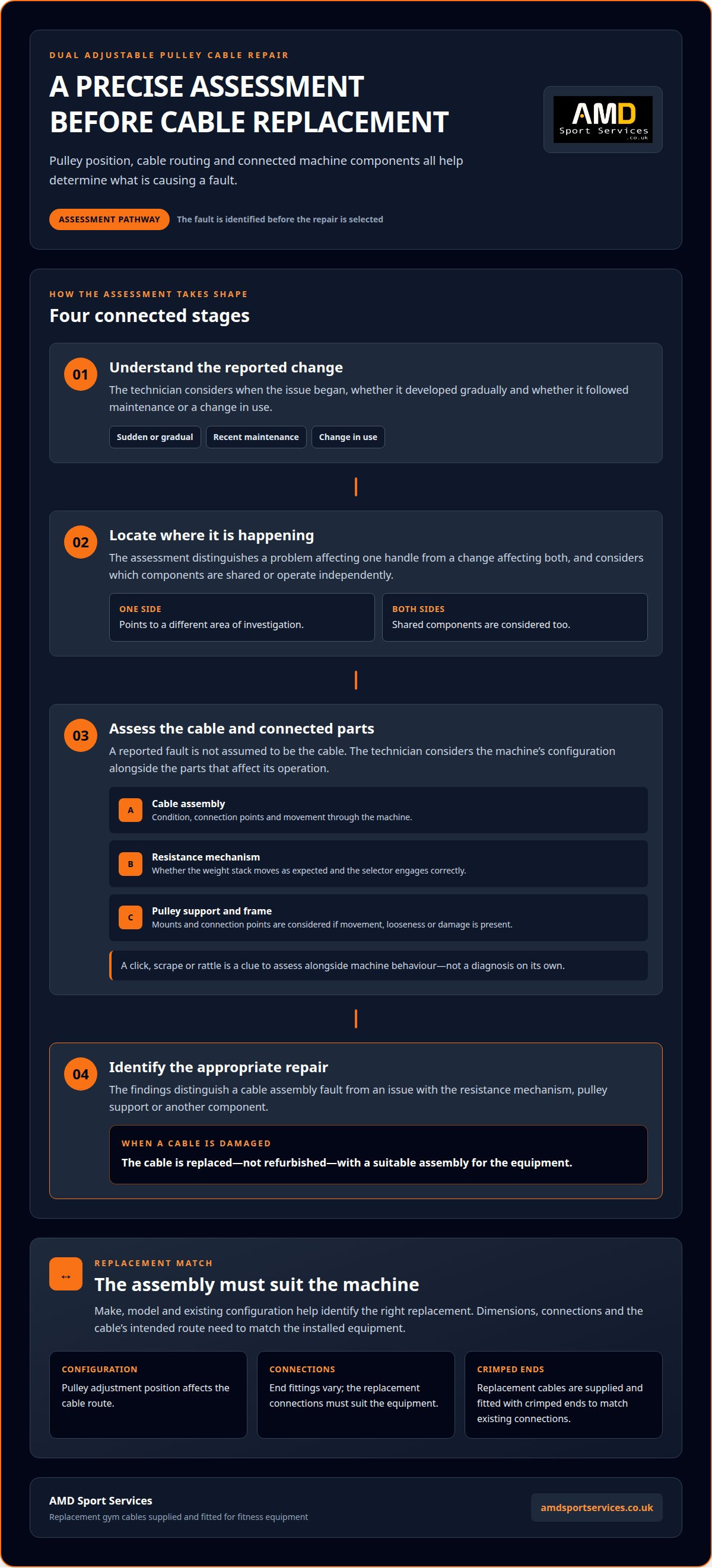
Diagnosis should identify which part of the machine is causing the reported problem, rather than assume the cable is at fault. A dual adjustable pulley has connected moving parts, so the technician considers the resistance mechanism and supporting components alongside the cable assembly. This broader assessment helps pinpoint the cause before a repair is selected.
The machine user’s account can provide a useful starting point. A technician can establish when the issue began, whether it developed gradually and whether it followed maintenance or a change in use. These details help distinguish an ongoing fault from one linked to a particular event or operating condition.
Note whether the issue affects one side or the whole machine. A problem confined to one handle points to a different area of investigation from a change felt at both handles. The technician considers which components the sides share and which operate independently. Comparing the symptoms helps narrow the assessment without assuming they have the same cause.
A professional assessment considers the resistance mechanism as a possible source of difficulty. For example, a handle that feels unusually heavy may indicate an issue with the resistance system rather than the cable alone. The technician can assess whether the weight stack moves as expected and whether the selector engages correctly. This helps identify when a new cable is needed and when another component requires attention.
The supporting structure is also part of the diagnosis. Pulley mounts and frame connection points bear forces during use, and a change in their condition can affect the machine’s operation. The assessment considers whether movement, looseness or damage in these areas may explain the problem. If so, the required repair may differ from work on the cable assembly.
Record useful diagnostic information in a short fault report:
Equipment identity: note the machine make or model, if available, and identify the affected side.
Reported change: describe what the user noticed, such as heavier resistance or an unfamiliar sound.
Timing: record whether the issue appeared suddenly or became more noticeable over time.
Recent context: include any recent maintenance or change in how the equipment was being used.
These details give the technician useful context, but do not replace a hands-on assessment. “Left handle feels heavier than the right” is more informative than simply reporting that the machine is faulty. It identifies an observable difference and directs attention to the affected side and the parts involved in its operation.
Treat noise as a clue, not a diagnosis. A click, scrape or rattle can come from different moving components, so note where the sound occurs and under what conditions. The technician considers it alongside the machine’s behaviour and the facility’s report, rather than identifying a cause from the sound alone.
Once the evidence has been gathered, the technician can identify whether the fault relates to the cable assembly, resistance mechanism, pulley support or another part. That distinction guides the repair and helps facilities describe the work clearly. Accurate diagnosis turns a general complaint into a specific maintenance requirement, including the correct new cable where replacement is needed.
AMD Sport Services: Sports equipment safety inspections
AMD Sport Services carries out sports equipment safety inspections for facilities that need a wider review alongside work on a pulley machine fault. The inspection can consider the cable issue within the equipment’s overall condition, helping facilities plan appropriate maintenance across their sports equipment.
All equipment should undergo a thorough visual inspection at least every 12 months. Some sites arrange inspections biannually where equipment experiences heavy use. The inspection frequency reflects the demands placed on equipment, while the assessment helps identify visible damage and maintenance needs.
For a facility managing several types of sports equipment, this service can support a structured view of its condition beyond one machine. Contact AMD Sport Services to discuss sports equipment safety inspections, or visit amdsportservices.co.uk.
Plan the next step for your facility
Make the next maintenance decision specific by identifying the affected machine, the adjustment positions where the fault occurs and the symptoms observed. This gives the replacement discussion a clear starting point and helps distinguish cable work from a wider equipment concern.
For facilities arranging dual adjustable pulley cable repair, AMD Sport Services supplies and fits new replacement gym cables. Its wider services include sports equipment safety inspections, basketball goal installation and safety surfacing, supporting maintenance across different areas of a sports facility.
Keeping equipment serviceable is part of effective facility management. A clear record of the fault and affected equipment helps organise the appropriate next step, whether the issue concerns fitting a new cable or another part of the sports provision.
Contact AMD Sport Services to discuss your facility’s equipment needs and take the next step with confidence.
Frequently Asked Questions
How to replace a frayed or broken cable on a dual adjustable pulley?
A frayed or broken cable needs assessment so the correct new replacement can be selected. The repair may be limited to the cable assembly; replacing the entire machine is not automatically necessary. For a dual adjustable pulley cable repair, the equipment’s make and model help identify the correct replacement and define the work before the machine returns to use.
What tools and replacement cable specifications are needed?
There is no single tool list or cable specification that applies to every dual adjustable pulley. Machine construction and the cable assembly determine what the repair requires, so a generic parts description may not be enough. The equipment’s identification plate, make and model help establish which machine is involved. The technician then determines the parts and tools needed for that specific replacement, rather than relying on a universal specification.
How to measure the correct cable length and diameter for a pulley machine?
The correct cable length and diameter depend on the machine, so a general measurement cannot reliably specify a replacement. It may be difficult to establish the cable’s full installed length from an exposed section alone. Equipment identification and the cable assembly provide context for determining the required dimensions. Do not treat a visual estimate as a definitive specification: the replacement must suit the machine’s design and complete cable arrangement.
Can you repair a dual adjustable pulley cable yourself, or should you hire a technician?
Using a technician is a practical option when a fitness facility needs the replacement parts identified, the new cable fitted and the equipment assessed afterwards. The work must suit the specific machine, and a generic guide cannot account for every design. AMD Sport Services supplies and fits replacement gym cables for fitness equipment, providing professional support without relying on an improvised repair or assumed universal method.
How much does dual adjustable pulley cable repair cost in the UK?
The cost depends on the case and is provided after a quote request. Factors include the work required, the replacement parts involved and the machine’s configuration. A quote based on the particular equipment is more useful than an industry-wide estimate, which may not reflect the repair needed at your facility.
Where to buy compatible replacement cables and parts in the UK?
AMD Sport Services supplies and fits replacement gym cables for fitness equipment. This gives UK facilities a direct way to obtain and install a new cable as part of a repair, rather than relying on a general parts listing that may not identify the equipment. The appropriate part is selected for the machine being repaired, with supply and installation handled as part of the service.
What are the step-by-step cable replacement and tensioning instructions?
There is no dependable universal sequence for replacing and tensioning a cable because pulley machines differ in construction. The work must follow the design of the specific equipment, and incorrect tension can affect its operation. A generic set of steps is not a suitable substitute for machine-specific replacement work. A technician can fit the new cable and assess the completed work on the relevant equipment.
What safety risks should you watch for when repairing a loaded pulley machine?
The key is to account for the machine’s condition and configuration during the replacement. Equipment design determines how its cable and resistance components are assembled, so a generic safety checklist cannot cover every machine. An assessment should establish the work required and whether the equipment is suitable to return to service afterwards. Do not assume guidance for one pulley machine applies to another design.
Comments