
Expert Playground Servicing for UK Safety Compliance

Table of Contents
Understanding Playground Servicing Standards and UK Compliance
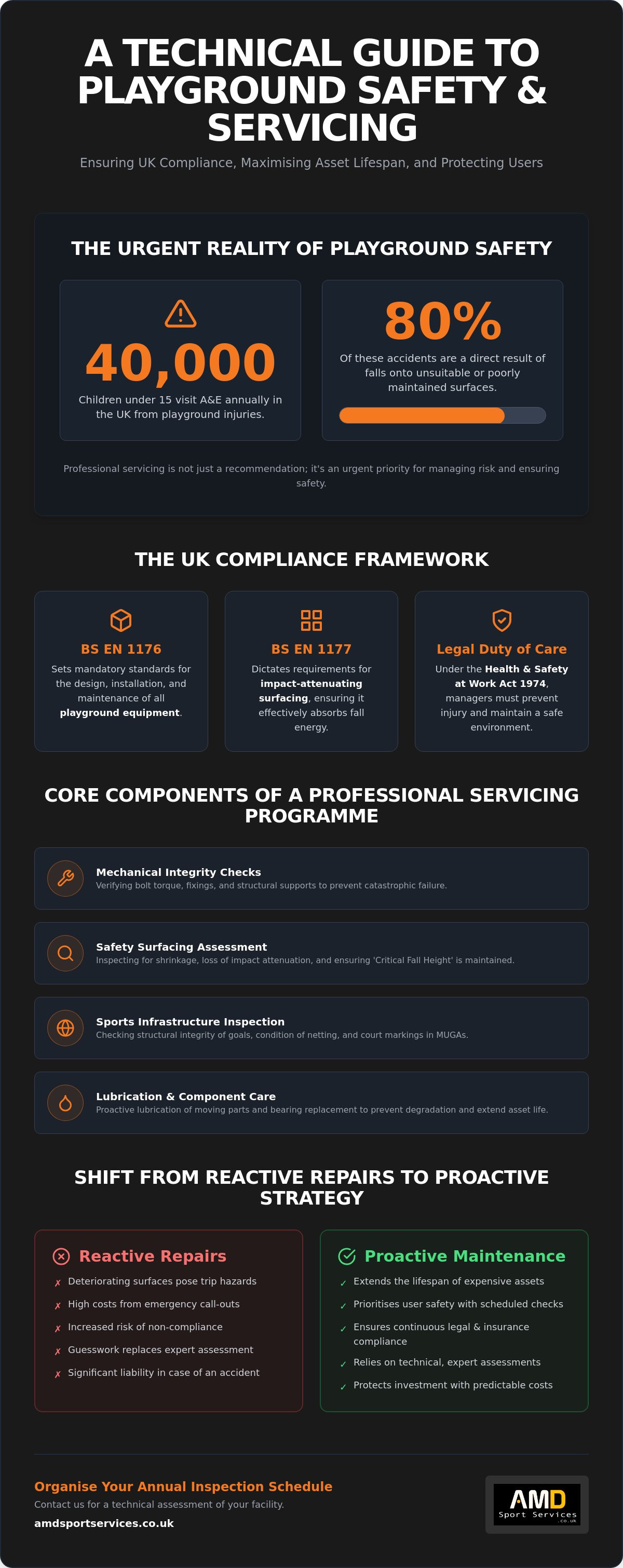
Professional playground servicing is a structured, preventative process of inspection, testing, and remedial work designed to ensure play equipment and its surrounding environment remain safe, compliant, and fit for purpose. It is not merely a box-ticking exercise; it is a fundamental aspect of facility management that protects users from harm and operators from legal and financial repercussions. The core objective is to identify and rectify wear, damage, or potential failures before they can cause an injury.
In the United Kingdom, this process is governed by a robust framework of safety standards. The two most critical are BS EN 1176, which specifies the general safety requirements for playground equipment and its installation, and BS EN 1177, which details the testing methods for impact-attenuating playground surfacing. Adherence to these standards is not optional; it forms the bedrock of an operator's legal duty of care. For organisations such as schools, local authorities, and parish councils, maintaining a documented history of professional servicing is essential for demonstrating due diligence and satisfying the stringent requirements of insurance providers.
Defining Playground Servicing: A methodical workflow involving routine visual checks, in-depth operational inspections, and comprehensive annual inspections performed by qualified technicians.
The Importance of BS EN 1176/1177: These standards provide the definitive technical benchmarks for everything from equipment stability and structural integrity to the critical fall height protection offered by safety surfaces.
Legal Duty of Care: Schools and local authorities have a legal obligation to ensure their play facilities are safe for public use, a responsibility underpinned by the Health and Safety at Work Act 1974.
The Role of RPII Inspectors: Inspectors registered with the Register of Play Inspectors International (RPII) are recognised as competent professionals qualified to conduct annual inspections and provide certified reports on the condition of play areas.
The Legal Framework for Play Area Safety
The legal responsibility for playground safety in the UK is primarily rooted in the Health and Safety at Work Act 1974. This legislation requires operators to take all reasonably practicable steps to ensure the safety of anyone using their premises, which explicitly includes children and adults in a play area. A well-documented playground servicing programme is the most effective way to demonstrate this commitment. Insurance providers now universally require proof of regular, professional inspections as a condition of providing public liability cover. Without a valid annual inspection certificate from a competent inspector, a facility may find its insurance void in the event of a claim.
It is vital to distinguish between different inspection types:
Routine Visual Inspections: These are simple, frequent checks (often daily or weekly) carried out by on-site staff to spot obvious hazards like broken glass, vandalism, or loose components.
Operational Inspections: A more detailed inspection (typically every 1-3 months) that looks at the operational stability and wear of the equipment.
Annual Specialist Inspections: A comprehensive annual inspection conducted by a qualified RPII-certified inspector. This is a deep dive into the equipment's structural integrity, compliance with BS EN 1176, and the condition of the surfacing, resulting in a formal report that documents any required remedial actions.
Risk Assessment and Liability Management
A professional service and inspection report is more than just a list of repairs; it is a crucial legal document. In the unfortunate event of an accident, this report serves as evidence that the operator has a proactive safety management system in place. It demonstrates that risks have been identified, assessed, and managed by a competent third party. This documentation can be a powerful defence against claims of negligence.
Inspectors categorise faults based on their risk level, typically distinguishing between 'high-risk' failures that require immediate attention (e.g., a frayed rope on a swing, a cracked structural support) and 'low-risk' issues (e.g., cosmetic damage, minor graffiti). This prioritisation allows facility managers to allocate resources effectively, addressing the most urgent safety concerns first. Ultimately, the cost of proactive maintenance and professional servicing is a fraction of the potential cost of negligence, which can include substantial fines, legal fees, and irreparable damage to an organisation's reputation.
The Essential Components of a Playground Maintenance Programme
A robust Playground Maintenance Programme goes beyond annual inspections to encompass the physical work required to keep equipment functional and safe throughout the year. This hands-on servicing addresses the mechanical and structural realities of high-use assets exposed to the British weather. A systematic approach ensures that minor issues are resolved before they escalate into major, costly failures.
Mechanical Integrity Checks: Systematically tightening bolts, checking all fixings and clamps, and assessing the condition of structural supports and foundations.
Moving Parts Lubrication: Regular lubrication of bearings, swing hangers, and other moving components to reduce friction, prevent premature wear, and ensure smooth operation.
Vandalism Assessment: Promptly identifying and repairing damage caused by misuse or vandalism to prevent further degradation and maintain the aesthetic quality of the play area.
Cleanliness and Debris Removal: Keeping the area free of litter, leaves, and other debris that can hide hazards, accelerate surface degradation, or create slip risks.
Structural Integrity and Mechanical Testing
The long-term safety of a playground hinges on its structural integrity. For timber equipment, this involves meticulous checks for rot, splintering, and insect infestation, particularly at the ground level where moisture is prevalent. For metal equipment, technicians look for signs of corrosion, stress fractures at weld points, and metal fatigue. Mechanical integrity testing for playground assets is a hands-on process of applying forces and checks to confirm that all structural and moving parts can withstand their intended operational loads without failure. Heavy-duty moving parts, such as those found on large roundabouts, zip lines, and multi-user swings, require specialist attention. This includes inspecting bearings, chains, and cable tensioning systems to ensure they operate within safe tolerances.
Component Replacement and Refurbishment
A key decision in any servicing visit is whether to repair a worn component or replace it entirely. An experienced technician can advise on the most cost-effective and safest course of action. For instance, a worn swing seat can be easily replaced, but a cracked structural post may necessitate decommissioning the entire unit. When replacements are needed, it is imperative to use manufacturer-approved or compliant fixings, caps, and components. Using non-standard parts can invalidate warranties and compromise the equipment's safety certification.
Refurbishment can significantly extend the life of existing assets. Metalwork showing signs of surface rust can often be professionally treated, primed, and repainted to protect it from further corrosion. This not only improves safety but also enhances the visual appeal of the playground, encouraging positive use and discouraging vandalism.
Safety Surfacing and Court Marking Refurbishment
The ground beneath the equipment is just as important as the equipment itself. Safety surfacing is the first line of defence in preventing serious head injuries from a fall. A critical part of any playground servicing programme is the detailed inspection of this surfacing. For materials like wet pour, rubber mulch, and synthetic grass, inspectors check for shrinkage away from edges, hardening of the surface, and signs of cracking or lifting that can create trip hazards. For loose-fill surfaces like bark or sand, the focus is on maintaining the correct depth to provide adequate impact absorption.
The effectiveness of a surface is measured by its ability to attenuate impact, which is directly related to its 'Critical Fall Height' (CFH). The CFH of the surface must exceed the maximum potential fall height from the adjacent equipment. Over time, compaction, contamination, and environmental exposure can degrade a surface's performance, making regular testing and maintenance essential. Furthermore, poor drainage is a common issue that can lead to moss and algae growth, creating dangerous slip hazards, particularly on hard surfaces.
Maintaining High-Performance Athletics Surfaces
In many school and community settings, traditional play areas sit alongside dedicated athletics facilities. The servicing principles for safety and performance extend directly to these surfaces. Tartan tracks and polyurethane running surfaces require specialist attention to check for delamination, surface damage, or loss of porosity which can affect both performance and user safety. For facilities with field event infrastructure, a comprehensive service must include the refurbishment of long jump runways and the maintenance of landing pits. This involves ensuring take-off boards are sound and that sand pits are free of contaminants and have the correct grade and depth of sand for safe landings. A properly maintained runway is crucial for training and competition. For a detailed overview of this specialist area, see our guide to long jump runway installation and maintenance.
Court Marking Renewal and Visibility
For MUGAs and sports-led play areas, clear and accurate court markings are essential for utility. Faded, worn lines for sports like netball, basketball, or five-a-side football can lead to confusion, disputes, and disorganised play. Professional line marking renewal is more than just a cosmetic upgrade. It involves using specialist, durable, and slip-resistant paints that are designed to bond with the specific court surface. A thorough servicing visit will often coordinate marking renewal with a deep cleaning of the surface, removing ingrained dirt and algae to ensure maximum paint adhesion and a crisp, professional finish that revitalises the entire facility.
Specialised Servicing for Sports-Led Play Areas and MUGAs
Modern play provision increasingly blurs the line between traditional playgrounds and structured sports facilities. Many schools, parks, and leisure centres now feature Multi-Use Games Areas (MUGAs), outdoor basketball goals, and other sports-specific hardware. These assets fall under the same duty of care as swings and slides and require a specialised servicing approach that understands their unique mechanical stresses and failure points.
This holistic view is critical for facility managers responsible for a diverse portfolio of equipment. A comprehensive safety programme must therefore extend beyond the playground fence to include:
Basketball Goals: Inspecting the integrity of backboards (checking for cracks), the tension and condition of hoops, and the security of all fixings, whether post-mounted or wall-mounted.
Sports Netting Systems: Checking all perimeter and roof netting on MUGAs for holes, fraying, or sagging, and ensuring tensioning wires and fixings are secure.
MUGA Infrastructure: Assessing the condition of perimeter fencing, rebound boards, and goal recesses for structural soundness and freedom from sharp edges or entrapment hazards.
Basketball and Netting System Maintenance
The forces exerted on sports equipment are often far greater than those on traditional play items. Wall-mounted basketball goals in sports halls, for example, must have their backboard and cantilever arm fixings rigorously tested to ensure they can withstand vigorous play. Outdoors, the foundations of freestanding goals and sports cages must be checked for any signs of movement or instability. Sports hall partition netting and throwing cages used for athletics also require specialist attention. Technicians will test the integrity and tension of divider nets and inspect the heavy-duty support structures and netting of hammer or discus cages to ensure they remain safe for both participants and spectators.
Servicing Indoor Sports and Gymnastics Equipment
This duty of care often extends indoors to shared-use facilities like sports halls, where equipment is frequently managed under the same maintenance budget and by the same personnel. Whilst distinct from outdoor play, the core principles of mechanical servicing and safety compliance are directly transferable. Specialist inspection of gymnastics equipment, for instance, involves checking trampoline beds for tears, ensuring all springs are correctly tensioned and attached, and verifying the stability of frames and padding. Gymnastics equipment requires a different and often more frequent servicing schedule than outdoor play gear due to its high-impact, precision-engineered components operating under significant mechanical stress. For organisations managing these integrated facilities, a partner who understands both environments is invaluable. You can learn more about our approach to indoor inspection and maintenance for sports facilities.
Organising Your Annual Inspection and Servicing Schedule
Establishing a clear, proactive schedule is the most effective way to manage playground and sports facility maintenance. Rather than reacting to failures, a bespoke maintenance calendar allows you to plan for inspections, budget for remedial work, and ensure compliance is consistently maintained. This schedule should be tailored to your specific facility, taking into account the age and type of equipment, levels of use, and any environmental factors like coastal locations that might accelerate corrosion.
When selecting a contractor, it is crucial to look for a partner who provides a 'no-nonsense' technical assessment rather than a thinly veiled sales pitch. The goal is to receive an honest, expert evaluation of your assets, not to be upsold on unnecessary replacements. For multi-site organisations like academy trusts or local authorities, a contractor with national UK coverage is essential to ensure a consistent standard of servicing and reporting across all locations.
Selecting a Seasoned Practitioner
The quality of a playground service depends entirely on the person carrying it out. When evaluating potential contractors, prioritise technical proficiency and demonstrable industry experience over glossy brochures. A seasoned practitioner will be able to diagnose issues quickly and accurately, distinguishing between superficial wear and genuine structural concerns. Look for transparent reporting with clear photographic evidence and jargon-free recommendations. Direct communication is key; you should feel confident that you are speaking with an expert who can answer your technical questions directly. A reliable partner will focus on building a long-term relationship based on trust and high-quality work. To understand our comprehensive approach, explore the details of our service and maintenance packages.
Preparing for Your Service Visit
To get the most out of a professional service visit, a little preparation goes a long way. Before the technician arrives, it is helpful to compile a list of any known issues or concerns you have. Documenting which pieces of equipment are most popular or receive the highest use can help the inspector focus on high-wear areas. Ensure that the site is accessible, particularly if heavy-duty repair machinery might be required for tasks like replacing structural posts. Finally, the handover process is critical. Take the time to walk the site with the technician and review their findings in the final compliance report. This ensures you fully understand the condition of your assets and the rationale behind any recommended actions.


header.all-comments