
Fitness Equipment Maintenance: A Complete Safety Guide

Poor maintenance doesn't just shorten the life of your fitness equipment; it puts the people using it at genuine risk. For facility managers, school sports coordinators, and leisure centre operators across the UK, that's a responsibility that can't be taken lightly. Fitness equipment maintenance is one of those disciplines where cutting corners today almost always costs more tomorrow, whether that's through premature equipment failure, costly emergency repairs, or worse, a preventable injury.
You already know that keeping equipment in good working order matters. The challenge is knowing exactly what to check, how often to check it, and what compliance standards apply to your setting. Without a structured approach, even well-intentioned maintenance routines can miss critical warning signs.
This guide cuts through the uncertainty. You'll learn the practical techniques that extend equipment lifespan, understand what a proper preventative maintenance schedule looks like, and get clear on the safety standards UK facilities are expected to meet. From treadmill components and gym cables to upholstery and structural inspections, we'll walk through the essentials that keep your facility safe, compliant, and operational.
Table of Contents
Understanding Fitness Equipment Maintenance
Fitness equipment maintenance is the systematic process of inspecting, servicing, and repairing gym and sports equipment to keep it safe, functional, and compliant with relevant standards. It's not a single task but a discipline that spans everything from daily visual checks to periodic structural assessments. For facility managers and sports coordinators, understanding what that discipline actually involves is the first step towards building a maintenance programme that holds up under scrutiny.
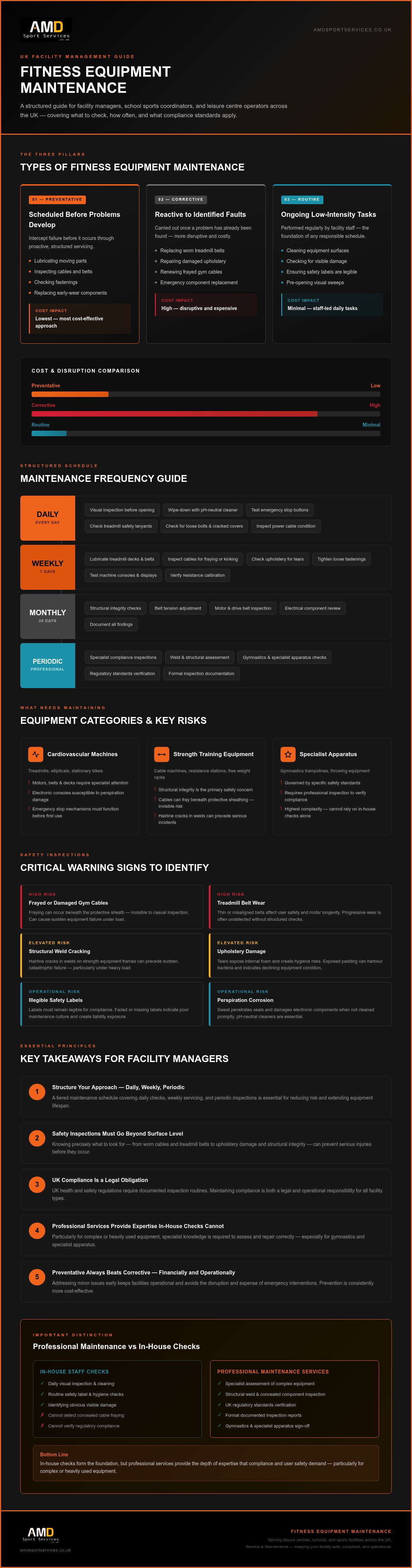
The scope of fitness equipment maintenance typically falls into three distinct categories:
Preventative maintenance: Scheduled servicing carried out before problems develop. This includes lubricating moving parts, inspecting cables and belts, checking fastenings, and replacing components showing early signs of wear. The goal is to intercept failure before it occurs.
Corrective maintenance: Reactive work carried out once a fault has been identified. This might involve replacing a worn treadmill belt, repairing damaged upholstery, or renewing a frayed gym cable. Corrective maintenance is often more disruptive and costly than preventative work.
Routine maintenance: Ongoing, lower-intensity tasks performed regularly by facility staff, such as cleaning equipment surfaces, checking for visible damage, and ensuring safety labels remain legible. These checks form the foundation of any responsible maintenance schedule.
The Importance of Regular Maintenance
Equipment that isn't maintained deteriorates in ways that aren't always visible to the untrained eye. A treadmill belt wearing thin, a cable fraying beneath its sheath, or a structural weld developing a hairline crack can all precede a serious incident. Regular maintenance catches these issues early. It also directly affects user confidence; members and students are far more likely to use equipment they trust, and trust is built through visible, consistent upkeep. From a financial standpoint, addressing minor faults promptly is consistently less expensive than emergency repairs or full replacements.
Types of Fitness Equipment
The breadth of fitness equipment found in UK facilities is considerable, and each category carries its own maintenance demands. Cardiovascular machines such as treadmills, ellipticals, and stationary bikes involve motors, belts, decks, and electronic consoles, all of which require specialist attention. Strength training equipment, including cable machines, resistance stations, and free weight racks, depends on structural integrity and component condition. Specialised apparatus such as gymnastics trampolines and throwing equipment introduces additional complexity, often governed by specific safety standards that require professional inspection to verify compliance.
Knowing which category each piece of equipment falls into helps facility managers allocate maintenance resources appropriately and prioritise the checks that carry the greatest safety implications.
Step-by-Step Maintenance Procedures for Fitness Equipment
Effective fitness equipment maintenance relies on a tiered approach. You don't need to strip a machine down every morning, but you do need to look for the obvious signs of trouble before they escalate into a safety hazard. A structured schedule ensures that nothing is missed, from the simple wipe-down of a console to the complex tensioning of a drive belt.
Daily Maintenance Tasks
The first line of defence is a thorough visual inspection performed before the facility opens. Staff should walk the floor and check for visible damage, such as loose bolts, cracked plastic covers, or frayed power cables. Hygiene is equally critical for mechanical longevity as it is for user health. Perspiration is corrosive; if left to sit, it can penetrate seals and damage electronic components. Every piece of equipment should be wiped down with a non-abrasive, pH-neutral cleaner to prevent grime build-up in moving parts. Ensure that all emergency stop buttons and safety lanyards on treadmills are tested and fully functional before the first user steps onto the deck.
Weekly and Monthly Procedures
Weekly tasks move from the surface into the mechanical workings of the machines. For cardiovascular equipment, this involves vacuuming around the base and side rails to prevent dust from being sucked into the motor. On strength machines, you should inspect the condition of all replacement gym cables and pulleys. Look for "milking" (where the outer coating bulges) or visible wire strands. These are non-negotiable signs that the cable must be replaced immediately. Monthly, you should check the tension and alignment of treadmill belts. A belt that is too loose will slip, whilst one that is too tight will put excessive strain on the motor and rollers.
Lubrication is another vital monthly task. Weight stack guide rods should be cleaned and then lubricated with a thin coat of silicone spray to ensure smooth movement. It's also a good time to reset electronic monitoring systems and check for any error codes stored in the machine's software. These logs often provide early warnings of motor strain or sensor failures that aren't yet obvious during use.
Whilst internal staff can handle basic cleaning and visual checks, complex mechanical adjustments and structural audits require a different level of expertise. For facilities managing high-traffic environments, booking specialist safety inspections ensures that your equipment meets official UK standards and remains under warranty. Professional technicians can perform deep-level servicing, such as deck flipping or motor carbon brush replacements, which are essential for extending the life of your investment and ensuring the safety of every person in your facility.
Conducting Safety Inspections: What to Look For
A visual sweep of the gym floor is not a safety inspection. Real inspections are structured, methodical, and documented. They follow a defined sequence, cover specific components, and produce a written record that can be reviewed, audited, and acted upon. Without that rigour, even well-meaning checks can miss the faults that matter most.
Key Safety Features to Inspect
Every fitness equipment maintenance inspection should begin with the safety-critical components: the systems designed to prevent harm if something goes wrong during use.
Emergency stop buttons and safety cut-offs: Test each one physically. A button that looks intact can still fail to trigger the cut-off circuit. On treadmills, verify that the safety lanyard clip connects correctly and that removing it halts the belt immediately. If there's any lag, the mechanism needs attention before the machine goes back into service.
Cables, pulleys, and moving parts: Inspect cables along their full length, not just at the visible ends. Look for kinking, corrosion at the swage fittings, fraying at the point where cable meets pulley, and any coating that has split or bubbled. Pulleys should spin freely without wobble or grinding. Seized bearings are a common fault on older cable machines and place excessive load on the cable itself.
Frame and base integrity: Check welded joints for cracking, particularly at stress points where uprights meet base plates. Inspect weight stack guide rods for straightness and confirm that all anchor bolts are torqued correctly. A frame that shifts or rocks under load is not safe to use, regardless of how minor the movement appears.
Upholstery condition also warrants specific attention. Torn padding exposes users to sharp foam edges and underlying metal, and it's a hygiene risk. Facilities offering fitness equipment upholstery repairs should prioritise any splits in high-contact areas such as bench surfaces and seat pads.
Documenting Inspections
Documentation is where many facilities fall short. A completed inspection that isn't recorded provides no audit trail and no legal protection. Every inspection report should include the date, the inspector's name, the specific equipment checked (by make, model, and asset reference if applicable), the findings for each component, and the action taken or recommended. Faults should be categorised by severity: immediate withdrawal from service, scheduled repair, or monitor at next inspection.
These records serve multiple purposes. They demonstrate compliance with health and safety obligations under the Health and Safety at Work Act 1974 and associated regulations. They also create a maintenance history for each piece of equipment, making it far easier to identify recurring faults or components that are approaching the end of their serviceable life.
Keep inspection logs accessible, whether in a physical file or a digital system, and review them periodically rather than simply filing them away. Patterns in the data are often more telling than any single inspection result.
As for timing, professional inspections should be scheduled at least annually for most fitness equipment, with higher-risk or heavily used items assessed more frequently. Specialist inspection providers, such as those working to the standards expected of UK schools, councils, and leisure operators, bring a level of technical assessment that in-house checks cannot replicate. Booking a professional safety inspection at defined intervals ensures that your compliance position is defensible and that nothing critical slips through the gaps between routine checks.
The Role of Professional Maintenance Services
There's a point in every facility's maintenance programme where in-house capability reaches its limit. Daily checks, weekly cleaning routines, and visual inspections are all within reach of a trained member of staff. But diagnosing a failing motor, assessing the structural integrity of a welded frame, or determining whether a cable assembly is approaching the end of its safe working load requires a different level of technical knowledge entirely. That's where professional maintenance services become not just useful, but necessary.
The trigger points are usually straightforward. If your equipment is heavily used, operates in a high-humidity environment, or is approaching the end of its manufacturer-recommended service interval, professional intervention should be scheduled rather than considered. The same applies when in-house inspections flag recurring faults that keep returning despite corrective action. A pattern of repeat failures is almost always a sign of an underlying issue that surface-level checks won't resolve.
Professional fitness equipment maintenance also carries a compliance dimension that in-house programmes cannot fully satisfy. Specialist technicians work to recognised industry standards and can provide signed inspection reports that demonstrate your facility has met its duty of care obligations. That documentation matters when a claim is made or a regulatory audit is conducted.
Choosing a Maintenance Contractor
Not every contractor offering equipment servicing has the breadth of experience that complex gym environments demand. When evaluating providers, look for demonstrable experience across multiple equipment categories, including cardiovascular machines, cable-based strength equipment, and specialist apparatus such as gymnastics trampolines. Ask directly about their familiarity with the specific makes and models in your facility. A contractor who works across schools, leisure centres, and sports clubs will have encountered a wider range of faults and failure modes than one who operates in a narrower context.
Questions worth asking any prospective provider include:
What does your inspection report cover, and how is it structured?
How do you categorise and communicate faults that require urgent action?
Can you supply replacement components directly, including items such as gym cables, treadmill belts, and treadmill decks?
Do you carry public liability insurance, and can you provide evidence of it?
What is your typical response time for follow-up repairs identified during inspection?
A contractor who answers these questions clearly and without hesitation is operating with the kind of transparency that institutional clients need. One who hedges or deflects is worth approaching with caution.
Cost Considerations
Pricing for professional maintenance services varies depending on the size of your facility, the volume and complexity of equipment, and the scope of the contract. Rather than quoting figures that may not reflect your specific situation, the more useful approach is to think in terms of value rather than cost in isolation. A maintenance contract that includes scheduled inspections, written reports, and prioritised access to repair services will almost always prove more economical than a pay-per-visit arrangement when repairs are reactive and urgent.
When budgeting, account for three distinct categories: planned servicing, component replacements (cables, upholstery, belts, and decks are the most frequent), and a contingency allowance for faults identified during inspection that require immediate remediation. Facilities that plan for all three categories avoid the disruption of unplanned expenditure and keep equipment operational rather than withdrawn from service whilst awaiting parts or authorisation.
If you manage a school, leisure centre, or sports club and want to understand what a structured maintenance programme looks like in practice, speak to AMD Sport Services about their inspection and maintenance services to get a clear picture of what's involved and what your facility specifically requires.
Maintaining Compliance and Safety Standards in Fitness Facilities
Compliance isn't a box-ticking exercise. For facility managers responsible for staff, students, and members, it's the framework that defines what a defensible standard of care actually looks like. Fitness equipment maintenance sits at the centre of that framework, and understanding the regulatory landscape is as much a professional obligation as it is a legal one.
Health and Safety Regulations
Several pieces of UK legislation directly govern how fitness facilities manage equipment safety. The Health and Safety at Work Act 1974 places a duty on employers to ensure, so far as is reasonably practicable, the health and safety of anyone affected by their operations. The Management of Health and Safety at Work Regulations 1999 extend this by requiring formal risk assessments, which must cover equipment condition and the controls in place to manage identified hazards. The Provision and Use of Work Equipment Regulations 1998 (PUWER) are particularly relevant; they require that all work equipment is maintained in an efficient state, in efficient working order, and in good repair.
Non-compliance carries real consequences. These include enforcement notices from the Health and Safety Executive, civil liability in the event of an injury claim, reputational damage, and in serious cases, prosecution. A facility that cannot produce documented evidence of regular inspections and corrective action is in a weak position regardless of how well-maintained its equipment actually is.
Staying informed on regulatory changes means monitoring HSE guidance updates, subscribing to relevant trade body communications, and reviewing your risk assessment documentation at least annually. Regulatory expectations don't change frequently, but when they do, facilities that have established review processes adapt without disruption.
Training and Awareness
Regulations only function when the people responsible for equipment understand what they're looking for. Staff training is not a one-off induction task; it's an ongoing commitment. Every member of staff who conducts daily checks, responds to reported faults, or takes equipment out of service needs to understand the criteria they're applying and the authority they have to act on what they find.
Effective training programmes cover the following:
Equipment-specific hazard recognition: Teaching staff to identify worn cables, damaged upholstery, belt misalignment, and structural irregularities by sight.
Fault reporting procedures: Clear, simple processes for logging issues, escalating urgent findings, and withdrawing equipment from service without requiring managerial sign-off each time.
Documentation habits: Ensuring that every check, however routine, is recorded consistently and filed in a retrievable format.
Building a genuine culture of safety means making these behaviours normal rather than exceptional. When staff treat a cracked seat pad or a stiff pulley with the same seriousness as a visible structural fault, the entire maintenance programme becomes more robust. That shift in attitude doesn't happen through a single training session; it develops when management reinforces the standards consistently and acts visibly on the findings that staff report.
Facilities that combine structured staff training with professional inspection support create a genuinely layered approach to safety. For schools, leisure centres, and sports clubs looking to strengthen that foundation, AMD Sport Services provides specialist inspections and maintenance that complement in-house programmes and provide the documented compliance evidence that regulators and insurers expect.
Build a Maintenance Programme That Holds Up When It Matters
Fitness equipment maintenance isn't a background task; it's a core operational responsibility. Done properly, it protects users, extends the working life of your equipment, and keeps your facility on the right side of UK health and safety legislation. The difference between a robust programme and an inadequate one often comes down to structure: consistent daily checks, documented inspections, and professional servicing at defined intervals.
Facilities that combine trained staff with specialist support are consistently better positioned to catch faults early, maintain compliance records that stand up to scrutiny, and avoid the disruption of reactive repairs. That layered approach is what separates genuinely safe environments from those that only appear to be.
AMD Sport Services brings established expertise across a wide range of sports equipment maintenance, working with schools, leisure centres, and sports clubs throughout the UK. Their professional safety inspections provide the documented compliance evidence that regulators and insurers expect.
Contact AMD Sport Services to discuss your facility's maintenance requirements and take the guesswork out of keeping your equipment safe and operational.
Frequently Asked Questions About Fitness Equipment Maintenance
What is included in fitness equipment maintenance services?
Professional fitness equipment maintenance services typically cover structured safety inspections, lubrication of moving parts, cable and pulley assessments, treadmill belt and deck checks, upholstery repairs, and written compliance reports. The scope varies depending on your equipment inventory and usage levels. Specialist providers like AMD Sport Services can also supply and fit replacement components directly, including gym cables, treadmill belts, and treadmill decks, reducing the time equipment spends out of service.
How often should fitness equipment be inspected for safety?
Most fitness equipment should receive a formal professional inspection at least once per year, with higher-traffic or higher-risk items assessed more frequently. Daily visual checks and weekly mechanical reviews by trained staff sit alongside these scheduled inspections rather than replacing them. Specialist apparatus such as gymnastics trampolines may carry manufacturer or standards-based requirements that dictate specific inspection intervals, so always check the relevant guidance for your equipment type.
Can I perform equipment maintenance myself, or should I hire a professional?
Routine tasks such as cleaning surfaces, checking for visible damage, and logging faults are well within the capability of trained in-house staff. However, technical assessments of structural welds, cable load integrity, motor condition, and belt tensioning require specialist knowledge that most facility staff don't hold. Attempting complex servicing without the right expertise can void manufacturer warranties and, more critically, miss faults that a qualified technician would identify. The two approaches work best in combination, not in place of each other.
What are the signs that fitness equipment needs repair?
Common warning signs include unusual noises during operation, visible fraying or coating damage on cables, belts that slip or track off-centre, frames that rock or flex under load, torn upholstery exposing foam or metal, and error codes stored in a machine's onboard software. Any emergency stop mechanism that doesn't respond immediately is a non-negotiable reason to withdraw the equipment from service. Don't wait for a fault to worsen; addressing it early is consistently less disruptive and less costly than reactive repair.
Are there specific compliance regulations for gym equipment in the UK?
Yes. UK facilities are subject to several overlapping legal frameworks. The Health and Safety at Work Act 1974 places a broad duty of care on operators, whilst the Provision and Use of Work Equipment Regulations 1998 (PUWER) specifically require that all work equipment is maintained in an efficient state and good repair. The Management of Health and Safety at Work Regulations 1999 additionally require documented risk assessments covering equipment condition. Facilities that can't produce inspection records and corrective action logs are in a weak compliance position, regardless of how well-maintained their equipment appears.
What should I do if my equipment fails a safety inspection?
Withdraw the equipment from use immediately and display clear signage to prevent access. Don't return it to service until the identified fault has been fully remediated and re-inspected. Record the failure, the action taken, and the outcome in your maintenance log. If the fault is beyond your in-house capability to repair, contact a specialist provider promptly. Leaving failed equipment in service, even temporarily, creates both a safety risk and a significant legal liability that's difficult to defend if an incident occurs.
How can I extend the lifespan of my fitness equipment?
Consistent preventative maintenance is the single most effective approach. Clean equipment daily to prevent corrosive perspiration build-up, lubricate moving parts on a monthly schedule, and address minor faults before they develop into structural or mechanical failures. Keeping accurate maintenance records also helps, since tracking component history makes it easier to anticipate replacements before failure occurs. Pairing regular in-house routines with periodic professional servicing gives equipment the best chance of reaching, and exceeding, its expected operational lifespan.


Comments