
Folding Basketball Hoop Installation for Schools: A Comprehensive Guide

A poorly installed basketball hoop isn't just an inconvenience; it's a liability. In a school environment, where pupils are actively using equipment day in and day out, the margin for error during folding basketball hoop installation school projects is essentially zero. Get it wrong, and you're looking at potential injuries, failed safety inspections, and costly remedial work.
If you're responsible for a school's sports facilities, you already understand the pressure. Compliance with safety standards, selecting equipment built to withstand heavy use, and ensuring the installation is carried out correctly are all genuine concerns, and understandably so. The consequences of cutting corners in a school gymnasium are far more serious than in any commercial setting.
This guide is designed to give you a clear, practical understanding of the entire process. You'll learn what safety standards apply to school basketball hoop installations in the UK, how to assess your facility's specific requirements, and what best practice looks like from the initial survey through to final sign-off. Whether you're planning a new installation or reviewing an existing setup, what follows covers everything you need to make an informed, confident decision.
Table of Contents
Understanding Folding Basketball Hoops: Features and Benefits
Folding basketball hoops are wall-mounted or ceiling-mounted units engineered to retract or fold away when not in use. Unlike fixed systems, they incorporate a hinged or pivoting mechanism that allows the backboard, ring, and supporting arm to be raised clear of the playing area. In a school gymnasium, where the same floor space might host basketball in the morning and badminton or gymnastics in the afternoon, that functionality isn't a luxury; it's a practical necessity.
Types of Folding Basketball Hoops
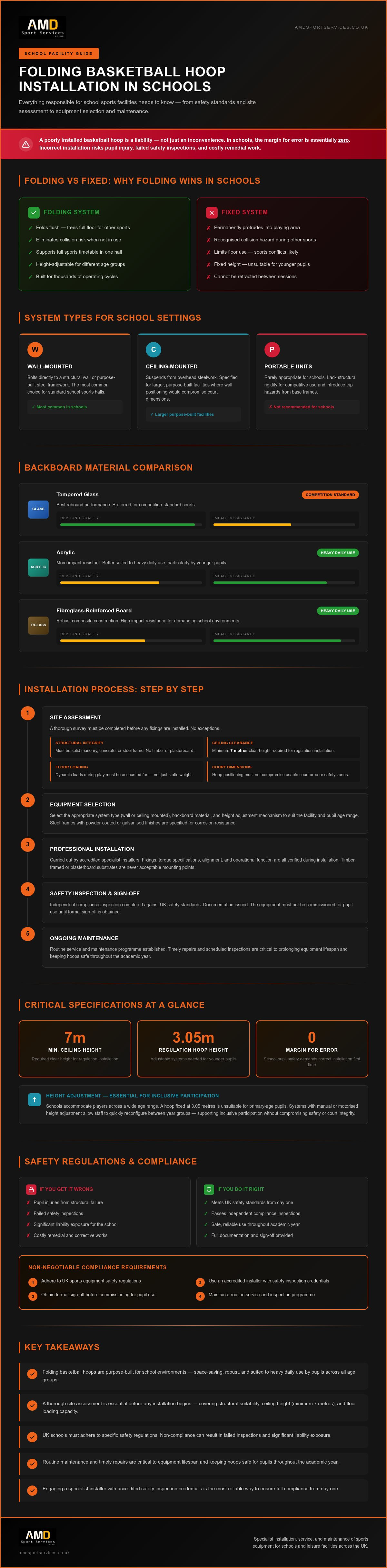
The two primary configurations used in school environments are wall-mounted and ceiling-mounted folding units. Wall-mounted hoops bolt directly to a structural wall or purpose-built steel framework, making them the more common choice for standard school sports halls. Ceiling-mounted systems suspend from overhead steelwork and are typically specified for larger, purpose-built facilities where wall positioning would compromise court dimensions.
Portable folding units do exist, but they're rarely appropriate for school settings. They lack the structural rigidity required for sustained competitive use and introduce trip hazards from base frames. For any serious folding basketball hoop installation school project, a fixed wall-mounted or ceiling-mounted system is almost always the correct specification.
Material selection directly affects service life. Steel frames with powder-coated or galvanised finishes resist corrosion and handle the mechanical stress of repeated folding cycles. Backboards are typically fabricated from tempered glass, acrylic, or fibreglass-reinforced board. Tempered glass offers the best rebound performance and is preferred for competition-standard courts; acrylic and composite boards are more impact-resistant and better suited to heavy daily use by younger pupils.
Height adjustment is another critical feature. Schools accommodate players across a wide age range, and a hoop fixed at the regulation 3.05 metres isn't appropriate for primary-age pupils. Systems with manual or motorised height adjustment allow staff to reconfigure the hoop quickly between year groups, supporting inclusive participation without compromising safety or court integrity.
Benefits of Folding Hoops Over Fixed Systems
The practical advantages of folding systems over fixed hoops are substantial in a multi-use facility:
Space efficiency: Folded units sit flush against walls or retract overhead, freeing the full floor area for other sports and activities.
Reduced collision risk: Protruding fixed structures are a recognised hazard; folding systems eliminate that risk when basketball isn't scheduled.
Versatility: The same hall can support a full timetable of different sports without equipment conflicts or reconfiguration delays.
Longevity: Purpose-built folding mechanisms are designed for thousands of operating cycles, provided the installation is carried out correctly and routine service and maintenance is kept up to date.
Fixed systems simply can't offer that combination of safety, flexibility, and spatial efficiency. For schools managing busy PE timetables across limited hall space, folding hoops are the considered, professional choice.
Step-by-Step Guide to Installing Folding Basketball Hoops
Installation quality determines everything that follows. A correctly installed folding basketball hoop will operate safely for years; a poorly executed one creates structural risk from day one. The process isn't complicated, but it demands methodical preparation, the right tools, and an honest assessment of what the building can actually support.
Preparing the Installation Site
Before any fixings go into a wall, a thorough site assessment must be completed. This covers four core areas:
Structural integrity of the mounting surface: Wall-mounted systems require a solid masonry, concrete, or steel-framed substrate capable of bearing both the static weight of the unit and the dynamic loads generated during play. Timber-framed or plasterboard partitions are not suitable mounting points under any circumstances.
Ceiling clearance: The minimum clear height for a regulation folding basketball hoop installation school project is 7 metres, though many systems require additional overhead clearance for the folding arm to operate without obstruction. Confirm this against the manufacturer's specification before procurement.
Overhead obstructions: Lighting rigs, HVAC ducting, and roof trusses all need to be mapped. The hoop's arc of travel when folding must be completely clear. This step is frequently underestimated and causes costly remediation work after installation has begun.
Floor loading and access: Confirm the floor can support the working loads from access equipment such as scissor lifts or tower scaffolding, which will be required during the installation itself.
Installation Process Overview
Once the site assessment is complete and the unit has been delivered and checked against specification, the installation sequence follows a logical order. Deviating from it introduces risk.
The wall plate or mounting bracket is positioned first, with fixing centres marked precisely against the structural drawing. Anchor bolts are drilled and set to the torque values specified by the manufacturer; under-torqued fixings are a common failure point. The main support arm is then lifted into position and bolted to the wall plate, with alignment checked both horizontally and vertically before any secondary fixings are tightened.
The backboard assembly is attached to the arm and adjusted to the correct playing height. On height-adjustable systems, the adjustment mechanism is tested through its full range of travel at this stage, not after. The ring and net are fitted last, once all structural connections have been verified.
Post-installation safety checks should include:
Torque verification on all structural fixings
Full operation of the folding mechanism through at least three complete cycles
Confirmation that the hoop locks securely in both the deployed and stored positions
Visual inspection of all welds, brackets, and pivot points for any signs of damage sustained during installation
Documentation matters here. Every check should be recorded and retained as part of the facility's compliance file. If you're commissioning a specialist to carry out the work, confirm in advance that they'll provide a signed installation record. You can find out more about what a professional basketball goal installation service should include before committing to a contractor.
Safety Regulations and Compliance Considerations
Compliance isn't optional in a school environment. When a folding basketball hoop installation school project is signed off and pupils start using the equipment, the legal and moral responsibility for their safety sits squarely with the institution. Understanding which regulations apply, and how to demonstrate adherence to them, is as important as the physical installation itself.
Key Regulations for Basketball Hoop Installations
In the UK, sports equipment installed in schools must conform to a framework of standards that spans product specification, installation practice, and ongoing inspection. The primary reference points are:
BS EN 1270:2006 - the European standard for basketball equipment, specifying performance and safety requirements for backboards, rings, nets, and supporting structures.
Health and Safety at Work etc. Act 1974 - places a duty of care on employers, including school governing bodies, to ensure that equipment used on their premises is safe and properly maintained.
The Provision and Use of Work Equipment Regulations 1998 (PUWER) - requires that equipment is fit for purpose, maintained in safe working order, and inspected at appropriate intervals by competent persons.
Building Regulations Approved Document A - governs structural loading requirements, directly relevant to wall and ceiling fixings used in hoop installations.
Documentation is a non-negotiable part of compliance. At a minimum, schools should retain the manufacturer's conformity declaration, the installer's signed completion record, structural calculations for the fixing points, and a log of all inspections and maintenance activity. These records form your evidence base during Ofsted visits, insurance assessments, or in the event of an incident.
Post-installation, equipment must be inspected at regular intervals. The frequency depends on usage intensity, but annual inspection by a qualified professional is the standard baseline for school sports halls. High-use facilities may require more frequent checks.
Engaging Professional Inspection Services
A visual check by a member of staff is not a safety inspection. Properly assessing a folding basketball hoop requires technical knowledge of load-bearing fixings, pivot mechanisms, and structural fatigue, none of which can be reliably evaluated without appropriate training and equipment.
Certified inspectors assess the full assembly: fixing torque, structural integrity of the wall plate and arm, condition of the folding mechanism, backboard security, and ring attachment. They'll identify wear that isn't visible to the untrained eye and provide a written report that stands up to scrutiny if questions are ever raised about the equipment's condition.
When selecting an inspection provider, look for demonstrable experience with school sports facilities and the ability to deliver a signed, dated inspection report that references the relevant standards. AMD Sport Services provides accredited indoor inspection and maintenance services specifically for school and institutional environments, giving facility managers the documented evidence they need to satisfy compliance requirements with confidence.
Don't treat inspections as a box-ticking exercise. They're the mechanism by which latent risks are caught before they become injuries, and the paper trail they generate is your school's primary defence against liability claims.
Maintenance and Care for Installed Basketball Hoops
Installation is the foundation, but maintenance is what determines how long that foundation holds. Even the most precisely executed folding basketball hoop installation school project will deteriorate without a structured care programme in place. The mechanical complexity of folding systems, with their pivot points, locking mechanisms, and height-adjustment components, means there's more to maintain than a fixed hoop, and more to go wrong if that maintenance is neglected.
Routine Maintenance Tasks
Daily checks don't need to be time-consuming, but they do need to be consistent. Before each session, the member of staff deploying the hoop should confirm that the locking mechanism has engaged fully, that the backboard shows no new cracks or delamination, and that the net is intact and properly attached to the ring. These take less than two minutes and catch the kind of issues that worsen rapidly under active use.
Beyond daily checks, a structured maintenance schedule should include:
Monthly: Inspect all visible fixings for signs of movement or corrosion; check the folding arm's pivot points for wear; test the height-adjustment mechanism through its full range of travel.
Termly: Clean the backboard with appropriate non-abrasive solutions to prevent surface degradation; lubricate pivot joints and adjustment mechanisms with a suitable engineering lubricant; inspect the wall plate and anchor bolts for any signs of cracking in the surrounding substrate.
Annually: Commission a full inspection by a qualified professional. This isn't optional; it's the baseline standard for school sports equipment under PUWER requirements.
Repairing and Upgrading Equipment
Knowing when to repair and when to replace is a practical skill. Not every fault warrants a full unit replacement, but some do, and misidentifying which is which creates risk.
Common issues with folding basketball hoops in school environments include worn or stiff folding mechanisms, corroded fixings, cracked backboard panels, and damaged or bent rings. Worn pivot components and corroded fixings are typically repairable through part replacement, provided the structural frame remains sound. A cracked tempered glass backboard, however, must be replaced rather than patched; structural integrity cannot be assumed once the glass has fractured.
If a unit is more than ten to fifteen years old and showing multiple concurrent faults, a cost-benefit assessment often favours full replacement over ongoing remedial work. Ageing systems may also fall short of current standards, in which case upgrading isn't just a performance decision; it's a compliance one. Motorised folding mechanisms, for example, are a worthwhile upgrade for facilities where staff are regularly raising and lowering heavy units, reducing both manual handling risk and mechanical wear from improper operation.
Every repair, inspection, and maintenance activity should be logged in a dedicated equipment register, recording the date, work carried out, and the name of the person responsible. This documentation is your compliance evidence. It demonstrates due diligence if an incident occurs and provides the audit trail required during formal safety assessments.
If your school's maintenance records are incomplete or your hoops haven't been professionally assessed recently, it's worth addressing that before the next academic year begins. AMD Sport Services provides specialist service and maintenance for sports equipment in school and institutional settings, giving facility managers a documented, compliant maintenance record from qualified professionals.
Choosing AMD Sport Services for Your Installation Needs
Schools need a contractor they can rely on, not just to complete the job, but to stand behind it. A folding basketball hoop installation school project involves structural fixings, compliance obligations, and equipment that pupils will use under load every day. The margin for error is narrow, and the consequences of a substandard installation are serious. AMD Sport Services works exclusively within the sports facility sector, bringing focused technical expertise to every project rather than treating school installations as a sideline to broader construction work.
The services AMD Sport Services provides to schools span the full lifecycle of sports equipment: from initial installation through to accredited safety inspections, ongoing maintenance, and repairs. That continuity matters. When the same team that installs your equipment also carries out its annual inspection, nothing gets missed in translation between contractors.
Our Commitment to Quality
Every installation follows a structured process: site assessment first, then procurement review, then physical installation carried out by qualified personnel who understand the load requirements and compliance standards that apply to school sports halls. Post-installation checks are documented and provided to the school as part of the completion record, giving facility managers the paperwork they need for their compliance files from day one.
Safety inspections are carried out by qualified professionals who assess the full assembly, including fixing torque, structural integrity, pivot mechanism condition, and backboard security. Written inspection reports reference the relevant standards and are signed and dated, giving schools a defensible audit trail for insurance assessments and formal safety reviews. You can find out more about what's covered through AMD Sport Services' indoor inspection and maintenance service.
Previous school projects are documented in AMD Sport Services' project portfolio, demonstrating practical experience across a range of facility types and equipment configurations. That track record is a more reliable indicator of capability than any sales claim.
Getting Started with Your Project
The starting point for any new installation is a site consultation. Before any quote is prepared, the facility needs to be assessed: structural suitability, ceiling clearance, overhead obstructions, and access requirements all need to be confirmed against the specification of the equipment being considered.
To request a consultation or discuss your requirements, contact AMD Sport Services directly through the AMD Sport Services website. From there, the process is straightforward:
Initial site visit and structural assessment
Equipment specification matched to your facility's dimensions and usage requirements
Detailed written quote covering installation, post-installation checks, and documentation
If your school's existing hoops are due for inspection or you're reviewing a maintenance backlog, AMD Sport Services' service and maintenance offering covers that too. Getting in touch early in the planning process gives you the best chance of completing installation before the academic year begins.
Make Your Next Installation Count
A successful folding basketball hoop installation school project comes down to three things: proper site assessment, compliant installation, and structured ongoing maintenance. Cut corners on any one of them, and the other two can't compensate. Get all three right, and you have equipment that serves pupils safely for years without becoming a liability.
The regulatory framework is clear, the standards exist, and the consequences of non-compliance in a school environment are serious. What makes the difference is working with a specialist who understands that from the outset, not one who learns it on your site.
AMD Sport Services brings over 20 years of industry experience to every project, delivering accredited installation services and qualified safety inspections specifically for school and institutional facilities. From initial site assessment through to signed completion documentation, every stage is handled by professionals who understand the compliance obligations you're working under.
Contact AMD Sport Services to discuss your installation requirements and get your project moving in the right direction.
Frequently Asked Questions
What qualifications should the installation team have?
The installation team should have demonstrable experience with sports facility equipment and a working knowledge of the structural and compliance requirements that apply to school environments. At minimum, they should be able to reference relevant standards such as BS EN 1270:2006 and provide signed completion documentation that includes structural calculations for the fixing points.
Accreditation from a recognised body and a track record of completed school projects are reliable indicators of capability. Ask any prospective contractor to confirm what post-installation checks they carry out and whether they provide a formal inspection report at handover.
How can I ensure the safety of the installed basketball hoop?
Safety begins with correct installation and is maintained through structured inspection. Once a folding basketball hoop installation school project is complete, the facility should retain the installer's signed completion record, the manufacturer's conformity declaration, and structural calculations for the anchor points. These documents form the foundation of your compliance file.
Beyond paperwork, annual inspection by a qualified professional is the baseline standard under PUWER requirements. Inspectors assess fixing torque, pivot mechanism condition, and backboard integrity, identifying wear that isn't visible during routine staff checks.
What maintenance is required for folding basketball hoops?
Folding systems require more structured care than fixed hoops because of their mechanical components. Daily checks should confirm the locking mechanism has engaged fully and the backboard shows no new damage. Monthly tasks include inspecting fixings for corrosion and testing the height-adjustment mechanism. Termly, pivot joints should be lubricated and anchor bolts checked for movement in the surrounding substrate.
Annual professional inspection is non-negotiable. Every maintenance activity should be logged in a dedicated equipment register, recording the date, work carried out, and the person responsible.
Are there specific regulations for basketball installations in schools?
Yes. UK schools must comply with several overlapping regulatory frameworks. BS EN 1270:2006 sets performance and safety requirements for basketball equipment itself. The Health and Safety at Work etc. Act 1974 places a duty of care on governing bodies to ensure equipment is safe. PUWER 1998 requires that equipment is maintained in safe working order and inspected at appropriate intervals by competent persons.
Building Regulations Approved Document A governs structural loading, which is directly relevant to wall and ceiling fixings. Non-compliance with any of these can result in failed inspections, insurance complications, and significant liability exposure.
How long does the installation process typically take?
The physical installation of a wall-mounted folding basketball hoop in a school sports hall generally takes one to two days for a standard unit, assuming the site assessment has been completed in advance and the mounting surface is confirmed as structurally suitable. More complex configurations, such as ceiling-mounted systems or facilities requiring remedial structural work, will take longer.
The site assessment itself should be scheduled well before any procurement decision, as it may identify overhead obstructions or substrate issues that affect the equipment specification. Building that lead time into your project plan avoids delays once installation begins.
What are the benefits of using professional installation services?
Professional installation services deliver more than just a correctly mounted hoop. Qualified installers carry out torque verification on all structural fixings, test the folding mechanism through multiple cycles, and confirm that locking positions are secure before signing off the work. That process produces the documented completion record schools need for their compliance files.
There's also a liability dimension. If an incident occurs and installation records are incomplete or absent, the institution's position is significantly weakened. A specialist contractor who provides signed, standards-referenced documentation protects the school as well as the pupils using the equipment.
Can folding hoops be used for outdoor facilities?
Folding basketball hoops are primarily designed and specified for indoor sports halls. Outdoor environments introduce corrosion risk from moisture and UV exposure, wind loading considerations, and substrate challenges that differ substantially from internal masonry or steel-framed walls. Standard indoor folding units aren't rated for those conditions and shouldn't be installed outdoors.
If your school requires outdoor basketball provision, the equipment specification needs to account for those environmental factors from the outset. A site assessment will confirm what's structurally viable and which product configurations are appropriate for the specific outdoor location being considered.


Comments