
Gymnastics Trampoline Bed Maintenance & Replacement Guide

A single millimetre of wear on a nylon weave is often the only thing separating a productive PE lesson from a serious equipment failure. For facility managers and headteachers, the pressure to balance shrinking department budgets against the uncompromising requirements of British Gymnastics safety standards is a constant challenge. It's often difficult to know whether a worn surface requires a simple repair or if a full gymnastics trampoline bed replacement is the only responsible course of action.
We understand that keeping your apparatus compliant with BS EN ISO 23659:2022 shouldn't feel like a guessing game. This guide provides the technical clarity you need to identify critical faults like "ghosting" or permanent spring elongation before they become a liability. You'll learn how to maintain rigorous safety standards, minimise facility downtime, and choose professional replacement services that ensure your equipment remains fit for purpose for years to come. We will examine the specific indicators of structural wear, the legal necessity of documented maintenance, and the practical steps for sourcing bespoke components for your sports hall.
Table of Contents
Why Professional Trampoline Maintenance is Essential for UK Facilities
Professional trampoline servicing ensures equipment remains fit for purpose in high-impact gymnastics environments. Unlike domestic units, the apparatus used for Trampoline gymnastics within schools and leisure centres must withstand intense, repetitive loads. Regular maintenance is the only way to guarantee that these mechanical systems don't fail under the pressure of technical manoeuvres. While daily visual checks are vital, they don't replace the need for a technical audit by a competent engineer who understands the structural limits of the frame and the tension requirements of the bed.
Planned servicing is always more cost-effective than emergency procurement or a full unit replacement. By identifying issues early, such as individual spring fatigue or minor frame misalignments, you can prevent the type of catastrophic failure that forces a facility to close. In some cases, a full gymnastics trampoline bed replacement is the only safe resolution for a unit that has reached the end of its operational life. However, a proactive maintenance programme often delays this capital expenditure by several years.
Duty of Care and British Safety Standards
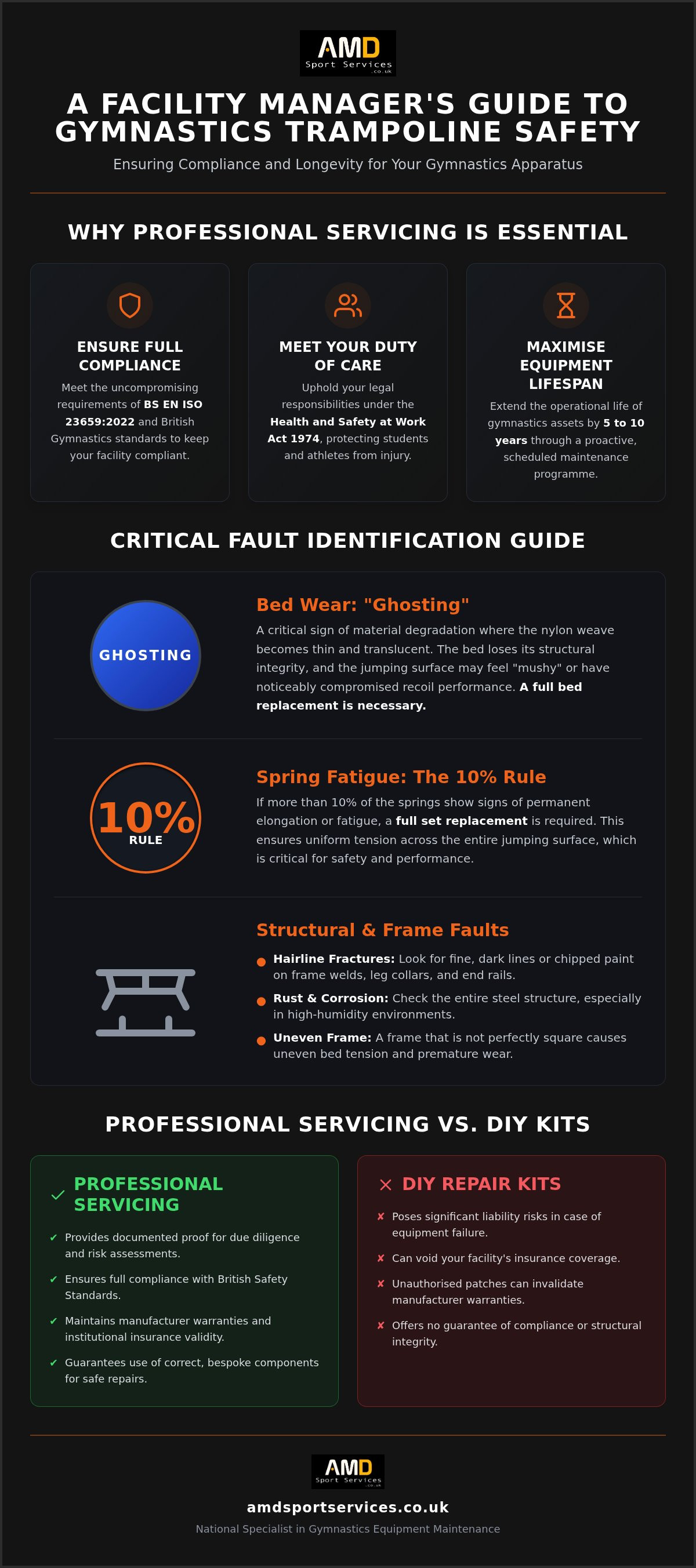
Facility managers have a high duty of care to students and athletes whilst they're using gymnastics apparatus. Compliance with the Health and Safety at Work Act 1974 and the specific standards set out in BS EN ISO 23659:2022 isn't optional; it's a benchmark used by insurance underwriters and legal teams. Faulty equipment doesn't just increase the risk of injury; it severely impacts user confidence amongst PE staff and coaches who rely on the integrity of the equipment. A professional gymnastics trampoline service provides the necessary documentation to prove due diligence. This paperwork is essential for your facility risk assessments and ensures that your equipment meets the rigorous criteria required for institutional use.
The Economic Value of Equipment Longevity
Extending the lifespan of gymnastics assets by five to ten years is achievable through scheduled maintenance. Professional lubrication and the tightening of floor fixings prevent premature wear on expensive side rails and leg sections. We often see units where the frame is in excellent condition, but the jumping surface has become unsafe. In these instances, a targeted gymnastics trampoline bed replacement restores the unit to full operational safety for a fraction of the cost of a new competition-standard model. We follow strict spring replacement guidelines; if more than 10% of your springs show signs of permanent elongation, a full set is required to maintain uniform tension. This methodical approach to repairs helps facility managers prioritise their budgets whilst maintaining a safe environment for all users.
Identifying Faults: When is Gymnastics Trampoline Bed Replacement Necessary?
Identifying when a trampoline has transitioned from a functional asset to a safety liability requires more than a casual glance. Whilst minor cosmetic snags in the mesh might look unsightly, they often signal the beginning of significant material degradation. A full gymnastics trampoline bed replacement is usually necessary when "ghosting" occurs. This is a condition where the nylon weave becomes thin and translucent, losing the structural integrity required for high-rebound manoeuvres. If the jumping surface feels "mushy" or the recoil performance is noticeably compromised, the bed has likely reached its elastic limit and can no longer distribute loads safely.
Structural Frame and Leg Inspections
The frame is the foundation of the unit's stability. We meticulously check for hairline fractures in frame welds and leg collars, which often appear as fine, dark lines or chipped paintwork. These stress marks on end rails and side rails are early indicators of metal fatigue that could lead to a sudden collapse. In high-humidity environments, such as leisure centres or pool-side sports halls, rust and corrosion are frequent issues that jeopardise the steel structure. Our technicians examine every bush and tightening fixing to ensure the unit remains level. A frame that isn't perfectly square will cause uneven bed tension, leading to premature wear on one side of the apparatus. If you've noticed unusual creaking or wobbling during use, it's advisable to book a professional safety inspection to verify the unit's structural health.
Bed, Springs, and Padding Assessment
Spring fatigue is a critical factor in facility safety. We follow a strict engineering guideline: if more than 10% of your springs show signs of permanent elongation or stretched coils, the entire set must be replaced to maintain uniform tension. Uneven spring tension puts lateral stress on the frame and increases the likelihood of the bed tearing at the anchor points. According to UK government trampoline safety advice, regular technical audits are the only way to prevent accidents caused by hidden equipment failure.
Padding is equally vital for user protection. We evaluate coverall pads and pad lifters to ensure they provide adequate cushioning over the steel frame and springs. When pads become compressed or the internal foam breaks down, they no longer offer sufficient impact protection. If the padding is failing alongside the mesh surface, it's often most efficient to source a professional gymnastics trampoline bed replacement to restore the entire unit to a "like-new" safety standard in a single service visit.
Professional Repairs vs DIY Kits: Understanding the Safety Risks
The temptation to use a DIY patch kit for a small tear in a trampoline mesh is understandable when budgets are tight. However, retail adhesives and iron-on patches cannot replicate the uniform tension of a professionally woven surface. In a high-performance environment, the forces exerted during a landing are concentrated on the weakest point of the apparatus. A DIY repair creates a "hard spot" that doesn't stretch at the same rate as the surrounding nylon, often leading to a secondary, more violent failure of the material. A gymnastics trampoline bed replacement is the only way to ensure the entire jumping surface reacts consistently to every impact.
Professional repairs focus on full component replacement rather than temporary fixes. We don't "patch" institutional equipment; we replace the bed, the springs, or the frame sections to restore the unit's original engineering specifications. A repair that looks functional to the naked eye isn't necessarily safe for technical gymnastics. If the tension isn't perfectly balanced across all four sides of the frame, the bed will "pull" to one side, which significantly increases the risk of an athlete landing awkwardly or striking the frame.
Compliance and Liability for UK Schools
School maintenance staff and PE departments should never attempt internal repairs on specialist gymnastics equipment. Institutional liability insurance is typically contingent on the apparatus being maintained by a "competent person" as defined by the Health and Safety Executive. Self-repairs on such critical equipment can void manufacturer warranties and leave the facility legally exposed in the event of an accident. Following indoor inspection and maintenance standards requires a clear, documented inspection trail provided by a qualified specialist contractor. This documentation proves that the equipment has been assessed against BS EN 13219 and remains fit for use in a curriculum setting.
Maintaining Performance Integrity
Consistency is vital for athletes performing complex manoeuvres in gymnastics or cheerleading. When a bed is patched or unevenly tensioned, the "bounce" becomes unpredictable. This lack of uniformity can disrupt a gymnast's timing and lead to serious injury. Professional gymnastics trampoline bed replacement ensures that the recoil performance is identical across the entire surface. Furthermore, correct professional tensioning preserves the structural life of the trampoline frame itself. An unevenly loaded bed puts twisting forces on the side rails, which can lead to the hairline frame fractures discussed earlier. By choosing professional component replacement, you protect both the safety of the users and the long-term value of your sports hall assets.
The Professional Bed Replacement and Servicing Process
Our maintenance process begins with a rigorous mechanical audit that extends far beyond the jumping surface. We examine the entire unit as a complete mechanical system, identifying wear in components that facility managers might overlook. This includes sourcing bespoke or brand-specific parts, such as end deck units, lifting equipment, and specialist floor fixings. By executing repairs on-site, we minimise facility downtime and eliminate the significant transport costs associated with moving competition-sized frames to a workshop. Our goal is to restore the apparatus to its original engineering specifications with minimal disruption to your PE curriculum or club timetable.
We provide a detailed report following every inspection, with faults categorised by urgency. This pragmatic approach helps facility managers prioritise maintenance budgets, distinguishing between immediate safety risks and advisory repairs that can be planned for the next financial year. When a gymnastics trampoline bed replacement is required, we ensure the new component is perfectly matched to the frame's dimensions and spring count to maintain structural integrity.
Step 1: The Multi-Point Safety Audit
A multi-point audit is the mandatory baseline for institutional gymnastics safety, ensuring every mechanical component is verified against current UK standards. Our technicians check every weld for hairline fractures, every spring for permanent elongation, and every bolt for correct alignment. We also conduct functional tests on the lifting and wheel mechanisms. These parts are critical for staff safety; if a lifting unit is stiff or misaligned, it poses a manual handling risk to the teachers and coaches who must move the equipment daily. We lubricate all moving parts and tighten all secondary fixings to ensure the frame remains square and stable during high-impact use.
Step 2: Bed Replacement and Refurbishment
The refurbishment process starts with the systematic removal of the old bed and springs. Once the frame is stripped, we perform a deep clean and a secondary inspection of the spring anchor points, which are often hidden during routine checks. Fitting a new gymnastics trampoline bed replacement requires precision tensioning. We install the new mesh and replacement springs in a specific sequence to restore uniform tension across the entire surface. This prevents the frame from twisting and ensures the "bounce" is consistent for the athlete. Finally, we conduct a performance test and issue a safety certificate, providing the documented proof of compliance required for your facility's insurance records.
If your equipment is due for its annual technical audit or requires specialist repairs, you can view our full range of sports equipment servicing options to ensure your facility remains safe and compliant.
AMD Sport Services: National Specialist in Gymnastics Equipment Maintenance
AMD Sport Services operates as a national specialist, delivering over 20 years of technical expertise to the UK sports sector. We specialise in sports equipment safety inspections, providing facility managers with the technical honesty required to manage complex apparatus. Our approach is strictly pragmatic; we don't recommend a full gymnastics trampoline bed replacement if a safe, durable repair is a viable alternative. This veteran presence in the industry allows us to solve unique structural or mechanical challenges that standard products or general handymen cannot address.
Our client base is diverse, ranging from small primary schools and local councils to universities and large-scale leisure centres across the UK. We understand the specific pressures of each environment, whether it's the high-traffic demands of a public sports hall or the budget constraints of a local academy. Beyond trampolines, we offer comprehensive support for all facility needs, including the installation and repair of sports hall netting systems, ensuring every corner of your sports hall meets current safety regulations.
Expert Technicians with National Coverage
Our mobile teams provide efficient, national service to schools and councils, ensuring that expert help is available regardless of your location. The benefit of using a single expert contractor for all indoor and outdoor sports apparatus is significant; it allows for a holistic safety audit and a single point of accountability. Our "Seasoned Practitioner" ethos is built on technical honesty and high workmanship standards. We aren't interested in polished sales pitches; we're interested in the quality of the work and the safety of the athletes who use the equipment we service.
Booking Your Professional Safety Survey
The process for requesting a site survey or a quote for a gymnastics trampoline bed replacement is designed to be simple and direct. You can access our full range of services through the AMD Sport Services installations page, which showcases our commitment to bespoke craftsmanship and mechanical proficiency. Our team is always available to provide specialist advice on equipment compliance, helping you navigate British Gymnastics standards whilst ensuring the maximum longevity of your facility's assets. Whether you're managing a single unit or an entire suite of gymnastics apparatus, we provide the dependable partnership you need to maintain a safe, compliant environment.
Securing Your Facility’s Compliance and User Safety
Maintaining high-performance gymnastics equipment requires a technical understanding of structural limits and material fatigue. By identifying indicators like "ghosting" or spring elongation early, you can manage your maintenance budget effectively whilst ensuring user safety. A professional gymnastics trampoline bed replacement is the most reliable way to restore a unit to full operational safety, preserving the integrity of the frame for years to come. This proactive approach prevents the sudden equipment failures that lead to facility downtime and compromised PE lessons.
AMD Sport Services provides national UK coverage for educational and leisure facilities, offering specialist expertise in structural gymnastics equipment repairs. Our mobile teams deliver comprehensive safety auditing and compliance reporting to ensure your sports hall meets the latest British standards. Request a Professional Trampoline Safety Inspection from AMD Sport Services to protect your athletes and maintain your facility's safety records. We're ready to help you ensure your apparatus remains fit for purpose and fully compliant.
Frequently Asked Questions
Can a gymnastics trampoline bed be repaired if it has a small hole?
Patching a small hole with a DIY kit is not a safe or compliant solution for institutional gymnastics. In a school or leisure centre, the high-impact forces of technical landings will quickly cause a patch to fail, often leading to a larger, more dangerous tear. We recommend a full gymnastics trampoline bed replacement to ensure the jumping surface maintains uniform tension and structural integrity. This prevents unpredictable recoil and protects the athlete from frame contact.
How often should a school trampoline be serviced by a professional?
Professional servicing should occur at least once every 12 months to comply with the Health and Safety at Work Act 1974. For high-traffic facilities where equipment is used for more than 20 hours per week, we recommend a six-monthly inspection cycle. Regular technical audits by a competent person identify issues like spring fatigue or frame fractures before they become critical, helping you maintain a safe environment and extend the lifespan of your apparatus.
Is it cheaper to repair a trampoline or buy a new one for my leisure centre?
Targeted repairs are almost always more cost-effective than the procurement of a new unit. A high-quality trampoline frame can last for decades if maintained correctly, whereas a new competition-standard model represents a significant capital investment. By opting for a gymnastics trampoline bed replacement or a full spring set renewal, you can restore a unit to its original safety standards for a fraction of the cost, effectively extending its operational life by several years.
What are the most common causes of trampoline frame failure in schools?
The most common causes of frame failure include hairline stress fractures in the welds, corrosion in humid environments, and uneven bed tension. If the springs aren't distributing loads equally, the side rails are subjected to twisting forces that lead to metal fatigue. Additionally, the wear of floor fixings and bushes can cause the frame to lose its square alignment. Regular lubrication and tightening of all secondary fixings during professional servicing prevent these structural issues from escalating.
Do you provide replacement parts for all major gymnastics trampoline brands?
We source and fit replacement parts for all major gymnastics trampoline brands used in the UK. Our mobile teams carry a range of specialist components, from replacement springs and beds to lifting equipment and end deck units. If your apparatus is a legacy model, we can often source or manufacture bespoke parts to ensure the unit remains compliant. This versatility allows us to support facilities with a diverse range of equipment from multiple manufacturers.
Are your trampoline repairs compliant with current British safety standards?
All our repairs and inspections are fully compliant with current British and European safety standards. We work to the benchmarks set out in BS EN ISO 23659:2022 for operational safety and BS EN 13219 for gymnastics equipment construction. Following every service, we provide documented certification that acts as proof of due diligence for your insurance underwriters and local authority health and safety officers, ensuring your facility meets its legal duty of care.
What happens if our trampoline fails its annual safety inspection?
If a unit fails its inspection, it must be decommissioned immediately to prevent use. We provide a detailed report categorising the faults by urgency, allowing you to prioritise the necessary repairs. Once the faults are rectified, such as through a gymnastics trampoline bed replacement or frame repair, we re-inspect the unit and issue a safety certificate. This clear audit trail is essential for maintaining compliance and ensures that only safe equipment is available for your users.
Can you repair the lifting and wheel mechanisms on gymnastics trampolines?
We provide full repair services for the lifting and wheel mechanisms on all institutional trampolines. These components are vital for the safe manual handling of the equipment by staff and coaches. Stiff or misaligned lifting units can lead to back injuries or accidents during setup. We lubricate moving parts, replace worn bushes, and ensure the wheel units operate smoothly, protecting your staff whilst ensuring the equipment can be moved and stored without difficulty.


Comments