
Hammer Cage Netting Regulations UK: The 2026 Facility Safety Guide

A single "near miss" in 2018 was all it took to trigger a total overhaul of athletics safety standards across Britain. If your facility hasn't updated its equipment since then, you're likely operating outside the current legal framework. Understanding hammer cage netting regulations UK is no longer just about passing an annual check; it's about mitigating the genuine risk of catastrophic equipment failure during high-velocity throws. For many facility managers, the fear of liability in the event of an accident is a heavy burden that requires technical certainty rather than guesswork.
We understand that navigating the technicalities of breaking strains and gate geometry can feel overwhelming, especially when you're responsible for the safety of athletes and spectators alike. You need to know that your equipment is up to standard without being forced into a full, costly replacement. This guide ensures your athletics facility meets the latest 2026 UKA and World Athletics safety standards with a pragmatic, step-by-step approach. We'll examine the critical differences between training and competition specifications, provide a practical checklist for your internal pre-use inspections, and help you identify when a bespoke repair is a viable alternative to buying new.
Table of Contents
Understanding Hammer Cage Netting Regulations in the UK
The regulatory framework for throwing events in Britain has undergone a total transformation. Current hammer cage netting regulations UK are defined by a move away from legacy designs toward a harmonised system that aligns with World Athletics. This shift was a direct response to a comprehensive safety review following a serious incident in 2018. Today, any cage that doesn't meet these specific structural and material benchmarks is considered non-compliant. Ensuring your facility adheres to hammer cage safety standards is a mandatory requirement for any site hosting athletics, whether for local club training or national championships.
Facility owners hold a strict legal duty of care under UK health and safety legislation. You're responsible for the structural integrity of the equipment and the safety of everyone on site. Standard safety netting, often used for football or cricket, is entirely insufficient for this application. A 7.26kg hammer travelling at high velocity carries immense kinetic energy. The netting must be specifically engineered to absorb this impact without failing or allowing the implement to rebound dangerously. Professional bodies like SAPCA set the installation benchmarks that ensure these cages are built to withstand these unique mechanical stresses.
The Difference Between Training and Competition Standards
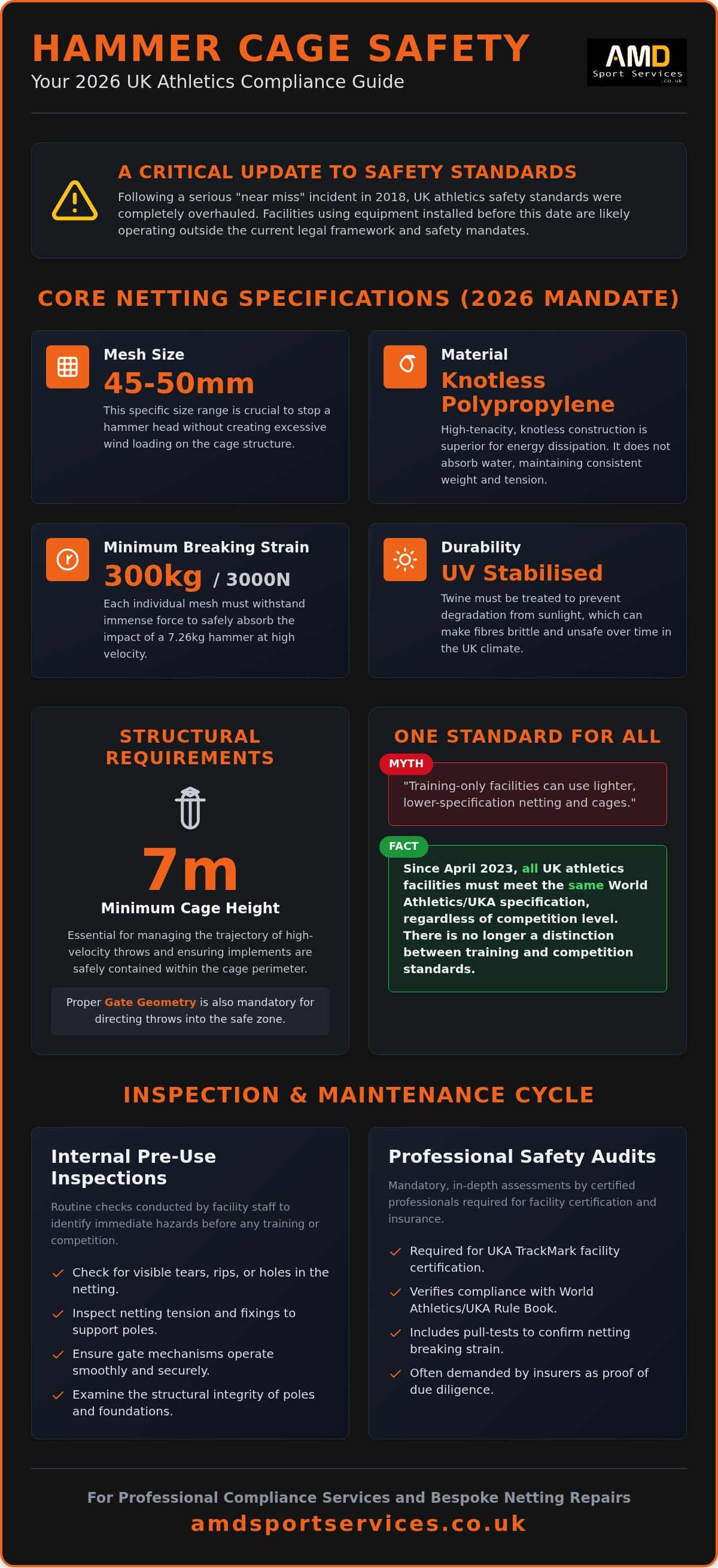
There's often confusion about whether training-only sites can use "lighter" specifications. The short answer is no. Since April 2023, all UK athletics facilities must meet the World Athletics/UKA specification, regardless of the level of competition. Competition cages typically require specific gate configurations and a minimum height of 7 metres to manage the trajectory of the hammer effectively. If your cage hasn't been inspected within the last three years, it's likely "out of certificate" under the TrackMark programme. This status can invalidate your facility's ability to host licensed events and may complicate insurance claims if an accident occurs.
Key Governing Bodies: UKA vs World Athletics
The 2026-2028 UK Athletics Rule Book, effective from 1 April 2026, codifies the latest safety requirements. Whilst World Athletics sets the global standard for elite performance, UKA adapts these rules for the British context, focusing heavily on risk assessment for venues where cages are positioned near tracks or spectator areas. These standards directly influence insurance premiums for sports clubs. Insurers increasingly demand proof of professional safety audits before providing cover. Managing these complex assets requires a structured approach to service and maintenance to ensure the cage remains a safe asset rather than a liability.
Technical Standards for Athletics Throwing Cage Netting
Technical compliance for throwing cages rests on the physical properties of the netting itself. Meeting the hammer cage netting regulations UK requires more than just hanging a barrier; it involves specific material science to ensure the structure can safely arrest a 7.26kg implement. The mesh size must fall between 45mm and 50mm. This specific range is calculated to stop a hammer head whilst allowing sufficient wind passage to prevent the structure from acting like a sail during the unpredictable British weather. If the mesh is too large, the implement could snag or penetrate; if it's too small, the wind loading can cause structural failure of the support poles.
Knotless high-tenacity polypropylene has become the industry standard for these installations. Unlike traditional nylon, it doesn't absorb water, which helps maintain the net's weight and tension throughout the season. Each individual mesh must have a minimum breaking strain of 300kg, or 3000 Newtons, as detailed in the World Athletics Facilities Manual. To ensure durability in the UK climate, the twine must be UV stabilised to prevent the fibres from becoming brittle and losing their energy-absorbing properties over time.
Breaking Strain and Energy Dissipation
Knotless netting is superior for energy dissipation because the lack of physical knots allows the fibres to slide and stretch slightly upon impact. In a knotted net, the impact energy concentrates at the joints, creating weak points where the twine often snaps under the stress of high-speed throws. Testing protocols are vital for aged equipment. We recommend regular pull-tests on sample sections to verify that the breaking strain hasn't dropped below the mandatory 3000N threshold due to environmental wear. If you're unsure about the current state of your equipment, arranging a professional throwing cage inspection is the most reliable way to confirm compliance.
Netting Colour and Visibility
Darker colours like black or deep green are preferred for two practical reasons. First, they provide high contrast against the sky, which helps athletes maintain focus on their release point and trajectory. Second, these colours are less intrusive for spectators, making it easier to track the flight of the implement whilst maintaining a safe distance. Maintaining a professional aesthetic is important for facility reputation, but visibility always serves a primary safety function. A faded or greyed net often indicates significant UV damage, suggesting that the material may no longer meet the required safety benchmarks.
Structural Requirements: Gates, Heights, and Safety Zones
The physical structure of a cage is just as critical as the material of the net. Modern hammer cage netting regulations UK mandate a minimum height of 7 metres for the rear and side panels to account for the high release trajectory of the implement. If the structure is too low, the hammer can easily clear the barrier, putting everyone on the facility at risk. This height isn't just a recommendation; it's a structural necessity to ensure the "danger zone" is properly contained. Current UKA specifications require that the danger zone for the hammer throw is restricted to no more than 56 degrees, whilst the discus throw allows for 69 degrees. Achieving these precise angles depends entirely on the correct positioning and height of the cage gates.
Netting tension plays a vital role in maintaining the stability of the structural poles. If the netting is too loose, it creates "pockets" that can trap the hammer or cause it to rebound in an unpredictable direction. Conversely, excessive tension can pull the support poles out of vertical alignment, compromising the entire structure's integrity. Facility managers must also enforce strict safe distances. Clearing the area around the cage during throwing sessions is a basic safety requirement. No one should be permitted within the potential flight path or near the netting, as even the best-maintained nets will deflect significantly when struck by a 7.26kg hammer travelling at high speed.
The Role of Moveable Gates in Compliance
Moveable gates are the most complex part of the cage and require regular attention. They must be adjusted to specific angles depending on whether the athlete is throwing left-handed or right-handed. We frequently see mechanical failures in gate pulleys and hoisting systems, which can prevent the gates from closing fully or staying in position. When a gate doesn't lock correctly, the safety angle is compromised, and the cage no longer meets official standards. For facilities struggling with legacy equipment, our external sport equipment installation services provide a path to full technical compliance through modern gate upgrades.
Ground Fixings and Structural Integrity
The foundations of the cage are often overlooked until a problem occurs. Inspecting ground sockets for corrosion and movement is a priority, especially for older installations. Vertical alignment is essential; if the poles lean, the netting cannot hang correctly, leading to those dangerous pockets mentioned earlier. Wind-loading is another major factor for permanent outdoor cages in the UK. High-tenacity netting has a large surface area, and in high winds, the pressure on the ground fixings is immense. Ensuring the sockets are clear of debris and the poles are securely seated is a fundamental part of any safety management system.
The Inspection and Maintenance Cycle for UK Facilities
A compliant facility relies on a continuous cycle of assessment and action. Establishing a robust safety management system is the only way to ensure your equipment remains within the hammer cage netting regulations UK throughout its service life. This system must move beyond casual observations; it requires a structured approach that separates daily operational checks from detailed technical audits. Documentation is the backbone of this process. Without a clear paper trail of inspections and subsequent repairs, you'll struggle to meet UKA certification requirements or satisfy insurance providers in the event of a claim.
Recognising "net fatigue" is a critical skill for any facility manager. Over time, the energy-absorbing properties of knotless polypropylene diminish due to UV exposure and repeated impacts. Signs of wear aren't always as obvious as a large hole. You should look for thinning twine, a change in the material's texture, or significant fading of the colour. Structural wear often manifests as stiffening gate hinges or fraying hoisting cables. If these issues aren't addressed early, they can lead to mechanical failures that compromise the safety of the entire cage.
Daily and Weekly Pre-Use Checklists
Before every session, a designated competent person should perform a visual sweep. This doesn't replace a professional audit but serves as a vital first line of defence. Your internal checklist should include:
Inspecting the netting for holes, fraying, or signs of UV degradation.
Testing gate movement to ensure they swing freely and lock at the correct angles.
Checking that pulley systems are lubricated and hoisting cables are intact.
Ensuring the throwing circle surface is clear of debris, moss, or trip hazards.
The Annual Professional Safety Inspection
Whilst internal checks are essential for day-to-day operations, an annual professional audit is mandatory for certification. During an AMD Sport Services audit, we conduct a comprehensive technical evaluation of every component. We inspect the structural integrity of the poles, the tension of the netting, and the security of the ground fixings. We also verify that the gate geometry still meets the 56-degree danger zone requirement. Following the assessment, you'll receive full compliance documentation that serves as proof of your facility's safety status for the upcoming season.
To ensure your facility remains safe and fully certified for the year ahead, you can book a comprehensive service and maintenance for sports equipment audit today.
Professional Repair and Compliance Services for Throwing Cages
Maintaining a facility that adheres to the hammer cage netting regulations UK often requires more than simple maintenance. When an inspection identifies a failure, the next step is a technical intervention designed to restore the cage to its full safety rating. We specialise in bespoke netting replacement tailored to the exact dimensions of your existing framework. Whether you're managing a modern World Athletics compliant structure or a legacy installation, the netting must be fitted with precision to ensure correct tension and energy absorption. Poorly fitted netting isn't just an aesthetic issue; it's a safety hazard that can lead to implement entrapment or structural instability.
A common question we face is whether to repair or replace a net. Technical honesty is the foundation of our service. A patch is only a safe solution if the surrounding material retains its original 3000N breaking strain and hasn't been compromised by UV degradation. If the twine has become brittle or the mesh is distorted across a large area, a full netting replacement is the only responsible course of action. Beyond the mesh, we also focus on hammer cage repairs for mechanical components. Restoring the functionality of gates and pulley systems is essential to ensure that your facility remains compliant with the 56-degree danger zone requirements mentioned earlier.
Bespoke Solutions for Non-Standard Cages
Many UK facilities operate with older or discontinued cage models that don't fit standard "off-the-shelf" netting sizes. We provide custom fabrication services to bridge this gap, ensuring that even non-standard equipment can meet modern safety benchmarks. This bespoke approach extends to internal protection as well. If you're also managing indoor facilities, you might find our sports hall netting systems guide useful for understanding the different requirements for indoor impact protection.
Getting Your Facility Ready for the Season
Timing is critical when scheduling hammer cage repairs. We recommend booking your professional safety audit during the off-season to ensure any necessary parts can be fabricated and installed without disrupting your training or competition schedule. Institutional clients, including councils and universities, trust us because we prioritise technical proficiency over sales targets. Using an experienced contractor for high-risk equipment ensures that your compliance documentation is robust and your athletes are protected. You can contact AMD Sport Services for a hammer cage safety audit to secure your facility's certification for 2026.
Securing Your Facility for the 2026 Season
Maintaining a safe throwing environment requires a combination of technical precision and rigorous structural oversight. We've seen that modern hammer cage netting regulations UK demand specific benchmarks, from the 3000N breaking strain of knotless polypropylene to the precise 56-degree danger zone managed by your gate configuration. Failing to meet these standards doesn't just risk your facility's certification; it compromises the safety of every athlete and spectator on site. Documented inspections and proactive maintenance are your best tools for managing this high-risk equipment effectively.
With over 20 years of technical expertise, AMD Sport Services provides a nationwide service to ensure schools and clubs remain in full compliance with UKA and World Athletics standards. We focus on delivering pragmatic, bespoke solutions that extend the life of your equipment whilst keeping your site safe. Don't leave your facility's safety to chance as the new season approaches. You can book a professional hammer cage safety inspection to verify your compliance and prepare your site for a successful year of competition. We're here to help you maintain the highest standards of workmanship and safety.
Frequently Asked Questions
What is the minimum height for hammer cage netting in the UK?
The minimum height for modern hammer cage netting in the UK is 7 metres for the rear and side panels. This standard ensures that high-release throws are safely contained within the cage structure. If your facility currently operates with lower netting, it's likely non-compliant with the 2026 UKA safety standards. Maintaining this height is essential for restricting the danger zone and protecting athletes and spectators across the site.
How often should a throwing cage undergo a professional safety inspection?
A throwing cage must undergo a professional safety inspection at least every three years to maintain its TrackMark certification. However, best practice for facility managers is to schedule an annual audit before the outdoor season begins. This ensures that any UV degradation or mechanical wear in the gate pulleys is identified early. Documenting these yearly checks is also a key requirement for most sports insurance policies in the UK.
Can we repair a small hole in our hammer net or must it be replaced?
You can repair a small hole with a professional patch, but only if the surrounding netting still meets the mandatory 3000N breaking strain. If the material feels brittle or shows significant fading from UV exposure, a patch won't restore the net's safety rating. In these cases, a full netting replacement is required. We always assess the overall "net fatigue" before recommending a bespoke repair over a complete replacement.
What mesh size is required for a compliant athletics throwing cage?
A compliant athletics throwing cage requires a mesh size between 45mm and 50mm. This specific range is engineered to stop a 7.26kg hammer head whilst allowing wind to pass through the material. If the mesh is larger than 50mm, there's a risk of the implement snagging or penetrating the barrier. Using the correct size ensures the netting effectively absorbs kinetic energy without putting excessive wind-loading stress on the support poles.
Does a training cage need to meet the same regulations as a competition cage?
Yes, training cages must meet the same hammer cage netting regulations UK as competition cages. As of 1 April 2023, UK Athletics mandates that all facilities, regardless of their use level, must align with World Athletics safety specifications. This rule ensures a consistent safety standard for all athletes. Operating a training-only cage with legacy, non-compliant netting can lead to significant liability issues and may invalidate your facility's insurance coverage.
What material is best for hammer cage netting to ensure longevity?
Knotless high-tenacity polypropylene is the superior material for hammer cage netting due to its durability and energy-absorption properties. Unlike nylon, polypropylene doesn't absorb water, which prevents the net from becoming heavy and sagging during wet weather. It's also highly resistant to UV degradation when properly stabilised. The knotless construction is particularly important because it allows the fibres to dissipate impact energy more effectively than traditional knotted designs.
What happens if our cage fails a UKA safety inspection?
If your cage fails a UKA safety inspection, it will be marked as "out of certificate," meaning you cannot host licensed athletics events. The facility manager must then address the specific failures identified in the audit report before the cage can be re-certified. This often involves hammer cage repairs to the gate geometry or replacing aged netting. We recommend addressing these issues immediately to maintain your site's safety and operational status.
Are there specific regulations for discus cages compared to hammer cages?
There are distinct differences in the regulations for discus and hammer cages, primarily regarding the danger zone and cage height. Whilst a hammer cage requires a 7-metre minimum height and a 56-degree danger zone, a dedicated discus cage can have a wider 69-degree opening. However, most UK facilities use a combined cage designed to the stricter hammer specifications. This ensures the structure is strong enough to arrest the heavier, high-velocity hammer implements.


Comments