
Hammer Cage Repairs UK: The Professional Guide to Throwing Cage Maintenance

Since the mandatory compliance deadline passed on 1 April 2022, many facilities have found themselves managing equipment that no longer meets UK Athletics safety standards. It's a common frustration for site managers who face the prospect of a massive capital layout just to correct a "danger zone" angle. You know that safety is non-negotiable, but the pressure to maintain a compliant environment while managing tight budgets is a difficult balance to strike. Professional hammer cage repairs UK offer a pragmatic middle ground, allowing you to upgrade existing structures to meet current specifications without the waste of a full replacement.
This guide provides a professional roadmap for maintaining and upgrading your throwing equipment. You'll learn how to identify structural weaknesses before they become liabilities and understand when a bespoke gate modification is the most efficient route to compliance. We'll break down the technical requirements for UKA and World Athletics standards, explain the durability of different netting types, and detail how to organise a maintenance programme that keeps your athletes safe and your facility fully insured.
Table of Contents
Understanding Hammer Cage Safety Standards in the UK
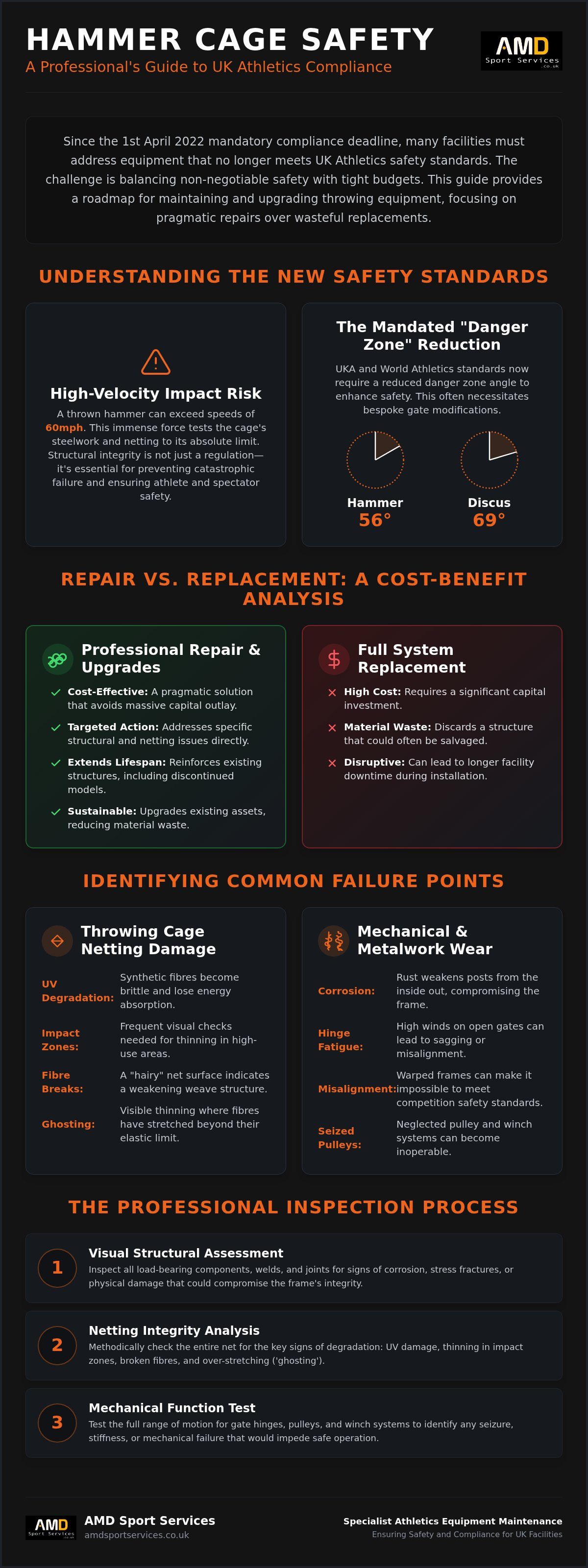
The landscape of athletics safety changed significantly following a 2018 review of Hammer throw safety standards. For facility managers, understanding the distinction between UK Athletics (UKA) and World Athletics (WA) is the first step in managing hammer cage repairs UK effectively. The 1 April 2022 deadline for compliance with revised specifications made it mandatory for all pre-November 2018 cages to be either modified or replaced. This isn't just a bureaucratic hurdle; it's a critical safety measure designed to reduce the "danger zone" where an errant throw could land.
Structural integrity is non-negotiable. A hammer can travel at speeds exceeding 60mph. When an implement of that weight hits a cage at high velocity, the steelwork and the energy absorption of the netting are tested to their limits. If the cage frame is weakened by corrosion or the netting has lost its elasticity due to UV exposure, the system will fail. Regular maintenance ensures that these forces are safely dissipated, protecting spectators, officials, and other athletes from catastrophic failure during competition or training.
UKA vs WA Compliance: What Facilities Need to Know
UKA standards generally align with WA for competition venues, but there are nuances regarding gate widths and heights that facilities must track. The primary requirement is a reduction in the danger zone angle. For a hammer, the danger zone must be no more than 56 degrees, and for a discus, it is 69 degrees. Achieving this often requires bespoke mechanical adjustments to the gate geometry. Whilst club-level requirements may differ slightly from international competition standards, the fundamental goal remains the same: ensuring the implement stays within the designated landing sector.
The Duty of Care for Schools and Leisure Centres
Schools and leisure centres have a legal obligation under the Health and Safety at Work Act to provide safe equipment. An annual professional inspection is a core component of this duty. If an accident occurs, insurance providers will scrutinise maintenance logs and inspection certificates. Documenting your service and maintenance history provides a clear audit trail for local authorities. It proves that you've taken reasonable steps to prevent equipment failure. Proactive repairs are significantly more manageable than the legal fallout of a preventable incident.
Identifying Common Structural and Netting Failures
Recognising the early signs of failure is essential for maintaining equipment longevity and user safety. Whilst most cages are engineered to withstand significant stress, constant exposure to the British weather and high-velocity impacts inevitably leads to material fatigue. Specialist hammer cage repairs UK focus on these specific failure points to prevent a total structural collapse. Identifying a problem during a routine check is always preferable to discovering it during a competition throw.
Analysing Throwing Cage Netting Damage
Netting doesn't just snap; it degrades. Synthetic fibres are particularly vulnerable to UV radiation, which causes photo-degradation. This process makes the fibres brittle and less able to absorb the kinetic energy of a hammer. You should look for the following signs of degradation:
Impact zones: These are the specific areas most frequently struck during training. They require monthly visual checks for thinning.
Fibre breaks: Individual strands that have snapped create a "hairy" appearance on the net surface, indicating the weave is losing its structural bond.
Ghosting: A visible thinning or "shadowing" of the net material suggests the fibres have stretched beyond their elastic limit and will no longer catch an implement safely.
Mechanical and Metalwork Wear and Tear
The steel framework faces its own set of challenges, especially in coastal or high-pollution areas where salt and chemicals accelerate corrosion. Even galvanised steel has a lifespan, and once the protective layer is breached, internal rust can weaken the posts from the inside out. Gate hinges often suffer from metal fatigue; if gates are left open during high winds, the leverage on the hinges is immense, leading to sagging frames or complete misalignment. This misalignment often makes it impossible to meet the strict UK Athletics safety standards required for competition certification.
Pulleys and winch systems are equally critical. If a pulley doesn't rotate freely, the net tensioning cable will rub against the housing, causing friction heat and eventual cable failure. Winch systems must be inspected for "bird-caging"—the separation of cable strands—and to ensure the braking mechanism holds firmly under the weight of the net. If you notice the net slipping or the winch handle kicking back, it's a sign of internal wear that requires immediate attention. To keep your facility in peak condition, it's often worth arranging specialist sport equipment repairs as soon as these mechanical issues are identified.
Finally, ground socket stability is often overlooked. If the concrete foundations have cracked or shifted, the entire geometry of the cage is compromised. Any movement at the base of a ten-metre post is magnified at the top, creating dangerous instability. Regular inspections should include a check for standing water in the sockets, which can lead to rapid base-level corrosion.
Hammer Cage Repair vs. Full Replacement: A Cost-Benefit Analysis
Deciding between a repair and a full replacement is a significant financial decision for any leisure centre or school. Whilst the lure of new equipment is strong, the structural life expectancy of high-quality galvanised steel often exceeds thirty years. If the core framework remains sound, opting for a full replacement is often an unnecessary drain on restricted budgets. Professional hammer cage repairs UK focus on restoring the safety and functionality of your existing asset, often at a fraction of the cost of a new installation.
Replacement involves substantial hidden costs that are rarely discussed in initial sales pitches. Beyond the price of the cage itself, you must factor in the mechanical removal of the old structure, the disposal of several tonnes of steel, and the potential need for new groundwork if the original sockets don't match modern designs. Lead times for bespoke new cages can also stretch into several months, potentially leaving your facility without a throwing area for an entire season. Professional refurbishment bypasses these logistical hurdles by working with the infrastructure you already have in place.
When to Choose Professional Net Patching
Netting doesn't always require a total replacement. For those managing hammer cage repairs UK, understanding the threshold for safe patching is critical. If damage is localised and situated away from the primary impact zones, professional patching is a safe and viable solution. This process involves "weaving in" new sections of high-density polyethylene netting using specialised lacing techniques that maintain the tension and strength of the original weave. It's a precise technical task that ensures the repair is as strong as the surrounding material. You should never use DIY fixes like cable ties or garden twine; these materials lack UV resistance and will snap under the first high-velocity impact, creating a significant liability risk.
When Full Structural Refurbishment is Required
There are instances where a simple patch isn't enough. If the main support posts show signs of deep-seated internal corrosion or if the gate mechanisms are fundamentally misaligned, a structural refurbishment is necessary. This often includes stripping back the mechanical components, replacing seized winches, and modifying gate frames to meet current gate height and "danger zone" angle requirements. Refurbishing an older, heavy-duty steel structure is often a better long-term investment than replacing it with a lighter, modern alternative. A well-executed refurbishment can add over ten years to the cage's lifespan, providing a far better return on investment than a complete rebuild. For facilities looking to extend the life of their assets, our external sport equipment installation and repair services provide a pragmatic path forward.
The Professional Throwing Cage Inspection and Repair Process
Professional hammer cage repairs UK require a methodical approach that prioritises structural safety over aesthetic fixes. Our workflow is designed to identify hidden mechanical issues before they lead to equipment failure. This is not a cursory walk-around; it's a technical audit of every component that keeps the structure standing under load. We follow a chronological sequence to ensure nothing is overlooked.
Step 1: Visual assessment. We examine every square metre of netting and all load-bearing steelwork for signs of fatigue, stress fractures, or corrosion.
Step 2: Mechanical testing. This involves operating gates, winches, and pulleys to ensure they move freely and lock securely under tension.
Step 3: Detailed reporting. We provide a clear document categorising defects by risk level, allowing you to allocate budget where it's most needed.
Step 4: Technical execution. Repairs are carried out using high-tensile cables and industrial-grade netting that matches or exceeds original specifications.
Step 5: Post-repair certification. Once work is complete, we provide the documentation necessary to satisfy your facility's compliance records and insurance requirements.
What Happens During a Safety Inspection?
We test the "draw" and tension of the net to confirm it can properly absorb the kinetic energy of a high-velocity impact. If a net is too loose, the implement can strike the framework; if it's too tight, the fibres may snap. We also check the plumb and level of the main support posts. Even a slight lean can indicate foundation movement or a bent post, both of which compromise structural stability. Every shackle, carabiner, and moving part is inspected for mechanical wear that could lead to a snag or failure during operation.
Preventative Maintenance and Seasonal Care
Longevity depends on how you treat the equipment between uses. One of the most effective ways to prevent netting degradation is to lower and store nets during the winter months. This protects the synthetic fibres from unnecessary frost damage and high wind-loading whilst the facility is less active. Lubricating moving parts, such as gate hinges and winch gears, prevents the seizing that often leads to expensive mechanical failures. Organising a regular maintenance schedule avoids the high cost of emergency repairs and ensures your facility is always ready for competition. If you need to book a professional audit, you can arrange a professional safety inspection to ensure your facility remains fully compliant.
By following this structured process, we ensure that every repair is both durable and compliant. It's about providing a safe environment for athletes and officials whilst extending the lifespan of your existing equipment through technical proficiency and regular care.
Specialist Athletics Equipment Maintenance from AMD Sport Services
At AMD Sport Services, we understand that a one-size-fits-all approach doesn't work for UK athletics facilities. Many venues operate with equipment that has been in place for decades, often outlasting the companies that originally installed them. When standard parts are no longer available from manufacturers, we provide bespoke hammer cage repairs UK that restore full functionality and safety. Our focus is on equipment longevity; we'd rather use our engineering expertise to fix a robust older structure than see a client spend unnecessarily on a lighter, less durable replacement.
We provide a comprehensive national service, working amongst schools, local councils, and professional athletics clubs. Our expertise extends beyond vertical structures. We often integrate cage refurbishments with a wider programme of athletics track maintenance to ensure the entire throwing environment is safe. By coordinating these services, we reduce the logistical burden on site managers and ensure that the cage, the circle, and the surrounding surfacing all meet the required safety standards simultaneously.
Why Institutional Clients Trust Our Expertise
Institutional clients value our "Seasoned Practitioner" approach. We don't rely on polished sales pitches; instead, we provide direct communication and technical honesty. Whether you're managing a local school track or a major stadium, our assessment remains the same: a pragmatic look at what's required to ensure safety and compliance. We take pride in solving unique structural challenges that other providers might avoid, prioritising quality workmanship over simple equipment sales. This transparent partnership is why so many public-sector decision-makers rely on us for their annual safety audits.
Enquire About Your Throwing Cage Refurbishment
If you're concerned about the condition of your equipment, the first step is a technical review. Providing us with clear measurements and detailed photos of the current damage allows our team to conduct an initial assessment. This helps us understand the specific model and the nature of the mechanical failure. From there, we can organise a national site visit and a formal safety audit to provide a detailed quotation. This methodical process ensures that every repair is technically sound and tailored to your specific cage. You can also explore our wider external sport equipment installation services to see how we manage complex projects from the initial survey through to final testing.
Securing the Future of Your Athletics Facility
Maintaining a compliant throwing environment requires a pragmatic focus on structural integrity and precise netting tension. You've seen that meeting current UKA safety standards is a matter of technical geometry rather than simple patchwork. By choosing professional hammer cage repairs UK, you can significantly extend the lifespan of your existing equipment whilst avoiding the substantial capital expenditure of a full replacement. Proactive maintenance doesn't just manage costs; it ensures that your facility remains a safe, high-performance space for every athlete.
Our team provides a UK-wide specialist service, offering bespoke repair solutions that keep your equipment fully compliant with the latest regulations. Whether you're managing a school field or a regional stadium, the first step towards a safer facility is a technical audit. Request a professional hammer cage safety inspection to verify the condition of your equipment and plan your maintenance schedule with confidence. We look forward to helping you maintain a safe and durable throwing environment for years to come.
Frequently Asked Questions
How often should a hammer cage be professionally inspected?
An annual professional inspection is the recommended minimum to ensure ongoing compliance and safety. For facilities with high usage, such as regional athletics hubs, bi-annual checks are often more appropriate. These inspections allow for the early detection of structural fatigue and netting degradation caused by the British weather. Regular monitoring ensures that your equipment remains within the strict parameters required for UKA competition certification throughout the season.
Can we repair a hammer cage net ourselves using heavy-duty twine?
No, you shouldn't attempt to repair a hammer cage net using standard heavy-duty twine or cable ties. These materials lack the UV resistance and tensile strength required to absorb the kinetic energy of a high-velocity hammer impact. A DIY fix creates a significant liability risk and will likely fail during use. Professional hammer cage repairs UK involve technical weaving with high-density polyethylene that maintains the structural integrity of the entire net.
What is the typical lifespan of hammer cage netting in the UK climate?
In the UK climate, hammer cage netting typically has a functional lifespan of between five and ten years. This duration varies based on UV exposure, local pollution levels, and whether the nets are lowered and stored during the winter months. Once the synthetic fibres become brittle or show visible "ghosting," they no longer provide the energy absorption required. Regular professional assessments help determine the exact point when a net transitions from safe to hazardous.
Does a repaired hammer cage still meet UKA safety standards?
Yes, a professionally repaired cage will meet UKA safety standards provided the work is carried out by specialist contractors using compliant materials. Repairs often involve modifying gate geometry or replacing worn netting to ensure the "danger zone" angles remain within the 2022 mandated limits. We provide the necessary documentation to prove that the structural and mechanical integrity of the equipment has been restored to the required official specifications.
How long does a typical hammer cage repair take to complete?
Most typical hammer cage repairs are completed within one to three days on-site. The exact duration depends on the complexity of the mechanical issues, such as seized gate hinges or winch failures, and the extent of the netting damage. Because we arrive with the necessary industrial-grade materials and specialised tools, we can usually restore your facility to full operational status quickly, minimising the disruption to your training or competition schedule.
What are the signs that our throwing cage gates are becoming dangerous?
Signs of dangerous gates include visible sagging, misaligned frames that don't close flush, and hinges that have seized due to corrosion. If you find the gates difficult to move or if they "kick back" during operation, the mechanical components are failing. These issues are often caused by wind-loading fatigue. Any misalignment makes it impossible to guarantee the correct throwing angles, which compromises the safety of everyone in the surrounding area.
Is it possible to motorise older manual hammer cage gates?
Yes, it's possible to motorise many older manual hammer cage gates to improve ease of use and safety. This upgrade involves installing specialised drive systems that eliminate the need for manual handling, which is particularly beneficial for larger gates that are susceptible to wind resistance. Motorisation ensures consistent gate positioning every time, helping your facility maintain precise compliance with UKA and World Athletics sector requirements without the physical strain of manual operation.
Do you provide safety certificates after a cage repair is finished?
We provide a detailed safety certificate and a comprehensive inspection report once every repair is finished. This documentation is essential for your facility's insurance records and local authority audits. It confirms that the equipment has been assessed by a seasoned practitioner and that the repairs meet current safety regulations. Having this paper trail is a critical part of your duty of care to athletes, officials, and spectators.


Comments