
Heavy Duty Sport Netting: A Professional Guide to Specification and Safety

For facility managers, school bursars, and council leisure officers, the specification of sport netting is a critical decision that balances budget, performance, and legal safety obligations. Choosing inadequate netting can lead to premature degradation, frequent repairs, and, most importantly, a failure to protect participants and spectators. Conversely, investing in professional-grade, heavy duty sport netting ensures long-term durability, compliance with UK standards, and peace of mind.
This comprehensive guide moves beyond basic product descriptions to provide a professional framework for specifying, installing, and maintaining heavy-duty netting systems. We will examine the technical details of material science, twine thickness, and mesh sizes, and explain how these factors relate to the safety standards required for UK sports facilities, from local MUGAs to UKA-compliant athletics centres.
The core principle is simple: heavy-duty netting is only as strong as its installation and inspection regime. The material specification is just the starting point for a safe and durable system.
Table of Contents
Understanding Heavy Duty Sport Netting Specifications
The term "heavy duty" is more than a marketing slogan; it refers to a specific class of netting engineered to withstand high-impact forces and prolonged exposure to the UK's demanding weather conditions. Understanding the technical specifications is the first step in procuring a system that is fit for purpose and offers a genuine return on investment.
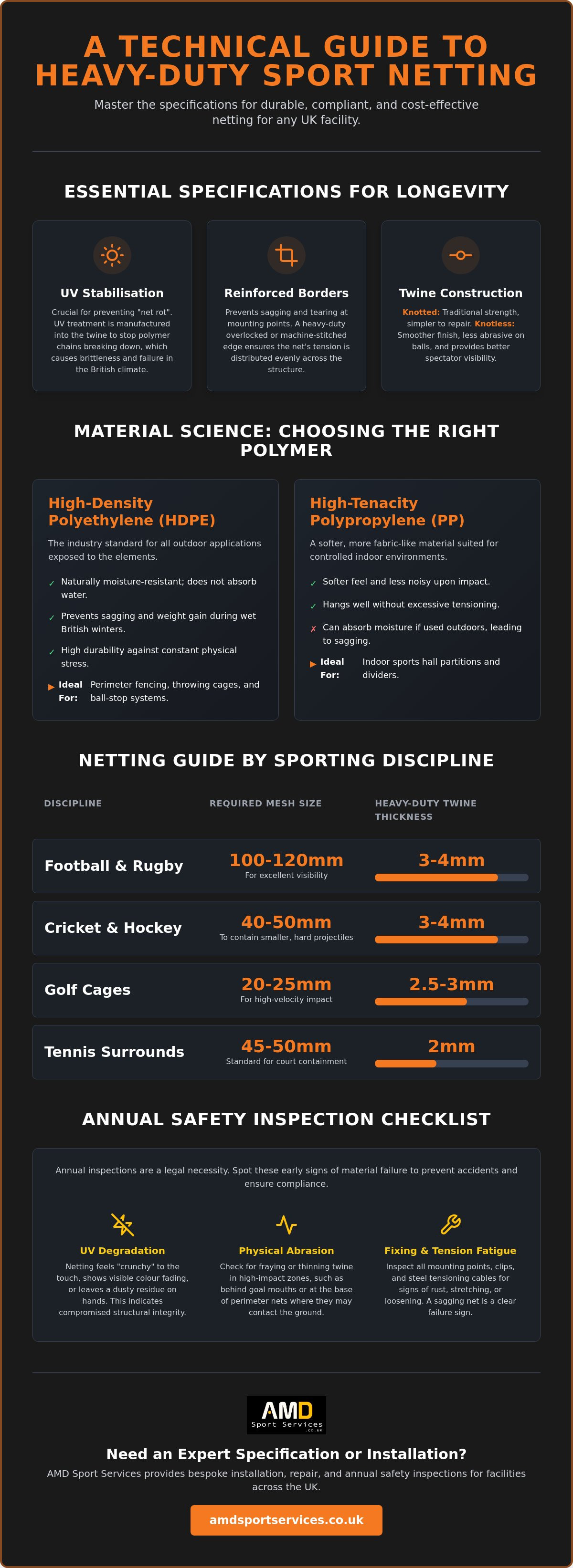
Definition of heavy-duty netting: At its core, heavy-duty netting is manufactured from high-density polyethylene (HDPE) or polypropylene (PP) twine, typically with a diameter of 3mm or more. It features reinforced, machine-stitched borders (selvedges) to prevent fraying and provide secure attachment points for tensioning wires.
The role of UV stabilisation: For any outdoor application in the UK, from perimeter ball stop netting to throwing cages, UV stabilisation is non-negotiable. This treatment protects the polymer from solar radiation, which would otherwise cause the material to become brittle and fail prematurely.
Why twine diameter is the primary indicator of durability: Measured in millimetres (mm), the twine diameter directly correlates with the net's breaking strain and ability to absorb impact energy. A 4mm twine net has significantly more material and strength than a 2.5mm net, making it the preferred choice for high-velocity sports like professional football or hammer throwing.
Knotless vs knotted netting: Knotted netting is the traditional choice, offering high strength at the intersections. However, knotless netting, which is woven or braided, provides a more uniform surface. This consistency is often preferred for spectator safety, as it reduces the risk of abrasion, and for ball rebound in sports like tennis, where a predictable response is crucial.
Material Science: Polyethylene vs Polypropylene
The choice between polyethylene and polypropylene is dictated by the specific application and environment. Whilst both are robust synthetic polymers, their distinct properties make them suitable for different roles within a sports facility.
Polyethylene (PE): Renowned for its high strength-to-weight ratio, excellent abrasion resistance, and extremely low water absorption, PE (specifically HDPE) is the superior material for permanent outdoor installations. Its inherent resistance to moisture and UV degradation makes it the industry standard for perimeter ball stop systems, cricket practice cages, and athletics throwing cages.
Polypropylene (PP): PP is a slightly lighter and softer material, which makes it an excellent choice for indoor applications. It is commonly used for sports hall division curtains, indoor cricket bays, and protection netting behind goals where it won't be permanently exposed to the elements. Its softer feel also reduces the risk of abrasion on sports equipment or players.
Comparing Lifespan: A professionally specified, industrial-grade HDPE net can be expected to last 10-15 years or more with correct maintenance. In contrast, standard retail nets often use lower-grade materials with minimal UV inhibitors, and may fail in as little as 2-3 years when subjected to the rigours of a busy school or club environment.
The Importance of UV Stabilisation
In the United Kingdom, UV radiation is a persistent threat to outdoor sports equipment, even on overcast days. This invisible radiation attacks the chemical bonds within the netting's polymer chains, a process that leads to photodegradation, commonly known as "net rot".
How UV radiation breaks down polymer chains: UV rays cause polymers like polyethylene to become brittle, lose their tensile strength, and eventually disintegrate. An untreated net will quickly become unsafe, tearing easily under impact and posing a significant risk.
Why bespoke UK-manufactured netting is treated: Reputable UK manufacturers formulate their UV inhibitors specifically for the northern European climate. This ensures the netting is treated to withstand our unique cycles of intense summer sun, prolonged dampness, and frost, providing a far more reliable lifespan than generic imported alternatives.
Identifying the signs of UV degradation: During a routine equipment inspection, look for tell-tale signs of UV damage. These include discolouration (fading), a chalky or dusty surface texture, and increased brittleness. If you can easily snap a single strand of twine between your fingers, the net has lost its structural integrity and requires immediate replacement.
Selecting Mesh Sizes and Twine Thickness for Different Sports
Choosing the correct mesh size and twine thickness is a critical safety function. The goal is to ensure total containment of the relevant sports ball or projectile whilst balancing factors like spectator visibility, wind loading, and budget. For multi-use facilities, guidance from national bodies like Sport England provides an essential benchmark for creating safe and versatile playing environments.
The relationship between mesh size and ball diameter: The fundamental rule is that the mesh aperture must be smaller than the smallest ball used in the area. This prevents any possibility of a ball passing through the net, even at high speed.
Impact energy: High-velocity sports like golf, cricket, and hockey generate immense impact energy. For these applications, a thicker twine is required to absorb and dissipate the force safely, regardless of the mesh size. A 2.5mm golf net will not withstand the same repeated impacts as a 4mm cricket net.
Balancing visibility and safety: A smaller mesh and thicker twine create a denser screen, which can impact spectator viewing. The specification process involves finding the optimal balance where the netting is dense enough for absolute safety but open enough to allow for a clear line of sight where required.
Standardising for Multi-Use Games Areas (MUGAs): For MUGAs hosting sports like football, basketball, and tennis, it's crucial to select a specification that accommodates all activities. Typically, a 45-50mm mesh is a versatile choice, as it contains tennis balls whilst remaining robust enough for football impacts. Consulting official design guidance from organisations such as Sport England is highly recommended to ensure MUGA specifications meet national standards for community facilities.
Football and Rugby: Large Mesh, High Impact
For ball stop netting surrounding full-size football and rugby pitches, the primary concern is containing large, heavy balls kicked or thrown with significant force.
100mm to 120mm mesh standards: This large mesh size is effective at stopping size 5 footballs and rugby balls. It offers excellent visibility for spectators and reduces the overall material cost and wind loading on the support structure compared to a smaller mesh.
The "heavy duty" benchmark: For goal backs in professional training grounds, schools, and busy parks, a 3mm to 4mm twine diameter is the established benchmark. This thickness provides the necessary durability to withstand thousands of high-velocity impacts without thinning or breaking.
Reinforced rope borders: All professional-grade perimeter netting should be finished with a reinforced selvedge edge or a stitched rope border. This provides a robust, load-bearing edge for attaching to tensioning wires and prevents the net from tearing away at its fixing points.
Cricket and Small Ball Sports
Sports involving small, hard, high-velocity balls require a much finer mesh and, often, a knotless construction to ensure absolute containment and predictable performance.
45mm to 50mm mesh for cricket: This is the standard for both indoor and outdoor cricket practice cages and boundary netting. It safely contains hard-hit cricket balls whilst providing a good level of visibility for coaches and players.
Golf impact netting: Golf balls are small, hard, and travel at extreme speeds. For this reason, specialist golf impact netting uses a dense 20mm to 28mm mesh, typically with a knotless design. This prevents the ball from becoming embedded and ensures it is safely deflected downwards.
Tennis and hockey: Tennis courts require a 45mm mesh to contain stray balls. For hockey, where the ball is played along the ground, the lower perimeter of the netting system often requires reinforcement or a heavier grade of twine to cope with constant, abrasive impacts.
Structural Considerations for Perimeter and Throwing Cage Netting
A heavy-duty net is only one component of a safe system. The support structure—comprising posts, tensioning wires, and anchor points—is equally critical. This is particularly true for large-scale perimeter systems and specialist applications like athletics throwing cages, where the forces involved are immense.
Throwing cage netting: This is a highly specialised area. Netting for hammer and discus cages must meet stringent UK Athletics (UKA) standards for strength and energy absorption. It is designed to safely catch and de-energise projectiles weighing up to 7.26kg.
Tensioning systems: To remain effective, netting must be kept taut. This is achieved using high-tensile steel catenary wires running along the top and bottom, which are tensioned using winches or ratchet strainers. A sagging net is a dangerous net.
Wind loading: A large expanse of netting acts like a sail. The structural calculations for the support posts must account for the significant wind loading the net will introduce, especially in exposed locations. A heavier, denser net places greater strain on the entire structure.
Bespoke fitting for indoor sports halls: In multi-use halls, netting is often used for division and protection. These systems typically run on ceiling-mounted tracks and need to be designed to integrate with the building's structure, lighting, and other equipment like retractable basketball goals.
Athletics Throwing Cage Safety
The safety of athletes, officials, and spectators around a throwing cage is paramount. The netting and its support structure are the primary safety control, and they must be specified and maintained to the highest standards, in line with UKA rules of competition.
Hammer cage netting: This is the pinnacle of heavy duty sport netting, often made from super-high-tenacity polyethylene or Dyneema®. Its job is to absorb the massive kinetic energy of a thrown hammer without breaking or allowing the implement to rebound dangerously.
Repairing vs replacing: Due to the extreme forces involved, any damage to a throwing cage net must be assessed by a specialist. Minor abrasion may be repairable, but any net that has sustained a full-impact implement strike or shows signs of UV degradation must be replaced immediately. A compromised net is no longer fit for purpose.
For safety and to allow for energy absorption, the netting must be installed with sufficient clearance from any rigid part of the cage structure, preventing dangerous rebounds.
Indoor Sports Hall Netting Systems
Effective space management is key to maximising the utility of a sports hall. Bespoke netting systems allow a single large space to be safely divided for multiple simultaneous activities.
Organise your hall: Motorised or manual pull-along division curtains are a common solution. These run on heavy-duty ceiling tracks and allow staff to quickly and safely reconfigure the playing area for different lessons or club sessions.
Weight considerations: These systems carry significant weight. Before installation, a structural engineer must verify that the roof structure or supporting steelwork of the school or leisure centre is capable of bearing the load of the tracks and the bunched netting.
Ensuring system integration: Professional installation ensures the netting system does not interfere with essential building services. This includes maintaining clearance from light fittings, radiant heaters, and fire suppression sprinkler heads, and ensuring that equipment like ceiling-mounted basketball goals can operate without obstruction.
Maintenance, Safety Inspections, and Compliance Standards
Procuring and installing high-quality netting is only half the battle. A rigorous and documented maintenance schedule is a legal necessity for any facility open to the public, as mandated by health and safety regulations. Regular inspections protect users and ensure the facility's insurance remains valid.
The legal necessity of annual inspections: In the UK, facility operators have a duty of care to their users. An annual safety inspection by a competent and qualified professional is considered the standard for demonstrating this duty of care and ensuring equipment remains safe for use.
Common failure points: Inspections focus on key areas of weakness. These include abrasion from contact with posts or the ground, UV damage in outdoor nets, and the failure of fixings like shackles, clips, and tensioning wires due to corrosion or metal fatigue.
How professional repairs extend lifespan: Addressing minor issues before they become major failures can add years to the life of a netting system. Professional repairs use the correct materials and techniques to restore the net's structural integrity, representing a cost-effective alternative to full replacement.
Documenting compliance: Following an inspection, a detailed report should be issued. This document provides a record of the equipment's condition, lists any required remedial actions, and serves as crucial evidence of proactive safety management for insurers and governing bodies.
The Annual Inspection Checklist
A thorough inspection goes beyond a quick visual check. A professional will systematically assess every component of the netting system.
Checking for "dead spots": This involves manually checking the twine in high-impact areas, such as behind football goals or in the primary impact zone of a cricket cage. The inspector will feel for areas where the twine has thinned or become brittle, indicating it is close to failure.
Inspecting hardware integrity: All metal components, including carabiners, shackles, tensioning wires, and winches, must be checked for signs of corrosion, wear, or deformation. Seized or damaged components must be replaced.
Verifying ground anchors: For perimeter netting systems, the security of ground anchors is vital, especially as soil conditions change with the seasons. The inspection ensures that anchors remain firmly in place and have not been disturbed by ground movement or vandalism.
Professional Repair vs DIY Patches
Attempting in-house repairs on structural netting can be a false economy that introduces significant risk. Professional mending is a technical skill that ensures the repair is as strong as the original net.
Why "knot-to-knot" mending is essential: A professional repair involves weaving new twine directly into the existing structure, following the original mesh pattern. This "knot-to-knot" or "mesh-to-mesh" technique ensures that impact forces are distributed correctly across the repaired area.
The dangers of non-compatible twine: Using the wrong type of twine for a repair can cause it to fail prematurely. A repair patch must have the same material properties (e.g., HDPE), diameter, and UV treatment as the parent net to be effective.
When to seek a comprehensive audit: Netting is often just one part of a facility's equipment inventory. For a complete overview of your facility's safety status, it is best to engage a service that provides comprehensive indoor inspection and maintenance, covering everything from netting to gymnastics equipment and basketball goals.
Bespoke Installation and Repair Services by AMD Sport Services
AMD Sport Services provides expert, end-to-end solutions for heavy-duty sport netting systems across the United Kingdom. We move beyond simple supply, offering a fully integrated service that covers technical specification, bespoke installation, and long-term maintenance and compliance.
Expert supply and installation: We design and install bespoke indoor and outdoor sport netting systems tailored to the precise needs of your facility, ensuring a perfect fit and optimal performance.
Specialist throwing cage expertise: We are specialists in the repair and replacement of hammer and discus throwing cage netting, ensuring your athletics facility meets the stringent safety and compliance standards set by UKA.
National coverage: Our teams provide national coverage for schools, councils, leisure centres, and professional sports clubs, delivering consistent quality and reliable service wherever you are located.
Integrated maintenance programmes: We believe in a holistic approach to facility safety. Our netting inspections can be combined with servicing for other critical equipment, such as basketball goals and athletics tracks, for a more efficient and cost-effective maintenance regime.
Why Choose a Specialist Contractor?
In a market filled with off-the-shelf products, a specialist contractor provides the technical expertise and practical experience necessary to deliver a solution that is truly fit for purpose.
Pragmatic, "no-nonsense" advice: With over 20 years of hands-on experience, our advice is grounded in practical reality. We recommend solutions that work in the real world, focusing on durability, safety, and long-term value.
Bespoke solutions for non-standard facilities: Many facilities have unique dimensions or structural challenges where standard retail nets simply won’t fit. We design, fabricate, and install netting to any size or shape, overcoming architectural obstacles to create a safe and effective system.
Minimising facility downtime: We understand the importance of keeping your facility operational. Our installation schedules are meticulously planned and efficiently executed to minimise disruption to your timetable.
Our Comprehensive Facility Support
Our expertise extends beyond netting to encompass the full spectrum of sports facility equipment and infrastructure. We are your single point of contact for maintaining a safe, compliant, and high-performing environment.
From external sport equipment installation of ball stop fencing to the complete refurbishment of an indoor sports hall, our services are designed to support the entire lifecycle of your facility.
We have a proven track record of delivering successful projects for a diverse range of clients, from primary schools to national sports centres across the United Kingdom.
To ensure your facility's netting meets current safety standards and is performing as it should, we invite you to request a professional assessment. Our team can provide a detailed report on your current systems and offer expert guidance on any necessary repairs or upgrades.


Comments