
How to Inspect School Wall Bars and Test Timber Brackets
A pre-session check can reveal problems before pupils use the wall bars. Look for wear or damage, and check that the frame is stable and securely attached. School wall bars safety inspection and timber bracket testing also help schools assess the equipment and its fixings.
It’s understandable to want clear guidance on what an inspection should cover and who should assess the brackets. This article explains pre-session checks, bracket placement and testing, and how to keep inspection and remedial-work records.
You’ll also learn when a competent tester is needed and how professional sports equipment safety inspections can support ongoing maintenance of school wall bars.
Inspecting wall bars before sessions
AMD Sport Services provides sports equipment safety inspections for school wall bars, assessing the frame, timber brackets and fixings. Inspection frequency and testing are tailored to equipment use, condition and any concerns identified.
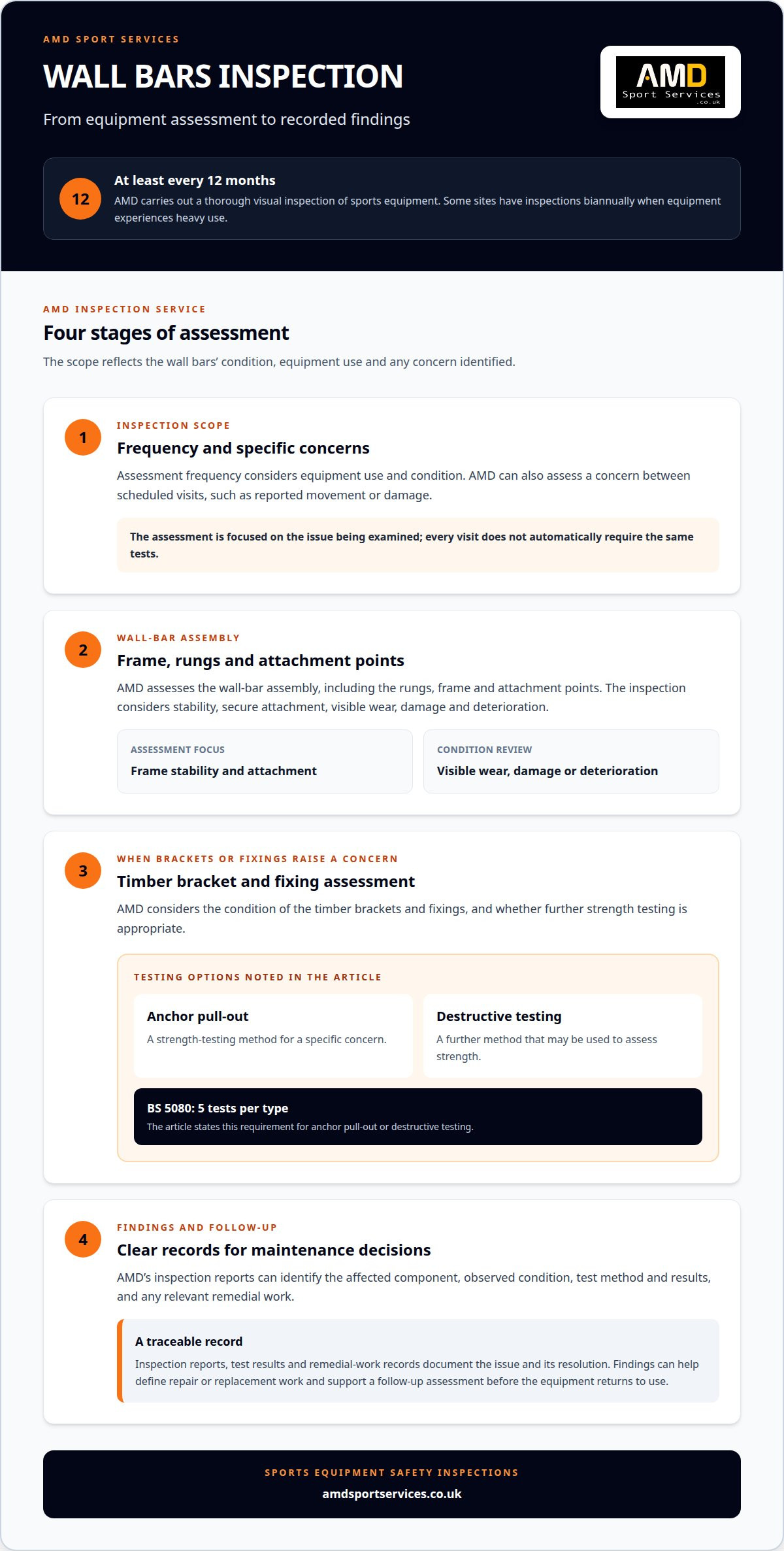
Set the inspection and maintenance frequencyAMD carries out a thorough visual inspection of sports equipment at least every 12 months. Some sites have inspections biannually when equipment experiences heavy use. For wall bars, the assessment considers visible wear or damage and the condition of the installation, helping schools plan suitable follow-up work.A school wall bars safety inspection and timber bracket testing assessment can also address a specific concern between scheduled visits, such as reported movement or damage. The scope should reflect the issue being assessed, rather than assuming every visit needs the same tests.
Check wall bars for safetyAn inspection covers the wall-bar assembly, including the rungs, frame and attachment points. AMD assesses whether the frame is stable and securely attached, and notes visible wear, damage or deterioration that may affect safe use. Findings are considered in context: a damaged rung is a different defect from movement at a fixing.The inspection record describes the affected component and its observed condition. This gives school staff useful detail to decide what maintenance or remedial work is needed, rather than relying on a general pass statement.
Test timber brackets and fixingsWhere timber brackets or fixings raise a concern, the assessment considers their condition and whether further strength testing is appropriate. Anchor pull-out or destructive testing can be used for this purpose. For anchor pull-out or destructive testing, BS 5080 requires 5 tests per type.AMD’s school wall-bar inspections can record the test method, results and relevant remedial work. This distinguishes a visual assessment from evidence gathered through testing. The report relates findings to the equipment and fixing type examined, giving the school a clearer basis for maintenance decisions.
Respond to failed checksIf an inspection identifies a defect, AMD records the affected component and the remedial action needed. This might include a damaged bracket or a fixing that moves. If repairs or replacement are required, the findings help define the work and support a follow-up assessment before the equipment returns to use.Inspection reports, test results and remedial-work records provide a traceable account of the issue and its resolution. This service is particularly useful when a school needs a competent assessment of wall bars, timber brackets or fixings after damage or a reported concern.
Bracket placement to avoid weakening the same stud
Bracket positions need to work with the wall’s supporting structure, not just the visible layout of the wall bars. A key consideration is whether several fixings rely on the same stud, potentially placing too much demand on the shared support.
Assess the support behind each fixing. A bracket’s position determines where its fixings transfer force into the wall. If several brackets depend on one stud, their combined fixing arrangement may affect the timber. Reviewing the support behind the wall surface helps establish whether the positions provide a suitable basis for installation.
Consider the whole bracket arrangement. Wall bars work as an assembly, so consider bracket locations together, not as isolated points. Review how the frame meets the wall and whether the positions rely too heavily on one section of support. Brackets spaced evenly across the visible frame may still rely on the same stud.
Account for existing fixings and alterations. Previous equipment or installation work may leave holes or fixings in the supporting timber. These can affect available fixing positions and the condition of a stud. A placement review should account for existing wall attachments, particularly when replacing or altering wall bars rather than installing them on an untouched surface.
Relate placement to timber condition. A proposed fixing position depends on the supporting timber as well as the bracket layout. Deterioration, damage or previous fixing points may affect how well the area supports the installation. Assess the timber and bracket positions together, rather than assuming a convenient location is suitable simply because it aligns with the frame.
Record the final arrangement. Recording the installed bracket positions gives future maintenance work a clear reference. It can show how the brackets relate to the supporting structure and note changes from the original layout. If a later inspection finds movement or damage, staff can compare the findings with the documented installation instead of relying on memory.
Competent persons for compliance
Assign compliance checks to people with relevant knowledge of sports equipment and its installation. The Health and Safety at Work etc Act 1974 and UK guidance provide the context for school safety responsibilities.
Identify competent persons for compliance
Choose someone able to assess wall bars, brackets and fixings, and explain the findings clearly. Their assessment should distinguish visible wear from concerns needing closer attention, such as movement at a timber fixing.
Review the person’s experience with similar equipment and the inspection records they provide. A useful report identifies the equipment checked, findings, limitations and remedial actions, rather than simply stating that the wall bars passed.
Check applicable standards and guidance
Use the Health and Safety at Work etc Act 1974 as the basis for British health and safety law. The Health and Safety Executive regulates health and safety in education settings, according to the Health and Safety Executive.
The Management of Health and Safety at Work Regulations 1999 support the Act in Great Britain. Schools should regularly inspect equipment used for physical education and maintain it in a safe condition.
Match the assessor’s experience to the task. A visual review of rungs and frames differs from assessing timber brackets or carrying out anchor testing. For example, the report should say whether the assessor examined the fixings, not just the visible timber surfaces.
Agree the inspection scope before work begins. Identify the wall bars, supporting brackets, attachment points and relevant records. If the work includes timber, specify whether the assessment concerns deterioration, fixing condition or strength testing. This makes the findings easier to interpret.
Ask for findings that support a clear decision. The report should identify defects by location, such as a split bracket or loose attachment point, and state what action is needed. Avoid relying on a brief pass statement when the school needs to track a specific repair.
Keep the legal context aligned with the equipment. The Management of Health and Safety at Work Regulations 1999 support the wider safety framework; they do not replace a practical assessment of wall bars. For timber, BS 8417 addresses durability or preservative treatment of load-bearing timber components.
Keep the inspection outcome with related records. Store certificates, findings and remedial-work details together, including the dates and equipment involved. If an inspection identifies a concern, record how it was resolved before the affected wall bars return to use.
Recording inspection and testing
AMD Sport Services provides sports equipment safety inspections and reporting for school wall bars. The inspection record connects the observed condition with the equipment assessed, giving schools a clear account of findings and recommended action.
Identify the equipment assessed. Inspection reports identify the sports equipment covered, so findings relate to the correct installation. For a school with several wall-bar frames, this distinguishes one location from another and prevents a finding about one assembly from being mistaken for a report on the whole site.
Document the condition found. Digital inspection reports include photographs and itemised defects. A photo of a damaged component, paired with a clear description, helps staff understand the issue and locate it on the equipment. This is more useful than a general note that does not identify the part needing attention.
Set out recommendations. Reports include recommendations arising from the inspection. These help schools understand what follow-up work may be needed, whether the finding concerns a bracket, a fixing or another part of the wall-bar assembly. Recommendations relate to recorded observations, rather than leaving staff to interpret a defect without supporting detail.
Record testing alongside inspection findings. Where anchor pull-out or destructive testing is carried out, the method and results can be documented with the relevant equipment findings. For anchor pull-out or destructive testing, BS 5080 requires 5 tests per type. This makes the report distinguish testing evidence from visual observations and connects the results to the fixing type assessed.
Provide a record for ongoing maintenance. Inspection documentation gives the school a reference for later maintenance and follow-up work. Reports, photographs and recommendations help staff understand the condition recorded at the time of inspection and identify items needing attention. AMD Sport Services’ sports equipment safety inspections provide a documented basis for managing wall-bar findings.
Schools should maintain certificates and records of statutory examinations, testing and remedial work. Keeping these together provides a broader account than an inspection report alone. Inspection findings describe the condition observed, while testing and remedial-work records document other relevant activity. Certificates also form part of this retained record. Keeping the materials together helps staff see what information is available when reviewing a wall-bar finding or considering recommended follow-up. Connect records to the equipment and findings they concern, so a document is not mistaken for evidence about a different assembly or fixing.
If an inspection identifies a defect, keep the report and photographs alongside remedial-work records. Where testing has taken place, consider its documented method and results with the inspection observations, while keeping certificates and statutory examination records in the same record-keeping system. These documents are not interchangeable: each may record a different aspect of the equipment’s condition or history. Maintaining them helps staff refer to the information available for the equipment, understand which observations prompted recommendations and record work carried out. Inspection findings then contribute to ongoing documentation rather than standing alone.
What UK standards and guidance apply to school wall bars and gym equipment safety inspections?
Apply the UK’s general health and safety framework alongside relevant equipment guidance. These sources provide context for safe maintenance, but unrelated standards should not be treated as wall-bar inspection rules.
Use the correct legal framework. The Health and Safety at Work etc Act 1974 is the basis of British health and safety law, and the Health and Safety Executive regulates health and safety in education settings, according to the Health and Safety Executive. This establishes the wider context for managing school safety. It does not, by itself, set a specific wall-bar inspection interval.
Read supporting regulations in context. The Management of Health and Safety at Work Regulations 1999 support the Health and Safety at Work etc Act in Great Britain, according to UK legislation. Together, these provide the general framework for managing workplace health and safety. Apply that framework to the school’s arrangements for equipment condition, maintenance and remedial work.
Use equipment-specific guidance for practical checks. Schools should regularly inspect equipment used for physical education to ensure it is maintained in a safe condition. For wall bars, consider the complete installation, including the frame, brackets and attachment points. A general legal framework does not replace an assessment of the equipment’s actual condition or recorded defects.
Keep timber requirements specific to the component. Load-bearing timber components must be naturally durable or preservative-treated in accordance with BS 8417. This requirement concerns timber durability and treatment. It should not be used as evidence that a particular bracket, fixing or wall installation has passed a strength assessment. The condition and performance of those parts still need appropriate assessment.
Separate standards by equipment type. EN 1176 concerns playground equipment inspections, with inspection intervals reflecting use, purpose and position. School wall bars are sports equipment, so don’t apply playground requirements automatically. Instead, identify whether a standard relates to the equipment being assessed, the timber material, or another part of the premises.
Connect requirements to records and action. Keep relevant inspection findings, certificates and remedial-work records together, then use them to track issues through to resolution. For example, note whether a finding concerns timber deterioration, a fixing or the wall-bar frame. Clear records help staff apply relevant guidance and understand the basis for decisions about continued use.
For a school equipment assessment, arrange sports equipment safety inspections that cover the wall bars and document relevant findings.
AMD Sport Services: Sports equipment safety inspections
AMD Sport Services carries out sports equipment safety inspections for schools needing an assessment, routine inspection or follow-up after a concern about wall bars. Checks can focus on the assembly, including the frame, timber brackets and fixings, helping schools identify issues requiring attention.
A documented inspection gives staff a clear record of findings and supports decisions about maintenance or remedial work. It’s a practical next step when visible damage, movement or uncertainty about the installation raises questions about safe use.
For a school sports equipment safety inspection, contact AMD Sport Services to discuss the wall bars at your site.
Plan the next inspection with confidence
Make inspection findings part of the school’s ongoing maintenance planning. A clear record can help staff schedule remedial work, track unresolved concerns and plan equipment access around school activities. Assigning responsibility for following up findings also keeps maintenance actions visible between inspections and school terms.
A consistent approach to school wall bars safety inspection and timber bracket testing gives staff a practical basis for decisions about equipment condition and next steps. For wider facility needs, AMD Sport Services also carries out basketball goal installation and safety surfacing, as well as sports equipment safety inspections.
If your school is planning maintenance or needs professional assessment of its sports equipment, contact AMD Sport Services to discuss the work. A considered next step can help your team plan with greater confidence.
Frequently Asked Questions
What signs of damage or failure make wall bars unsafe to use?
Cracked rungs, split or splintered timber, shifting brackets, missing fixings or bent metal are warning signs. A scratch through galvanised steel’s zinc coating can expose the steel beneath to rust. If you spot a defect, keep children away from the affected frame and report it for assessment. Don’t assume that wiping a surface or tightening a fixing proves the equipment is safe to use.
Who is qualified to inspect and test school gym wall bars and timber brackets?
Choose someone with relevant practical experience inspecting sports equipment and assessing wall-bar assemblies and timber fixings. Their competence should match the task: a visual inspection differs from a pull-out test. Anyone carrying out a test should identify the method used and explain what the results mean for the equipment. AMD Sport Services carries out sports equipment safety inspections that include school wall bars.
What records and risk assessments should schools keep for wall-bar inspections?
Keep inspection reports, test certificates and remedial-work records alongside the school’s risk assessment. Make the assessment useful by linking a specific hazard, such as a damaged rung, to the control applied, such as restricting access to that frame. Record who will arrange follow-up and how completion will be confirmed. Review the assessment if repairs, alterations or changes in use affect existing controls.