
Indoor Sports Netting for Sports Halls and Lanes

A sports hall does not have to function as one large, shared space. A professional indoor sports netting installation can divide activity areas or separate courts, helping different sessions run at the same time with fewer interruptions.
For schools, leisure centres and other multi-use facilities, division nets offer a practical way to adapt the layout as activities change. They can separate an indoor cricket area from the rest of the hall or create distinct spaces for different sports. The right arrangement depends on how the space is used and whether the net needs to move aside when it is not required.
This article explains why sports hall division nets are installed and how they can be used in halls and gymnasiums. It also compares manual systems, which use tracks and trolleys, with motorised systems that move horizontally using a motor and tube suspended from the ceiling. Understanding the options helps facilities managers choose a system suited to the building and its programme.
Why Install Sports Hall Division Nets?
Division nets separate activities, helping a school run cricket practice alongside another session in the same hall. For protection netting, professionals assess the building and install netting on suitable walls, ceilings or support structures. Avoiding drilling depends on existing support points and the building; a site survey identifies suitable fixing options.
Fixed, Removable and Retractable Systems
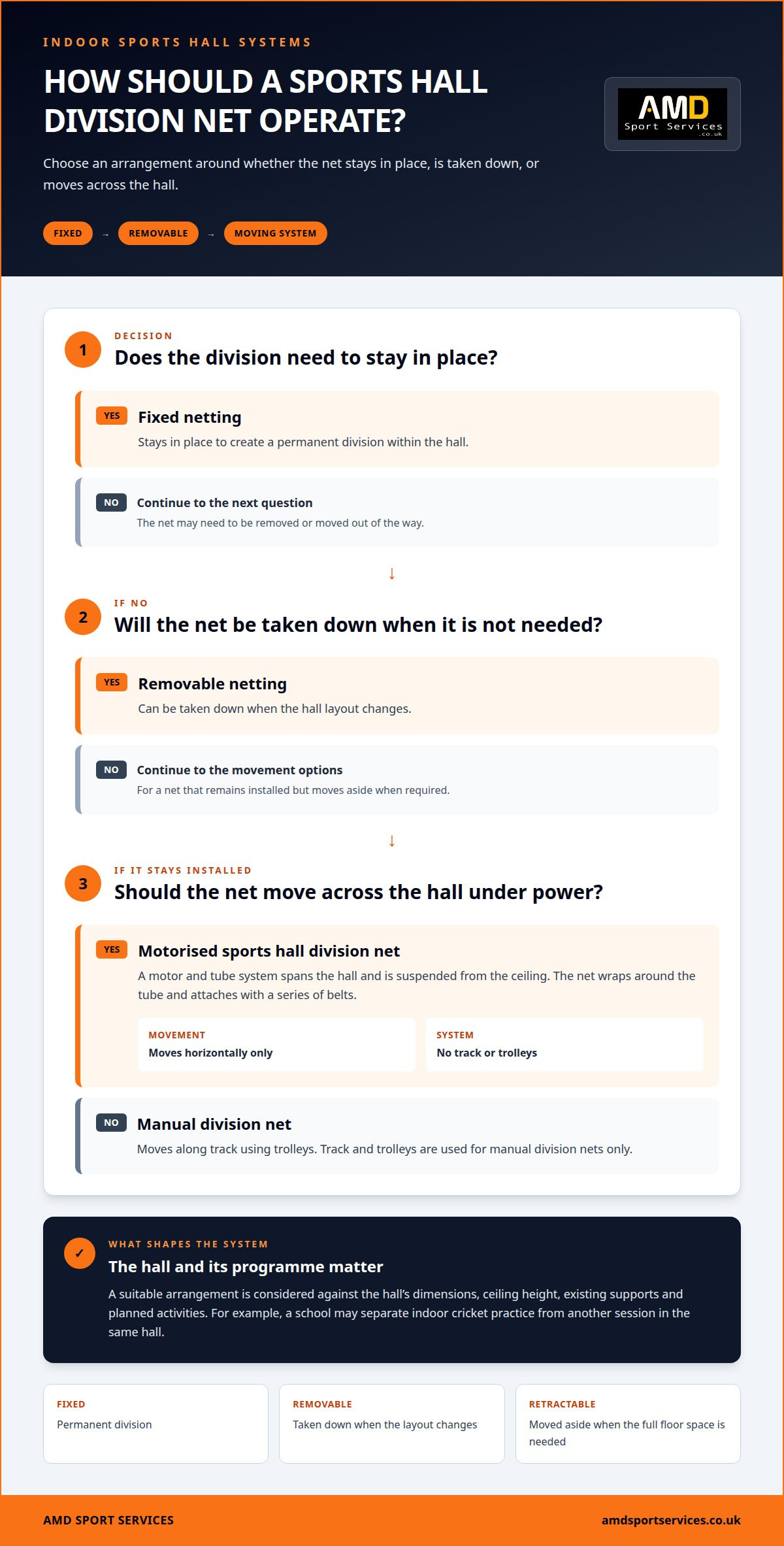
Fixed netting stays in place to create a permanent division, while removable netting can be taken down when the layout changes. Retractable nets move aside when a facility needs its full floor space. Manual systems travel across the hall on tracks and trolleys. New tracked systems can suit a new layout, while replacement track can renew an existing arrangement.
The choice depends on how often the area changes and the height available. For example, a school may keep a cricket lane separate during practice, then open the hall for another activity. Football and other ball sports can also benefit from netting that contains play within a defined area.
Fixed-Point and Suspended Nets
Fixed-point systems attach netting at set positions rather than using tracks and trolleys. Suspended nets hang from overhead supports and may suit situations where a floor-level division is unsuitable. The building layout and the separation required determine which arrangement is appropriate.
Motorised sports hall division nets use a motor and tube system suspended from the ceiling and spanning the hall. The net wraps around the tube and attaches by a series of belts, without tracks or trolleys. It moves horizontally, making this system suitable when a hall needs a powered division.
A site survey considers the hall’s dimensions, ceiling height, existing supports and planned activities. Those details help determine whether a fixed, removable, retractable or suspended arrangement is suitable, including for a replacement tracked system. Across the UK, sports equipment installation also depends on matching the system to the facility and its intended use.
Indoor Sports Netting Supply and Installation
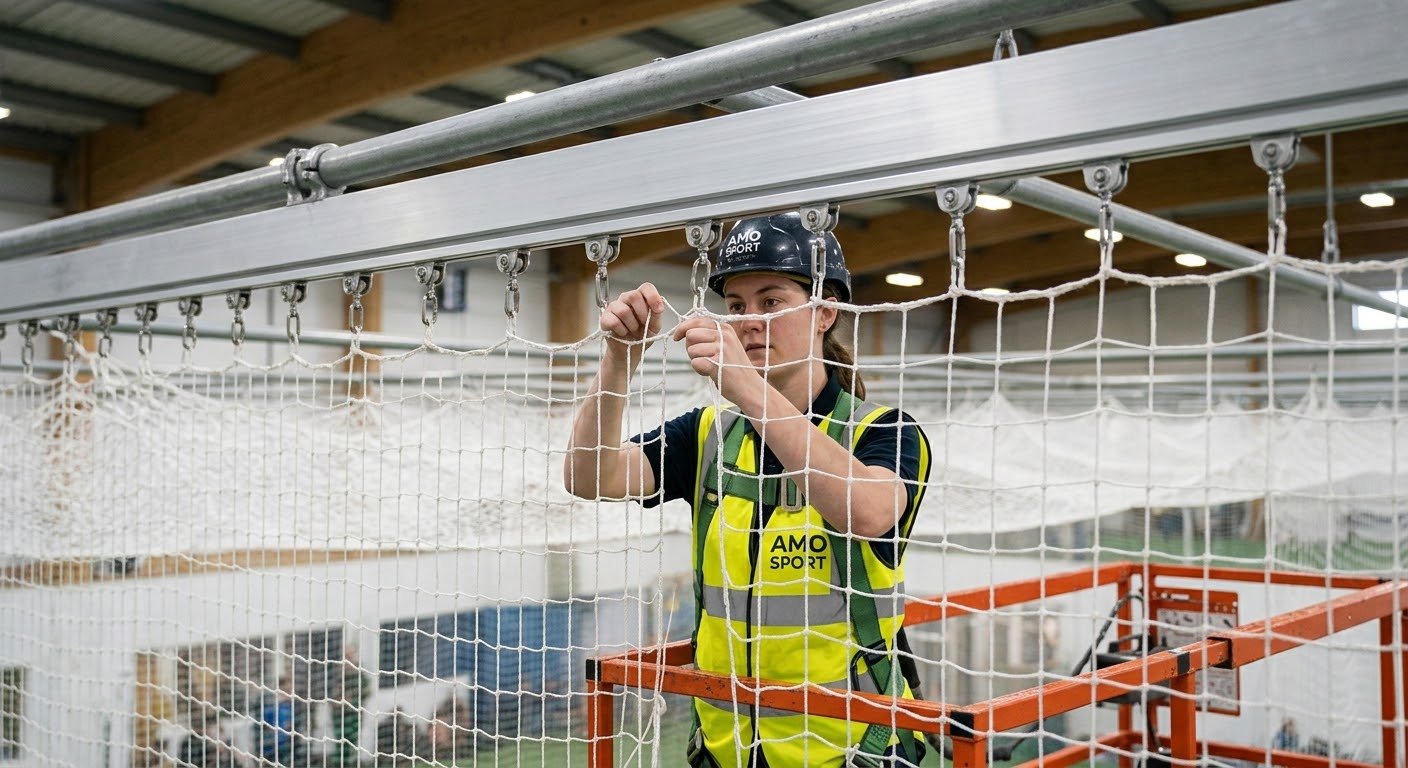
Supply and installation should suit the facility, its activities and its building supports. For dividing up spaces, bespoke trackway brackets are installed to the ceiling, aluminium track is attached to the brackets, trolleys and clips are installed into the track, and the nets are secured and levelled onto the clips.
Net Supply and Fixing Materials
Mesh size and net strength depend on the sport, ball size, impact and containment requirements. Fixings must suit the building’s support structure and the net’s position. A professional indoor sports netting installation considers these factors together, helping avoid loose or poorly aligned netting that does not divide the intended area effectively.
Professional Installation and UK-Wide Supply
Professional supply and installation brings together the net, suitable fixings and fitting for the facility’s layout. A school might need to separate a cricket practice area from other activities, while a leisure centre may need netting around tennis practice. AMD Sport Services works with facilities across the UK, tailoring systems to their buildings and programmes.
Existing netting may also need maintenance or repair if it is damaged or no longer performing as intended.
Choosing Suitable Materials and Mesh Sizes for Indoor Sports Netting
Mesh selection depends on the sport, ball size, impact level, containment needs, installation height and surroundings. A cricket practice area and a tennis space may therefore require different specifications. The net material and fixing arrangement should be considered alongside the intended layout, not chosen in isolation.
Regulations, Fire Safety and Sports Standards
Building and fire-safety considerations depend on the facility and the proposed work, so one rule should not be assumed to cover every hall. The project specification should reflect the building and intended use. Poorly fitted netting may sag, shift out of position or leave gaps, reducing its effectiveness.
Cost depends on the net dimensions, mesh and strength requirements, support arrangement, access and installation scope. A project-specific quote follows a request.
Sports Hall and Gymnasium Netting Installation
A sports hall may host several activities in one day, from indoor cricket to badminton or basketball. An indoor sports netting installation can divide shared floor space without creating permanent rooms. Unlike outdoor pitches, indoor courts share overhead space and building supports, so each system needs to suit both the hall and its timetable.
A school using its hall for cricket practice may need to separate that activity from other sessions. A division net can create a dedicated practice area, then allow the wider space to serve other groups. The arrangement should reflect how the facility uses its courts throughout the week, not just for one activity.
Every sports hall has practical constraints. Ceiling height, existing supports, lighting, court markings and fixed equipment can affect where netting can sit and how the system works alongside scheduled activities. In a leisure centre, for example, adjacent areas may host different groups at the same time, making the position and coverage of each net important.
Gymnasiums with unusual dimensions or several activity zones may benefit from a bespoke layout. Netting can separate an indoor practice area from a court used for another sport while keeping the remaining floor available. For an indoor sports netting installation, the intended activities, available supports and building layout all shape the specification. Matching these details to daily use helps the division fit the facility’s programme rather than restrict it.
For a cricket area, the indoor system uses white knotted netting described as 16Z BS 5867. Tytherington High School in Macclesfield commissioned a division net to separate its indoor cricket facility when the cricket nets were not in use. Sports netting can also be installed as perimeter fencing, roof netting or internal compartmentation to stop balls leaving a sports venue and potentially damaging property or injuring the public.
Chain-link fencing, particularly with angle-iron posts, may be unsuitable for roof netting because of the high tension loads. Roof netting can instead be supported by strong, tensioned cross-court line wires. The design can be flat, pitched or apexed to suit the sports played, aligning the overhead coverage with the facility’s intended use.
What Types of Indoor Sports Netting Are Available and What Sports Are They Used For?
Indoor netting has several roles, from enclosing a practice space to protecting areas around a sports hall. The choice depends on where balls travel during play and which parts of the facility need protection or separation.
Perimeter netting runs around an activity area, helping contain balls within its boundaries. In a school hall, it can be useful around a court where balls might otherwise reach nearby equipment or areas used by other groups. The net position is planned around the court layout and surrounding spaces.
Roof netting covers the overhead space above a court or enclosed practice area. It can help keep balls within fenced pitches or courts and reduce the chance of them reaching nearby property. This can be useful where an indoor facility has open space above its playing area and activities regularly send balls upwards.
Internal netting creates enclosed practice zones within a larger hall. Indoor cricket is one example: netting can define a practice area that remains separate from the rest of the venue. A school or leisure centre can then use the surrounding space for other scheduled activities, subject to the hall’s layout.
Different types of netting can be combined when a facility needs both overhead and boundary containment. The sport, ball size, impact level, installation height and surroundings all influence the required mesh and coverage. Distinguishing between perimeter, roof and internal netting helps facilities managers identify each part’s function, rather than treating every net as a general-purpose division.
AMD Sport Services: Sports Equipment Safety Inspections
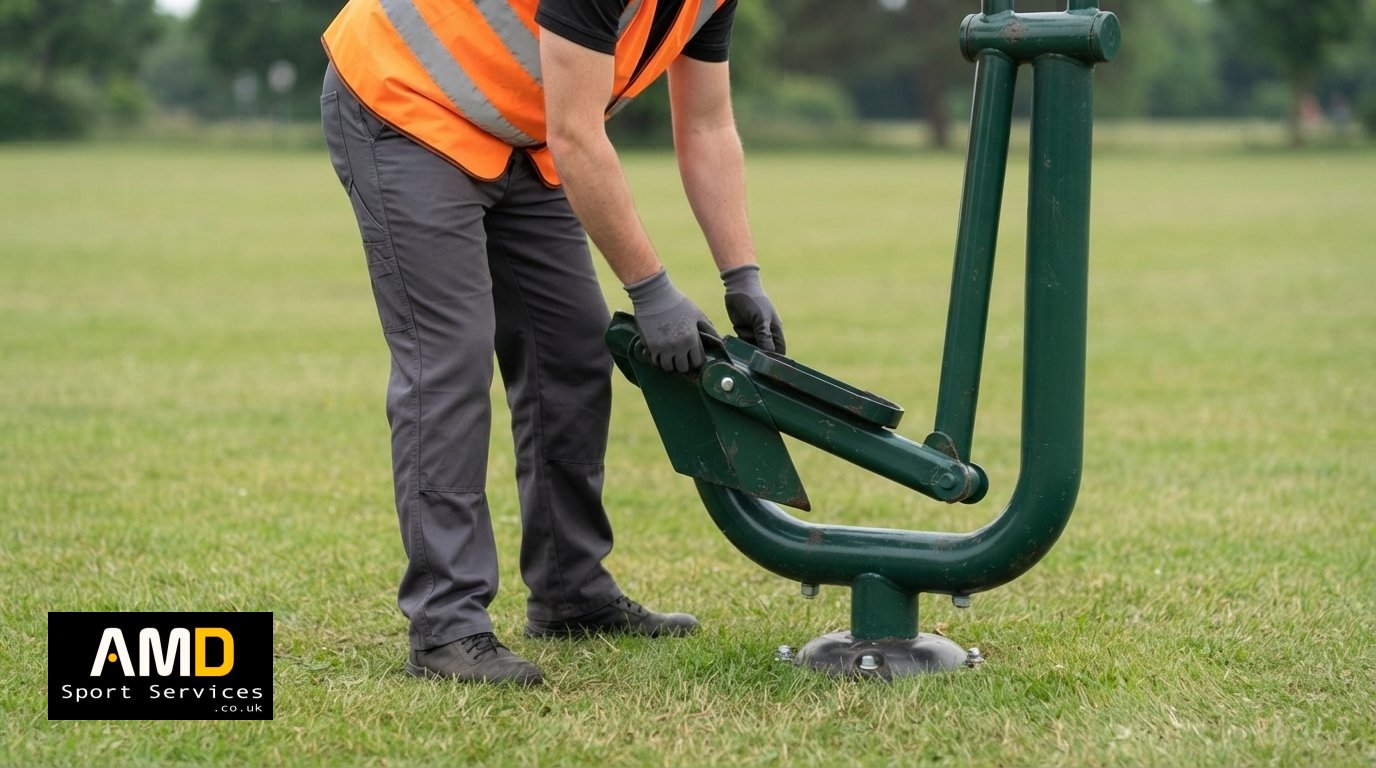
AMD Sport Services provides sports equipment safety inspections for schools, leisure centres and other facilities. An inspection is a useful next step when reviewing equipment used in a busy sports hall, including alongside indoor netting. It gives managers a clearer picture of the equipment’s condition and any remedial work needed.
All equipment should undergo a thorough visual inspection at least every 12 months. Some sites arrange inspections biannually when equipment experiences heavy use. The frequency reflects how intensively the equipment is used, which can vary between a school hall with regular lessons and a leisure centre hosting activities throughout the day.
Where remedial work is identified, each affected item is graded as low, medium or immediate risk. This helps a centre prioritise repairs and identify equipment that must be taken out of action immediately. Clear risk categories give facilities managers a practical basis for planning work around their programme and available spaces.
For example, an inspection can help a school distinguish routine remedial work from an issue requiring immediate attention. The findings help managers decide which equipment needs attention first, rather than treating every item as equally urgent. This is particularly useful where several sports share equipment and hall space.
Sports equipment safety inspections complement good facility management; they do not replace decisions about how to divide a hall for different activities. For schools and leisure centres managing busy sports spaces, inspection findings can help set maintenance priorities and support the continued use of equipment.
To discuss a sports equipment safety inspection, contact AMD Sport Services.
Frequently Asked Questions
Can You Measure the Net Area on a Site Visit?
Yes. A site visit can establish the net area needed for a sports hall or practice space. The assessment considers the intended boundary and how the netting relates to nearby activities. This is useful when existing court lines or equipment mean the practical coverage differs from the apparent floor area.
How Long Will the Installation Process Take?
There is no single installation duration that applies to every project. The time depends on the system, the work involved and access to the installation area. Facilities managers can help keep the programme clear by arranging access and accounting for sessions that use the hall. The schedule is set around the specific project.
Why Consider Roof Netting Now?
Roof netting may be worth considering if activities send balls above the playing area or beyond its boundaries. It can help contain play and protect nearby property. A change in how a hall or enclosed court is used can also prompt a review of whether the existing arrangement still suits those activities.
How Are Indoor Sports Spaces Measured for Netting Installation?
Professionals measure the coverage required for the net rather than relying only on the marked floor area. They relate the proposed coverage to the activity boundary and consider openings or areas that must remain accessible. This helps the finished netting serve its intended purpose without unnecessarily covering adjacent spaces.
How Long Does Professional Installation Take, and What Should Facilities Plan For?
Installation time varies with the work involved and the building’s access arrangements. Facilities should consider the effect on the hall timetable and arrange suitable access for the installation team. Where the space hosts lessons, clubs or public sessions, planning around those bookings helps reduce disruption.
How Can a Professional Inspect, Clean and Maintain Indoor Sports Netting?
A professional can assess netting for visible wear or damage and identify repairs that may be needed. Cleaning requirements depend on the netting’s condition and setting, so maintenance should suit the specific installation. If netting or related sports equipment needs repair, AMD Sport Services provides sports equipment repair services for facilities.
Comments