
Leisure Centre Equipment Safety Check: The Essential UK Guide 2026

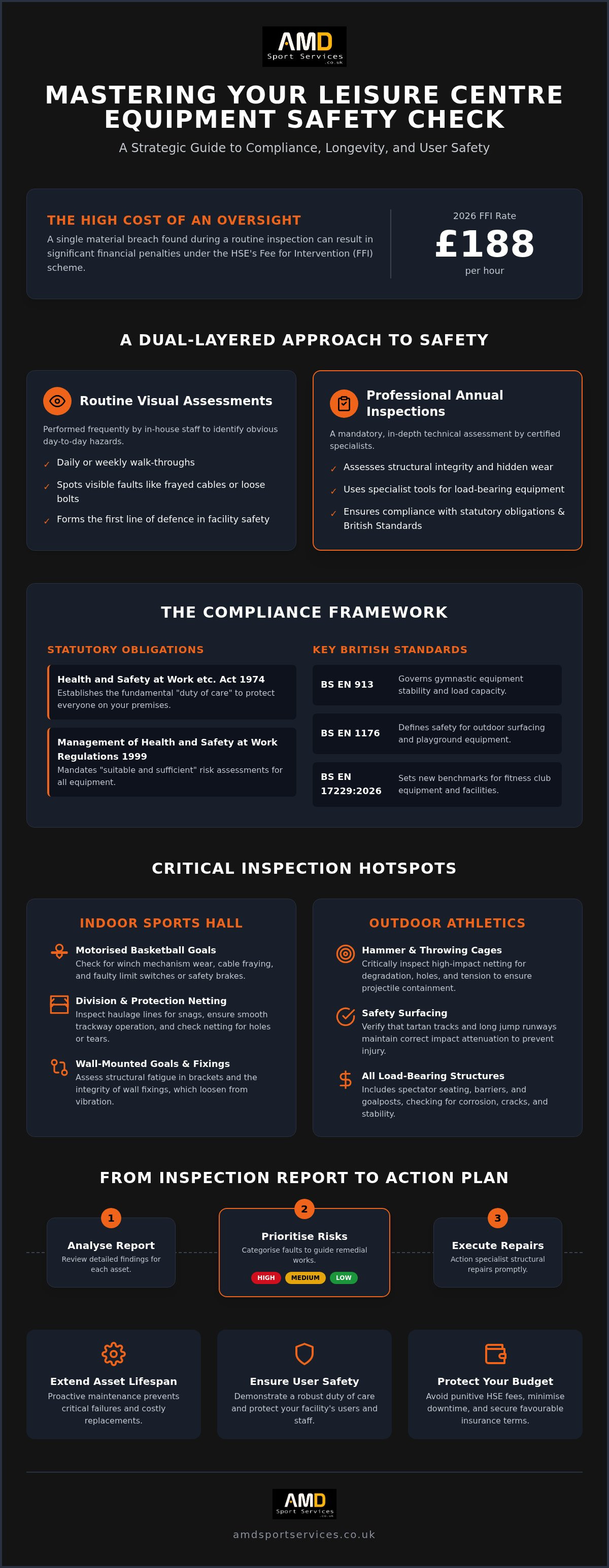
With the HSE Fee for Intervention (FFI) rate now set at £188 per hour for 2026, a single material breach during a routine inspection can cost your facility more than a year's worth of preventative maintenance. It's a high price for an avoidable oversight. Managing a diverse inventory of indoor and outdoor kit is a constant challenge, especially when British Standards seem to shift every time you look at the ledger. You likely feel the pressure of balancing user experience with the strict demands of the Health and Safety at Work etc. Act 1974.
This guide provides a pragmatic roadmap to mastering your leisure centre equipment safety check, ensuring your facility remains compliant, your users stay safe, and your equipment lasts longer. We'll break down the latest BS EN 17229:2026 requirements, clarify maintenance workflows for everything from gymnastics trampolines to outdoor throwing cages, and help you navigate the new tiers of Martyn's Law. By the end, you'll have a clear strategy to turn complex inspection reports into actionable maintenance plans that protect both your budget and your reputation.
Table of Contents
Understanding the Framework for Leisure Centre Equipment Safety Checks
The Health and Safety at Work etc. Act 1974 forms the bedrock of facility management in the UK. It isn't just about avoiding the £188 per hour HSE Fee for Intervention; it's about establishing a robust "duty of care" that protects every person entering your building. A comprehensive leisure centre equipment safety check isn't a single event. It's a dual-layered process involving frequent in-house visual assessments and a rigorous annual professional inspection. While your staff might spot a frayed cable or a loose bolt on a daily walk-through, they often lack the technical tools to assess the structural integrity of roof-mounted basketball goals or the tension in sports hall division netting.
Legislative Requirements for Facility Managers
The Management of Health and Safety at Work Regulations 1999 mandate that employers conduct suitable and sufficient risk assessments. For a leisure centre operator, this means moving beyond guesswork. Professional audits provide a legal shield. They demonstrate that you've taken "reasonably practicable" steps to mitigate risk. Central to this is the maintenance of a chronological safety log for every piece of apparatus. This log acts as your primary evidence during insurance renewals or in the event of a RIDDOR-reportable incident. In 2026, insurers are scrutinising these logs with greater intensity, often requiring digital proof of remedial actions following a failed inspection.
The Role of British Standards in Sports Safety
British Standards provide the technical blueprints for what "safe" actually looks like. BS EN 913 remains the core standard for gymnastic equipment, specifying requirements for stability, load-bearing capacity, and surface finishes. For facilities with outdoor zones, the cross-over with playground safety guidelines and standards like BS EN 1176 is vital. These regulations ensure that safety surfacing, such as tartan tracks or long jump runways, maintains the correct impact attenuation to prevent serious injury. In 2026, the introduction of EN 17229 has also set new operation benchmarks for fitness clubs, focusing on equipment placement and amenities.
Ensuring equipment performance matches safety compliance is a technical task. It requires an inspector who understands the mechanical nuances of the kit. For example, checking the motorisation of basketball goals involves more than just seeing if it moves; it requires testing the limit switches and safety brakes. You can find more detail on these specific requirements in our indoor inspection and maintenance guide. By aligning your facility with these established benchmarks, you reduce the risk of facility closure and extend the operational life of your assets. A leisure centre equipment safety check shouldn't be viewed as a tick-box exercise, but as a specialist structural assessment.
Critical Indoor Equipment: What Your Inspection Must Cover
Indoor sports halls are high-traffic environments where mechanical failure can lead to severe injury. A thorough leisure centre equipment safety check must prioritise load-bearing assets and motorised systems. Unlike floor-based kit, high-level equipment like roof-mounted goals often hides wear and tear until a critical failure occurs. Regular assessments are essential to identify these hidden risks before they escalate into costly repairs or accidents.
Basketball Goal and Netting Integrity
Motorised roof-mounted goals are complex mechanical systems that require a specialist assessment of the winch mechanism, limit switches, and safety brakes. Cable fraying is a primary cause of failure. Even a single broken strand can compromise the entire lifting capacity. For wall-mounted goals, the focus shifts to structural fatigue in the brackets and the integrity of the wall fixings. These units are subject to constant vibration and impact during play, which can loosen bolts over time.
Similarly, sports hall division netting and protection netting systems rely on smooth trackway operation. We often find that haulage lines become snagged or frayed, leading to uneven tension and potential collapse. Inspecting the trackway for debris and ensuring the trolleys move without resistance is a vital part of our indoor inspection and maintenance programme. If your hall uses division netting to separate high-impact sports, the netting itself must be checked for holes that could allow balls or equipment to pass through.
Gymnastics and Trampoline Servicing
Trampolines require a high level of technical proficiency to inspect correctly. The frame welds and leg stability are critical, but the bed and spring tension are where most performance issues arise. Over time, springs lose their elasticity, and beds can develop micro-tears that lead to catastrophic failure under load. Identifying these issues early allows for a bespoke repair, such as a bed replacement, rather than a full unit decommission.
Beyond trampolines, your audit should include vaulting horses and balance beams. Look specifically for worn upholstery or exposed internal structures that could cause abrasions or impact injuries. Climbing frames and rope systems also demand close scrutiny. These static assets are often overlooked, yet they are subject to significant stress. Inspections must verify the security of wall-to-floor fixings and the condition of natural or synthetic ropes. Following Health and Safety Executive (HSE) guidance ensures that your facility meets the minimum legal standard for public use. If you are managing high-use facilities, scheduling a professional safety audit is the most reliable way to ensure long-term compliance and operational longevity.
Outdoor Athletics Safety: Beyond the Sports Hall
Outdoor sports facilities face environmental stresses that indoor halls do not. UV radiation, heavy frost, and persistent moisture can compromise structural integrity and surface safety in ways that aren't always visible to the untrained eye. A comprehensive leisure centre equipment safety check must extend to the perimeter of your site, covering everything from the tension in hammer cage netting to the grip levels on a long jump runway. Neglecting these assets often leads to rapid deterioration, making once-safe equipment a significant liability for the operator.
Adhering to UK health and safety legislation and industry best practices means ensuring that every outdoor risk assessment includes a detailed maintenance log for fixed athletics kit. When we conduct these audits, we frequently find that while the indoor hall is well-maintained, the outdoor tracks and cages have been left to the elements. This inconsistency can lead to failed inspections and, more importantly, user injuries that were entirely preventable with a structured maintenance schedule.
Throwing Cage and Netting Standards
Athletics throwing cages are high-risk structures. The gate hinges and ground anchors are prone to corrosion, which can lead to mechanical failure during high-wind events or under the impact of a hammer or discus. We pay close attention to the heavy-duty sport netting used in these cages. UV degradation is a silent killer for polymer-based nets; it makes the fibres brittle, significantly reducing their energy-absorption capacity. Our specialist approach involves testing the net's "burst strength" and performing bespoke repairs to the netting or the cage structure itself to ensure it remains a safe barrier for spectators and officials.
Long Jump and Track Surface Integrity
The safety of a long jump runway relies on more than just the absence of litter. Moss growth and algae can turn a polyurethane surface into a slip hazard, especially in the shaded areas of a facility. We also inspect for "bubbling" or thinning in the tartan track, which indicates a failure in the bond between the surface and the sub-base. These structural defects create trip hazards that are particularly dangerous for athletes at full sprint. Take-off boards and pole vault troughs must also be checked for structural decay or loose fixings that could cause a foot to slip at the point of maximum force.
Maintaining these surfaces requires specialist knowledge. For instance, landing pits must only use UKA-approved silica sand to ensure correct impact attenuation and drainage. If you are planning a refurbishment or need to understand the technical requirements for a new build, our Long Jump Runway Installation Guide provides a detailed breakdown of the materials and standards required for UK facilities. By addressing these outdoor issues proactively, you ensure operational longevity and maintain a high standard of safety throughout the year.
The Inspection Report: Managing Failures and Remedial Actions
Receiving a professional condition report is the most critical stage of any leisure centre equipment safety check. The document shouldn't just list what is broken; it must provide a clear, risk-based roadmap for action. A technical audit translates physical wear into a prioritised list of tasks, allowing you to allocate your maintenance budget where it is most needed to ensure user safety and legal compliance.
Interpreting Your Safety Audit
Professional reports typically categorise findings using a three-tier priority system. Understanding these ratings is vital for scheduling work without causing unnecessary facility downtime. Most seasoned practitioners use a structure similar to this:
Priority 1 (Immediate Danger): The equipment is unsafe for use and must be decommissioned immediately. This often applies to frayed winch cables on basketball goals or structural cracks in trampoline frames.
Priority 2 (Essential Remedial): The asset remains operational but requires repair within a specific timeframe (usually 30 days) to prevent it from becoming a Priority 1 risk.
Priority 3 (Monitor): The equipment shows standard wear and tear. It's safe for now, but its condition must be logged and reviewed during the next inspection.
By following this hierarchy, you can organise repairs logically. If a sports hall division net has a minor snag (Priority 3), you might wait for a scheduled maintenance block. However, if a motorising roof-mounted basketball goal has a failing limit switch (Priority 1), the court must be closed until the repair is finished. Once the work is complete, ensure the "action-result" is documented in your centre’s health and safety file. This creates a transparent audit trail for insurers and local authorities.
Bespoke Repairs vs. Standard Replacements
When a failure is identified, the temptation is often to source a generic replacement part. In a commercial leisure environment, this is a mistake. High-use kit like gymnastics trampolines, throwing cage netting, and basketball systems often requires bespoke engineering to maintain its original safety rating. Generic parts frequently fail to meet the specific tension or load-bearing requirements of specialised sports equipment, leading to premature failure and renewed safety risks.
A pragmatic cost-benefit analysis usually favours a bespoke repair over a full replacement. For example, replacing a worn trampoline bed or refurbishing a long jump runway is significantly more cost-effective than installing entirely new systems. Specialist engineering allows you to solve unique structural challenges, such as fitting new netting to an older, non-standard throwing cage. If your latest report has highlighted failures, you can book a professional safety audit and repair assessment to determine the most durable and compliant path forward.
Partnering with Professional Safety Inspection Contractors
Choosing the right partner for your leisure centre equipment safety check is as much about technical proficiency as it is about operational reliability. A generalist health and safety consultant might understand the broad strokes of the law, but they won't have the mechanical insight to spot a failing winch on a basketball goal or the structural fatigue in a throwing cage gate. You need a contractor who speaks the language of British Standards whilst possessing the hands-on skills to perform the physical repairs required to keep your facility open. It's about finding a veteran presence that prioritises accountability over a polished sales pitch.
What to Look for in a Specialist Contractor
Technical competence across both indoor and outdoor environments is non-negotiable. Many providers specialise in one area, such as gym floors or playground kit, but a versatile provider understands the entire facility's ecosystem. They can deliver a leisure centre equipment safety check that covers every asset from the sports hall to the athletics track. When vetting a partner, prioritise firms that offer a combined "inspect and repair" service. This approach eliminates the gap between identifying a fault and resolving it, which is essential for minimising facility downtime. A no-nonsense, pragmatic approach is also vital. You don't need vague adjectives; you need a seasoned practitioner who provides clear, technical honesty about the state of your kit.
Proven Experience: Look for a minimum of 20 years in the industry. This level of experience ensures they've encountered and solved the unique structural challenges older leisure centres often present.
Technical Proficiency: Verify their ability to handle complex mechanical systems, such as motorising roof-mounted basketball goals or replacing gym cables.
Full-Service Capability: Ensure they can handle both the initial assessment and the physical repair work, from gymnastics trampoline servicing to throwing cage repairs.
AMD Sport Services: Your Safety Partner
With over 20 years of hands-on industry experience, AMD Sport Services has established itself as a dependable specialist for facilities across the UK. We don't just identify problems; we solve them. Whether it's the precision required for gymnastics trampoline repairs or the bespoke craftsmanship needed for throwing cage netting, our focus remains on durability and adherence to the latest regulations. We understand that every facility has unique requirements, which is why we prioritise bespoke solutions over generic, one-size-fits-all fixes.
Our commitment to high standards of workmanship means we treat every installation and repair as a critical safety task. From refurbishing long jump runways to motorising basketball goals, we provide the technical expertise needed to extend the operational life of your assets. If you're looking for a partner who values direct communication and technical proficiency, contact AMD Sport Services for a comprehensive safety audit. We provide the clarity and expertise you need to maintain a compliant, high-performing facility.
Securing the Future of Your Facility
Maintaining a compliant sports facility requires a move away from reactive fixes toward a structured, specialist-led maintenance programme. By prioritising a regular leisure centre equipment safety check, you don't just meet your legal obligations under the Health and Safety at Work etc. Act 1974; you actively protect your budget by extending the operational lifespan of your assets. Whether it's the mechanical winches on your basketball goals or the UV-exposed netting of a hammer cage, every asset demands technical scrutiny from a seasoned practitioner.
AMD Sport Services brings over 20 years of specialist industry experience to every audit. We provide national UK coverage for all sports facilities, offering bespoke repair solutions for gymnastics and athletics equipment that standard replacements cannot match. Our approach ensures that your inspection reports lead directly to durable, compliant results that stand up to the scrutiny of insurers and local authorities alike. We focus on technical honesty and workmanship that lasts.
Don't wait for a material breach or an equipment failure to take action. Book your professional leisure centre safety inspection today to ensure your facility remains a safe, high-performing environment for every user. Proactive care is the most reliable way to secure your centre's operational future and maintain the trust of your community.
Frequently Asked Questions
How often should a leisure centre equipment safety check be carried out?
A professional leisure centre equipment safety check must be conducted at least once every 12 months to satisfy insurance requirements and legal duty of care. This annual audit should be supported by routine visual inspections carried out by on-site staff on a daily or weekly basis. High-use facilities often benefit from bi-annual professional visits to address wear on high-impact kit, such as trampolines or motorised basketball goals, before they become critical hazards.
What is the difference between an annual inspection and a routine check?
An annual inspection is a technical assessment performed by a seasoned practitioner to verify structural integrity and compliance with British Standards. It involves testing mechanical parts, such as winch cables and safety brakes. In contrast, routine checks are basic visual assessments conducted by facility staff to identify obvious issues like surface debris, loose bolts, or frayed netting. Both are essential components of a robust safety management system for any sports facility.
Does our facility need to close during a sports equipment safety audit?
No, your entire facility doesn't need to close during an audit. We typically work in specific zones, such as the sports hall or the athletics track, allowing other areas to remain operational. Our team coordinates with facility managers to schedule inspections during off-peak hours or scheduled maintenance blocks to minimise downtime. If a specific asset is found to be Priority 1, only that piece of equipment or its immediate area is decommissioned.
Are there specific British Standards for basketball goal safety in 2026?
Yes, BS EN 1270 remains the primary standard for basketball goal safety, covering requirements for stability and load-bearing capacity. In 2026, there is an increased focus on the motorisation of roof-mounted systems and the integrity of secondary safety brakes. Documentation must now provide explicit proof that these mechanical components have been tested under load to ensure compliance with the latest health and safety auditing protocols for public venues and schools.
Can AMD Sport Services repair equipment that they did not originally install?
Yes, we frequently repair and service equipment originally installed by other providers. Our 20 years of industry experience allows us to handle bespoke structural challenges across a wide range of brands and custom configurations. Whether it's replacing gym cables, refurbishing long jump runways, or repairing throwing cage netting, our focus is on technical proficiency and restoring the asset to its original safety specification regardless of the initial installer.
What happens if a piece of equipment fails its safety inspection?
If an item fails its leisure centre equipment safety check, it's assigned a priority rating based on the severity of the risk. Priority 1 failures require the equipment to be taken out of use immediately until a professional repair is completed. We provide a detailed report outlining the necessary remedial actions and can often perform the physical repairs on-site or schedule a bespoke engineering solution to restore compliance and safety quickly.
Is outdoor athletics equipment covered under a standard leisure centre audit?
Yes, a comprehensive safety audit should cover all fixed indoor and outdoor assets. This includes athletics throwing cages, hammer cage netting, and the structural condition of long jump runways and tartan tracks. Outdoor equipment is subject to environmental degradation from UV radiation and frost, making professional inspections vital to identify corrosion or surface thinning that staff-led visual checks might miss during a standard site walk-through.
How do we document safety checks for our insurance provider?
You should maintain a chronological safety log that includes every professional inspection report and proof of any remedial works. In 2026, insurance providers increasingly require digital documentation that tracks the "action-result" workflow for each asset. Storing these records in your facility's health and safety file demonstrates a proactive approach to risk management and provides a clear audit trail in the event of an HSE inspection or an injury claim.


Comments