
Leisure Centre Trampoline Maintenance: The Professional UK Safety Guide 2026

Can your facility's current inspection regime distinguish between superficial wear and critical structural fatigue within a high-tension spring system? For duty holders, leisure centre trampoline maintenance is no longer just about checking mats for visible tears; it's about managing high-performance machinery under constant mechanical stress. You're likely familiar with the pressure of balancing a busy booking schedule with the absolute necessity of user safety. It's often difficult to find the middle ground between basic visual checks and the deep technical audits required to satisfy modern insurance underwriters.
This guide provides a pragmatic roadmap to mastering the technical and regulatory requirements of gymnastics trampoline maintenance in line with BS EN ISO 23659:2022. We'll demystify complex safety standards and explain how to implement a rigorous mechanical audit that extends the operational lifespan of your expensive apparatus. You'll learn how to identify early signs of metal fatigue and the importance of professional servicing to ensure your facility remains fully compliant. By the end of this article, you'll have the technical knowledge to manage your equipment with total confidence and peace of mind.
Table of Contents
The Regulatory Landscape of Leisure Centre Trampoline Maintenance
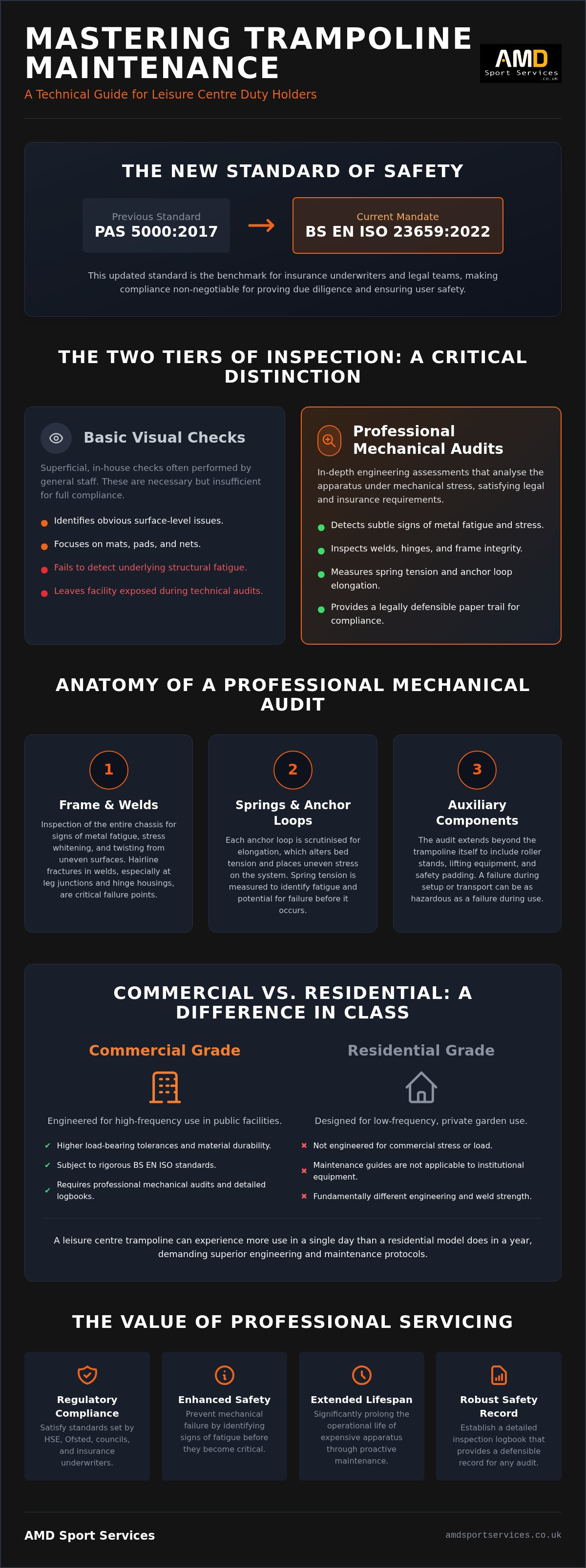
Managing a public facility involves a complex web of legal duties that have become increasingly stringent. The transition from the old PAS 5000:2017 to the current BS EN ISO 23659:2022 standard marks a significant tightening of safety requirements across the UK. This standard isn't just a suggestion; it's the primary benchmark used by insurance underwriters and legal teams to determine liability following an incident. Effective leisure centre trampoline maintenance requires a deep understanding of how these regulations apply to your specific apparatus, whether you're running a dedicated park or a multi-use sports hall.
Whilst BS EN 13219 specifically dictates the physical requirements of gymnastics equipment, ISO 23659:2022 addresses the broader operational safety of the environment. Relying solely on "in-house" visual checks by untrained staff often leaves a facility exposed during a technical audit. Professional servicing creates a legally defensible paper trail that proves you've met your obligations. Without documented evidence of professional sports equipment safety inspections, proving compliance during an Ofsted audit or an insurance claim becomes nearly impossible. It's about accountability as much as it's about hardware.
Health and Safety Executive (HSE) Expectations
The HSE is clear about the duty of care under the Health and Safety at Work Act. You must have a written risk assessment that specifically addresses the mechanical risks of gymnastics apparatus. This includes the potential for frame failure, spring fatigue, or the failure of safety padding. Failing to provide evidence of professional servicing isn't just a technical oversight; it's a breach of statutory duty. We've found that consistent, expert-led audits are the only way to satisfy these rigorous legal expectations and ensure user safety remains the priority.
The Distinction Between Commercial and Residential Standards
It's a common mistake to equate institutional equipment with garden products. The Trampoline construction and safety principles for commercial units involve significantly higher load-bearing tolerances and engineering precision. A leisure centre trampoline might experience more usage in a single Saturday than a residential model sees in an entire year. This high-frequency usage demands superior material durability and specific weld strengths that residential guides simply don't cover. Institutional-grade maintenance focuses on these technical engineering specifications, ensuring the machinery can withstand the unique stresses of a commercial environment.
Anatomy of a Professional Mechanical Audit: Beyond the Visual Check
Professional leisure centre trampoline maintenance requires an engineering mindset that looks past the surface. While a basic visual check might identify a torn mat, it rarely reveals the structural fatigue hiding within the steelwork. A comprehensive mechanical audit must evaluate how the frame behaves under dynamic load. When a gymnast lands, the force isn't just absorbed by the springs; it radiates through the entire chassis. We look for the subtle signs of metal fatigue and stress whitening that indicate a frame is nearing its elastic limit before a failure occurs.
Anchor loops and spring attachment points are high-wear zones that require individual scrutiny. If an anchor loop begins to elongate, it changes the tension profile of the bed and puts uneven stress on the surrounding springs. Similarly, the roller stands and lifting equipment used for transporting these heavy units must be part of the audit. A failure during setup or storage can be just as hazardous as a failure during use. Ensuring these auxiliary components are in peak condition is a core part of a professional indoor equipment inspection.
Welds and Structural Integrity
Weld failure often starts as a hairline fracture, invisible under layers of dust or old paint. These fractures usually occur because of uneven floor surfaces that force the frame to twist, creating racking stresses the original design didn't intend to handle. On a standard 77-series frame, the critical stress points are located at the junction where the leg assemblies meet the main side-rails and around the hinge pivot housings. Identifying these early prevents a catastrophic collapse and allows for managed repairs rather than emergency replacements.
Hinges, Chains, and Moving Parts
Hinges are the heart of a folding trampoline. Over time, the internal bushings wear down, leading to play or lateral movement. This misalignment causes the frame to close incorrectly, further damaging the steel and increasing the risk of finger traps. Whilst many facilities use heavy grease, we recommend specific dry-film lubricants that don't attract abrasive grit. We also meticulously check leg collars and locking pins to ensure they engage with a positive mechanical lock. This level of detail is aligned with the rigorous safety expectations outlined in BSI PAS 5000:2017, which remains a vital reference for best practice in the UK.
Managing Critical Wear Components: Beds, Springs, and Pads
If the frame is the skeleton of the apparatus, the bed and springs represent the engine. Effective leisure centre trampoline maintenance requires a precise understanding of how these components dissipate energy. Unlike the structural steelwork, these parts have a high perish rate because they are designed to be elastic. Over time, that elasticity fails. We monitor the perish rate of nylon and wire-web beds meticulously, as a bed that looks intact can still be mechanically unsafe due to internal fibre degradation.
Every landing creates a cycle of stress that slowly breaks down the molecular structure of the jumping surface. In a high-traffic facility, this degradation is accelerated by constant use. It's not enough to simply patch a small hole; you must understand the integrity of the entire surface to prevent a catastrophic mid-air failure. This level of technical oversight ensures that your facility remains safe for high-performance use while protecting your long-term capital investment in the equipment.
Trampoline Bed Safety and Replacement
Institutional gymnastics beds are subject to intense friction and heat. We look for "ghosting" in nylon beds; this is a condition where the weave begins to thin and separate, becoming translucent when viewed against the light. If you can see through the weave, the tensile strength is compromised. We also check for friction burns and UV damage, though the latter is less common in indoor sports halls. A critical part of the process is ensuring the bed remains perfectly centred. An off-centre bed creates uneven loading, causing some springs to work harder than others and leading to premature failure of the entire tension system. For facilities with legacy equipment, gymnastics trampoline repairs often involve custom bed tensioning to restore original performance levels.
Spring and Anchor Loop Maintenance
Springs are the most frequently replaced component in a high-use environment. We apply the "10% rule" during our audits; if more than 10% of the springs show signs of permanent elongation or stretched coils, we recommend a full set replacement. Mixed tension across a bed creates an unpredictable bounce and increases the risk of the user striking the frame. We also inspect the anchor loops on the frame itself. These loops can thin out through constant metal-on-metal friction, eventually snapping under load. In humid leisure centre environments, such as those near swimming pools, we check for surface rust and deeper corrosion that can embrittle the spring steel. Adhering to these checks ensures you remain aligned with the PAS 5000:2017 industry standard for operational safety.
Finally, frame pads must be evaluated for their shock absorption capacity, not just their appearance. If the internal foam has become compacted or brittle, it will fail to decelerate a body sufficiently during a frame strike. We test for bottoming out to ensure the pads still meet the required safety ratings for impact protection. This technical oversight is what separates a professional audit from a simple custodial walk-through.
Establishing a Robust Maintenance Frequency and Safety Record
A successful maintenance strategy relies on consistency rather than occasional deep cleaning. Effective leisure centre trampoline maintenance must be structured as a tiered programme that involves every level of staff, from floor assistants to senior facility managers. We recommend a three-tier system: daily visual checks, weekly functional audits, and annual professional inspections. This approach ensures that minor issues, such as a loose pad strap, are caught before they develop into serious safety hazards. It's a pragmatic way to manage risk without overcomplicating daily operations.
Documentation is the backbone of legal compliance. You should maintain a comprehensive equipment logbook that records every check, repair, and part replacement. In the event of an insurance claim or a health and safety audit, this logbook serves as your primary evidence of due diligence. It's not enough to do the work; you must be able to prove it was done on schedule and by competent individuals. This level of record-keeping is a non-negotiable requirement for modern UK leisure facilities and public sector sports halls.
The Daily Visual Inspection Checklist
Before the first session of the day, trained staff must perform a systematic walk-around of every unit. This isn't a technical audit, but a verification that the equipment is in a safe configuration for use. We've found that a simple checklist prevents staff from overlooking the basics during a busy shift opening.
Verify pad security: Ensure all frame pads are correctly positioned and that no springs are exposed or accessible to the user.
Clear obstructions: Check the void beneath the trampoline bed for debris, sports equipment, or cleaning supplies that could cause injury during a deep landing.
Test roller stands: Confirm that locking mechanisms on the transportation stands are fully engaged and that the unit is stable on the floor surface.
Professional Servicing Intervals
While daily checks catch obvious faults, an annual professional service is the absolute minimum requirement to satisfy UK safety standards. For high-traffic centres where equipment is used for more than 20 hours per week, we often recommend moving to a six-monthly inspection cycle. Factors such as the average weight of users and the humidity of the hall environment will also dictate how quickly components degrade. Coordinating these visits during off-peak hours or school holidays is the most efficient way to minimise disruption to your booking schedule.
Integrating your trampoline care into a wider gymnasium equipment safety inspection ensures that all your indoor apparatus meets the same rigorous standards. If you're unsure whether your current regime meets the 2026 regulatory requirements, you can book a professional safety inspection to establish a compliant baseline for your facility.
Specialist Repairs and Servicing with AMD Sport Services
Many UK facilities operate with legacy equipment from brands that no longer exist or have discontinued specific product lines. Finding replacement parts or qualified technicians for these units is a common hurdle in leisure centre trampoline maintenance. We specialise in bespoke repair solutions that restore these older frames to their original safety specifications. Our team doesn't just rely on off-the-shelf components; we apply over 20 years of technical expertise to solve unique mechanical challenges, ensuring your equipment remains safe and session-ready.
A professional sports equipment safety inspection is the most effective way to identify these hidden issues. We provide national coverage, bringing specialist engineering knowledge to leisure centres, schools, and local authorities across the UK. By choosing a partner who understands the physical mechanics of the equipment, you move away from reactive repairs toward a managed maintenance programme. This proactive approach prevents unexpected downtime and ensures your facility remains compliant with the latest 2026 safety standards.
Beyond Trampolines: A Holistic Safety Approach
Trampoline safety doesn't exist in a vacuum. A truly safe hall environment requires every piece of apparatus to be audited under the same rigorous criteria. We've found that facilities benefit from linking their trampoline care with other critical infrastructure, such as sports hall netting systems. Whether it's ceiling-mounted basketball goals or floor-fixed division nets, the mechanical integrity of each system contributes to the overall safety profile of the hall. Using a single-contractor solution for all indoor sports maintenance provides a consistent safety record and simplifies your administrative burden.
Securing Your Facility’s Future
Long-term budgeting for leisure centres often involves a difficult choice between total replacement and ongoing refurbishment. Professional oversight allows you to make these decisions based on technical data rather than guesswork. We help facility managers understand which components are worth refurbishing and when a frame has reached the end of its safe operational life. This transparency reduces long-term operational costs by extending the lifespan of expensive gymnastics apparatus through targeted, high-quality repairs. If you're looking to establish a more dependable safety regime, contacting AMD Sport Services for a comprehensive facility audit is the first step toward total peace of mind.
Securing Long-Term Safety and Compliance
Mastering leisure centre trampoline maintenance is a continuous commitment to engineering precision and regulatory adherence. By moving from surface-level checks to deep mechanical audits of frames, springs, and beds, you protect both your users and your facility's reputation. Adhering to the BS EN 13219 and ISO 23659:2022 standards ensures your equipment remains compliant with insurance requirements whilst extending the operational lifespan of your apparatus. A structured, tiered maintenance approach is the only way to manage the unique mechanical stresses of institutional use.
Don't leave your facility's safety to chance. Request a professional trampoline safety inspection from AMD Sport Services. Our UK-wide specialist team provides fully compliant servicing for all major gymnastics equipment brands, backed by over 20 years of technical expertise. We're here to help you maintain a session-ready environment that prioritises user safety without compromising on performance. Taking these steps today ensures your equipment remains a dependable asset for years to come.
Frequently Asked Questions
How often should a leisure centre trampoline be professionally serviced?
Professional servicing should occur at least once every 12 months for standard use. However, for high-traffic environments where equipment is used for more than 20 hours per week, we recommend a six-monthly cycle. This frequency ensures that mechanical fatigue in the springs and frame hinges is identified early. Regular leisure centre trampoline maintenance by a specialist contractor is often a prerequisite for maintaining valid insurance coverage and meeting council safety mandates.
What are the legal requirements for trampoline safety in UK schools and centres?
UK facilities must comply with the Health and Safety at Work Act 1974 by providing a safe environment. Specifically, you must adhere to the BS EN ISO 23659:2022 standard, which governs the design and maintenance of trampoline facilities. This involves conducting regular risk assessments and maintaining professional servicing records. Failing to provide evidence of these inspections can lead to significant legal liability if a mechanical failure occurs during a session.
Can our own staff perform the annual safety inspection?
Your internal staff are responsible for daily pre-session visual checks, but they cannot perform the annual technical inspection. Insurance providers and the HSE require a competent person with specialist engineering knowledge to conduct deep-level audits. A professional inspector identifies structural issues like hairline weld fractures or internal bushing wear that untrained eyes will miss. Relying on staff for technical certification often invalidates your facility's liability insurance.
How do I know if a trampoline bed needs replacing instead of repairing?
A trampoline bed requires replacement when the structural integrity of the weave is compromised. Look for ghosting, where the nylon becomes translucent against the light, or deep friction burns that have melted the fibres. Whilst minor surface snags might be repairable, any thinning of the jumping surface is a signal to replace. We prioritise safety over repair when the tensile strength can no longer be guaranteed under high dynamic loads.
What is the difference between BS EN 13219 and ISO 23659?
BS EN 13219 is the technical standard for the construction and testing of the gymnastics equipment itself. In contrast, ISO 23659:2022 focuses on the operational safety, inspection, and maintenance of the entire trampoline facility. Both are essential for leisure centre trampoline maintenance. One ensures the hardware is fit for purpose, whilst the other dictates how you must manage and inspect that hardware throughout its operational life in a commercial setting.
Is it safe to use a trampoline if one or two springs are missing?
It's never safe to operate a trampoline with missing or damaged springs. Each spring is part of a balanced tension system designed to distribute force evenly across the frame and bed. A missing spring creates a weak point that puts excessive stress on the remaining coils, leading to a zipper effect of failures. This imbalance also increases the risk of the user hitting the frame or the floor during a deep landing.
How long does a professional trampoline service usually take?
A professional service typically takes between 90 minutes and three hours per unit. This duration depends on the age of the apparatus and whether on-site repairs, such as spring replacement or hinge lubrication, are required. We work methodically through a multi-point checklist to ensure every weld, anchor loop, and safety pad is inspected. Coordinating these sessions during off-peak hours helps you avoid disruption to your scheduled classes or public sessions.
What records must a facility manager keep for trampoline maintenance?
Facility managers must maintain a comprehensive equipment logbook for every trampoline on the premises. This record should include the dates of all daily, weekly, and annual inspections. You must also document any repairs performed, parts replaced, and the full name of the competent person who conducted the professional service. These records are vital evidence of due diligence for local authorities, Ofsted inspectors, and insurance underwriters during a safety audit.


Comments