
Long Jump Runway Regulations UK: The Complete Compliance Guide 2026

For facility managers, school bursars, and club committees, navigating the technical maze of long jump runway regulations in the UK can be a significant challenge. Ensuring your athletics facility is not just functional but fully compliant is a matter of legal and financial necessity. Non-compliance risks athlete safety, invalidates official records, and can jeopardise insurance coverage and funding applications.
This guide provides a no-nonsense breakdown of the mandatory UK standards for 2026. We will cover the governing bodies, precise runway dimensions, official surfacing specifications, landing pit construction, and the critical safety inspection protocols you must follow. Our focus is on providing the technical clarity needed to assess your existing facility, plan a refurbishment, or commission a new installation that meets every legal and sporting requirement.
Table of Contents
Understanding UKA and World Athletics Regulatory Frameworks
Compliance begins with understanding the hierarchy of governance. In the UK, athletics facility standards are primarily dictated by United Kingdom Athletics (UKA), the national governing body. However, for facilities hosting high-level competitions, the regulations set by World Athletics (formerly the IAAF) become the benchmark. Adhering to these frameworks is not optional; it is fundamental for validating official results, securing insurance, and accessing funding from bodies like Sport England.
The role of United Kingdom Athletics (UKA): UKA sets the definitive standards for all national-level competition and affiliated club facilities. Their rulebook provides the core technical specifications for dimensions, surfaces, and equipment.
How World Athletics regulations influence UK competition: For international events or facilities aiming to host elite athletes, World Athletics rules provide the top-tier standard. UKA regulations are closely aligned with these, ensuring a consistent pathway for athlete development.
Why compliance is essential: A compliant facility is a safe facility. It demonstrates a duty of care, protects against liability, and is often a prerequisite for grants and official event sanctioning.
Distinguishing facility grades: Regulations differ based on the intended level of use. A primary school’s recreational long jump differs significantly from a national competition venue, particularly in runway length and take-off board configurations.
The Hierarchy of Athletics Governing Bodies
Understanding which set of rules applies to your facility is crucial. For most UK-based schools, colleges, and athletics clubs, UKA regulations are the primary reference. World Athletics rules come into play for stadia hosting international meets. Additionally, the Sports and Play Construction Association (SAPCA) provides codes of practice for construction, which are recognised by UKA as best practice for building and maintaining high-quality, safe facilities. Local authority planning and safety requirements may also add another layer of compliance obligations.
UKA vs. World Athletics: If your facility hosts events under UKA jurisdiction, its rules are paramount. If it is intended for international competition, World Athletics standards must be met.
The importance of SAPCA guidelines: SAPCA’s codes of practice translate regulatory standards into practical construction guidance, covering everything from base construction to surface installation and drainage.
Local authority requirements: Local councils may have specific health and safety or planning stipulations that must be integrated with the sporting regulations.
Legal and Safety Implications of Non-Compliance
Operating a non-compliant athletics facility carries significant legal and financial risks. Schools and leisure centres have a statutory duty of care to their users under UK health and safety law. An improperly constructed runway, a worn-out surface, or an inadequate landing pit can lead to serious injuries, leaving the facility owner liable. Furthermore, funding bodies will not invest in infrastructure that fails to meet the recognised national standards, making compliance a key factor in facility development.
Duty of care: Facility operators must provide a safe environment. A non-compliant long jump facility can be deemed a breach of this duty.
Athlete safety and injury liability: Hardened surfaces, uneven take-off boards, or compacted sand pits are common causes of injury. Full compliance minimises these risks and the associated liability.
Funding eligibility: To secure funding from Sport England, the National Lottery, or other official sources, you must demonstrate that your project will result in a fully compliant and certified facility.
Mandatory Long Jump Runway Dimensions and Layout
Precision is non-negotiable when it comes to the physical layout of a long jump runway. UKA and World Athletics specify exact dimensions, gradients, and positions to ensure fair competition and athlete safety. These measurements are the foundation of a compliant facility.
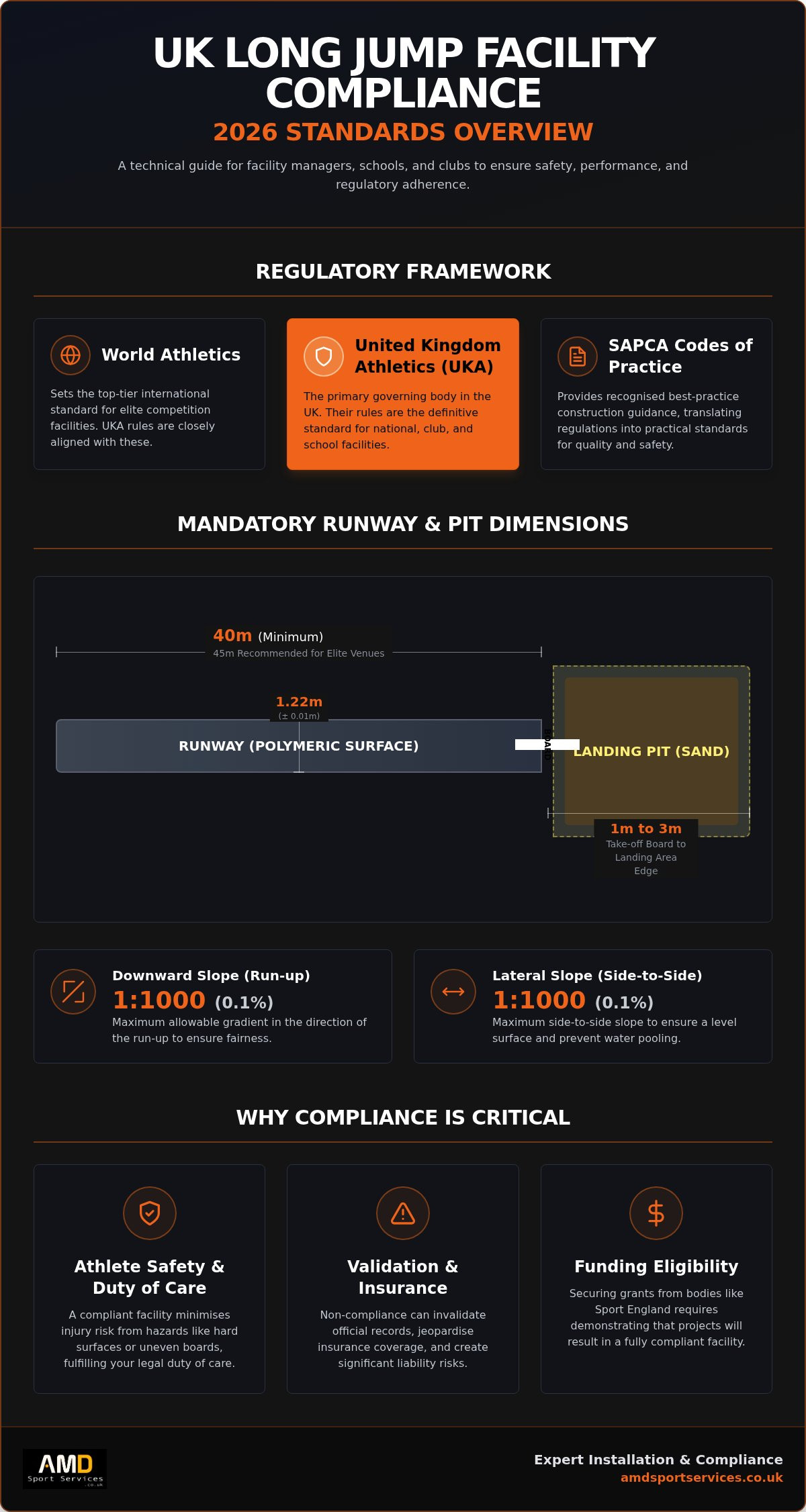
Standard runway length: The minimum required length for a competition-grade runway is 40 metres, measured from the take-off line to the start of the run-up. For world-class facilities, 45 metres is recommended.
Runway width requirements: The standard width of a long jump runway is 1.22 metres (± 0.01m), identical to a standard athletics track lane.
Tolerance levels for inclination: The runway must be exceptionally level. The maximum allowable downward slope in the running direction is 1:1000 (0.1%), and the maximum lateral (side-to-side) slope is also 1:1000 for new installations.
Take-off board positioning: The take-off board must be positioned between 1 and 3 metres from the front edge of the landing area for long jump. For triple jump, multiple take-off lines are required at set distances.
Standard Runway Geometry and Tolerances
The geometry of the runway is designed to eliminate any potential for unfair advantage and to maximise safety. The gradient rules ensure that an athlete is not running significantly downhill, whilst the lateral slope prevents water from pooling. The entire runway surface must be flush with the surrounding track and, critically, with the take-off board and the edge of the landing pit to prevent trip hazards.
The 1:1000 gradient rule: This tiny tolerance ensures a virtually flat surface, critical for the validity of athletic records.
Level transition to the landing pit: The top surface of the runway, the take-off board, and the frame of the landing pit must all be at the same level.
Calculating "effective" runway length: For restricted sites like schools, the effective length is measured from the start of the run-up area to the take-off line being used. Even if the full construction is shorter than 40m, the run-up provided must be safe and adequate for the age group.
Take-Off Board Positioning for Different Levels
The take-off board is a critical component. It must be a white, rigid board, typically wooden or synthetic, measuring 1.22m long, 20cm wide, and no more than 10cm deep. It is sunk flush into the runway. For multi-discipline use (long and triple jump), a system with multiple board positions is required.
Standard Long Jump positioning: The front edge of the board is placed between 1 and 3 metres from the near edge of the sand pit.
Triple Jump take-off lines: For triple jump, boards or painted lines are required at specified distances from the sand. Common markings for clubs and secondary schools are 7m, 9m, 11m, and 13m.
The requirement for blanking boards: When multiple take-off board troughs are installed, any not in use must be filled with a "blanking board" covered in the same surface material as the runway. This ensures a continuous, safe surface.
Official Polymeric Surfacing Regulations and Standards
The runway surface is not just a coloured track; it is an engineered system designed for performance and safety. For all competition-standard long jump facilities in the UK, a polymeric rubber surface is the required standard. These non-porous or porous systems, often known as "tartan" tracks, provide the specific levels of grip, energy return, and shock absorption mandated by UKA.
Polymeric rubber systems: This is the benchmark material for professional athletics tracks, providing a consistent and high-performance surface.
Compliance with EN 14877: European standard EN 14877 defines the performance requirements for outdoor synthetic sports surfaces, including critical factors like slip resistance, spike resistance, and shock absorption.
Refurbishment vs. Replacement: An aged polymeric surface can often be refurbished through cleaning and re-spraying its structural coat. However, if the rubber base (SBR) has hardened or delaminated, a full replacement is necessary. Expert assessment is key to making a cost-effective decision. For more on this, see our detailed guide to long jump runway refurbishment.
Polymeric Surface Specifications
A compliant polymeric runway is built in layers. It typically consists of a black SBR (Styrene Butadiene Rubber) shock-absorbing base mat, topped with a wearing course of coloured EPDM (Ethylene Propylene Diene Monomer) rubber granules bound with polyurethane. The exact construction can vary, but the performance outcomes are rigidly defined.
The 13mm thickness rule: For a typical spray-coat system, a minimum overall thickness of 13mm is standard for competition tracks to ensure adequate shock absorption and durability.
Permeability requirements: Runways can be porous (allowing water to drain through) or non-porous (sandwich systems, which drain via the surface slope). The choice depends on climate, budget, and the underlying base construction, but both must prevent standing water.
Colour and line marking regulations: The runway is typically red, with white lines 5cm wide marking the lane edges. The take-off line is the edge of the board nearest the pit, and a plasticine indicator board is required immediately after it to register foul jumps.
Landing Pit and Sand Quality Compliance
The landing pit is a critical safety feature, and its construction and contents are strictly regulated. An incorrectly sized pit or the wrong type of sand can lead to serious injuries and render a facility non-compliant.
Official landing pit dimensions: The landing area must be a minimum of 2.75 metres wide and should be positioned symmetrically in relation to the runway. For higher-level competition, a width of 3.0 metres is recommended. The pit must be long enough to accommodate the longest potential jump safely.
Depth regulations: A minimum depth of 300mm of sand is critical for safe impact absorption. This depth must be maintained consistently across the entire pit.
The importance of UKA-approved washed silica sand: This is a non-negotiable requirement. Standard builder's or play sand is prohibited.
Sand pit kerbing: The pit must have a rigid concrete or polymer concrete surround. For safety, the edges and corners should be fitted with a soft, durable covering, such as EPDM rubber.
Landing Pit Construction Standards
A well-constructed pit is designed to be safe, durable, and easy to maintain. The transition from the runway to the pit must be seamless, with no raised "lip" that could cause an athlete to trip. Proper drainage is also essential for outdoor facilities to prevent the sand from becoming waterlogged and compacted, which turns a soft landing area into a hard, dangerous surface.
Avoiding "lip" hazards: The pit surround must be installed perfectly level with the runway surface.
Drainage requirements: Outdoor pits should be built with a permeable base, such as gravel over a geotextile membrane, to allow rainwater to drain away effectively.
Installation of sand traps: Where the pit is part of a larger athletics track, sand traps or trays can be installed around the perimeter to help prevent sand from migrating onto the track surface.
Silica Sand: The Technical Requirements
The choice of sand is a key differentiator between a compliant facility and a dangerous one. UKA specifies the use of a light-coloured, washed silica sand with specific properties. This is because its performance under impact is predictable and safe.
Why standard sand is prohibited: Builder’s sand contains a high percentage of silt and clay, which causes it to compact when wet, creating a hard landing surface. It also stains clothing and equipment. Play sand is often too fine and can pose a respiratory risk.
Grain size and shape: Compliant sand consists of sub-angular or rounded grains within a specific size range (typically 0.2mm to 2mm). This ensures the grains move freely upon impact, absorbing energy effectively, rather than locking together.
Maintenance: The sand must be regularly raked to keep it loose and aerated. It will need topping up over time as it is displaced during use. A durable, well-fitted sand pit cover is essential to keep the sand clean, dry, and free from animal contamination.
Safety Inspections and Refurbishment Protocols
A long jump facility is not a "fit and forget" asset. Regular, professional inspection and maintenance are mandatory to uphold safety standards and ensure long-term compliance. An annual safety inspection by a specialist contractor is the minimum requirement for any school, club, or leisure centre.
The annual safety inspection: A professional audit assesses every component of the facility against current UKA and health and safety standards.
Common compliance failures: Frequent issues include surface hardening ("fatting"), worn or faded line markings, loose take-off boards, and compacted or contaminated sand in the landing pit.
Refurbishment strategies: Depending on the inspection outcome, remedies can range from a simple surface deep-clean and line re-marking to a full polymeric re-spray or a complete runway replacement. Timely tartan track repair can prevent minor issues from becoming major capital projects.
Organising a compliant maintenance schedule: A documented schedule of in-house checks (e.g., sand raking, debris removal) and professional annual inspections is best practice for demonstrating due diligence.
Is your facility due for an audit? A professional inspection is the only way to be certain of compliance. Book a Professional Long Jump Runway Safety Inspection to get a definitive assessment of your facility's condition.
Professional Safety Inspection Criteria
A qualified inspector will conduct a series of technical tests and visual checks to produce a comprehensive report on your facility's condition. This goes far beyond a simple visual check and involves assessing the structural and performance integrity of the entire system.
Testing for surface delamination and integrity: The inspector will check for any areas where the top EPDM layer is peeling away from the SBR base, which is a significant trip hazard.
Inspecting take-off board troughs: The trough will be checked for corrosion, and the board itself for stability. A rocking or uneven board is a major failure point.
Checking the "No Jump" indicator: The plasticine board and its tray must be secure and fit for purpose, allowing for clear and accurate foul jump rulings.
Long Jump Runway Refurbishment
If an inspection reveals compliance issues, a structured refurbishment plan is the next step. This is often a far more cost-effective solution than a complete replacement. A specialist contractor can restore an aged facility to a safe, competition-ready standard.
Restoring slip resistance: Over time, polymeric surfaces can become smooth. A professional deep clean followed by a new coat of polyurethane binder and EPDM granules (a re-spray) restores the required surface texture and grip.
Renewing court markings: Faded, inaccurate markings are a common compliance failure. Markings must be re-applied using templates and specialised paint to ensure they meet the precise 5cm width and positioning rules.
Case studies: Transforming a worn, non-compliant track into a vibrant, safe, and certified facility is a core specialist skill. This process not only ensures safety but also revitalises a key sporting asset for the school or club.
Frequently Asked Questions (FAQs)
What is the minimum runway length for a school long jump?
For a competition-standard facility at a secondary school or club, the minimum runway length is 40 metres. For primary schools or recreational use, a shorter runway may be acceptable, but it must provide a safe and sufficient run-up for the intended age group. The key is ensuring the facility is fit for purpose.
How often should a long jump runway undergo a safety inspection?
A thorough safety inspection conducted by a qualified professional should be carried out at least once a year. This should be supplemented by regular in-house visual checks by facility staff to identify any emerging issues like surface damage or sand contamination.
Can we use standard sand for our long jump landing pit?
No. Using standard builder's sand or play sand is strictly prohibited under UKA regulations. These materials compact when wet, creating a hard and dangerous landing surface. You must use a specialist washed silica sand with specific grain size and shape properties to ensure proper impact absorption.
What is the difference between polymeric and needlepunch surfacing?
Polymeric rubber, often called a 'tartan' surface, is an engineered system made from rubber granules and a polyurethane binder. It is the mandatory standard for competition-level athletics in the UK, providing specific, tested levels of shock absorption and energy return. Needlepunch is a synthetic carpet-style surface, more commonly used for multi-use games areas, and is not compliant for UKA-regulated long jump competitions.
Do we need to replace the entire runway if the lines have faded?
Not necessarily. If the underlying polymeric surface is still structurally sound, with no delamination or hardening, the lines can be professionally re-marked as part of a maintenance or refurbishment project. An expert inspection will determine the most appropriate course of action.
What are the triple jump take-off board regulations for secondary schools?
For secondary school and club-level competition, it is standard to have take-off boards or clearly marked lines at 7m, 9m, 11m, and 13m from the front edge of the landing pit to accommodate different age groups and abilities.
Are sand pit covers a legal requirement in the UK?
Whilst not always a specific legal mandate in statute, they are considered essential best practice for health and safety. A cover protects the specialist silica sand from animal fouling, debris, and adverse weather, which maintains its safety performance and hygiene. An uncovered pit could be seen as a failure in an operator's duty of care.
How much depth is required for a compliant long jump sand pit?
A minimum depth of 300mm (approximately 12 inches) of compliant silica sand is required across the entire landing area. This depth is critical for ensuring safe landings and absorbing the impact of the athlete effectively.


Comments