
Motorising Roof-Mounted Basketball Goals: The Complete UK Facility Upgrade Guide

How much time does your team lose every week just winching heavy basketball goals into position? For many UK facility managers, the physical strain of manual operation is a constant headache, especially when trying to maintain a tight schedule between diverse sports bookings. It's understandable to feel anxious about the safety of ageing overhead equipment, particularly when staff are forced to handle high-torque manual winches multiple times a day. You're likely looking for a way to improve efficiency without the massive capital expense of a full system replacement.
Motorising roof mounted basketball goals is a strategic mechanical upgrade that transforms these cumbersome units into efficient, push-button systems. By making this transition, you can significantly reduce manual handling risks and ensure your facility remains fully compliant with LOLER 1998 and PUWER 1998 regulations. This guide provides a clear, technical overview of the motorisation process, the essential safety hardware required, and how to modernise your existing framework to achieve a safer, more versatile sports hall environment.
Table of Contents
The Shift from Manual to Motorised Systems in Modern Sports Halls
In modern UK sports facilities, the transition from manual to electric operation is becoming standard practice. Motorisation involves integrating dedicated electric winching systems into existing or new basketball backboard systems. This mechanical upgrade replaces the traditional hand-cranked winch with a high-torque electric motor, allowing for automated height adjustment and storage at the touch of a button.
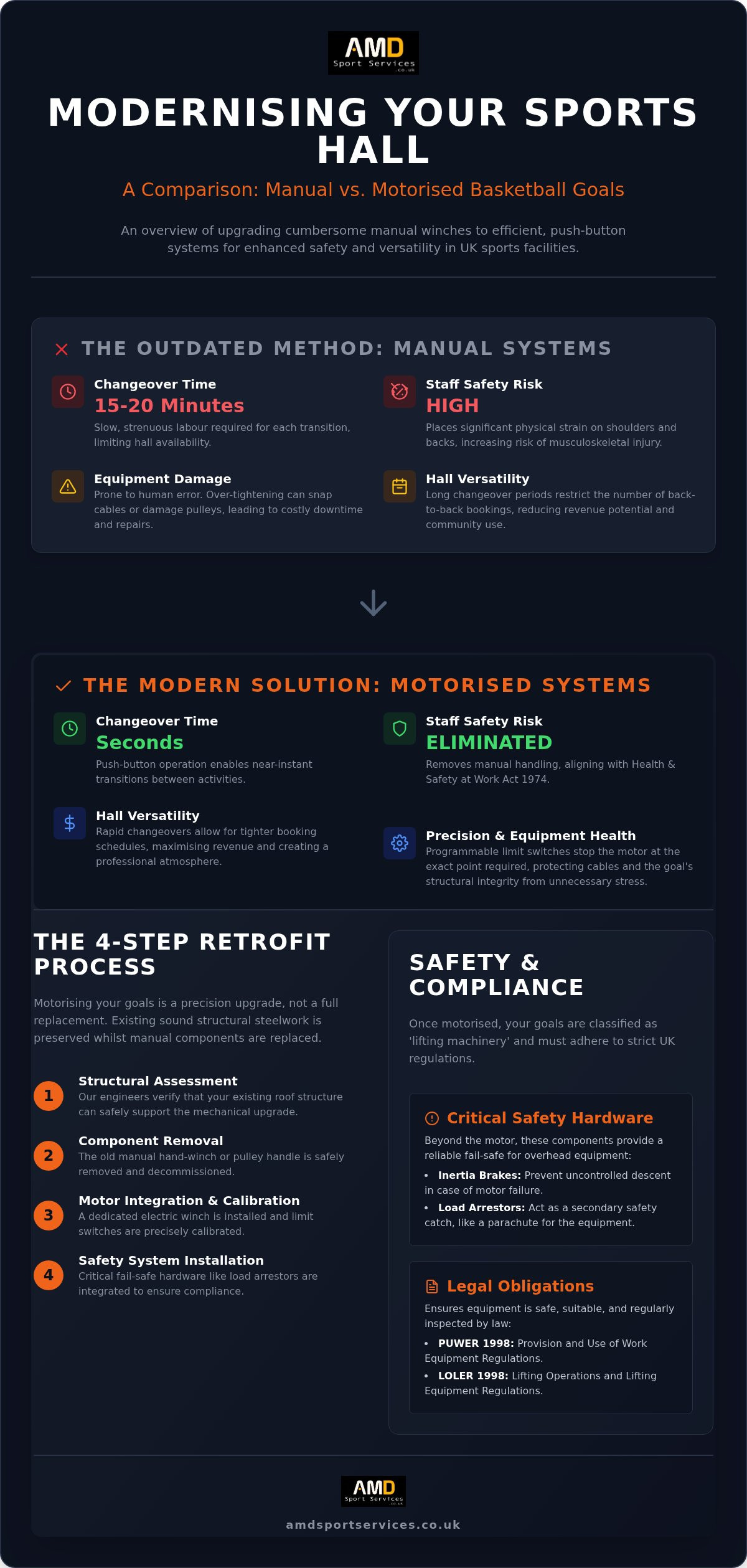
The most immediate benefit of motorising roof mounted basketball goals is the total elimination of the physical exertion required from site teams. Manual winching isn't just slow; it's a strenuous task that places significant load on the operator's shoulders and back. By automating the lift, you remove the physical variability of manual labour and replace it with a consistent, controlled mechanical process.
Beyond physical effort, manual systems are prone to human error. Over-tightening a manual winch can snap cables or damage pulleys, leading to costly repairs and equipment downtime. Motorised units use programmable limit switches to stop the motor at the exact point of tension required. This protects the structural integrity of the goal and ensures the cables aren't subjected to unnecessary stress during every deployment.
Mitigating Manual Handling Risks for Staff
Repetitive manual winching has a cumulative effect on staff health. In a busy hall, goals might be moved several times a day to accommodate different user groups. Automating this process aligns directly with the Health and Safety at Work Act 1974, which requires employers to reduce risks to health so far as is reasonably practicable. By removing the need for physical winching or the use of ladders to clear obstructions, facility managers significantly lower the likelihood of workplace injury claims and long-term musculoskeletal issues amongst their employees.
Optimising Sports Hall Versatility
Modern sports halls are high-demand environments. Managers in 2026 prioritise multi-use capability to maximise revenue and serve a wider community. A manual changeover between a basketball booking and a badminton session can take 15 to 20 minutes of strenuous labour. With motorising roof mounted basketball goals, this transition takes seconds. This efficiency allows for tighter booking schedules and creates a professional atmosphere suitable for high-level competitive play. For those planning a new facility or a complete overhaul, choosing specialist basketball goal installation ensures the mechanical systems are integrated correctly from the start.
The Retrofit Process: How Manual Roof-Mounted Goals are Motorised
Many facility managers assume that moving to an automated system requires the complete removal of their existing equipment. In reality, motorising roof mounted basketball goals is often a process of precision retrofitting. This approach preserves the existing structural steelwork whilst replacing the obsolete manual components with modern mechanical drives. We begin by assessing the structural integrity of the roof frame and the condition of the original cables. If the frame is sound, it can usually support the transition to electric operation without requiring a total overhaul.
The core of the retrofit involves removing the manual hand-winch or pulley handle and installing a dedicated electric winch motor in its place. This motor is responsible for the heavy lifting, but its performance depends on correct calibration. We set precise limit switches that dictate exactly where the goal stops in both the retracted and deployed positions. This prevents the motor from pulling the frame too tight against the ceiling or allowing the cables to slacken excessively when the goal is lowered. Once the motor is integrated, the equipment is officially classified as lifting machinery. This means it must be maintained in accordance with LOLER 1998 regulations to ensure continued safety and compliance.
Selecting the Right Electric Winch
Choosing a motor depends entirely on the weight of the backboard and the height of the hall. Heavy-duty commercial backboards require high-torque motors to ensure a smooth, steady lift without stuttering. Depending on your facility's electrical infrastructure, we may specify 240V or 415V systems. In educational environments, we prioritise quiet-running motors. This ensures that transitions between sports can happen during a lesson in a neighbouring part of the hall without causing significant acoustic disruption.
Electrical Requirements and Control Wiring
Safety is the primary concern when routing electrical cables in a sports hall. All wiring is typically tucked into ceiling voids or secured within high-impact trunking to prevent accidental damage. For the control interface, we strongly recommend key-operated wall switches. Unlike wireless remotes that can be lost or standard switches that students might tamper with, a key-operated system ensures only authorised staff can move the goals. If you're unsure if your current system is ready for this upgrade, our indoor inspection and maintenance services provide the technical clarity you need. Taking the time to discuss your specific hall layout with a practitioner ensures the final installation is both practical and durable.
Critical Safety Hardware: Beyond the Electric Motor
The motor provides the convenience, but the safety hardware provides the security. When motorising roof mounted basketball goals, simply adding an electric winch isn't enough to meet modern safety expectations. Because these units are suspended above students, athletes, and the public, they require multi-layered fail-safes. These components act as a final line of defence, ensuring that a single mechanical failure, such as a snapped cable or a gearbox malfunction, doesn't result in a catastrophic drop. Adhering to FIBA design and safety standards is essential here, as these guidelines specify how overhead units must be stabilised to prevent dangerous vibrations or structural fatigue.
High-tensile steel cables are the first point of concern. Unlike cables used for manual winches, those used in motorised systems must be specifically rated for the constant torque and rapid tension changes of electric operation. We also integrate tension sensors into the control circuit. These sensors act as an intelligent cut-off, immediately stopping the motor if it detects an obstruction or if the cable goes slack. This prevents the motor from forcing the goal against a physical barrier, which could otherwise lead to structural damage or cable snapping.
The Role of Inertia Brakes in Overhead Safety
An inertia brake is a mechanical device that locks the goal in place if it exceeds a set descent speed. In the event of a primary cable failure, the brake engages instantly, stopping the goal’s fall within centimetres. These devices are non-negotiable for any goal mounted directly above high-traffic areas. Because they are mechanical, they operate independently of the building's power supply. To maintain compliance, these brakes must be inspected as part of an annual safety audit to ensure the internal locking mechanism hasn't been compromised by dust or wear.
Safety Straps and Load Arrestors
Whilst the lifting cable handles the daily movement, safety straps, often called load arrestors, provide a completely independent secondary fail-safe. These heavy-duty nylon or steel straps remain slack during normal operation but are designed to take the full weight of the backboard system if all other supports fail. This secondary layer is crucial for protecting the expensive sports hall floor and, more importantly, the people beneath the structure. Keeping these components in peak condition requires service and maintenance expertise from practitioners who understand the specific stresses placed on motorised overhead gear. Regular lubrication and tension checks are essential to prevent the degradation of these vital safety systems over time.
Compliance and Legal Obligations: PUWER and LOLER 1998
When you commit to motorising roof mounted basketball goals, you're doing more than just upgrading your hall's efficiency. You're reclassifying the equipment under UK law. Manual units are generally considered standard sports apparatus, but once a motor is integrated, they are legally defined as lifting machinery. This change brings the installation under the strict remit of the Provision and Use of Work Equipment Regulations 1998 (PUWER) and the Lifting Operations and Lifting Equipment Regulations 1998 (LOLER).
Under LOLER 1998, any equipment used for lifting loads must undergo a "thorough examination" by a competent person at least once every 12 months. This isn't a suggestion; it's a statutory requirement. These inspections ensure the mechanical integrity of the motor, the winch, and the supporting cables. Facility managers must maintain a robust safety logbook containing these inspection reports. This documentation is the first thing an insurance provider or health and safety inspector will ask for in the event of an incident or a routine audit.
Statutory Inspections for Motorised Equipment
The transition to motorised operation requires a more technical approach to maintenance. During a LOLER inspection, a technician doesn't just look for general wear. They perform a detailed assessment of the motor's internal gearing, check for any microscopic fraying in the high-tensile cables, and test the engagement of the inertia brakes. Neglecting these annual checks can lead to serious legal consequences for schools and leisure centres, particularly if equipment failure leads to an injury. Maintaining a rigorous schedule of indoor sports equipment inspections is the only way to prove you've met your duty of care as a facility operator.
Adhering to BS EN 1270 Standards
Motorisation must also respect the BS EN 1270 standards, which govern the functional and safety requirements for basketball equipment. The addition of an electric winch shouldn't compromise the stability of the backboard or the "ring-to-floor" tolerances. If the motor pulls the frame too tightly or unevenly, it can warp the structure over time, leading to a system that no longer meets competitive play standards. A seasoned practitioner ensures that the motorisation retrofit maintains the precise alignment required for official matches. To keep your hall fully compliant across all sporting disciplines, it's helpful to review our comprehensive service and maintenance options to ensure every overhead system is performing safely.
Professional Implementation: Partnering with a Seasoned Practitioner
Successful motorisation is not a simple task of bolting an engine to a frame. It requires a deep understanding of structural load, mechanical leverage, and electrical safety. AMD Sport Services positions itself as the specialist choice for these complex retrofits across the UK. With over 20 years of industry experience, we understand the nuances of sports hall mechanics that general contractors might overlook. Our process is methodical; we begin with a thorough structural survey to assess the suitability of your current setup, move through the technical installation, and conclude with the provision of full safety certification.
We don't believe in generic sales pitches. Instead, we offer a grounded, pragmatic service that prioritises clarity and technical proficiency. This "no-nonsense" attitude ensures that you receive an honest appraisal of your equipment's condition. We take pride in solving unique mechanical challenges that standard products cannot address, positioning our team as a veteran presence in the sports equipment sector. When you partner with a seasoned practitioner, you're investing in a solution that is built for durability and official compliance.
Bespoke Solutions for Unique Roof Structures
UK sports hall architecture is rarely uniform. Many older facilities feature non-standard beam configurations, obstructed ceiling voids, or restricted heights that make standard installations difficult. We specialise in these bespoke mechanical challenges. When motorising roof mounted basketball goals in these environments, we design custom mounting brackets and specify high-torque motors that fit the specific geometry of your roof. We use only high-quality, durable components that are built to withstand the heavy-duty usage typical in busy secondary schools and community centres. You can view our latest projects and installations to see how we've addressed varied structural hurdles across the country.
Why Choose AMD Sport Services?
Our reputation is built on a commitment to safety and technical honesty. We prioritise reliable, cost-effective solutions over making a quick sale. If an existing frame is too degraded to support an upgrade, we'll tell you directly and suggest the necessary repairs before proceeding. This transparency has made us a trusted partner for local authorities and academy trusts nationwide. We don't just provide a service; we foster a sense of partnership by ensuring your facility remains compliant and operational for the long term.
Choosing an expert means you're ensuring your facility remains a safe environment for all users. We understand the operational pressures of modern leisure centres, where equipment downtime equals lost revenue. Our efficient installation process is designed to minimise disruption to your hall's schedule. By motorising roof mounted basketball goals through a specialist who understands UK-specific regulations, you ensure that your equipment is a safer asset for your staff and students alike. To begin your facility upgrade, contact AMD Sport Services to discuss motorising your basketball goals and schedule your initial site survey.
Securing the Future of Your Sports Facility
Upgrading your hall's infrastructure is a significant step toward operational excellence. By motorising roof mounted basketball goals, you effectively eliminate the manual handling risks that lead to staff fatigue and potential injury. You also ensure that your equipment meets the rigorous standards of LOLER and PUWER 1998, providing peace of mind for both users and insurers. A successful retrofit relies on high-quality safety hardware, such as inertia brakes and load arrestors, to provide a multi-layered fail-safe for overhead structures.
AMD Sport Services brings over 20 years of specialist industry experience to every project. We provide national UK coverage for installations and safety inspections, ensuring your bespoke mechanical challenges are handled with technical proficiency. Whether you're managing an older school hall or a modern leisure centre, our grounded approach prioritises long-term durability and safety above all else.
Ready to modernise your equipment? Enquire about motorising your basketball goals today and let our experts guide you through the transition. Modernising your facility doesn't have to be complex when you have the right specialist partner by your side.
Frequently Asked Questions
Can any roof-mounted basketball goal be motorised?
Most existing structures are suitable for an upgrade, provided the primary steelwork is in good condition. We perform a structural assessment to check for metal fatigue or compromised welds before motorising roof mounted basketball goals. If the frame is structurally sound, we can usually retrofit a motor without replacing the entire assembly. Older, non-standard designs often require bespoke mounting brackets to accommodate the new mechanical drive system safely.
How long does the motorisation retrofit process take to complete?
A standard retrofit typically takes between one and two days per pair of goals. This timeline includes the mechanical installation of the winch motor, the wiring of the control system, and the calibration of the limit switches. Access to the hall must be cleared of other bookings to allow for high-level plant equipment like scissor lifts. We aim to complete the work with minimal disruption to your facility's weekly schedule.
Do motorised basketball goals require a special electrical supply?
Yes, motorised systems require a dedicated electrical feed, usually a standard 240V single-phase or a 415V three-phase supply depending on the motor's torque requirements. The supply must be installed by a qualified electrician and should include a lockable isolator switch near the control point. This ensures that the system is properly grounded and protected against electrical surges, which is vital for the long-term reliability of the winch motor.
Is it cheaper to motorise old goals or buy new motorised units?
Retrofitting is almost always the more cost-effective option if your existing steel frames are in good condition. motorising roof mounted basketball goals avoids the high costs associated with fabricating and installing new heavy-duty steelwork. By reusing the original structure and only replacing the manual winch components, you achieve a modern, automated system at a fraction of the price of a complete replacement whilst maintaining full safety compliance.
How often do motorised basketball goals need to be serviced under UK law?
Under UK law, motorised goals must undergo a thorough examination at least every 12 months. Because they are classified as lifting equipment once a motor is added, they fall under the remit of LOLER 1998. This annual inspection must be carried out by a competent person who will check the motor, cables, and safety brakes. Keeping a detailed logbook of these services is essential for meeting your legal duty of care.
What happens if the power fails whilst the goals are lowered?
If the power fails, the goal will remain in its current position thanks to the internal mechanical brake within the motor unit. It won't drop or move unexpectedly. Most systems include a manual override or a hand-winding point that allows the goal to be moved in an emergency, though this is rarely needed. The secondary safety straps and inertia brakes provide additional security, ensuring the load is held firmly even without electrical power.
Are motorised basketball goals safer than manual ones?
Motorised goals are significantly safer because they eliminate the risk of manual handling injuries for your staff. Repetitive winching of heavy goals often leads to musculoskeletal issues over time. Additionally, motorised systems include electronic limit switches and inertia brakes that prevent human error, such as over-tightening cables. These built-in fail-safes provide a level of protection that manual systems simply cannot match in a busy public environment.
Will motorising my goals affect our sports hall insurance policy?
Motorisation can positively impact your insurance profile by reducing the likelihood of workplace injury claims. However, your insurer will require proof that the equipment is maintained in accordance with LOLER 1998 and PUWER 1998. Failing to provide evidence of annual safety inspections could invalidate your coverage in the event of an accident. We recommend notifying your provider once the upgrade is complete and keeping all certification on file for their review.


Comments