
Playground Safety Surfacing: The UK Facility Manager’s Guide 2026

A playground surface is a technical safety asset where a single millimetre of wear can be the difference between a minor tumble and a costly liability claim. For UK facility managers, the pressure to maintain strict compliance with BS EN 1177:2018 standards is often complicated by tight budgets and the rapid degradation of poor-quality installations. You likely understand that a reactive approach is far more expensive than a proactive one, yet scheduling a professional playground surface inspection often reveals just how quickly performance can drop below legal safety thresholds.
This guide provides the pragmatic clarity you need to select, install, and maintain safety surfacing that ensures long-term facility compliance. We will detail how to evaluate Head Injury Criterion (HIC) values and compare the durability of materials like wet pour and rubber mulch. By following these technical workflows, you'll reduce maintenance overheads and secure the professional certification required to protect both your users and your organisation. We'll break down exactly how to achieve a durable, compliant play area that stands up to the rigours of 2026 and beyond.
Table of Contents
Understanding British Safety Standards and Critical Fall Height (CFH)
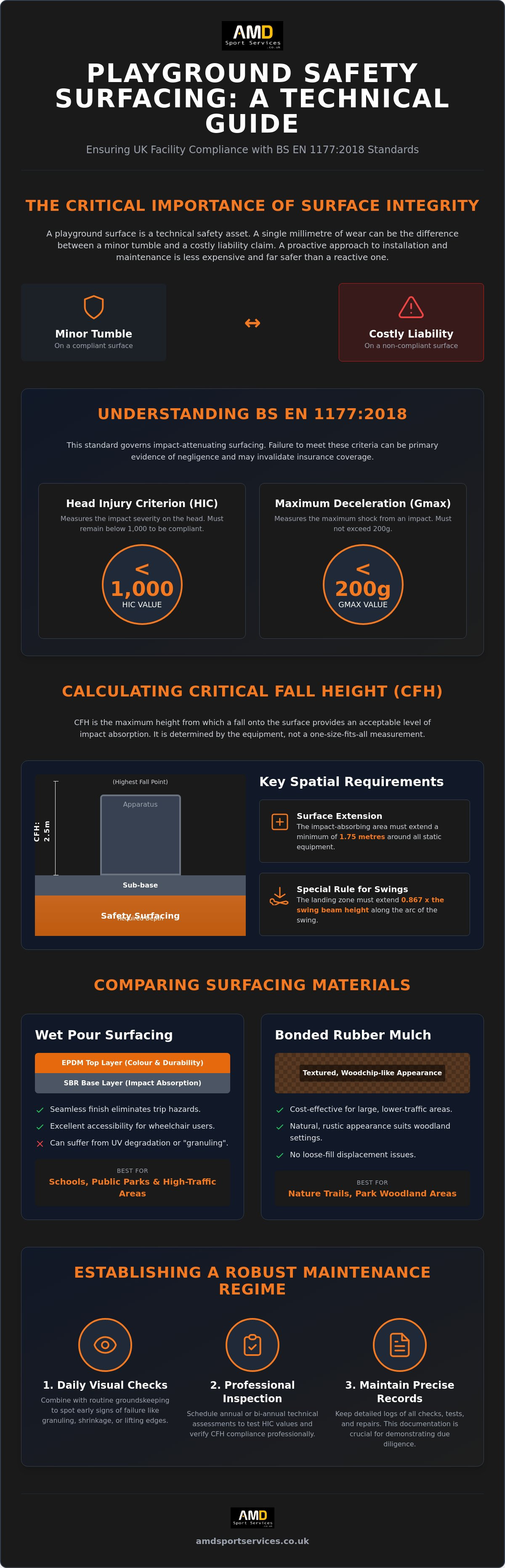
The safety of a play environment isn't a matter of opinion or aesthetic preference. It's a technical requirement governed by BS EN 1177:2018. This standard dictates the performance of impact-attenuating surfacing by measuring how well a material absorbs energy during a fall. Whilst some industry voices suggest that safety surfacing isn't a strict legal requirement in every scenario, this is a dangerous oversimplification for any facility manager. In practice, failing to meet these standards leaves you exposed to significant liability. A professional playground surface inspection is the only way to verify that your installation still meets the necessary Head Injury Criterion (HIC) values, which must remain below 1,000 to be considered compliant. Additionally, the Gmax value, which measures maximum deceleration, must stay below 200g under test conditions to prevent severe injury.
The Legal Framework for UK Playgrounds
UK facility managers operate under the Health and Safety at Work Act 1974. This legislation requires you to take all reasonably practicable steps to ensure the safety of site users. If an injury occurs on a non-compliant surface, the lack of adherence to BS EN 1177:2018 becomes the primary evidence of negligence in a court of law. Insurance providers typically treat these standards as the minimum baseline for coverage. They don't view them as optional "recommendations" when a claim is filed. By investing in professional surfacing and a regular programme of service and maintenance, schools and local authorities can effectively mitigate these long-term legal risks. It's about accountability and providing documented proof of due diligence through technical proficiency.
Calculating Critical Fall Height Requirements
Critical Fall Height (CFH) is the maximum height of fall for which a surface provides an acceptable level of impact attenuation. This isn't a one-size-fits-all measurement. You must accurately measure the highest potential fall point on each piece of apparatus. For a climbing frame, this is usually the height of the highest platform or handrail. Different playground surfacing materials offer varying levels of protection based on their depth and composition. A surface depth suitable for a 1.2-metre fall height will fail a playground surface inspection if the equipment installed above it is 2.5 metres high. You also need to account for the extent of the surfacing. Current regulations require the impact-absorbing area to extend a minimum of 1.75 metres around all equipment. For swings, this distance is even more specific, extending to 0.867 times the swing beam height in the direction of the arc to ensure the landing zone is fully protected.
Matching material thickness to equipment height is a precise engineering task. If a surface is too thin, it won't absorb enough energy. If it's poorly installed, it'll degrade prematurely. We often see installations where the sub-base has shifted, causing the top layer to thin out in high-traffic areas. This directly compromises the CFH rating and creates a hidden hazard that only professional testing can identify. Maintaining these standards isn't just about checking a box; it's about the physical integrity of the play area over its entire lifespan.
Comparing Primary Types of Playground Safety Surfacing
Selecting the right material depends on the equipment's fall height and the expected footfall of the facility. Wet pour remains the preferred choice for most UK schools and high-traffic public parks. It consists of a dual-layer system: a base of recycled SBR rubber for impact absorption and a top layer of coloured EPDM granules for durability. This seamless finish eliminates trip hazards and provides excellent accessibility for wheelchair users. However, even the highest quality EPDM can suffer from UV degradation or "granuling" over time. A regular playground surface inspection is vital to check for these surface failures before they compromise the Critical Fall Height (CFH) ratings established in the initial design.
For more rustic environments, such as park woodland areas or nature trails, bonded rubber mulch offers a textured, woodchip-like appearance without the maintenance headache of loose-fill materials. It's often more cost-effective for large areas with lower traffic. For smaller, targeted zones under specific apparatus like springers, rubber safety tiles provide a modular solution. Whilst tiles are easy to install, they require a stable sub-base to prevent the edges from curling; this can lead to failed RoSPA playground safety inspections if the joints become hazardous trip points.
Grass mats are the most unobtrusive option for green spaces. These honeycomb rubber mats allow natural grass to grow through whilst providing a basic level of impact protection. They're particularly useful on embankments where other materials might struggle with slippage or where a facility manager wants to maintain a natural aesthetic whilst meeting safety obligations.
Synthetic vs. Natural-Look Solutions
Choosing between synthetic EPDM and natural-look mulch involves balancing aesthetics with technical performance. EPDM offers a vast range of colours and allows for bespoke graphics, making it a favourite amongst primary schools looking to link play to the curriculum. Conversely, bonded mulch is favoured by local authorities for its ability to blend into the landscape. Both materials require professional installation to ensure the binder-to-rubber ratio is correct. If the mix is too lean, the surface will crumble; if it's too rich, it becomes slick and loses its impact-absorbing properties.
Performance and Durability Comparison
In high-traffic urban playgrounds, durability is the primary concern. Wet pour surfacing typically offers the longest life expectancy, often exceeding ten years when maintained correctly. Its porous nature allows for rapid drainage, which is essential for the UK's wet climate. Poor drainage can lead to standing water, which accelerates the breakdown of the rubber binders. Professional safety surfacing installations prioritise sub-base integrity to prevent the subsidence that often plagues DIY or low-budget projects. A solid sub-base ensures that the material depth remains consistent across the entire play area, maintaining compliance through years of heavy use.
Selection Criteria for Schools and Public Leisure Facilities
Facility managers in educational settings face a unique set of challenges. High-traffic areas in primary schools require surfaces that can withstand hundreds of children daily without losing their impact-attenuating properties. Balancing initial capital expenditure with long-term maintenance costs is a critical part of the procurement process. Whilst a lower-cost material might seem attractive during the tender stage, the rapid degradation of poor-quality binders often leads to a failed playground surface inspection within just a few years. It's often more cost-effective to invest in a higher-specification EPDM top layer that resists the heavy footfall typical of school break times.
Often, playground surfacing must sit alongside or integrate with technical sports assets. For example, a long jump runway installation requires the same level of sub-base precision and surface durability as a primary play area. Managing these distinct zones as part of a unified maintenance programme ensures that both play and athletic facilities remain compliant simultaneously. This holistic approach prevents the "patchwork" effect where different contractors use incompatible materials that fail at different rates.
Accessibility and Inclusive Play
Level access is non-negotiable for SEND (Special Educational Needs and Disabilities) compliance. According to the RoSPA guidance on play area surfacing, the choice of material significantly impacts the site's inclusivity. Wet pour is the pragmatic choice here because it provides a firm, consistent finish that doesn't hinder mobility aids or wheelchairs. Slip resistance is another factor. Surfaces must maintain high grip levels in both wet and dry conditions to ensure year-round utility. This is especially vital in the UK, where damp mornings can turn a poorly specified surface into a slip hazard.
Environmental and Site Factors
Site topography and environmental factors dictate the complexity of the installation. Poor drainage is the most common cause of premature surface failure. If the sub-base isn't engineered with a slight fall, standing water will eventually rot the rubber binders and lead to "granuling". UV stability is also a pragmatic consideration. Selecting UV-stable colours prevents the EPDM from becoming brittle and fading, which preserves the aesthetic and mechanical integrity of the site amongst high-exposure areas. A professional playground surface inspection will often highlight these environmental stressors before they cause irreparable damage, allowing for targeted repairs rather than a full replacement.
The Importance of Regular Safety Inspections and Maintenance
Daily visual checks by site staff are the first line of defence, spotting immediate hazards like litter or vandalism. However, these checks don't provide the technical data needed to verify the continued performance of the impact-absorbing layers. A professional playground surface inspection is required to assess the underlying binder integrity and the system's continued ability to meet BS EN 1177 standards. Without this technical audit, a surface may look acceptable whilst failing to provide the deceleration required to prevent serious head injuries.
Identifying early signs of surface failure is a technical skill that prevents minor wear from becoming a major liability. Granuling, where the rubber crumbs physically detach from the top layer, indicates that the polyurethane binder is breaking down. Shrinkage is another common issue, typically appearing as gaps at the perimeter where the surface pulls away from the kerb or equipment legs. These gaps become trip hazards and allow water to seep into the sub-base, leading to structural instability. UV exposure makes the rubber brittle over time, whilst winter frost can expand within micro-cracks to accelerate the crumbling. Neglecting these signs doesn't just increase the risk of injury; it often voids the manufacturer’s warranty and compromises the Critical Fall Height (CFH) rating.
Developing a Maintenance Programme
Biological growth like moss and algae is a persistent issue in the UK's damp climate. These growths create a slippery film that turns a safe play area into a hazard. A structured cleaning protocol, using professional equipment that doesn't strip the binder, is essential for year-round safety. Repairing minor damage, such as small holes or worn patches under swings, prevents them from becoming major safety hazards that require full replacement. For comprehensive support, establishing a formal service and maintenance programme ensures your assets are managed by experts who understand the physical properties of rubberised surfacing.
Professional Safety Compliance Audits
An audit conducted by our team involves more than a visual walkthrough. We use specialised equipment to perform HIC (Head Injury Criterion) testing, measuring the deceleration of a simulated impact to ensure the surface still provides adequate protection. We check for consistent depth and sub-base stability across the entire site, including transition zones between different materials. A professional audit provides a certified record of compliance that is vital for insurance purposes. These documents form a critical part of your health and safety records, providing the evidence of due diligence required by local authorities and educational institutions.
Professional Installation and Surface Refurbishment
Full excavation and replacement isn't always the only solution for a failing play area. If the underlying structural layers remain stable, refurbishment offers a pragmatic route to restoring safety and compliance at a fraction of the capital cost. This process involves a technical assessment of the existing sub-base to ensure it hasn't subsided or lost its drainage capacity. During a professional playground surface inspection, we evaluate whether the wear is purely superficial or if the system's impact-attenuating properties have been fundamentally compromised. If the core is sound, specialist intervention can extend the asset's life by several years.
Over-coating is one of the most effective refurbishment techniques. It involves high-pressure cleaning to remove ingrained moss and algae, followed by the application of a specialist primer. A new 15mm to 20mm EPDM top layer is then installed directly over the existing surface. This doesn't just improve the aesthetics; it physically restores the Critical Fall Height (CFH) rating to meet modern standards. We have seen this approach transform tired school play areas that were previously flagged as high-risk, providing a fresh, durable finish that withstands heavy institutional use.
Refurbishment vs. Full Replacement
The decision between refurbishment and replacement rests on the integrity of the sub-base. If the rubber is cracking due to base movement or if there are significant "hollows" where water collects, refurbishment is often a false economy. However, if the surface is simply "balding" or losing its colour due to UV exposure, re-binding the granules or over-coating is highly effective. The technical process requires precise chemical ratios to ensure the new layer bonds permanently to the old. A cost-benefit analysis usually reveals that refurbishment is the preferred choice for tight institutional budgets, provided the work is carried out by a seasoned practitioner rather than using a DIY repair kit.
Expert Installation Standards
The longevity of any safety surface is determined by the quality of the sub-base. Whether it's an MOT Type 1 stone base or an open-textured bitmac, the foundation must be engineered to allow for a 1:80 fall towards drainage channels. This prevents the standing water that leads to binder rot. Professional installation also ensures that perimeter edging is secure and joins are seamless. Gaps at the edges are a common reason for a failed playground surface inspection, as they quickly develop into trip hazards or allow weeds to compromise the rubber. If you require a site assessment or a bespoke installation quote, our team provides the technical honesty needed to determine the most durable solution for your facility.
Our approach focuses on tangible outcomes: a surface that is safe, compliant, and easy to maintain. By prioritising sub-base integrity and using high-grade polyurethane binders, we ensure that every installation or refurbishment project provides a certified record of safety that protects both the site users and the facility manager's budget.
Securing Your Facility’s Long-Term Compliance
Managing a play area in 2026 requires a shift from reactive repairs to technical asset management. By prioritising the requirements of BS EN 1177:2018 and understanding the specific Critical Fall Height needs of your equipment, you protect both your budget and your site users. We have seen how professional refurbishment can restore a surface for a fraction of the cost of replacement, provided the sub-base integrity is maintained through a structured maintenance programme. It's about making informed, pragmatic decisions that balance initial expenditure with durability.
A routine playground surface inspection remains the most critical tool in your compliance kit. It provides the documented evidence of due diligence that insurance providers and local authorities demand. With over 20 years of technical expertise and a specialist focus on safety standards, we provide national UK coverage to help schools and councils maintain high-performance play spaces. Don't wait for a surface failure to reveal a hidden hazard that could have been identified through professional testing.
Book your professional playground safety inspection with AMD Sport Services to ensure your facility meets every British safety standard. Taking these proactive steps today ensures a durable, compliant environment for years to come.
Frequently Asked Questions
Is playground safety surfacing a legal requirement in the UK?
There is no specific law that mandates the installation of safety surfacing, but you have a legal duty of care under the Health and Safety at Work Act 1974 to provide a safe environment. If an injury occurs on a surface that doesn't meet BS EN 1177:2018 standards, it's difficult to prove you've taken all reasonably practicable steps to protect users. Most insurance providers treat these standards as the minimum baseline for liability coverage.
What is the best safety surface for a school playground?
Wet pour is generally considered the most effective choice for schools due to its high durability and level-access properties. It handles heavy footfall better than mulch or tiles and provides a seamless finish that reduces trip hazards amongst large groups of children. For rustic or woodland areas where a natural aesthetic is preferred, bonded rubber mulch is a robust alternative that still meets technical safety requirements.
How often should playground surfacing be inspected for safety?
You should implement a three-tier regime: daily visual checks by site staff, monthly routine inspections, and a professional annual playground surface inspection. The annual audit is vital because it uses technical equipment to measure impact attenuation through HIC testing. This identifies if a surface has hardened or thinned beyond safe limits, which isn't always possible to determine through a visual walkthrough alone.
Can existing playground surfacing be repaired or refurbished?
Refurbishment is a viable and cost-effective option if the sub-base remains structurally intact. We can often restore tired surfaces through professional cleaning and over-coating with a new EPDM layer to renew both safety performance and appearance. This process avoids the disruption and expense of a full excavation, provided the work is carried out before the underlying layers suffer significant degradation.
What is Critical Fall Height and why does it matter?
Critical Fall Height (CFH) is the maximum height from which a person could fall onto a surface without sustaining a life-threatening head injury. It dictates the required thickness of your surfacing material based on the height of your play equipment. You must ensure the CFH rating of the surface matches or exceeds the highest potential fall point on your apparatus to remain compliant with UK safety regulations.
How long does wet pour surfacing typically last?
Professionally installed wet pour surfacing typically has a lifespan of around 10 years, though well-maintained sites often exceed this. Its longevity depends on the quality of the polyurethane binder used and the stability of the sub-base. Surfaces in damp or shaded areas may require more frequent cleaning to prevent biological growth from breaking down the binders and causing the rubber to crumble prematurely.
Does rubber safety surfacing require much maintenance?
Whilst rubberised surfaces are low maintenance, they aren't maintenance-free. You must keep the area free of debris and treat any moss or algae growth promptly to prevent slip hazards and binder rot. Catching minor issues like shrinkage or small cracks early prevents them from developing into significant structural failures that would eventually lead to a failed playground surface inspection.
Are there specific surfacing requirements for athletics equipment like long jump pits?
Athletics assets like long jump runways require specific surfacing that balances impact protection with high traction for running. These areas experience different wear patterns than general play zones and require specialist binders to prevent the surface from becoming slick or brittle. A professional inspection programme should include these assets to ensure they meet both the safety standards and the performance requirements for school sports.


Comments