
Professional Cricket Netting Installation UK: The Specialist Guide for 2026

A cricket net is not a mere sports accessory; it is a safety-critical structural installation that protects your players and your institution's reputation. When commissioning a professional cricket netting installation UK sports directors must often balance the need for durability against increasingly strict compliance standards. Managing a facility frequently feels like a constant battle against fraying mesh and frames that warp under the weight of the British weather, which can lead to valid concerns regarding student safety and long-term liability.
This specialist guide simplifies your decision. You'll discover how to build a practice area that adheres to the latest 2026 ECB safety guidelines and performance standards. We will examine the technical requirements for durable HDPE netting, the specific groundwork needed for outdoor systems, and the essential safety inspections that provide peace of mind. By the end of this article, you will have a clear understanding of the installation timeline and the technical specifications required to deliver a compliant, high-performance training environment for your cricketers.
Table of Contents
Understanding Cricket Netting Installation Requirements in the UK
A professional cricket netting installation UK project is a structural engineering task, not a simple equipment setup. It involves the integration of heavy-duty galvanised steel frames, tensioned wire tracks, and weighted mesh designed to withstand years of repetitive impact. Outdoor systems must account for wind loading and ground stability, whereas indoor systems focus on ceiling-mounted track efficiency. Facility managers amongst UK schools and clubs prioritise permanent systems because they provide the necessary stability for high-intensity training. These installations typically fall into three categories: individual practice cages for focused drills, multi-lane bays for team sessions, and perimeter protection to shield the wider facility. According to this Cricket nets overview, the primary function remains providing a safe environment for both the batter and the bowler. ECB-compliant netting is a system designed to absorb ball impact safely whilst protecting the surrounding environment.
The Role of Netting in Facility Safety
Containing high-velocity ball strikes is the primary safety function of any professional system. In a multi-use environment, a stray ball can cause serious injury to spectators or participants in adjacent activities. Professional netting acts as a safety-critical barrier, containing every strike within the designated zone. Beyond player safety, these systems preserve the longevity of the hall itself. Without adequate stop-netting, indoor walls suffer from scuffing and high-level lighting fixtures can be shattered by direct hits. Meeting these technical standards is often a prerequisite for school and leisure centre insurance. Insurers demand evidence that sports equipment is fit for purpose, which is why regular indoor inspection and maintenance is vital for compliance.
Bespoke vs. Off-the-Shelf Systems
Many institutions find that "one-size-fits-all" kits fail within months of heavy use. These retail-grade products don't account for the unique structural challenges of a school sports hall, such as varying ceiling heights or specific floor fixing requirements. A professional cricket netting installation UK relies on bespoke engineering to ensure every millimetre of mesh is correctly tensioned. Technicians use laser-guided measurements to align tracks, ensuring the system operates smoothly for years. Bespoke systems are particularly valuable for multi-sport centres because they can be motorised or designed to retract fully, clearing the floor for other sports. This tailored approach ensures you aren't wasting valuable space with bulky, poorly fitted equipment that hinders other activities like basketball or gymnastics.
Bespoke Design: Indoor and Outdoor Netting Systems
A professional cricket netting installation UK requires a dual approach that respects the specific stresses of the environment. Indoor systems must be lightweight and retractable to maintain the hall's multi-functional nature, whilst outdoor cages face the relentless pressures of wind loading and corrosion. Design matters. It requires precise integration with existing infrastructure. For instance, trackways must be positioned with millimetre accuracy to avoid obstructing basketball goals, scoreboard visibility, or high-level lighting fixtures. Integrating new cricket bays into existing sports hall division netting requires a specialist who understands how these separate systems can coexist without tangling. It is essential that all designs align with ECB facility standards to guarantee performance across all age groups.
Indoor Sports Hall Solutions
Indoor facilities rely on aluminium trackway systems for smooth, snag-free operation. These tracks allow nets to be drawn out quickly for practice and stored away neatly when the hall is needed for other activities. Visibility is key. When choosing netting colours, green is traditional, but white often provides better visibility against typical sports hall wall colours. For academies managing multi-lane setups, side-folding or ceiling-mounted systems maximise floor space. These solutions allow coaches to run several sessions simultaneously without the nets encroaching on the run-up area. If you are planning a renovation, it's helpful to review professional installations to see how different track configurations can solve specific spatial challenges.
Outdoor Practice Cages and Enclosures
Outdoor engineering prioritises structural resilience against the elements. Unlike indoor tracks, outdoor frames must be designed to handle significant wind loading. Durability is paramount for any cricket netting installation UK clubs might consider. We utilise heavy-duty galvanised steel frames to ensure long-term resistance to the British weather and prevent the frame warping that often occurs with cheaper alternatives. The groundwork is equally critical. Concrete sockets provide a permanent, stable base for high-use areas, whereas socketed ground sleeves allow for the uprights to be removed during the off-season. One often overlooked detail is the addition of anti-vermin skirting. This reinforced base layer protects the netting from being chewed by rodents at ground level, which is a common cause of premature mesh failure in school field settings. Every component is selected for its ability to maintain structural integrity. You can contact us for a bespoke design consultation to discuss your specific site requirements.
Material Standards: Durability, Safety, and Compliance
Selecting the correct material is the most critical factor in ensuring the longevity of your practice area. When specifying a cricket netting installation UK weather conditions must be the primary consideration for material selection. We typically recommend knotless polypropylene over traditional nylon. Polypropylene is naturally moisture-resistant and does not absorb water, which prevents the mesh from becoming heavy and sagging during wet winter months. For outdoor systems, UV-stabilisation is a technical requirement. Without this treatment, the sun's rays break down the polymer chains, leading to sun-bleaching and "rot" that causes the mesh to snap under the force of a ball strike. Every system should ideally adhere to BS EN 1263-1 standards for energy absorption to ensure it can safely contain high-velocity impacts over several seasons.
Netting Weight and Performance
Twine thickness determines the overall durability and safety of the system. Whilst 2mm netting is suitable for light recreational use, professional and school environments require 3mm heavy-duty netting to withstand daily sessions. The performance of the net also depends on its "hang." A net should never be pulled drum-tight; instead, it requires a specific amount of slack to absorb the ball's kinetic energy and prevent dangerous rebounds. For indoor facilities, fire safety is a legal priority. All indoor sports hall equipment must be treated with flame retardant chemicals to comply with UK building regulations and insurance mandates. This treatment ensures that the netting does not become a fire hazard in multi-use halls.
Structural Integrity of Frames
The frame provides the necessary tension to keep the netting functional and safe. For outdoor cages, we use galvanised steel tubing with a wall thickness of at least 2mm to 3mm to prevent the structure from buckling under wind pressure. These frames are supported by high-tensile tension wires that maintain the shape of the mesh and prevent it from billowing into the path of the batter. Structural safety also extends to player protection. Safety padding should be fitted to all indoor poles and outdoor uprights that sit within the field of play. This reduces the risk of injury if a player makes contact with the steelwork during a drill. Maintaining these components through regular service and maintenance ensures the system remains structurally sound and safe for use year after year.
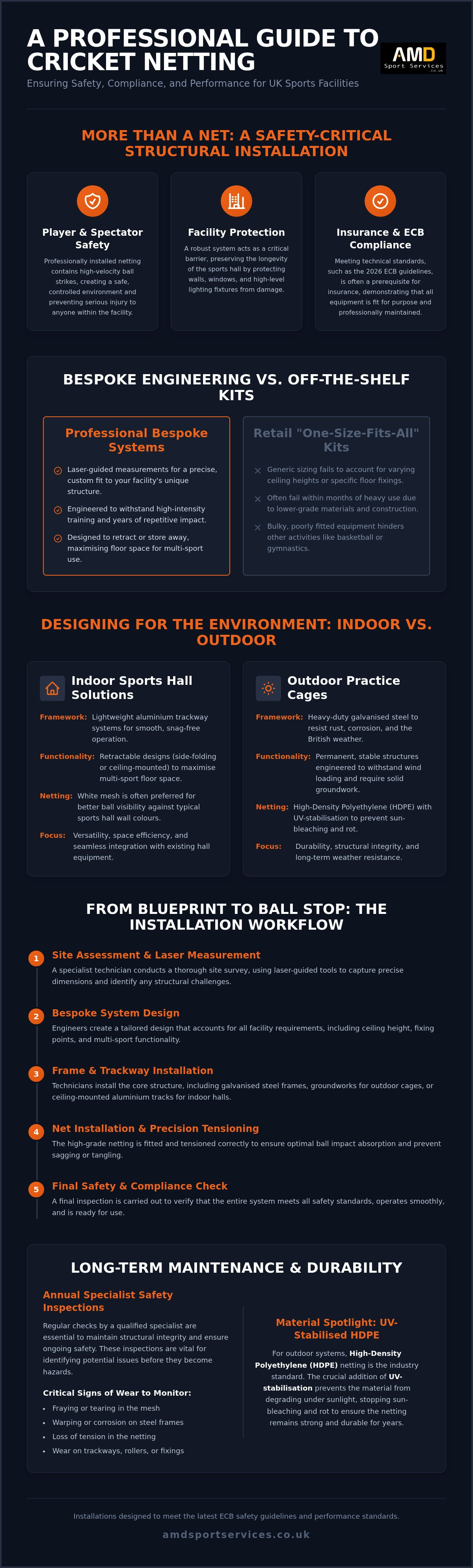
The Installation Process: From Groundwork to Tensioning
A successful cricket netting installation UK follows a methodical sequence to ensure structural stability and player safety. It begins with a comprehensive site assessment using laser-guided measurements to define lane alignment. Precision at this stage prevents the nets from interfering with other hall equipment or obstructing lighting. Technicians then install the primary infrastructure, whether that involves securing aluminium trackways to ceiling joists or excavating concrete sockets for outdoor uprights. The frame is assembled and anchored to meet specific load-bearing requirements, followed by the hanging of the mesh. We employ multi-point tensioning to ensure the net behaves predictably upon impact. Finally, a rigorous safety inspection is completed before the facility manager receives the handover documentation and maintenance guidelines.
Professional Fitting and Alignment
Alignment is vital for high-performance training. If lanes aren't perfectly parallel, bowlers' run-ups and batters' visual cues are compromised. For indoor side-folding systems, we test the trackway movement repeatedly to ensure smooth operation without snags or resistance. Outdoor installations often require ground level corrections to prevent the netting from dragging or leaving gaps at the base. This attention to detail ensures the facility is ready for immediate use and that the structural components don't suffer from uneven stress. You can view our recent installations to see how we manage these technical alignments in various facility types.
Health and Safety During Installation
Institutional environments require strict adherence to safety protocols. Indoor projects involve working at height, necessitating the use of scaffold towers or MEWPs operated by certified staff. We manage the site area to prevent unauthorised access whilst students or the public are on the premises. This is particularly important during the external sport equipment installation phase where heavy machinery or excavations may be required. Once the project is finished, we ensure the responsible disposal of old netting and frames, recycling materials where possible to minimise environmental impact and leave the site clean and ready for play.
Long-Term Maintenance and Specialist Safety Inspections
The lifecycle of a professional cricket netting installation UK depends entirely on the rigour of its maintenance schedule. For schools and leisure centres, annual safety inspections aren't just a recommendation; they are a vital component of institutional risk management. Over time, even high-quality HDPE mesh or galvanised steel frames show signs of wear. Common issues include fraying mesh at high-impact zones, loose tension wires that cause the net to sag, and frame corrosion in outdoor systems where moisture has penetrated the protective coating. We integrate safety inspections into our service lifecycle to ensure that small mechanical issues don't escalate into safety hazards or liability concerns.
Deciding whether to repair or replace equipment requires a pragmatic assessment of structural integrity. Small tears in the mesh can often be professionally repaired using high-tensile twine, extending the system's life by several seasons. However, if the mesh has lost its elasticity or if the structural frames show signs of buckling, a full upgrade is necessary to maintain compliance. Upgrading your cricket netting installation UK ensures that your facility continues to meet the 2026 safety standards whilst providing a professional environment for player development.
Routine Care for Facility Managers
Facility managers can extend the lifespan of their equipment through simple routine care. Indoor nets should be stored in a gathered, tied position when not in use to prevent tangling in the trackway or accidental damage from other hall activities. For outdoor cages, checking ground sockets for debris ensures that moisture doesn't sit against the steel, which accelerates corrosion at the base. Cleaning indoor netting is also essential. Dust accumulation doesn't just look poor; it can interfere with the flame retardant treatments required for sports hall compliance. Keeping the tracks clear of dust ensures the smooth, snag-free operation of side-folding systems.
The AMD Advantage: Compliance and Repair
We provide specialist repair services for a wide range of institutional equipment, including throwing cages and cricket netting. Our technicians deliver the official safety certification required for school and council records, providing transparent evidence of compliance and workmanship. We understand the specific rigours of school sports hall use and the mechanical challenges that standard products cannot address. It's about maintaining a safe, high-performance environment for every player through technical proficiency and dependable service. Ensure your facility is compliant with a professional safety inspection.
Securing the Future of Your Cricket Facility
Providing a safe and compliant training environment requires a structural approach that respects the rigours of the British climate and heavy institutional use. Selecting UV-stabilised, knotless polypropylene and high-tensile galvanised steel ensures your facility remains functional for years. By adhering to the latest 2026 ECB safety guidelines, facility managers can mitigate liability whilst offering players a professional standard of ball containment. These technical choices directly impact the longevity and safety of your practice area.
As a specialist in UK-wide school sports equipment and a member of the Seasoned Practitioner network, AMD Sport Services prioritises technical honesty and durable workmanship. We focus on solving unique mechanical challenges with bespoke solutions that standard products cannot match. You can contact AMD Sport Services for a bespoke cricket netting quote to start your cricket netting installation UK project. We look forward to helping you build a safer, more efficient practice area for the 2026 season and beyond.
Frequently Asked Questions
How much space do I need for a standard cricket practice lane in the UK?
A standard practice lane requires a minimum width of 3.6 metres to ensure the batter has sufficient room to play shots safely. For a full-length run-up, the installation should ideally extend to 30 metres. If space is limited, shorter lanes can be installed, but they must still provide a safe strike zone for the batter. Precise site assessments help determine how to fit these dimensions within your existing facility boundaries.
Can I install outdoor cricket netting on an existing concrete surface?
You can install outdoor netting on concrete, but it requires bolt-down base plates or core-drilling for sockets rather than traditional excavation. This method ensures structural stability without the need for extensive groundwork. However, the surface must be structurally sound to handle the tension and wind loading of the frame. It's essential to check for underground services before drilling to prevent accidental damage to site utilities during the process.
Do indoor cricket nets require special fire safety certifications?
Indoor netting must comply with BS 5867 Part 2 for flame retardancy in all UK sports halls. This certification is a legal requirement for school and local authority insurance compliance. The netting is chemically treated during manufacturing to ensure it doesn't support combustion. When commissioning a cricket netting installation UK facility managers should always request a certificate of conformity to present during annual fire safety audits or building inspections.
How long does a typical professional cricket netting installation take?
A typical professional installation usually takes between three and five working days to complete. This timeline depends on the complexity of the project, such as whether groundwork is required for outdoor cages or if indoor trackways need mounting to high-level steelwork. Initial site preparation and laser-guided alignment take the first day, followed by frame assembly and mesh tensioning. Weather conditions can occasionally impact the schedule for outdoor projects.
What is the best netting colour for a multi-use sports hall?
White netting is often the best choice for multi-use sports halls as it provides the highest contrast against typical hall wall colours. This improved visibility helps players track the ball more effectively during high-speed practice. Whilst green is the traditional choice for outdoor settings, it can sometimes blend into darker indoor backgrounds. Choosing the right colour ensures the facility remains safe and functional for cricketers of all skill levels.
Can an old outdoor cricket cage be refurbished or does it need full replacement?
A professional cricket netting installation UK specialist can often refurbish old cages if the primary galvanised steel frame remains structurally sound. Refurbishment typically involves replacing the mesh, tightening tension wires, and clearing debris from the ground sockets. It's a cost-effective alternative to a full replacement, which is only necessary if the frame has buckled or suffered from severe corrosion. An inspection will determine if the structure can safely support new netting.
How often should a school have its sports netting inspected for safety?
Schools should arrange a specialist safety inspection at least once every twelve months to remain compliant with health and safety regulations. These annual checks identify early signs of wear, such as fraying mesh or loose ceiling fixings, before they become a hazard. Regular inspections are particularly important for indoor systems that are frequently moved or retracted. Documenting these audits provides essential evidence of due diligence for insurance providers and local education authorities.
What is the difference between knotless and knotted netting for cricket?
Knotless netting is generally preferred for cricket because it's more durable and less abrasive than knotted alternatives. The smooth finish reduces friction when the ball strikes the mesh, which prevents the burn that leads to premature fraying. It also maintains its shape better over time as there are no knots to slip or tighten under pressure. This makes it a superior choice for high-use environments where longevity and consistent ball behaviour are priorities.


Comments