
Professional Netball Post Installation UK: The Complete Facility Resource 2026

A netball post that wobbles during a match isn't just a nuisance for the players; it's a structural failure that compromises the safety of your entire facility. Whether you're managing a school sports hall or a regional leisure centre, the stability of your equipment is the foundation of a professional playing environment. You likely understand the frustration of freestanding units that shift under impact or the technical headache of choosing between socketed and floor-mounted systems that must meet British Standard requirements.
Our guide simplifies these complexities by providing a clear, technical roadmap for professional netball post installation UK. We'll show you how to achieve a regulation-height system that remains stable under high-use conditions while ensuring full compliance with safety inspections. We'll examine the specific requirements for socketed installations, the 2024 World Netball ring specifications, and the essential maintenance workflows that protect your investment and ensure long-term durability in any high-traffic environment.
Table of Contents
Understanding Professional Netball Post Installation Standards in the UK
Comparing Netball Post Systems: Socketed, Floor-Mounted, and Freestanding
The Professional Installation Process: From Site Survey to First Goal
Safety Compliance and Post-Installation Maintenance Protocols
Securing Your Facility with Specialist Netball Post Solutions
Understanding Professional Netball Post Installation Standards in the UK
Professional netball post installation UK is a technical requirement for any facility hosting competitive play or educational sessions. There's a fundamental difference between a portable system used in a residential garden and an institutional post designed for a school or leisure centre. Institutional equipment is engineered to withstand hundreds of hours of high-impact use. It must remain perfectly vertical and stable, even when players make contact with the pole or the ring during aggressive match play. If a post fails in a public or educational setting, the liability risks are substantial. This is why we prioritise structural integrity over simple assembly.
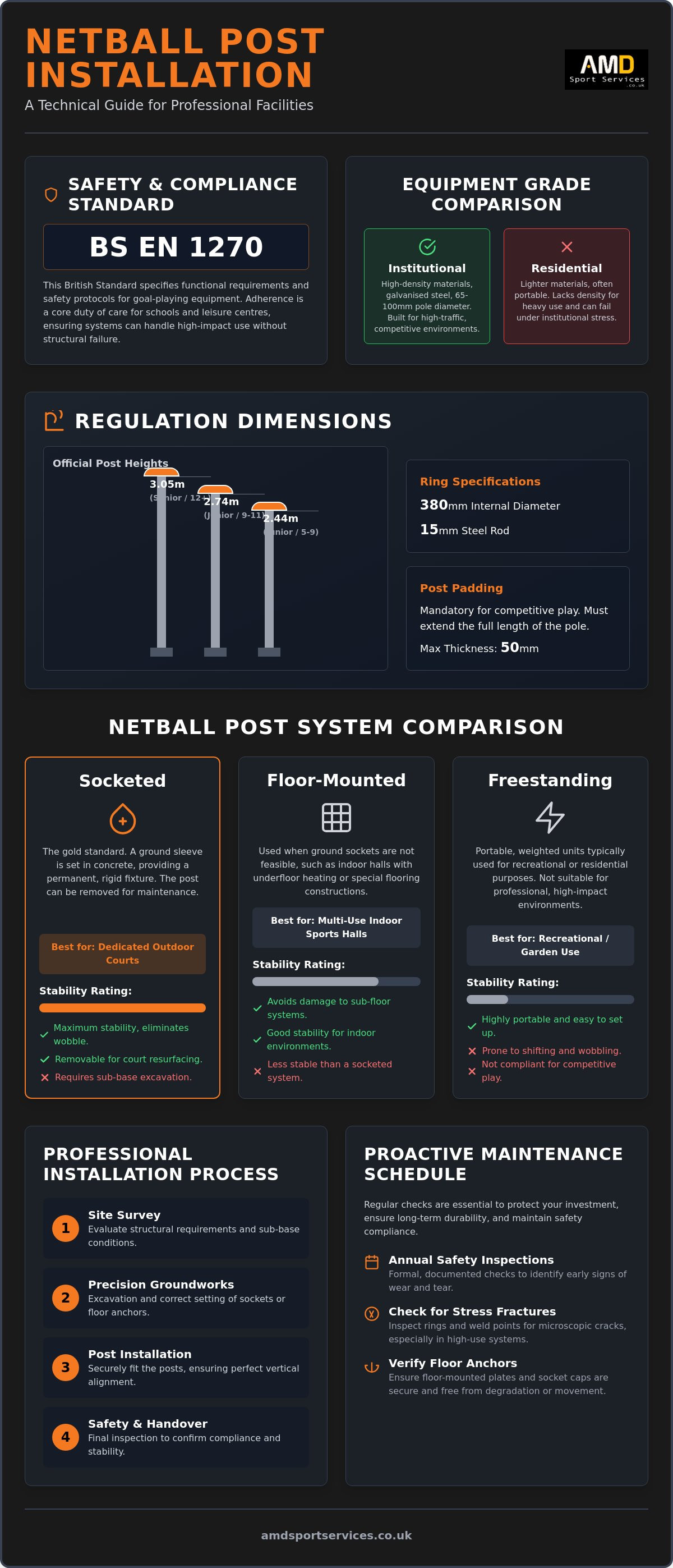
The primary benchmark for equipment safety in this sector is BS EN 1270. This British Standard specifies the functional requirements and safety protocols for goal-playing equipment. It ensures that the system can handle specific loads without tipping or structural failure. For schools and leisure centres, adhering to these standards isn't optional; it's a core part of their duty of care. An unstable post that shifts or wobbles during a shot doesn't just ruin the game; it indicates a failure in the groundwork or the mounting system that could lead to a serious injury. Proper installation involves precise groundworks to ensure the socket or floor anchor is set correctly within the sub-base.
Regulation Heights and Ring Specifications
To ensure your facility meets the international netball rules, posts must be set at specific heights based on the age group of the players. For senior players aged 12 and over, the official height is 3.05m. Junior heights are lower, typically 2.44m for ages 5-9 and 2.74m for ages 9-11. We use regulation rings made from 15mm steel rods with an internal diameter of 380mm. In competitive environments, post padding is mandatory. This padding should be of uniform thickness, not exceeding 50mm, and must extend the full length of the pole to protect players during close-range action.
Institutional vs. Residential Equipment
Residential portable systems often fail in school environments because they lack the material density required for heavy-duty use. For outdoor courts in the UK, galvanised steel is the industry standard. It provides the necessary resistance to corrosion whilst maintaining its structural strength under environmental stress. We've seen many "off-the-shelf" solutions buckle or rust through within a single season. Professional systems use thicker wall diameters, usually between 65mm and 100mm, to ensure the post remains rigid. Maintaining these systems requires regular indoor inspection and maintenance to check for stress fractures in the rings or degradation in the floor anchors that could compromise safety.
Comparing Netball Post Systems: Socketed, Floor-Mounted, and Freestanding
Selecting the right hardware is as critical as the installation itself. For high-traffic facilities, we categorise systems into three primary types: socketed, floor-mounted, and freestanding. Each serves a specific operational purpose, but the gold standard for stability remains the socketed system. Unlike portable alternatives, a socketed netball post installation UK provides a permanent, rigid fixture that eliminates the swaying common in weighted units. This stability is essential for meeting World Netball equipment specifications, ensuring the ring height and position remain precise throughout the match.
Socketed Systems for Outdoor Courts
Socketed posts are the preferred choice for dedicated outdoor courts. The process involves excavating the sub-base and setting a ground sleeve in concrete, allowing the post to be removed when the court requires maintenance or resurfacing. We always include flush-fitting caps to seal the sockets when posts are removed, preventing trip hazards and debris accumulation. When planning a holistic outdoor facility, it's often efficient to coordinate this work with other ground-heavy projects like long jump runway installation to ensure consistent sub-base integrity across the site.
Indoor Floor-Mounted and Wall-Mounted Solutions
In multi-use indoor sports halls, ground sockets aren't always feasible due to underfloor heating or specific floor constructions. Floor-mounted systems use heavy-duty anchors to secure the post to the surface. This is a space-saving alternative to freestanding units, as it removes the need for bulky weighted bases that can obstruct the run-off area. We often integrate these systems alongside existing basketball goal installation services to maximise the utility of the hall. Specialist floor anchors are non-negotiable here; they must be rated to prevent post-toppling during high-intensity play.
Professional freestanding units still have their place, particularly in facilities that require maximum flexibility or lack the structural capacity for fixed anchors. However, institutional-grade portable posts are significantly heavier than retail models. They require large, wheeled bases and counterweights to maintain safety compliance. Whilst they offer portability, fixed systems improve court flow and eliminate the need for dedicated equipment storage rooms. Fixed systems also facilitate better court management. When posts are socketed, the court boundaries remain clear and unobstructed, reducing the risk of collisions with heavy bases. If you're unsure which system suits your sub-base, our team can provide a technical site assessment to guide your decision.
The Professional Installation Process: From Site Survey to First Goal
A successful netball post installation UK starts long before the first hole is dug. We begin every project with a comprehensive site survey to assess the specific structural conditions of your facility. For outdoor courts, this involves testing the sub-base integrity and identifying the surface type, whether it's porous macadam or a specialised synthetic finish. For indoor halls, we must determine the floor depth and the location of any underfloor heating systems. This initial diagnostic phase prevents costly errors and ensures that the chosen mounting system is compatible with the existing infrastructure.
Once the survey is complete, we move to the precision groundworks phase. This is where most "off-the-shelf" installations fail. For socketed posts, we excavate to a specific depth based on the soil conditions and the expected load. We then set the ground sleeves in a high-grade concrete mix, ensuring they're perfectly level. This step is critical; even a minor deviation at the base will result in a significant tilt at the 3.05m ring height, making the equipment unfit for competitive play.
Groundwork Requirements for Outdoor Posts
Outdoor installations face unique environmental challenges. We calculate the concrete volume and depth required to prevent frost heave and movement in varying UK soil conditions. Proper drainage around the sockets is essential to prevent water from pooling, which leads to long-term corrosion of the metalwork. If your facility features a specialised polyurethane track or asphalt surface, we carefully reinstate the material around the socket to maintain a seamless, safe finish that prevents trip hazards.
Indoor Fitting and Floor Integrity
Indoor installations require a delicate approach to protect the playing surface. We use specialised equipment to navigate underfloor heating pipes, ensuring anchors are secured without damaging the building's core services. We install high-quality floor plates that provide a flush, trip-free finish when the posts are removed. To ensure the posts are positioned correctly for match play, we often coordinate this work with court marking renewal services. This alignment is vital for meeting international competition standards and ensuring the goal is centred within the goal circle.
The final stage is assembly and safety testing. We validate the verticality of each post using precision levels and confirm the ring height meets regulation standards for the intended age group. This methodical approach ensures that your facility is ready for its first goal, with equipment that is safe, stable, and fully compliant with British Standards. Our process prioritises long-term durability, ensuring the equipment can withstand the rigours of daily school use and weekend league matches.
Safety Compliance and Post-Installation Maintenance Protocols
Completing a professional netball post installation UK is a significant milestone for any facility, but it's not the end of a manager's responsibility. To remain compliant with school insurance policies and health and safety regulations, you must schedule regular sports equipment safety inspections UK. These assessments aren't just a formality; they're a technical audit designed to catch structural fatigue before it leads to an accident. Failure to maintain a regular inspection log can invalidate insurance claims and leave institutions vulnerable during safety audits.
Common failure points often stem from the sheer intensity of high-frequency play. Stress fractures in the 16mm steel rings are a frequent issue in competitive environments where the goal is under constant load. Indoor systems face different challenges; floor anchors can work loose over time, compromising the post's verticality and stability. Outdoor systems must contend with the British climate. Whilst galvanised coatings provide excellent protection, corrosion can still take hold in areas where the protective layer has been scratched or worn, particularly around the base of the post or the socket entry point.
Maintaining post-protectors and padding is equally vital for player safety. These components are often the first to show signs of wear, with straps breaking or foam degrading over time. Ensuring that padding remains in good condition is a requirement for competitive play and a core part of your duty of care to the players. If your equipment is showing signs of wear, you can book a professional assessment through our service and maintenance department to ensure continued compliance.
The Safety Inspection Checklist
A rigorous inspection goes beyond a visual check. Our technical team follows a methodical process to ensure every component remains fit for purpose:
Structural Integrity: We examine all structural welds for hairline fractures and ensure all bolts are tightened to the correct torque.
Socket Condition: For outdoor posts, we verify that floor sockets remain flush with the surface and are free of debris that could prevent the post from seating correctly.
Ring Stability: Under BS EN 1270, the goal rim must be securely attached to the post to withstand specific downward loads without permanent deformation.
Repair vs. Replacement
In many cases, a post doesn't need to be replaced entirely. We can often refurbish institutional systems by replacing specific components, such as rings, nets, or floor anchors. However, using non-standard replacement parts in professional systems is a significant risk. Third-party components may not meet the original structural specifications, which can compromise the safety of the entire unit. When a post shows signs of deep-seated corrosion or significant structural deformation, replacement is the only safe option to maintain facility standards.
Securing Your Facility with Specialist Netball Post Solutions
Choosing a bespoke solution over an off-the-shelf product is the difference between a system that lasts a decade and one that requires replacement after two seasons. For UK schools, the intensity of use is often underestimated. Standard retail units aren't designed to handle the mechanical stress of daily physical education and community league matches. By opting for a professional netball post installation UK, you're investing in structural components that are engineered for durability and safety. We prioritise high-grade materials and precision groundworks to ensure your equipment remains a long-term asset rather than a recurring maintenance headache.
AMD Sport Services brings over 20 years of industry experience to every project. We don't just supply equipment; we provide the technical groundwork and structural expertise required to solve unique site challenges. Whether it's navigating complex sub-bases or ensuring a flush finish on multi-sport surfaces, our "Seasoned Practitioner" approach prioritises the quality of workmanship over sales volume. We understand that institutional decision-makers value reliability and compliance above all else, which is why we handle the entire process with a focus on technical honesty and transparency.
National Expertise, Professional Standards
Our team provides national coverage, supporting facility managers and local authorities across the UK. We understand that every site has different requirements, from high-traffic leisure centres to smaller primary school courts. This localised expertise allows us to provide a no-nonsense technical consultation, ensuring your equipment meets the 2026 safety standards. To begin your project, we recommend requesting a technical site assessment to evaluate your current infrastructure and determine the most stable installation method for your specific environment. This initial step is vital for identifying potential structural issues before they become costly problems.
Comprehensive Sports Facility Support
Maintaining a professional sports environment often involves coordinating multiple services. We act as a single partner for your facility's needs, whether you're looking for indoor and outdoor sport netting systems or integrating a netball post installation UK with other athletic upgrades. For instance, we can coordinate groundwork for pole vault trough installation alongside your court upgrades to minimise site disruption. This comprehensive approach ensures that your entire facility remains compliant and safe for years to come, with all equipment meeting the same high standards of workmanship.
If you're ready to secure your facility with a stable, regulation-standard netball system, the first step is a professional site survey. You can contact our team through our services page to discuss your requirements and schedule a technical assessment. We'll guide you through the process from initial groundwork to the final safety inspection, ensuring a result that is as dependable as it is durable. Our goal is to foster a sense of partnership, providing you with the expert support needed to manage a safe and successful sports facility.
Securing Your Facility’s Competitive Future
Ensuring your facility meets the demands of 2026 requires more than just buying equipment. It's about a methodical approach to netball post installation UK that prioritises structural integrity and user safety. We've discussed why permanent socketed systems outperform portable alternatives and why precision groundworks are the only way to guarantee a wobble-free playing experience. By adhering to BS EN 1270 standards, you don't just provide a better game; you protect your institution from liability and ensure equipment longevity.
With over 20 years of technical expertise, AMD Sport Services provides national UK coverage for schools and leisure centres seeking dependable, compliant solutions. We handle the supply, the technical groundwork, and the essential post-installation inspections. If you're ready to upgrade your courts with a system built for high-frequency use, Request a Professional Netball Post Installation Quote from AMD Sport Services. Let's build a facility that stands up to the rigours of competitive play.
Frequently Asked Questions
Do netball posts need to be permanently fixed in schools?
England Netball strongly advises using socketed or floor-fixed goalposts for competitive match play to ensure maximum stability. Whilst freestanding units are suitable for training or junior recreational use, permanent fixtures are the preferred choice for secondary schools and leisure centres. Fixed posts prevent equipment from shifting during high-intensity PE lessons and ensure the facility remains compliant with official league standards without the need for constant repositioning.
How deep do ground sockets need to be for netball posts?
Ground sockets for a professional netball post installation UK are typically set between 300mm and 450mm deep within a high-grade concrete pad. The precise depth is determined by the soil conditions and the post diameter, which usually ranges from 65mm to 100mm. Correct excavation and setting are vital to resist the leverage forces applied when players impact the post or ring during aggressive match play.
Can netball posts be installed on existing sports hall floors?
Netball posts can be installed on existing floors using specialised floor anchors or surface-mounted plates that provide a flush finish. We conduct a technical survey to identify the floor construction and navigate around underfloor heating systems or structural beams. This approach allows for a secure installation that maintains the hall's multi-use integrity, ensuring the surface remains safe for other activities when the posts are removed.
What is the regulation height for netball posts in the UK?
The official regulation height for senior players aged 12 and over is 3.05m. Junior heights are lower to accommodate developing players, with High-Five Netball (ages 5-9) set at 2.44m and the 9-11 age group requiring 2.74m. Professional installations often utilise telescopic posts to allow for these height adjustments, ensuring the facility can host various age groups whilst adhering to World Netball equipment specifications.
How often should netball posts be inspected for safety?
Institutional netball posts should undergo a professional safety inspection at least once every 12 months. This annual audit is an essential part of a facility's duty of care and is often a requirement for school insurance compliance. Inspections identify technical failures such as stress fractures in the rings, loose floor anchors, or corrosion in outdoor sockets that could compromise the safety of the players.
Are wall-mounted netball goals a safe alternative to floor-mounted posts?
Wall-mounted goals are a safe alternative provided the building's structure is load-bearing and the installation uses heavy-duty, reinforced brackets. They're an excellent space-saving solution for smaller halls, though they lack the flexibility of socketed systems. For competitive play, the ring must be positioned exactly at the centre of the goal line, which requires precise measurement and structural assessment during the initial fitting phase.
What is the difference between a match-play and a practice netball post?
Match-play posts must meet the full structural requirements of BS EN 1270 and include regulation 16mm steel rings and mandatory padding. They're designed for permanent or semi-permanent installation to ensure zero movement during a shot. Practice posts are often lighter and may be portable, making them useful for drills but unsuitable for the high-impact demands and safety regulations of a competitive league match.
How much does professional netball post installation cost in the UK?
The cost of a professional netball post installation UK varies based on site-specific factors such as the sub-base integrity, surface type, and the chosen mounting system. Groundwork requirements for outdoor sockets differ significantly from the anchoring needs of an indoor sprung floor. We provide bespoke technical quotes after assessing these variables, ensuring the solution is engineered for long-term durability rather than providing a generic estimate.


Comments