
Professional Throwing Cage Safety Inspection: Ensuring UKA Compliance and Athlete Safety

A professional throwing cage safety inspection is a highly specialised audit designed to protect athletes, officials, and spectators from the significant dangers posed by discus and hammer events. For facility managers at schools, universities, leisure centres, and athletics clubs across the United Kingdom, ensuring the structural and functional integrity of these cages is a critical responsibility. It is not merely a matter of maintenance; it is a fundamental component of legal duty of care, risk management, and venue viability.
Neglecting this crucial aspect of facility management can lead to catastrophic equipment failure, severe injury, and significant legal and financial repercussions. This guide provides a detailed breakdown of the inspection process, the governing UK Athletics (UKA) standards, and the corrective actions required to keep your throwing facilities safe, compliant, and ready for use.
Table of Contents
Why Throwing Cage Safety Inspections Are Essential for UK Facilities
At its core, a throwing cage safety inspection is a specialist audit of the structural and functional integrity of hammer and discus facilities. It moves far beyond a simple visual check, employing a methodical process to identify hidden weaknesses, material degradation, and non-compliance with national safety standards. The primary objectives are clear and non-negotiable:
Compliance: It ensures the facility meets the stringent safety standards set by UK Athletics (UKA) and World Athletics, which is essential for maintaining venue licensing and the ability to host official competitions.
Safety: It serves as the first line of defence in protecting athletes, officials, and spectators from high-velocity implement escapes or dangerous ricochets, which can result from compromised netting or structural failure.
Liability Mitigation: For schools, local authorities, and leisure centres, it mitigates legal liability by creating a documented safety trail, demonstrating proactive adherence to health and safety obligations.
The Legal and Regulatory Landscape in 2026
Operating a sports facility in the UK comes with a significant legal "Duty of Care". This principle, enshrined in health and safety legislation, requires operators to take all reasonably practicable steps to ensure their equipment and premises are safe for all users. A throwing cage, due to the inherent risks of the sport, falls under a high level of scrutiny.
Understanding "Duty of Care": This legal obligation means that facility managers must be able to prove they have actively managed the risks associated with their equipment. A documented history of professional inspections by a competent body is a cornerstone of this proof.
Governing Body Standards: UK Athletics sets the technical and safety specifications for equipment used in licensed competitions. Whilst not all facilities host high-level events, these standards represent the established best practice for safety and are often cited in legal or insurance assessments following an incident.
Insurance Implications: Regular, professional inspections can directly influence insurance premiums. Insurers view a proactive and documented maintenance programme as a sign of responsible risk management, which can lead to more favourable terms and is often a prerequisite for processing a claim.
Consequences of Neglecting Cage Maintenance
The forces exerted on a throwing cage are immense, and constant exposure to the British weather accelerates wear and tear. Ignoring the need for regular, expert assessment can lead to a rapid decline in safety and performance, with consequences including:
Structural Fatigue: Steel and aluminium frames are susceptible to environmental corrosion, particularly at ground level and within hinge mechanisms. This can lead to stress fractures and, in the worst-case scenario, the collapse of an upright pole during use.
Netting Degradation: The high-tensile netting is the primary safety barrier. Constant exposure to UV radiation makes the fibres brittle over time, drastically reducing their ability to absorb the impact of a 4kg discus or a 7.26kg hammer. This can result in a catastrophic "pass-through" where the implement escapes the cage entirely.
Loss of Competition Rights: For clubs and venues that host events, a cage that fails to meet UKA safety certification will result in an immediate loss of hosting rights, impacting revenue and reputation within the athletics community.
The Professional Inspection Process: A Step-by-Step Technical Breakdown
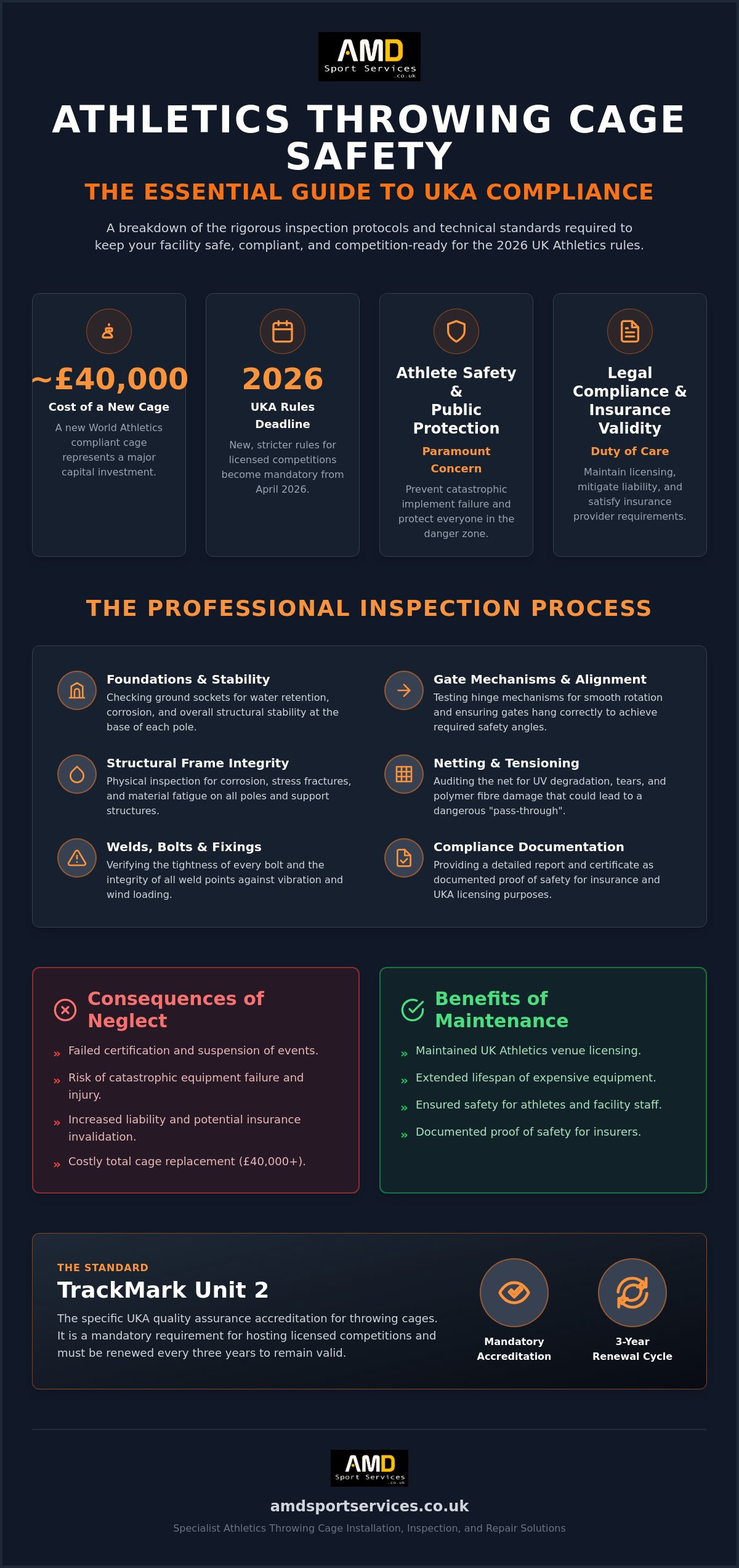
A professional throwing cage safety inspection is not a casual walk-around. Competent inspectors utilise a methodical, evidence-based approach to evaluate every single component of the cage system, from its foundations to the highest pulley. The process is designed to identify not only existing faults but also potential future points of failure.
The process begins with a thorough ground-level assessment of the cage's foundation, base plates, and gate locking mechanisms, which are critical to its overall stability.
A detailed visual and physical examination of the entire netting system is conducted to assess its energy-absorption capacity and identify signs of degradation.
Every structural element, including poles, welds, and tensioning wires, is inspected for signs of corrosion, fatigue, or damage.
The final report provides a clear, prioritised list of findings and recommended remedial actions required to meet immediate safety standards and prolong the life of the asset.
Structural Integrity and Frame Assessment
The frame is the skeleton of the throwing cage, and its integrity is paramount. An inspector will systematically check for any signs of weakness that could compromise the entire structure. This involves:
Corrosion Checks: Meticulously examining the base of each pole, where water and debris collect, and inspecting hinge mechanisms for rust that could impede movement or weaken the joint.
Stability and Alignment Testing: Physically testing the stability of each upright to ensure it is secure in its foundation. The alignment of the gate system is also checked to confirm it closes correctly and forms a continuous, safe enclosure.
Component Inspection: A close-up inspection of all weld points for cracks or stress fractures, and checking that every bolt and fastening across the athletics throwing cage installation is secure and correctly tightened.
Netting, Tensioning, and Energy Absorption
The netting is arguably the most critical safety component, and its condition is a primary focus of any inspection. Its job is to safely absorb and dissipate the immense kinetic energy of a thrown implement.
Mesh Examination: The inspector will examine the entire surface of the mesh for frays, holes, sun-bleaching, or UV-related brittleness. They will pay special attention to areas of previous repair and seams.
Tension and Sag Verification: The "sag" of the net is a crucial factor. If it's too tight, it can cause an implement to ricochet back towards the athlete. If it's too loose, it may not effectively contain the throw. The inspector verifies that tension levels are correct for optimal energy absorption.
Fixings and Pulleys: The inspection includes checking all ground-fixing points, tensioning wires, and pulley systems. These must be free from corrosion and operate smoothly to allow the net to be raised and lowered safely, especially in high winds.
Navigating UK Athletics (UKA) Standards for Throwing Cages
UK Athletics (UKA) provides detailed rules and specifications for athletics facilities to ensure safety and fair competition. For facility managers, understanding and adhering to these standards is essential for ensuring their throwing cage is fit for purpose, particularly if the venue is used for licensed events.
Compliance with UKA standards requires specific cage heights and gate angles to create a mathematically calculated "danger zone" that protects surrounding areas.
Inspections must be carried out by a competent person who possesses specialist knowledge of athletics apparatus and the forces they must withstand.
A safety certification is not a one-time event; it requires periodic re-validation through regular professional inspections to ensure the equipment remains safe over its lifespan.
Height and Danger Zone Requirements
The geometry of a throwing cage is precisely defined by UKA to contain errant throws. The rules differentiate between the requirements for different disciplines due to the varying trajectories and power involved.
Hammer vs. Discus Cages: UKA specifies different minimum height requirements for cages intended for hammer throwing versus those only for discus. As of current standards, a standard hammer cage requires 7-metre-high panels, extending to 10 metres at the gateposts, to contain the high trajectory of the implement.
Gate Alignment: The precise positioning and angle of the gates are critical. They are designed to protect the track, infield, and spectator areas from the most likely sector of an errant throw. Misaligned or improperly secured gates render the entire safety system ineffective.
Bespoke Risk Assessments: For facilities with unconventional layouts, such as those with nearby buildings or public footpaths, a standard cage may not be sufficient. These locations require a bespoke risk assessment to determine if additional control measures, like increased height or modified positioning, are necessary.
The Role of the Competent Person
The term "competent person" has a specific meaning in health and safety law. It refers to someone with the necessary training, experience, and knowledge to identify and assess risks accurately for a specific type of equipment.
Defining Competence: In the context of a throwing cage, competence requires a deep understanding of athletics regulations, material science (metal fatigue and polymer degradation), and structural engineering principles.
Specialist vs. General Inspectors: A general playground or sports hall inspector often lacks the niche expertise to evaluate a throwing cage correctly. They may miss subtle signs of UV degradation in netting or stress fractures in welds that a specialist would immediately identify as critical failures.
The Value of an Integrated Service: Using an organisation that can both inspect and subsequently repair athletics equipment is highly efficient. It streamlines the process from fault identification to rectification, minimising facility downtime and ensuring the repairs are carried out by technicians who fully understand the original inspection report.
Common Faults and Corrective Maintenance for Athletics Cages
A proactive approach to maintenance, guided by professional inspections, is the most effective way to manage facility budgets and ensure uninterrupted safety. Identifying and addressing faults early prevents them from escalating into major, costly structural failures.
Many structural issues, such as localised corrosion or cracked welds, can be rectified through specialist on-site welding and reinforcement if caught in time.
For safety netting, a full replacement is often more cost-effective and safer in the long run than attempting multiple small patches on a net that is failing due to age.
A simple, regular programme of lubricating gate hinges, pulleys, and locking mechanisms can prevent mechanical seizure and ensure the cage can be operated safely and correctly.
Addressing Netting and Mesh Failures
The netting is the cage's most vulnerable component and requires careful assessment. Deciding between repair and replacement is a critical safety decision.
Repair vs. Replacement: A key decision is when to opt for a full hammer cage netting replacement versus localised repairs. If the netting shows widespread brittleness, discolouration from UV exposure, or multiple holes, patching is a false economy. A full replacement is the only safe option.
Correct Specification: When replacing a net, it is vital to ensure the new mesh meets the specific weight, ply, and knotless construction requirements for hammer throwing. The impact forces are far greater than in other sports.
The Danger of General Netting: Using "general purpose" safety netting or ball-stop netting for a throwing cage is exceptionally dangerous. These materials are not engineered to absorb the concentrated, high-velocity impact of a hammer or discus and will fail instantly.
Mechanical and Gate Mechanism Repairs
The operational components of the cage are just as important as its static structure. A failure in a gate or pulley can render the cage unsafe or unusable.
Seized Gates: Gates that have seized due to corrosion or damage prevent the cage from being correctly positioned for different wind conditions or disciplines, creating a significant safety hazard. These often require specialist attention to free up hinges and realign the structure.
Gate Fixing Points: The ground sockets and locking pins that hold the gates in their open position must be robust and fully functional. If these fail, a gate could swing into the path of a thrower or be blown out of position.
Specialist Athletics Throwing Cage Installation and Repair Solutions
At AMD Sport Services, we provide a comprehensive "inspect and fix" model designed to offer facility managers a seamless, efficient, and reliable solution to throwing cage safety. Our approach minimises facility downtime and removes the complexity of coordinating multiple contractors. Our expertise covers the full lifecycle of athletics equipment, from initial external equipment installation to long-term safety auditing and maintenance.
We provide bespoke solutions for non-standard cages, including those that require unique mounting or reinforcement to meet modern safety standards.
Every throwing cage safety inspection concludes with a clear, actionable report. It is written in plain English and designed to provide facility managers, bursars, and health and safety committees with the information they need to make informed decisions.
Bespoke Repairs and Structural Upgrades
Many facilities operate with older throwing cages that may no longer meet current standards or for which replacement parts are unavailable. Our specialist fabrication and engineering capabilities allow us to provide solutions where others cannot.
Custom Fabrication: We can custom-fabricate replacement parts, such as hinge components or gate locking mechanisms, for older cage models that are no longer in production.
Structural Reinforcement: Our team can design and implement structural reinforcements, allowing existing cages to be upgraded to meet modern UKA height and safety standards without the cost of a full replacement.
Interim Safety Measures: Whilst major refurbishments are being planned or funded, we can provide temporary safety measures and repairs to mitigate immediate risks and keep the facility operational where possible.
Why Choose AMD Sport Services for Your Inspection?
Choosing the right partner for your throwing cage safety inspection is a decision that directly impacts athlete safety and your organisation's legal standing. We offer a service built on deep industry expertise and a commitment to practical, effective solutions.
Pragmatic Expertise: You receive no-nonsense advice from seasoned practitioners with over 20 years of hands-on experience in the athletics equipment industry. We identify problems and provide workable solutions.
National Coverage: Our services extend across the UK, serving a diverse client base of schools, councils, universities, and professional athletics clubs with a consistent, high-quality standard of work.
Our Commitment: Our commitment is to deliver technical precision and unwavering adherence to UKA standards, ensuring your facility is not just compliant, but demonstrably safe for every user.
Frequently Asked Questions
How often should a throwing cage safety inspection be carried out? For any facility used regularly, a professional inspection should be carried out at least annually. This should be supplemented by frequent in-house visual checks by facility staff to spot obvious damage, such as holes in the net or loose fixings, between professional audits.
What is the difference between a hammer cage and a discus cage in terms of safety? The primary difference lies in the required height and gate configuration. A hammer travels at high velocity with a much higher potential trajectory than a discus. Therefore, a UKA-compliant hammer cage must be significantly taller (typically 7m high with 10m gates) to safely contain the implement. A cage designed only for discus may be lower.
Can we carry out our own throwing cage inspections in-house? Routine visual inspections for obvious faults (e.g., litter, visible damage) are good practice and should be done by ground staff. However, these do not replace the need for a professional inspection by a "competent person." A specialist can identify issues like metal fatigue, UV degradation in netting, and structural stresses that are not apparent to the untrained eye.
Are UKA standards mandatory for all athletics facilities? UKA standards are mandatory for any facility wishing to host a licensed athletics competition. For other facilities, such as schools or local parks, they are not legally mandatory but are considered the established best practice. In the event of an incident, a court or insurance provider would almost certainly refer to these standards to determine if the facility operator had met their duty of care.
How long does a professional throwing cage inspection typically take? A thorough inspection of a single throwing cage typically takes between 2 to 4 hours on-site, depending on its condition and complexity. This is followed by the compilation of a detailed report with photographic evidence and recommendations.
What happens if our throwing cage fails its safety inspection? If a cage fails, the inspector will issue a report detailing the faults, categorised by risk level. For critical failures that pose an immediate danger, the recommendation will be to close the facility until repairs are completed. The report will form a clear action plan for the facility manager to bring the cage back to a safe and compliant standard.
Is it possible to repair athletics netting or must it always be replaced? Small, isolated areas of damage on an otherwise healthy net can sometimes be repaired with specialist patches. However, if the netting shows signs of widespread degradation from age or UV exposure (brittleness, extensive fraying), patching is unsafe and ineffective. In such cases, a full replacement is the only responsible course of action.
Do the safety standards change for indoor throwing cages? Yes, the requirements for indoor cages are different. Whilst the principles of structural integrity and netting energy-absorption remain, the design must account for the surrounding building structure, roof height, and proximity of other activities. A bespoke risk assessment is always required for an indoor installation to ensure both the thrower and the building itself are protected.


Comments