
Safety Surfacing UK: Pro Guide for Sports Facilities

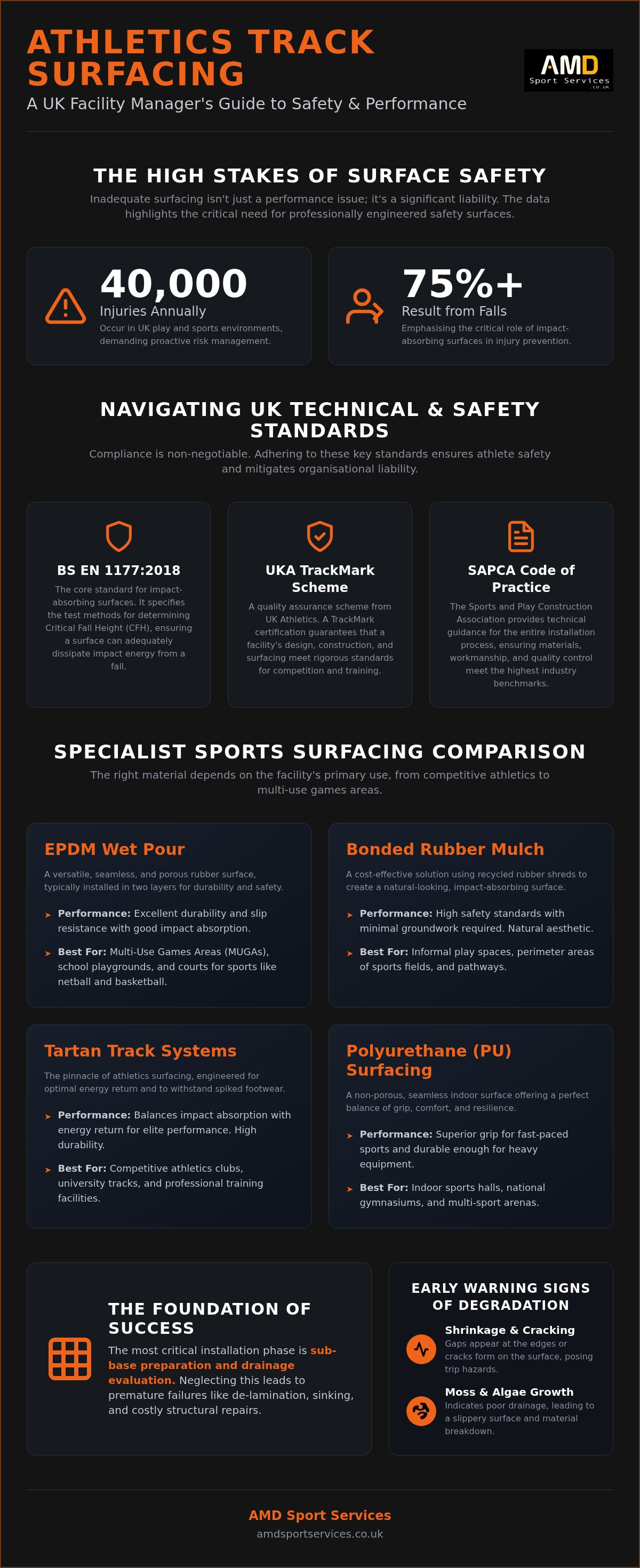
With approximately 40,000 injuries occurring annually in UK play and sports environments, and over 75% of those resulting from falls, the margin for error in facility management is non-existent. You're likely well aware that a single overlooked trip hazard or a degraded surface doesn't just risk athlete safety; it exposes your organisation to significant liability and costly litigation. Managing these risks whilst navigating complex technical standards often feels like a moving target for even the most experienced site managers.
We've designed this guide to simplify the process of selecting and installing the athletics track surfacing UK facilities require for high-level performance and safety. You'll discover how to navigate the latest BS EN 1177:2018 standards and the UKA TrackMark scheme to ensure your site meets every rigorous compliance requirement. We'll provide a clear overview of the technical specifications, installation workflows, and maintenance programmes needed to protect your athletes and reduce long-term costs through durable, expert craftsmanship.
Table of Contents
Why Safety Surfacing Installation is Critical for UK Sports Facilities
Professional safety surfacing is much more than a cosmetic finish. It's a precisely engineered system designed to manage the physical forces exerted by athletes during high-intensity training and competition. For UK sports facilities, particularly those managed by local authorities or educational trusts, installing high-quality safety surfacing is a primary method of meeting statutory health and safety obligations. A compliant surface provides a predictable, stable environment that minimises the risk of acute injuries from falls and chronic injuries caused by repetitive impact.
Whilst playground rubber focuses almost entirely on fall protection, professional athletics track surfacing UK providers must balance impact absorption with energy return. A surface that's too soft will sap an athlete's power and increase the risk of tendon strain, whereas a surface that's too hard leads to stress fractures. Investing in a specialist all-weather running track ensures that the facility supports long-term athletic development rather than hindering it. This distinction is vital; generic solutions often fail to provide the technical properties required for competitive sports.
The Role of Impact Absorption in Athletics
In track and field, impact absorption is about force reduction. During events like the triple jump or hurdles, the forces travelling through an athlete's joints can be several times their body weight. High-performance surfacing mitigates these peaks without sacrificing the "rebound" needed for speed. Although "Critical Fall Height" (CFH) is a term often associated with playgrounds, it's equally relevant for sports halls and tracks where athletes might fall from height or at high velocity. Impact absorption is the measured capacity of a surface to dissipate the kinetic energy of an impact, thereby reducing the peak force experienced by the body, as standardised under BS EN 1177:2018.
Compliance and Liability for UK Facility Managers
Facility managers face significant legal pressure to maintain safe environments. Hiring generalist contractors who lack specific experience in sports-grade installations often leads to non-compliant surfaces that fail independent testing. This creates a massive liability gap. If an injury occurs on a surface that doesn't meet BS EN 1177:2018, insurance providers may refuse to cover claims, and the Health and Safety Executive (HSE) could intervene.
Maintaining rigorous safety standards across national sports centres requires more than just a good installation. It demands documented evidence of compliance and regular external sport equipment installation and inspection cycles. By choosing specialists who understand the technical nuances of SAPCA and UK Athletics requirements for athletics track surfacing UK, managers ensure their facility remains a safe, high-performance asset for years. This proactive approach to compliance doesn't just protect athletes; it safeguards the institution's reputation and financial stability.
Types of Specialist Sports Surfacing: Performance and Durability
Selecting the correct material for your facility depends on the specific athletic disciplines hosted and the volume of foot traffic. Different surfaces offer varying levels of shock absorption, energy return, and slip resistance. For schools and multi-use games areas (MUGAs), EPDM wet pour rubber is a versatile choice. It consists of a base layer of SBR rubber topped with a colourful EPDM wear layer, providing a seamless, porous finish that's ideal for netball and basketball courts. If you're managing perimeter areas or informal play spaces, bonded rubber mulch offers a cost-effective, natural-looking alternative that requires minimal groundworks whilst maintaining high safety standards.
For competitive environments, specialist Tartan tracks represent the pinnacle of athletics track surfacing UK wide. These systems are engineered for high-performance clubs and schools that require a surface capable of withstanding spiked footwear. While outdoor facilities focus on weather resistance, indoor sports halls often utilise Polyurethane (PU) surfacing. This non-porous material is the standard for national gymnasium facilities, offering a perfect balance between grip for fast-paced sports and the durability needed for heavy-duty equipment. Adherence to the SAPCA Code of Practice is essential for ensuring these technical standards are met during every phase of construction.
Athletics-Specific Installations: Runways and Tracks
Professional long jump runway installation requires a more intensive technical approach than standard playground surfacing. The sub-base must be perfectly levelled and compacted to prevent shifting, which can lead to surface cracks or "puddling" that compromises athlete safety. If your existing track has lost its elasticity or grip, a full replacement isn't always necessary. Refurbishing Tartan tracks through re-topping can restore the surface's original performance characteristics, extending the lifecycle of the asset and improving the overall aesthetics of the facility. This process involves cleaning, repairing the base layer, and applying a new textured wear coat to ensure the facility meets modern athletics track surfacing UK requirements.
Indoor Sports Hall Surfacing Solutions
Indoor environments present unique challenges, particularly regarding the interaction between footwear and the floor. The surface must provide enough slip resistance to prevent falls, yet allow for a controlled "slide" to protect an athlete's ligaments during sudden changes of direction. Over time, even the highest quality PU floors lose their clarity and grip. Professional court marking renewal services are vital for maintaining the multi-sport functionality of these halls. Clear, accurate lines are necessary for official competition and help manage the flow of different activities within the same space. If you're seeing signs of wear on your facility's floor, our team can assist with expert installations and repairs tailored to your specific site needs.
Technical Standards: Navigating BS EN 1177 and UKA Requirements
Procuring athletics track surfacing UK wide requires a firm grasp of the technical benchmarks that separate a compliant facility from a liability. The primary standard, BS EN 1177:2018, dictates the testing methods for impact-attenuating surfacing. During procurement, facility managers must verify that the proposed materials have been laboratory tested to meet the specific requirements of their site. Choosing "budget" imported materials often backfires during independent compliance audits, as these products frequently fail to maintain their elastomeric properties under UK weather conditions, leading to surface hardening and increased injury risk.
For competitive venues, the technical requirements become even more granular. UK Athletics (UKA) sets strict parameters for track thickness, force reduction, and vertical deformation to ensure a level playing field. A surface that's too firm will fail force reduction tests, whilst one that's too soft will exceed vertical deformation limits, potentially causing ligament injuries. Adhering to the UK Athletics TrackMark scheme is the most reliable way to ensure your facility remains eligible for hosting licensed competitions and that any records set on the track are officially recognised.
Understanding Critical Fall Height (CFH)
Critical Fall Height (CFH) is the maximum height from which an athlete can fall onto a surface without sustaining a life-threatening head injury. This metric directly dictates the required depth of the rubber layers; for instance, a high jump area requires significantly more cushioning than a standard sprint straight. Calculating the CFH involves assessing the highest potential fall point of any equipment on-site, such as climbing frames or pole vault structures. During an on-site assessment, a seasoned practitioner conducts CFH testing by dropping a weighted headform onto the surface and using accelerometers to measure the Head Injury Criterion (HIC) value at varying heights.
Governing Body Compliance for Competitive Athletics
Compliance extends beyond the track surface itself to include field event areas. For long jump and triple jump, runways must be perfectly integrated with landing pits that utilise UKA-approved washed silica sand. If the surfacing quality or the pit dimensions fall outside of official tolerances, the facility may lose its competition certification, rendering it useless for official event record-keeping. Because surfacing and hardware are intrinsically linked, professional sports equipment safety inspections are a necessary companion to surfacing audits. This dual approach ensures that every component, from the track's elasticity to the stability of the throwing cages, meets the rigorous safety and performance standards expected by national governing bodies.
The Installation Journey: From Site Assessment to Handover
A high-quality finish is only as durable as the sub-structure supporting it. The process of installing athletics track surfacing UK wide begins with a comprehensive site assessment that evaluates the existing sub-base integrity and surface levels. We look for signs of subsidence or poor compaction that could lead to structural failure later. Precise drainage calculations are also vital at this stage; without an effective runoff or soakaway system, water will eventually sit beneath the rubber layers, causing the binder to degrade and the surface to lift.
Precision application follows the groundworks phase. Mixing EPDM or Tartan granules with high-grade polyurethane binders requires strict adherence to manufacturer ratios to ensure the resulting mix has the correct elasticity. Weather conditions play a decisive role here. We don't lay surfacing in heavy rain or when temperatures drop below five degrees Celsius, as this prevents the binder from curing correctly. Once laid, the surface requires a specific curing period, usually between 24 and 48 hours, before it can withstand the pressure of athletic activity or heavy equipment.
The Importance of Professional Groundworks
Poor drainage is the primary cause of surfacing failure in the UK. When water is trapped within the system, it leads to "bubbling" where the rubber layers de-laminate from the base. A professional installation manages the transition between different surfacing types, such as the border where a grass field meets a rubber runway, using heavy-duty concrete kerbs or metal edgings. This prevents soil migration and ensures the edge of the athletics track surfacing UK facilities rely on remains secure and trip-free. A solid, porous sub-base of compacted stone and open-textured macadam provides the stable foundation needed to prevent cracking over time.
Quality Control and Final Handover
Before the facility is handed back to the manager, we conduct on-site testing to ensure depth consistency and impact attenuation across the entire track. We verify that the thickness meets the original design specification and that the HIC values are within the safety limits discussed in previous sections. This data is compiled into a final handover pack. This pack includes maintenance manuals, safety certification documents, and a schedule for future inspections. To ensure your entire facility is ready for operation, we also offer external sport equipment installation for items like throwing cages and jump pits.
If you're planning a new facility or need to refurbish an existing site, our team provides the technical expertise to manage the project from the first shovel in the ground to the final line marking. Contact our specialist installation team to discuss your site requirements and receive a professional assessment.
Ensuring Longevity: Maintenance and Professional Inspections
The idea that modern rubber or PU systems are "maintenance-free" is a dangerous misconception for facility managers. Whilst these surfaces are engineered for extreme durability, they remain subject to environmental stress and mechanical wear. Neglecting a surface leads to a build-up of organic matter, which clogs the pores of an athletics track surfacing UK system. This eventually causes standing water and binder degradation, which compromises the impact-absorbing properties discussed in earlier sections.
You should regularly check for shrinkage around the edges, as this often indicates the binder is failing or the sub-base has shifted. Moss and algae growth aren't just an aesthetic issue; they create severe slip hazards and physically break down the rubber granules. De-lamination, where the wear layer separates from the base, is a critical failure that requires immediate attention. Early identification allows for localised patching, which is a far more cost-effective strategy than a full surface refurbishment. There is also a clear synergy between floor condition and hardware safety. A worn surface beneath a basketball goal can lead to uneven weight distribution and increased vibration during use, which is why we integrate sports equipment safety inspections UK wide with our surfacing assessments.
Routine Maintenance for Facility Staff
Effective cleaning protocols are the first line of defence for any sports installation. For outdoor tracks, this involves regular pressure washing and the removal of detritus to maintain slip resistance and effective drainage. High-traffic areas, such as take-off boards for long jump or goal mouths on MUGAs, require more frequent monitoring as they experience the highest friction and mechanical stress. For indoor polyurethane surfaces, facility staff should utilise a pH-neutral detergent and a mechanical scrubber-dryer fitted with soft, non-abrasive pads to ensure the wear layer remains intact without losing its vital grip characteristics.
Annual Professional Safety Audits
An annual audit is your best defence against structural failure and legal liability. These inspections provide a documented trail of compliance, which is essential if an injury occurs on-site and an insurance claim is made. AMD Sport Services specialises in comprehensive service and maintenance, helping schools and councils identify minor issues before they escalate into high-cost repairs. By catching small cracks or areas of thinning early, regular professional inspections can extend the functional life of a Tartan track by several years. This proactive approach ensures your athletics track surfacing UK remains a high-performance asset that protects both your athletes and your budget.
Securing the Future of Your Athletic Infrastructure
Maintaining a high-performance sports facility requires a disciplined approach to both technical compliance and physical upkeep. By prioritising the rigorous standards of BS EN 1177 and the UKA TrackMark scheme, you ensure that your site remains a safe, competitive environment for years to come. It’s vital to remember that the longevity of any athletics track surfacing UK project depends on the integrity of the initial sub-base and a consistent commitment to professional annual audits.
AMD Sport Services brings over 20 years of technical expertise to sports facility maintenance, offering national coverage for schools, councils, and leisure centres. As specialist athletics surfacing contractors for runways and tracks, we understand the unique structural challenges of institutional sites. Whether you’re planning a new installation or require a specialist inspection to mitigate liability risks, we provide the pragmatic, hands-on guidance needed to protect your athletes and your budget.
Request a professional safety surfacing consultation from AMD Sport Services to ensure your facility meets every modern standard for performance and safety. We look forward to helping you build a more resilient and compliant athletic environment.
Frequently Asked Questions
How long does a professional safety surfacing installation take to complete?
Installation timelines vary significantly based on project scale and weather conditions. A specialist installation like a long jump runway typically takes three to five days on-site; however, larger athletics track surfacing UK projects can span several weeks. Curing times are fixed and non-negotiable; the binder requires 24 to 48 hours of dry weather to set correctly before the surface can safely support foot traffic or heavy equipment.
Is safety surfacing mandatory for UK school sports facilities?
Whilst not a single "mandatory" law, providing compliant surfacing is a statutory requirement under the Health and Safety at Work Act 1974. UK schools have a legal duty of care to protect students from foreseeable injury. Surfaces must meet BS EN 1177 standards for impact attenuation wherever a fall risk from equipment or high-velocity activity exists. Failing to provide a compliant surface exposes the institution to significant liability.
What is the difference between EPDM wet pour and rubber mulch?
EPDM wet pour is a precision-engineered, two-layer system consisting of a base shock pad and a durable wear layer, ideal for high-performance MUGAs. Rubber mulch is a single-layer, shredded product that offers a more natural, bark-like aesthetic. Mulch is often chosen for perimeter safety areas or informal training spaces because it requires less intensive groundworks whilst still meeting the necessary technical requirements for head injury protection.
Can safety surfacing be installed over existing concrete or tarmac?
Yes, installing over existing concrete or tarmac is often a viable and cost-effective solution for many UK facilities. The existing surface must be structurally sound, free from significant cracks, and properly cleaned to ensure the new binder adheres correctly. We conduct a porosity test during the site assessment to determine if additional drainage holes or a perimeter soakaway are required to prevent water from becoming trapped between the layers.
How often should I have my sports surfacing inspected for safety?
Annual professional safety inspections are the industry standard for most schools and leisure centres. These audits identify early signs of wear, such as de-lamination or shrinkage, before they become dangerous trip hazards. Facilities pursuing TrackMark accreditation must also undergo independent laboratory testing every three years to verify that the surface still meets official force reduction and vertical deformation standards required for competitive use.
What are the drainage requirements for outdoor athletics tracks?
Outdoor tracks must be designed to manage the UK's high rainfall levels to prevent surface degradation and aquaplaning. Porous systems allow water to drain directly through the rubber layers into a stone sub-base. Non-porous systems, such as full PU tracks, require a precise cross-fall gradient of 1:100 to guide water into a perimeter drainage channel. Correct drainage is the single most important factor in preventing the "bubbling" failures seen in poorly installed sites.
How much does safety surfacing installation cost in the UK?
The total project cost depends on the specific surfacing system chosen, the total area in square metres, and the current condition of your sub-base. High-performance systems like Sandwich or Full PU tracks involve more complex material mixing and labour than a standard porous Spraytop. Because every site has unique technical challenges, we recommend a professional assessment to provide an accurate, bespoke quote tailored to your facility's specific requirements.
Can you refurbish a long jump runway without a full replacement?
Yes, refurbishment is a highly effective way to restore a runway's performance without the expense of a full dig-out. If the sub-base remains stable, we can clean the existing rubber, repair any localised damage, and apply a new wear layer. This process restores the grip and elasticity required for competitive use, effectively resetting the lifecycle of your athletics track surfacing UK asset for a fraction of the cost of new construction.


Comments