
School Gymnastics Trampoline Inspection: Ensuring Safety and Compliance

With over 11,500 hospital admissions for trampoline-related injuries in the UK each year, the pressure on PE departments to maintain flawless equipment is immense. You likely feel the weight of responsibility every time a student steps onto the bed, worrying if your current checks are enough to prevent a serious failure. It's common to feel caught between strict safety requirements and the reality of tightening school budgets, especially when the lines between general PE checks and a formal school gymnastics trampoline inspection seem blurred.
We understand that safety isn't just about ticking a box; it's about protecting your pupils and ensuring your facility remains legally compliant. This article provides a clear roadmap for meeting your statutory obligations under the Health and Safety at Work Act 1974 and PUWER 1998. You'll discover exactly what a competent technician looks for during an annual service, from structural frame integrity to the condition of springs and beds. We also explore the latest BS EN ISO 23659:2022 standards to help you move from confusion to complete confidence in your equipment's longevity and safety.
Table of Contents
The Importance of School Gymnastics Trampoline Inspections
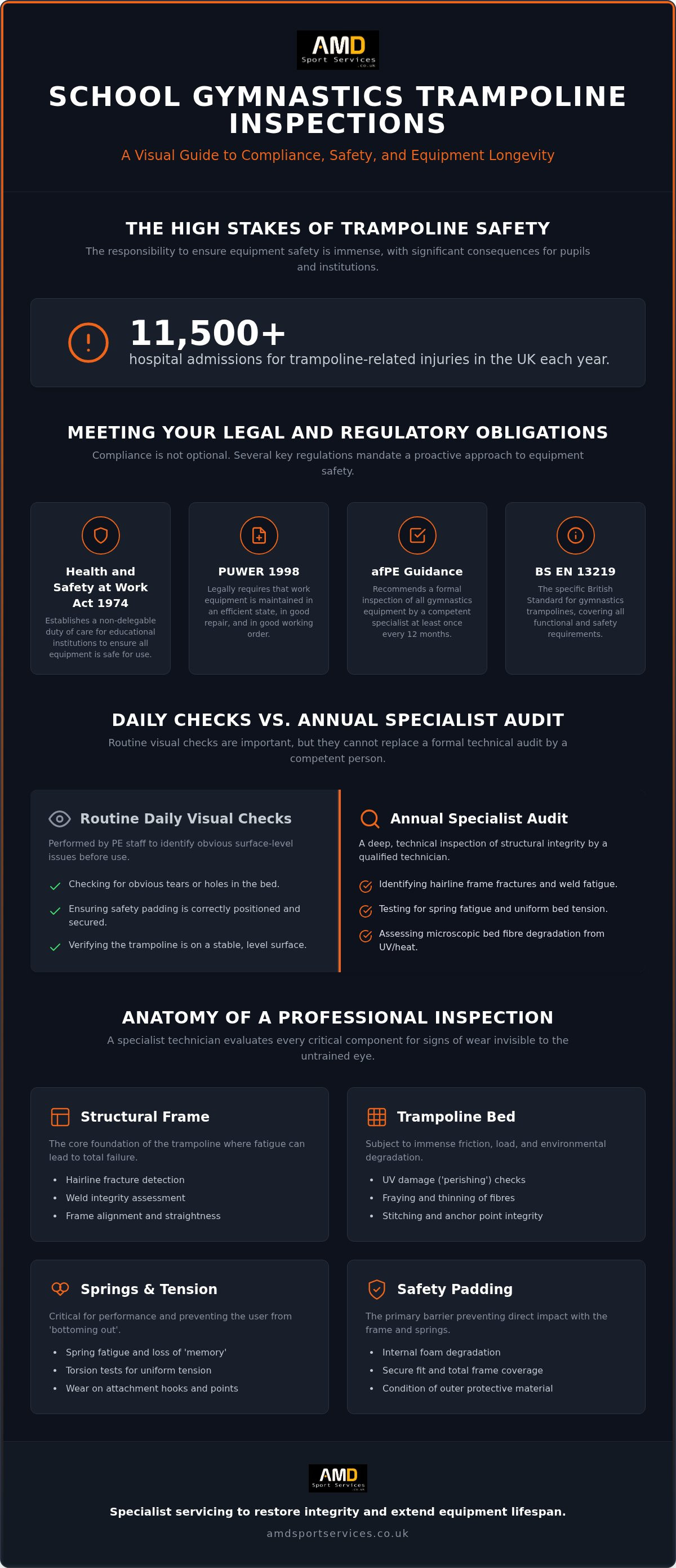
A professional school gymnastics trampoline inspection is a comprehensive technical audit of the equipment's structural and mechanical integrity. It's far more than a simple visual check; it's a systematic evaluation of the frame, bed, springs, and safety padding to ensure every component meets rigorous safety criteria. Under the Health and Safety at Work Act 1974, educational institutions hold a non-delegable duty of care to ensure all work equipment is safe for use. This responsibility is reinforced by the Provision and Use of Work Equipment Regulations (PUWER) 1998, which legally requires that equipment is maintained in an efficient state and in good repair.
The Association for Physical Education (afPE) provides the industry benchmark for sports safety in schools. Their guidance specifically recommends that all gymnastics equipment undergoes a formal inspection by a competent specialist at least once every twelve months. Adhering to these standards is a critical part of a school's risk management strategy. By conducting regular audits, schools significantly reduce their facility liability whilst directly protecting student welfare. A Trampoline safety overview highlights that mechanical failure and structural fatigue are primary risk factors, making these professional audits indispensable for any active PE department.
Compliance with British Standards (BS EN 13219)
BS EN 13219 is the specific British Standard governing the functional and safety requirements of gymnastics trampolines. Whilst general PE equipment checks might identify obvious tears or surface dirt, they often overlook trampoline-specific faults such as hairline frame fractures, weld fatigue, or microscopic spring degradation. A professional school gymnastics trampoline inspection requires a technician with the expertise to assess the physics of the machine. They check for precise tension levels and frame alignment to prevent the bed from "bottoming out" during use. Without this technical certification, a school cannot claim full compliance with national safety benchmarks.
Insurance and Ofsted Requirements
Maintaining a transparent maintenance trail is vital for school administration and legal protection. Insurance providers typically require evidence that "reasonable care" has been taken to prevent accidents. An informal checklist is rarely sufficient; professional inspection records serve as legal proof that the school has met its statutory obligations. Similarly, whilst Ofsted doesn't inspect individual pieces of equipment, they do review how a school manages its safety documentation and risk assessments. Having a current, specialist report from a provider like AMD Sport Services demonstrates a proactive approach to pupil safety and institutional accountability. This documentation creates a clear history of care that protects the school in the event of an incident or an external audit.
Technical Audit: What a Professional Inspection Covers
A professional school gymnastics trampoline inspection is a precision-led process that evaluates the mechanical health of every component. Whilst a teacher might notice a large tear in a bed, a specialist technician identifies the subtle degradation that leads to catastrophic failure. This audit focuses on material fatigue, structural stress, and the efficacy of safety barriers to ensure the unit performs exactly as the manufacturer intended. We look for signs of wear that are invisible to the untrained eye, ensuring that every bounce remains predictable and safe for the student.
Beds, Springs, and Tension Testing
The trampoline bed is subject to immense friction and load. In school environments, nylon beds can suffer from "perishing," where the fibres become brittle and lose their elasticity. This degradation is often accelerated by UV exposure if equipment is stored near windows or by heat in poorly ventilated storage areas. We meticulously check for fraying and thinning areas that could give way under high impact. Identifying these weak points early prevents the bed from failing whilst a student is mid-air.
Spring fatigue is another critical safety hazard. Over time, springs lose their "memory" and fail to return to their original length. This alters the bed's tension and significantly increases the risk of the user hitting the floor or the frame. According to CPSC safety recommendations, maintaining proper tension and replacing worn parts is essential to prevent accidents. We use specific torsion tests to measure mechanical stress, ensuring the tension is uniform across the entire surface. If your springs show signs of over-extension, a professional indoor inspection and maintenance check can determine if a partial or full replacement is necessary.
Frame Integrity and Moving Parts
The steel frame is the foundation of the unit's safety. Amongst older models, stress fractures often develop in the welds or around the leg collars due to the constant vibration of repeated use. Our technicians conduct a structural analysis to locate these fractures before they become critical. We also examine the moving parts that facilitate storage, as these are often the first components to fail in a busy school hall.
Folding mechanisms and floor protectors require regular lubrication and adjustment to prevent metal-on-metal wear. If these parts seize, the frame can warp during folding, leading to permanent structural damage and making the unit unsafe to move. We also inspect the roller stands and lifting equipment. These must be stable and fully functional to ensure staff can transport the equipment safely without risk of entrapment or strain. Finally, we assess the coverall pads for impact attenuation. These pads must be correctly positioned and sufficiently thick to protect users from the frame and springs during an off-centre landing.
Maintenance Schedules: Annual Audits vs. Daily Checks
Distinguishing between a routine visual check and a technical school gymnastics trampoline inspection is essential for effective facility management. Whilst daily observations identify immediate surface hazards, they cannot replace the forensic detail of a professional audit. We recommend a tiered approach to maintenance that combines teacher-led vigilance with specialist technical expertise. This structure ensures that small issues don't escalate into costly repairs or, worse, safety incidents during a lesson.
The Annual Professional Safety Audit
The annual audit is your primary line of defence against equipment failure. During a full service from AMD Sport Services, we dismantle key sections to inspect hidden components like leg collars and internal frame welds. We align our checks with the ASTM F381-16 standard, which provides the technical foundation for component safety and assembly. To minimise disruption to the PE curriculum, many schools schedule these inspections during the summer or half-term holidays. Upon completion, you'll receive a formal Certification of Safety and a detailed fault report, providing the documented evidence required for your health and safety records.
Daily and Weekly User Checks
PE teachers and coaching staff are the first responders for trampoline safety. Before any student steps onto the bed, staff must conduct a pre-use checklist. Training your team to identify "red flag" hazards immediately is the most effective way to prevent accidents between professional visits. This routine should include several key points:
Verifying the trampoline is correctly levelled on the sports hall floor.
Checking that all coverall pads are securely tied and correctly positioned over the frame.
Searching for loose or over-extended springs.
Inspecting the bed for signs of fraying or perishing fibres.
Integrating these habits into your School PE Equipment Safety Checks ensures a culture of safety amongst both staff and pupils. For high-usage sports centres, termly interim reviews are also advisable to catch wear and tear caused by frequent folding and unfolding.
All findings, whether from a daily teacher check or a professional audit, must be recorded in a central safety logbook. This logbook is a critical asset for the school business manager, providing a transparent maintenance trail that simplifies insurance renewals and demonstrates accountability during external reviews. Keeping these records organised ensures that your equipment remains a safe, long-term investment for the school.
Common Trampoline Faults in School Environments
In a busy school environment, trampolines are subject to unique stresses that differ from permanent club setups. Frequent folding, transit across uneven hall floors, and storage in confined spaces lead to specific mechanical issues. Identifying these during a school gymnastics trampoline inspection is vital to prevent minor wear from becoming a structural danger. Often, faults occur not through use, but through the physical handling of the equipment by various staff members and year groups.
The hazards of using "home-made" repairs or non-compliant spare parts cannot be overstated. Using standard hardware store bolts or attempting to restitch a nylon bed with domestic thread creates a false sense of security. These materials don't possess the tensile strength required to withstand the dynamic loads of gymnastics. We frequently identify several common faults amongst school-based equipment:
Warped frames: Caused by forced folding when mechanisms are dry or misaligned.
Corrosion: Resulting from storage in damp boiler rooms or areas with high humidity.
Padding degradation: Safety padding that has compressed over years of use, losing its ability to absorb impact.
Frame misalignment: Occurs when the unit is used by multiple year groups with varying weight loads, leading to uneven stress on the leg braces.
The Repair vs. Replacement Decision
Deciding whether to refurbish or replace requires a technical assessment of the frame's life expectancy. Whilst a perished bed or stretched springs are easily replaced, a frame with multiple weld fractures or significant warping may be beyond safe repair. We prioritise bespoke Gymnastics Trampoline Service and Maintenance solutions that restore structural integrity without the immediate need for capital expenditure on new units. However, if the core frame is compromised, replacement is the only responsible course of action to protect your students.
Storage and Transit Safety
Transit damage is often the root cause of both mechanical failure and damage to sports hall floors. Roller stands that have lost their rubber tyres or have bent axles put excessive strain on the equipment frame and the staff moving it. Additionally, height-adjustable legs must be checked to ensure the locking pins function correctly; a failing leg during setup creates a significant trapping hazard for staff. When moving heavy equipment amongst students, it's essential to clear a wide path and ensure at least two trained staff members are managing the unit's weight. Regularly checking that floor protectors are intact will also prevent the need for expensive court marking renewal or floor sanding.
If you've noticed your equipment is becoming difficult to fold or shows visible signs of wear, book a specialist school gymnastics trampoline inspection to ensure your facility remains safe and compliant.
Specialist School Trampoline Servicing with AMD Sport Services
Securing a professional school gymnastics trampoline inspection is a matter of technical necessity and institutional accountability. AMD Sport Services provides comprehensive servicing and maintenance for educational facilities across the United Kingdom. We understand that school halls are high-traffic environments where equipment is frequently moved, folded, and stored. Our role is to ensure that these physical stresses don't compromise the safety of your students or the longevity of your assets. We work with all major brands of institutional gymnastics trampolines, bringing a deep understanding of material science and structural engineering to every site visit.
Why Choose AMD Sport Services for Your School?
We pride ourselves on being seasoned practitioners rather than just equipment vendors. With over 20 years of industry experience, our technicians don't just look for faults; they provide pragmatic, technical solutions. We understand the budget constraints facing modern schools. Instead of simply recommending a total replacement at the first sign of wear, we offer bespoke repair solutions for beds, springs, and frames. This approach prioritises student safety whilst respecting your school's financial requirements. Our service includes:
Detailed structural assessments of frames and folding mechanisms.
Precision tension testing for springs and beds to ensure uniform performance.
Replacement of safety padding using high-density, impact-attenuating materials.
Full lubrication of moving parts to prevent frame warping and metal fatigue.
Our work is organised to cause minimal disruption to the school day. We arrive with the necessary parts and tools to complete most repairs onsite, ensuring your equipment is back in service as quickly as possible. Every inspection concludes with comprehensive reporting and certification, giving you the documented evidence required for insurance and health and safety audits.
Booking Your Annual Safety Inspection
It's efficient to manage your sports equipment maintenance in a single, organised visit. Many schools choose to combine their trampoline servicing with other indoor inspection and maintenance tasks, such as checking basketball goals, wall bars, or division netting. This consolidated approach reduces administrative overhead and ensures that all sport hall equipment meets the same high standard of durability and safety. We recommend planning these audits during school holidays to ensure the hall is clear for our technicians to conduct a thorough technical review.
Don't leave equipment safety to chance. A proactive maintenance schedule is the most effective way to protect your pupils and extend the life of your gymnastics gear. Contact us for a professional school trampoline inspection and receive a clear, no-nonsense assessment of your facility's current safety status.
Secure Your Facility with Expert Compliance
Maintaining a safe environment for gymnastics requires more than just enthusiasm; it demands technical precision and strict adherence to national standards like BS EN ISO 23659:2022. We've explored how a professional school gymnastics trampoline inspection identifies hidden material fatigue and structural stress that daily visual checks often miss. By formalising your maintenance schedule, you don't just protect your students from avoidable injuries; you also safeguard the school's legal position and prolong the lifespan of expensive assets.
AMD Sport Services brings over 20 years of industry experience to every site visit, offering national UK service coverage as specialists in school sports equipment compliance. We focus on providing pragmatic, technical solutions that keep your facility running smoothly without unnecessary replacement costs. Don't wait for a component failure to compromise your curriculum. Book your professional school trampoline inspection with AMD Sport Services today to guarantee a safe and compliant sports hall for the coming term.
Frequently Asked Questions
How often should school trampolines be professionally inspected?
School trampolines must undergo a professional inspection at least once every twelve months. This annual requirement is set out by the Association for Physical Education (afPE) and is necessary to comply with the Health and Safety at Work Act 1974. Whilst staff should conduct daily visual checks, only a specialist audit can certify the equipment's structural integrity for the coming year. High-usage sports centres often benefit from termly interim reviews to catch wear and tear early.
What qualifications should a trampoline inspector have for a school setting?
An inspector must be a "competent person" as defined by PUWER 1998 regulations. In a school setting, this means an independent specialist with technical knowledge of BS EN 13219 and BS EN ISO 23659:2022 standards. They should possess the mechanical expertise to identify weld fatigue and material degradation. Choosing a seasoned practitioner ensures the inspection is thorough and the resulting safety certification is legally robust for your school's essential health and safety records.
Can we repair a gymnastics trampoline bed ourselves?
No, you shouldn't attempt "home-made" repairs on a gymnastics trampoline bed. Domestic threads and standard sewing machines aren't designed to handle the dynamic loads produced during high-impact gymnastics. Using non-compliant materials voids safety certifications and creates a significant injury risk for students. A professional school gymnastics trampoline inspection will identify if a bed requires a specialist repair or a full replacement using factory-standard nylon or web materials to restore its original strength.
Is it cheaper to repair or replace a school trampoline?
Repairing a trampoline is usually more cost-effective than a total replacement, provided the steel frame remains structurally sound. Replacing individual components like springs, beds, or safety padding can restore a unit to its original safety specifications for a fraction of the cost of a new model. However, if an inspection reveals multiple weld fractures or significant frame warping, the cost of a safe refurbishment may eventually exceed the value of the equipment, making replacement necessary.
What are the most common safety hazards found during inspections?
Technicians frequently identify spring fatigue, where over-extended coils no longer provide uniform tension across the bed. Other common hazards include "perished" nylon fibres caused by UV exposure and safety padding that has lost its impact attenuation properties. We also find frame fractures in older models and seized folding mechanisms. These issues often stem from improper storage or handling rather than just student use, making a regular school gymnastics trampoline inspection essential for spotting hidden faults.
Does our school insurance cover accidents if the trampoline hasn't been serviced?
Most insurance providers require schools to demonstrate that they've taken "reasonable care" to maintain equipment. If an accident occurs on a trampoline that hasn't received its mandatory annual service, the insurer may argue that the school is in breach of its duty of care. Without a current safety certificate and a documented maintenance log, defending a liability claim becomes extremely difficult. Regular professional audits provide the legal evidence needed to support your school's insurance policy effectively.
How long does a professional trampoline service usually take?
A standard technical inspection and service typically takes between one and two hours per unit. This timeframe allows the technician to conduct a full structural audit, test spring tension, and lubricate all moving parts. If minor repairs are required onsite, such as replacing individual springs or adjusting leg collars, the process may take slightly longer. We aim to work efficiently to ensure your sports hall is ready for the next scheduled PE lesson without causing unnecessary disruption.
What standards must school gymnastics equipment adhere to in the UK?
School gymnastics equipment in the UK must adhere to several key standards. These include:
BS EN 13219, which covers the functional and safety requirements for trampolines.
BS EN ISO 23659:2022, focusing on the operational safety and maintenance of the facility.
PUWER 1998, which legally mandates that work equipment is suitable for use and maintained in a safe condition.
Following afPE guidelines ensures your department meets these statutory obligations and protects student welfare.


Comments