
School PE Equipment Safety Check: The Ultimate Compliance Checklist for 2026

Ensuring the safety of physical education equipment is a non-negotiable responsibility for every UK school. It’s a continuous process that goes far beyond a simple annual tick-box exercise. For PE coordinators, site managers, and headteachers, navigating the requirements for a compliant school PE equipment safety check can feel complex. The ultimate goal is simple: to create a safe environment where students can thrive, confident that the apparatus they use is fit for purpose and meticulously maintained.
This comprehensive guide moves beyond the basics, empowering your staff with the technical insight to conduct effective daily visual checks whilst clarifying the critical role of professional annual inspections. We will break down the specific 'red flags' to look for on everything from indoor wall bars to outdoor throwing cages, establishing a culture of observation that protects students, supports staff, and ensures your school meets the highest standards of care. By understanding what to look for, you transform safety from a yearly requirement into a daily habit.
Table of Contents
Understanding the UK Standards Framework for School PE Safety
Whilst many factors contribute to a safe PE environment, the foundation is built on adherence to established technical standards and best practice guidelines. For UK schools, this means looking to the benchmarks set by British and European Standards (BS EN) and the expert advice from the Association for Physical Education (afPE). These frameworks provide the definitive measure of whether equipment is structurally sound and safe for its intended use.
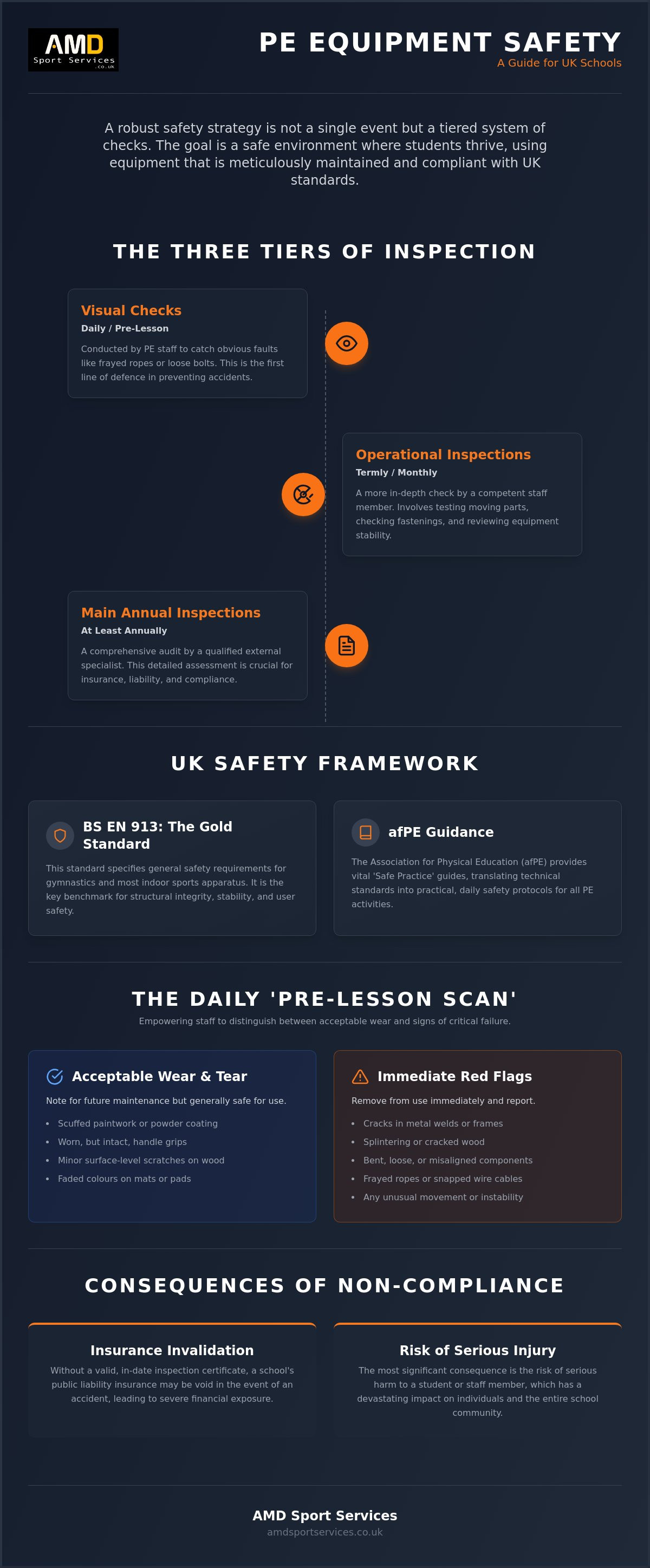
BS EN 913: The Gold Standard for Sports Equipment Safety: This standard specifies the general safety requirements and test methods for gymnastics equipment. Its principles of structural integrity, stability, and user safety are widely regarded as the benchmark for most indoor school sports apparatus. Adherence to this standard is a key indicator that equipment is manufactured and maintained to a high quality.
The Role of afPE (Association for Physical Education): As the subject association for PE, afPE provides essential guidance on best practices. Their 'Safe Practice in Physical Education, School Sport and Physical Activity' (PESSPA) guide is a vital resource for teachers, translating technical standards into practical, day-to-day safety protocols for lessons and activities.
Why 'Annual' is the Minimum, but 'Regular' is the Requirement: A professional, external inspection is required at least annually for insurance and compliance purposes. However, for equipment that sees heavy use, such as in a busy secondary school sports hall, more frequent professional checks may be necessary. The core principle is that equipment must be safe every time it is used, which is why a multi-layered inspection programme is essential.
The Difference Between Visual, Operational, and Main Inspections
A robust safety strategy is not a single event but a tiered system of checks, each with a specific purpose and frequency. Understanding the distinction between these inspection types is fundamental to creating a truly safe environment.
Visual Checks: These are daily or pre-lesson observations conducted by PE staff. They are designed to catch obvious faults that may have occurred since the last use, such as frayed ropes, loose bolts, or debris in floor sockets. This is the first line of defence in preventing accidents.
Operational Inspections: Typically performed on a termly or monthly basis by a competent member of staff (like the site manager or head of PE), these checks are more in-depth. They involve testing moving parts, checking fixings and fastenings, and reviewing the stability of equipment like basketball goals or climbing frames.
Main Annual Inspections: This is the comprehensive, professional audit that must be carried out by a qualified external specialist. The inspector will perform a detailed technical assessment of every piece of equipment, providing a formal report that is crucial for insurance, liability, and strategic maintenance planning.
Consequences of Non-Compliance in Educational Settings
Failing to maintain a rigorous inspection and maintenance programme has serious repercussions that extend beyond the equipment itself. The consequences of non-compliance with established safety standards can be severe for schools and the pupils they serve.
Insurance Invalidation Risks: In the event of an accident involving faulty equipment, an insurer will demand to see evidence of a regular, professional inspection history. Without a valid, in-date inspection certificate from a competent provider, a school's public liability insurance may be invalidated, leaving it financially exposed.
The Impact of Equipment Failure: The most significant consequence is, of course, the risk of serious injury to a student or staff member. An equipment failure can have a devastating impact on the individuals involved and significantly damage the morale and confidence of the entire school community.
In the context of UK school sport, compliance means systematically adhering to the safety benchmarks set by British and European Standards (like BS EN 913) and the operational best practices recommended by bodies such as afPE, ensuring all equipment is verifiably safe for student use.
The Daily Visual Checklist: What PE Staff Must Look For
Empowering PE staff to become the first line of defence is the core of a proactive safety culture. A quick but systematic 'Pre-Lesson Scan' can identify potential hazards before they cause harm. The key is knowing how to distinguish between acceptable 'wear and tear' and signs of impending 'structural failure'. A logbook should be kept in the sports hall or changing rooms to record any faults, ensuring a clear and consistent reporting trail throughout the academic year.
Establish a 'Pre-Lesson Scan' Routine: Make it a non-negotiable part of every lesson plan. Before any activity begins, the teaching staff responsible should perform a quick walk-around of the apparatus being used, focusing on key stress points.
Identify 'Wear and Tear' vs. 'Structural Failure': Wear and tear might be scuffed paint or worn grips, which can be noted for future maintenance. Structural failure indicators are far more serious and include cracks in metal, splintering wood, or any component that appears bent, loose, or misaligned.
Check Floor Fixings and Wall-Mounted Apparatus: For any equipment anchored to the building, always check the connection points. Ensure floor sockets are clear of dirt and debris, and that wall-hinged equipment has its locking mechanisms fully and securely engaged.
Organise a Reporting Log: A simple, accessible logbook is crucial. Staff should be encouraged to record even minor concerns. This data helps the site manager and senior leadership track the condition of equipment over time and prioritise professional repairs.
Indoor Apparatus: Wall Bars, Ropes, and Beams
Fixed indoor apparatus forms the backbone of many gymnastics and circuit training programmes. Due to their static nature, faults can sometimes develop unnoticed. Your daily scan should focus on material integrity and security.
Splintering Wood or Frayed Ropes: Run a hand (carefully) over wooden surfaces like wall bars and beams to check for splinters. Visually inspect climbing ropes along their entire length for signs of fraying, particularly around the top anchor point, which can cause friction burns or indicate a loss of strength.
Secure Locking of Wall-Hinged Frames: For hinged climbing frames or wall bars, physically check that the locking pins or bolts are fully engaged and secure when the apparatus is in the 'open' or in-use position. Any movement or 'play' in the locked position is a major red flag.
Debris in Floor Sockets: Floor sockets for equipment like netball or volleyball posts must be completely clear. Small stones, dust, or other debris can prevent the post from seating correctly, leading to instability during a game.
Portable Equipment: Mats, Benches, and Vaults
Portable equipment is subject to constant movement and handling, which can accelerate wear and tear. Checks should focus on stability, surface integrity, and the condition of connecting parts.
'Bottoming Out' in Gymnastics Mats: Press down firmly in the centre of safety mats. If you can easily feel the hard floor through the foam, the mat is 'bottoming out' and no longer offers adequate impact absorption. It must be taken out of service immediately.
Cracks or Looseness in Bench Hooks: Check the wooden or metal hooks at the end of gym benches. Look for cracks in the wood around the screws or any sign that the hooks are loose. These are essential for connecting benches to other apparatus safely.
Wobbling Vaulting Box Sections: When a vaulting box is assembled, each section should fit snugly onto the one below. A new-looking box with a wobbly construction could indicate a manufacturing defect or damage from improper use, making it unstable and unsafe for use.
Specialist Equipment: Basketball Goals and Trampolines
Certain pieces of equipment, due to their mechanical complexity and high-impact nature, demand specialist technical knowledge for both inspection and maintenance. Basketball goals, particularly ceiling-mounted systems, and gymnastics trampolines fall squarely into this category. A daily visual check is still important, but it must be backed up by a rigorous professional servicing schedule from a qualified expert.
Why Specialist Knowledge is Required: These systems involve high-tension springs, winch mechanisms, structural welds, and safety chains that are beyond the remit of a general caretaker. A specialist understands the unique failure points and metal fatigue risks associated with this apparatus.
Risks of Roof-Mounted and Wall-Pivoted Systems: Motorised, retractable basketball systems add another layer of complexity. Failures in the winch, cable, or locking mechanism can lead to catastrophic failure. Regular professional servicing is the only way to ensure these complex systems remain safe. Learn more about our detailed approach to indoor inspection and maintenance.
Gymnastics Trampoline Safety: A school or club trampoline is a highly-strung piece of performance equipment, not a toy. The forces involved are immense, and the safety relies on the perfect calibration of the bed, springs, and frame pads.
Basketball Goal Safety Standards
From the playground to the sports hall, basketball goals are a hub of activity. Daily checks should focus on the parts that take the most strain.
Backboard and Ring Integrity: Look for any cracks, especially around the points where the ring is bolted to the backboard. Even a small crack can propagate quickly under the force of a dunk or impact. Check that the ring is level and securely attached.
Safety Chains and Winches: For height-adjustable or retractable systems, visually inspect the winch cables for any signs of fraying or broken strands. Ensure safety chains are present and correctly attached, as these are designed to prevent the backboard from falling in the event of a primary mechanism failure.
Signs of Metal Fatigue: Pay close attention to the welds and joints on the support structure. Look for any signs of rust, which can indicate water ingress and corrosion, or fine cracks in the paint around joints, which can be a sign of the metal flexing and fatiguing underneath.
Gymnastics Trampoline Servicing Requirements
A professional trampoline service is an in-depth mechanical strip-down and rebuild. However, PE staff can spot critical warning signs that a trampoline needs immediate attention.
Nicks in the Trampoline Bed: Carefully inspect the entire surface of the bed, both top and bottom. Even a tiny nick or cut from a shoe buckle or stone can become a point of weakness that leads to a complete tear under tension.
The 'Spring Tension Test': Look at the springs when the trampoline is at rest. Do they all look uniform? Are any visibly stretched, deformed, or heavily rusted? A loose or 'dead' spring creates an inconsistent bounce and puts extra strain on the surrounding springs and the bed's D-rings.
Frame Pad Security and Condition: The frame pads (coveralls) are a critical safety feature. Ensure they completely cover the frame and springs, are securely tied in place, and have not lost their cushioning. Any gaps could expose a user to the hard steel frame or spring mechanisms. For more detailed information, view our commercial trampoline maintenance checklist.
Outdoor Athletics Facilities: From Sand Pits to Throwing Cages
Outdoor equipment presents a unique set of challenges. Constant exposure to the elements, from UV radiation to frost, accelerates material degradation. These facilities are also more susceptible to vandalism. A regular inspection programme is therefore vital to ensure they remain safe for use by students and club athletes alike.
Unique Challenges of Outdoor Equipment: Weathering is the primary enemy. UV rays break down netting, water ingress can cause rust or rot in structural poles, and freeze-thaw cycles can damage runway surfaces and foundations.
Maintaining Long Jump Runways and Sand Pits: The safety of a long jump facility depends on the seamless transition from the runway to the take-off board and the correct composition of the landing pit. These elements require diligent, year-round attention.
Throwing Cage Integrity: For sports like hammer and discus, the throwing cage is the most important piece of safety equipment, protecting spectators, officials, and other athletes. Its structural integrity and the condition of its netting are paramount.
Long Jump Runway and Pit Maintenance
A safe and effective long jump facility requires more than just a strip of track and a hole full of sand. Each component must be correctly installed and maintained.
'Delamination' on Tartan Surfaces: Inspect the surface of the polyurethane runway for any areas where the top layer is peeling away from the base (delamination). These loose patches create significant trip hazards for athletes approaching the board at speed.
Take-Off Board Safety: The take-off board must sit perfectly flush with the runway surface. Any raised edge is a trip hazard, whilst a sunken board can cause an ankle injury. The board itself should be free from rot or cracks. Find out more in our specialist guide to take-off board replacement.
Managing Sand Levels: The sand in the landing pit must be regularly raked to keep it loose and free of debris. Crucially, the level must be maintained to be flush with the runway, ensuring it provides sufficient depth to absorb an athlete's landing safely and prevent injury.
Throwing Cage and Netting Safety
A throwing cage is a complex structure designed to absorb massive forces. Its inspection requires a focus on both the steel framework and the specialist netting.
Corrosion on Structural Poles: Examine the base of the main support poles, especially where they enter the ground or are bolted to concrete pads. This area is a hotspot for corrosion, which can compromise the entire structure's strength.
The 'Aperture Test' for Netting: The netting must be inspected for holes or signs of UV degradation, which often presents as brittleness or discolouration. A key test is ensuring the net's apertures (the small holes) have not stretched, as this could allow an implement to pass through.
Smooth Operation of Gate Mechanisms: The gates of the cage must swing freely and lock securely. Stiff or damaged gates can be dangerous for officials to operate and can compromise the cage's safety during a competition.
Implementing a Professional Maintenance and Repair Strategy
A successful safety programme pairs diligent in-house checks with a strategic partnership with a professional maintenance provider. This approach not only ensures compliance but also maximises the lifespan of your equipment and provides better value for your school's budget. It's about moving from a reactive 'fix it when it breaks' model to a proactive 'prevent and maintain' strategy.
When to 'Quarantine' Equipment: Implement a simple Red-Amber-Green (RAG) rating system. Green: Fit for use. Amber: Minor fault noted, can be used with caution but needs monitoring/scheduled repair. Red: Serious fault found, equipment is immediately removed from service, labelled 'DO NOT USE', and quarantined until professionally repaired.
Benefits of a Multi-Year Service Agreement: Partnering with a specialist company for a multi-year inspection and maintenance contract helps with budget forecasting. It often provides better value than ad-hoc callouts and builds a relationship with a provider who understands the unique needs and history of your school's facilities.
Why Bespoke Repairs are Often Better: For older or heavily used equipment, a standard replacement part may not be sufficient. A specialist repair can often reinforce a known weak point, fabricate a stronger component, or adapt a solution that is more durable than the original, saving money in the long run.
Next Steps: Booking Your 2026 Professional Safety Audit: The start of the academic year is the ideal time to schedule your main annual inspection. This ensures you have a full year of compliance ahead and allows time to plan for any necessary repairs identified in the report.
The Professional Inspection Report
The report you receive after a professional inspection is more than just a certificate; it's a vital tool for planning and risk management. It should be clear, detailed, and actionable, providing the evidence you need to maintain a safe environment.
What a Comprehensive Report Should Include: A good report will feature a full asset list of all equipment inspected, clear photographic evidence of any faults found, a RAG rating for each item, and specific, actionable recommendations for repair or replacement.
Justifying Capital Expenditure to Governors: This official, third-party document is the perfect tool for demonstrating the need for investment to your school's governing body or local authority. It replaces subjective opinion with objective, expert evidence, making budget allocation a more straightforward process.
A Seasoned Practitioner's approach to repairs involves diagnosing the root cause of a failure, not just treating the symptom, often fabricating a bespoke solution that reinforces the equipment beyond its original specification.
Choosing the Right Maintenance Partner
The quality of your inspection is entirely dependent on the competence of the company you hire. A thorough check is an investment in safety, so it’s crucial to select a partner with the right credentials, experience, and operational approach.
Check for Industry-Specific Certifications and Insurance: Your chosen provider should be able to supply evidence of public liability insurance and any relevant industry accreditations. Ask about their technicians' experience with the specific types of equipment you have, particularly specialist apparatus like trampolines or motorised goals.
The Value of National Coverage with a Local, Expert Feel: A national provider offers the reassurance of standardised procedures and significant resources, whilst a dedicated local team ensures you receive a responsive, personal service from technicians who understand the region. At AMD Sport Services, we combine over 20 years of technical expertise with a nationwide reach, providing comprehensive reports for insurance and compliance.
To ensure your school's PE equipment is safe, compliant, and ready for the year ahead, it’s time to act. Book your professional school PE equipment safety check today with AMD Sport Services and partner with the seasoned practitioners in UK school sport safety.
Frequently Asked Questions about School PE Equipment Safety
How often should school PE equipment be professionally inspected? As a minimum, all school PE and sports equipment must be professionally inspected by a qualified specialist at least once every 12 months. However, for facilities with very high usage or for specific high-stress equipment like gymnastics trampolines, a more frequent 6-month inspection schedule is often recommended.
Who is legally responsible for the safety of sports equipment in a school? The ultimate responsibility for ensuring a safe environment lies with the employer, which is typically the school's governing body or the local authority. This 'duty of care' is delegated down through the headteacher to the PE department and individual teachers, who are responsible for conducting daily visual checks and reporting faults.
Can our school caretaker perform the annual PE equipment safety check? No. While a competent caretaker or site manager is ideal for conducting regular 'operational' inspections (e.g., termly checks of fixings), the main annual inspection must be performed by an independent, external specialist. This is to ensure an impartial and technically proficient assessment is made, which is a requirement for most insurance policies.
What should I do if I find a fault during a daily visual check? If you find a fault, you must immediately apply the Red-Amber-Green system. If the fault poses any risk of injury (e.g., a crack, a loose fixing, a tear in a mat), it is a 'Red' item. The equipment must be taken out of service, clearly labelled 'DO NOT USE', and the fault must be reported to the site manager or head of department through your school's official reporting procedure.
Does outdoor athletics equipment need the same inspection frequency as indoor gear? Yes, and in some cases, it may need more diligent monitoring. Outdoor equipment is subject to weathering, corrosion, and potential vandalism, which can cause its condition to deteriorate faster than indoor apparatus. The annual professional inspection is essential, and regular visual checks are crucial, especially after periods of bad weather.
What are the most common safety 'red flags' for gymnastics trampolines? The most common critical red flags are: any small nicks or tears in the trampoline bed, visibly stretched or broken springs, and frame pads (coveralls) that are worn, displaced, or incorrectly secured, leaving the steel frame or springs exposed.
Is it necessary to replace a basketball backboard if it only has a small crack? Yes, absolutely. A small crack in a perspex or wooden backboard is a critical failure point. The immense forces exerted on a backboard during play can cause a small crack to propagate suddenly and catastrophically, leading to the board shattering. The unit should be taken out of service immediately until the backboard is professionally replaced.
How long does a typical professional school sports equipment inspection take? The duration depends on the amount of equipment. A small primary school gym might take 2-3 hours, whereas a large secondary school with extensive indoor facilities, a sports hall, a gym, and outdoor athletics areas could take a full day or longer to inspect thoroughly.


Comments