
School Playground Equipment Inspection: The UK Compliance Guide 2026

With an estimated 40,000 children under 15 visiting UK A&E departments annually due to playground injuries, the pressure on educational institutions to maintain flawless safety records has never been higher. For many headteachers and site managers, the annual school playground equipment inspection is a source of significant anxiety rather than a simple tick-box exercise. You want your pupils to challenge themselves, yet the fear of liability and the complexity of technical standards can make outdoor play feel like a legal minefield.
We understand that deciphering the difference between a routine visual check and a full structural audit is often frustrating, especially when you need specialist repairs for items like basketball goals or safety surfacing. This guide serves as a definitive resource for navigating BS EN 1176 and 1177 safety standards and your legal duties under the Health and Safety at Work etc. Act 1974. We will outline the essential three-tier inspection system, explain how to identify qualified contractors for technical repairs, and provide a clear roadmap to ensure your school's outdoor assets remain durable and compliant for years to come.
Table of Contents
Legal Obligations and Safety Standards for UK School Playgrounds
The Health and Safety at Work etc. Act 1974 forms the bedrock of safety management in British schools. It requires governors, academies, and local authorities to take all reasonably practicable steps to ensure the safety of pupils, staff, and visitors. While understanding What is a Playground? might seem straightforward, the legal reality is that these spaces are complex, high-risk environments that demand formal, expert oversight. A regular school playground equipment inspection isn't just a recommendation. It's the primary method for demonstrating that you've fulfilled your legal duty of care and managed risks effectively.
BS EN 1176 and BS EN 1177 are the two most critical safety standards for school sites. The former dictates the design and structural requirements for play apparatus, whilst the latter focuses on impact-attenuating surfacing. Adhering to these standards ensures that if a fall occurs, the risk of a life-changing injury is significantly reduced. This is vital, as RoSPA data indicates that 80% of playground accidents involve falls. Modern safety philosophy now embraces a risk-benefit approach. We don't aim for a sterile, risk-free environment. Instead, we manage hazards so children can experience challenge without facing unacceptable danger.
The Consequences of Non-Compliance
Failure to maintain accurate safety records can lead to severe financial and reputational damage. Insurance premiums for educational institutions are often contingent on following the three-tier inspection model. If a child is injured and you lack a professional school playground equipment inspection report, your liability increases significantly. Ofsted also evaluates how well facilities are managed as part of their leadership assessment. A technical report from a specialist acts as a vital legal defence, proving that the school has been proactive in its safety duties. You can find more about our service and maintenance workflows to see how we document these essential checks.
Key Standards to Recognise
BS EN 1176 (Parts 1-11): This is the primary standard for general playground equipment. It covers everything from swings and slides to cable ways and spatial networks.
BS EN 15312: This standard applies to Multi-Use Games Areas (MUGAs) and free-access sports equipment. It's particularly relevant for schools with basketball goals and football units.
BS EN 16630: This covers permanently installed outdoor fitness equipment. This has become a major trend for older pupils in 2026 and requires specific structural checks.
The Three Tiers of Playground Safety Inspections
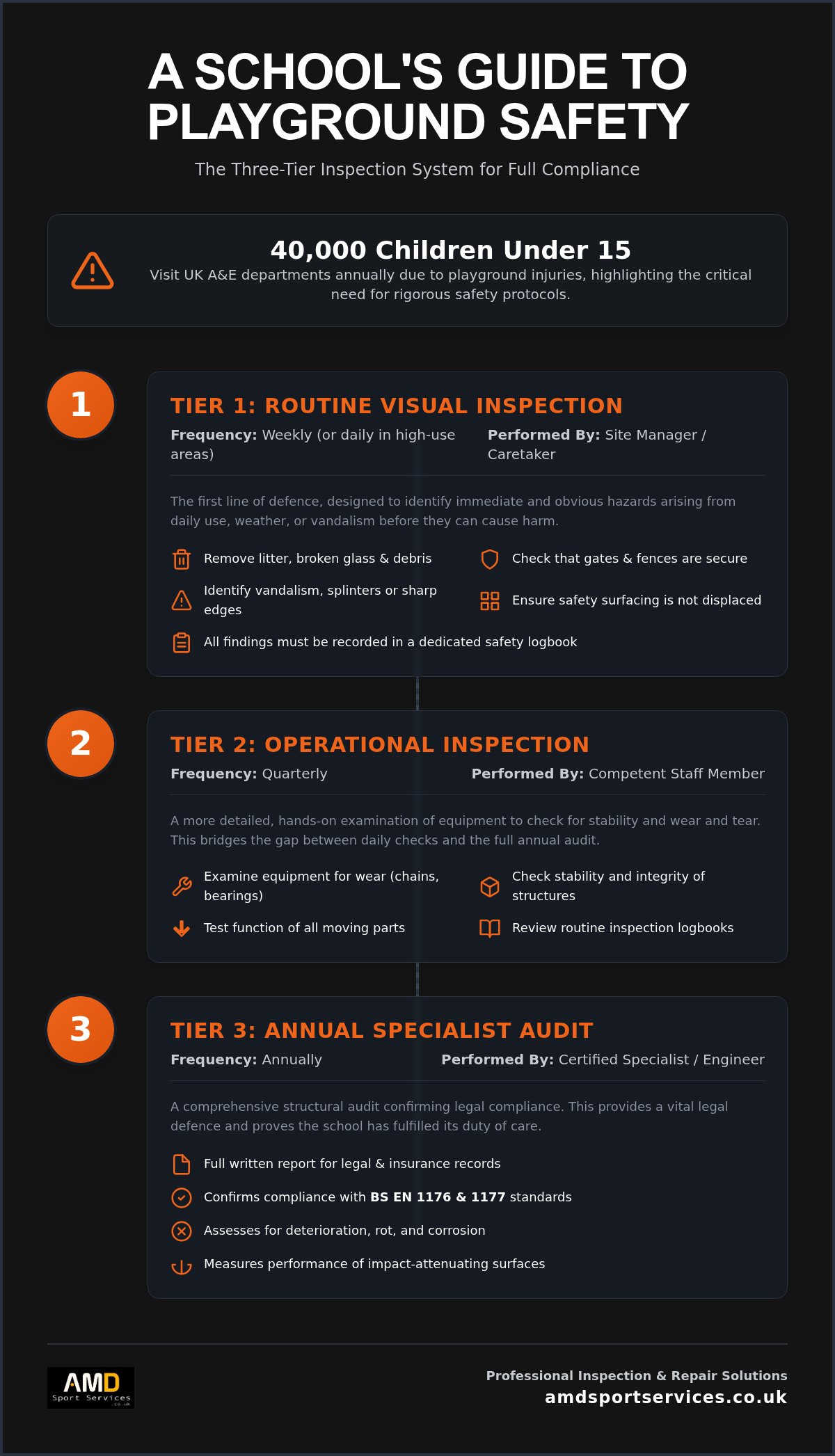
To maintain a safe environment, schools shouldn't rely on a single yearly check. A robust safety strategy uses a layered approach. This hierarchy, often referred to as RoSPA playground safety inspections cycles, ensures that hazards are caught before they cause injury. Each tier serves a specific purpose, ranging from the daily removal of debris to the high-level structural analysis of complex equipment. By following this three-tier system, school leaders can demonstrate a proactive commitment to pupil safety whilst protecting the school's long-term budget.
Routine Visual Inspections (Weekly)
The first line of defence is the routine visual inspection. This task is usually managed by the school caretaker or site manager. It doesn't require specialist engineering knowledge, but it does require a keen eye and consistency. The goal is to identify immediate dangers that arise from daily use, weather conditions, or antisocial behaviour. We recommend that these checks are performed weekly, or even daily in high-traffic areas. Key focus points include:
Removing broken glass, litter, or animal fouling from the play area.
Identifying vandalism or graffiti that could create splinters or sharp edges.
Checking that gates close correctly and perimeter fences are secure.
Ensuring that safety surfacing hasn't been displaced, leaving hard ground exposed.
Consistency is vital. All findings, even if no faults are found, must be recorded in a dedicated safety logbook. If an accident occurs, this log serves as essential evidence that the school was actively monitoring the site.
Operational and Annual Audits
Operational inspections occur quarterly and provide a more technical look at the equipment. Here, the focus shifts to hidden wear and tear. We check the internal components that a daily visual sweep might miss. This includes testing the stability of posts, checking the tension in swing chains, and looking for early signs of corrosion in metal structures. This tier bridges the gap between basic checks and the specialist annual audit.
Once a year, a comprehensive school playground equipment inspection must be carried out by an independent, RPII-accredited specialist. This is a structural assessment that goes beyond surface-level checks. The inspector provides a detailed report with a 'Risk Rating' for every item. Understanding these ratings is vital for your site management. A 'Low Risk' might only require monitoring, whilst a 'High Risk' demands immediate decommissioning and repair. If you are unsure how to prioritise these tasks, our team can help you develop a clear service and maintenance plan based on your latest audit findings.
Finally, never overlook the post-installation inspection. When you invest in new equipment, an independent check ensures the installer has followed BS EN 1176 standards correctly. An annual school playground equipment inspection then maintains that safety baseline throughout the life of the asset.
Beyond the Swing Set: Specialist Sports and MUGA Inspections
A standard school playground equipment inspection often focuses on slides, swings, and climbing frames. However, modern school sites are multi-functional. You likely have MUGAs, basketball goals, and athletics tracks within the same footprint. These assets require a different inspection mindset. Play equipment is usually designed for static or pendulum loads. Sports apparatus handles high-impact, dynamic forces. Think of a teenager dunking on a basketball rim or a football repeatedly hitting a perimeter fence. We see many schools neglect these items until a failure occurs, but proactive maintenance is far more cost-effective.
The foundational Legal Obligations and Safety Standards for UK School Playgrounds apply to every square inch of your outdoor space. For athletics infrastructure, like long jump pits and runways, we focus on surface integrity. A cracked Tartan track or a weed-infested sandpit isn't just a maintenance issue. It's a safety liability for PE lessons and competitive sport. We check for 'delamination' in runway surfacing, where the top layer peels away, creating a significant trip hazard for sprinting pupils. We also assess the depth of the sand and the condition of the pit edging to prevent impact injuries.
Multi-Use Games Areas (MUGAs)
MUGAs are the workhorses of the school day. They face constant use and often double as social spaces during break times. During an inspection, we look for fence fatigue, where the weld mesh breaks away from the posts. This creates sharp, protruding wires that can cause serious lacerations. Integrated goal systems and overhead netting must also be checked for structural stability. If your school uses similar setups indoors, see our guide on Sports Hall Netting Systems to understand the crossover in safety requirements.
Basketball and Netball Equipment
Basketball and netball posts are high-risk items if they fail. Wall-mounted units need their masonry fixings checked for vibration looseness, whilst socketed posts require checks for ground-level corrosion. We also identify 'finger entrapment' hazards in older net designs and rim assemblies. This specialised focus ensures your school playground equipment inspection is truly comprehensive, covering every asset from the sandpit to the hoop. If your equipment is reaching the end of its life, following professional Basketball Goal Installation Services standards ensures your new assets meet 2026 safety benchmarks.
How to Organise and Action a Playground Safety Audit
Organising a school playground equipment inspection should never be a last-minute scramble. Effective preparation ensures the audit is thorough and that the resulting data is truly actionable. Start by gathering all historical documentation. This includes previous inspection reports and manufacturer manuals for complex items like motorised basketball goals or gymnastics trampolines. Having these records ready allows the inspector to track the progression of wear and tear, which is vital for predictive maintenance and long-term budgeting.
We recommend scheduling these visits during school holidays. This minimises disruption and allows the inspector unrestricted access to every piece of equipment without safety cordons or school bells interrupting the workflow. Clear communication with stakeholders is also essential. Inform governors of the upcoming audit to demonstrate compliance, and use the eventual positive results to reassure parents that the school environment is managed to professional standards. Once the audit is complete, the site manager should review the findings immediately to identify any 'High Risk' items that require urgent decommissioning.
The Inspection Day Checklist
To get the most value from the day, ensure your site team is prepared for the inspector's arrival. A smooth process leads to a more accurate report. Use the following checklist:
Ensure full access to all areas, including locked equipment sheds where indoor sports gear is stored.
Provide a clear site map that highlights any recent installations or refurbishment projects.
Arrange a post-inspection debrief with the site manager to discuss immediate concerns before the formal report is drafted.
Actioning the Findings
The resulting report from your school playground equipment inspection will categorise findings by risk level. You must distinguish between routine maintenance, which your site team can likely handle, and specialist repairs. For example, tightening a basic bolt is routine, but refurbishing a long jump runway or repairing a hammer cage net requires technical proficiency. Bespoke repairs often involve sourcing specific components that standard off-the-shelf kits cannot address. This is where many schools struggle to find reliable contractors who understand the mechanical nuances of sports apparatus.
Budgeting for long-term refurbishment rather than repeated short-term patching will ultimately protect your school's outdoor assets and reduce the total cost of ownership. If your latest report has highlighted complex mechanical or structural failures that require expert attention, you can request a specialist repair quote to ensure your facilities meet 2026 compliance standards.
Professional Inspection and Repair Solutions from AMD Sport Services
Receiving a detailed report after a school playground equipment inspection often creates more questions than it answers. Many inspection firms specialise only in identifying faults, leaving site managers with a list of problems but no technical means to rectify them. At AMD Sport Services, we bridge this gap by acting as both the auditor and the engineer. We've spent over 20 years developing the technical proficiency required to service equipment that standard contractors often avoid, such as specialised athletics infrastructure and complex indoor sports hall systems.
Our approach is rooted in pragmatic professionalism. We understand that school budgets are finite, so we focus on repairs that restore safety whilst maximising the durability of your existing assets. Whether we're refurbishing a long jump runway or motorising roof-mounted basketball goals, our work is characterised by technical honesty. We don't rely on polished sales pitches; instead, we depend on a steady, matter-of-fact delivery of high-quality workmanship that meets the rigorous demands of the educational sector.
Integrated Service and Maintenance
Choosing a single partner for your school playground equipment inspection and subsequent repairs is a sensible choice for any school business manager. This integrated model eliminates the communication breakdown that often occurs between an independent inspector's findings and a third-party repair team's execution. It ensures that the person fixing your equipment understands the exact safety standard they are working towards. Our teams work to strict British Standards, ensuring every weld, bolt, and net meets 2026 compliance benchmarks. You can learn more about our Service and Maintenance packages to see how we categorise and prioritise your facility needs.
Case Studies and Projects
We take pride in solving unique mechanical and structural challenges that off-the-shelf products cannot address. Our portfolio includes everything from the renewal of multi-use games areas to the intricate repair of gymnastics trampolines and indoor cricket netting. We provide national UK coverage, supporting academies and local authorities from the initial safety check through to the final refurbishment. Browse our recent Projects to see evidence of our work in school environments. If your latest audit has highlighted equipment failures or if you're planning a facility upgrade, our team is ready to provide a bespoke safety consultation based on decades of hands-on experience.
Securing the Future of Your School's Outdoor Assets
Maintaining safety in a modern educational setting requires more than just good intentions. It demands a methodical approach to the three-tier inspection cycle and a deep understanding of current BS EN standards. By prioritising a professional school playground equipment inspection, you protect your pupils from harm whilst shielding your institution from the legal and financial risks of non-compliance. A thorough audit provides the baseline you need for a robust, evidence-based site management plan.
AMD Sport Services brings over 20 years of industry experience to every site visit. Our RPII registered inspectors identify structural vulnerabilities, and our engineering teams provide specialist repair capabilities for all sports and play apparatus. We pride ourselves on solving the complex technical challenges that standard service providers often miss. You can book your professional school playground equipment inspection today to ensure your facilities remain durable and safe for years to come. Let's work together to create an environment where every child can play and exercise with total confidence.
Frequently Asked Questions
How often should school playground equipment be inspected by a professional?
Professional inspections should occur at least once a year as part of a formal annual main inspection. This specialist audit sits within a wider three-tier cycle that includes weekly visual checks by site staff and quarterly operational inspections. Following this structured approach ensures that a school playground equipment inspection identifies structural fatigue or hidden wear before it leads to an equipment failure or pupil injury.
Is a playground inspection a legal requirement for UK schools?
Yes, maintaining safe facilities is a legal obligation under the Health and Safety at Work etc. Act 1974. Whilst the legislation doesn't name a specific inspection frequency, adhering to the BS EN 1176 and 1177 standards is the recognised way to demonstrate compliance. Failing to produce valid inspection records can leave a school liable in the event of an accident and may invalidate your insurance cover.
What is the difference between an operational and an annual inspection?
An operational inspection is a quarterly deep-dive that focuses on the stability and technical wear of the equipment, such as checking bolt tightness or bearing lubrication. The annual main inspection is a more comprehensive structural audit. It must be conducted by an independent specialist to provide an unbiased assessment of the entire site's safety, including the integrity of foundations and the performance of impact-absorbing surfacing.
Can our school site manager carry out the annual playground inspection?
No, the annual main inspection must be performed by an independent, RPII-registered professional. Whilst your site manager is the best person for routine weekly checks, they don't typically have the specialist tools or insurance required for a full structural audit. Using an external expert ensures the report is a valid legal document that provides an objective view of the facility's safety and maintenance needs.
What happens if our playground equipment fails its safety inspection?
If an item fails, you must decommission it immediately to prevent pupil access. Your report will provide a risk rating to help you prioritise repairs. Because many items, like basketball goals or outdoor gym gear, require technical proficiency to fix, you should seek a contractor who specialises in structural repairs. Often, these failures require bespoke components that standard off-the-shelf maintenance kits simply cannot replace.
Do we need to inspect the surfacing separately from the play equipment?
No, surfacing is assessed as part of the same safety audit under the BS EN 1177 standard. We test the impact-absorbing properties of the ground to ensure it still provides adequate protection against falls. We check for hardening in wet-pour rubber, displacement in loose-fill bark, and signs of delamination. A safe play frame is ineffective if the ground beneath it has lost its ability to cushion an impact.
How much does a professional school playground inspection cost?
The investment for a professional audit varies depending on the size of your site and the volume of equipment. Factors such as the presence of MUGAs, athletics tracks, or large-scale climbing networks will influence the time required for a thorough assessment. Schools should prioritise providers who offer a clear roadmap for repairs, as identifying a minor fault early often prevents the need for a total equipment replacement later.
Does the inspection cover indoor sports hall equipment as well?
A comprehensive school playground equipment inspection can be extended to include your indoor sports hall assets. This includes checking the safety of gymnastics trampolines, wall-mounted basketball goals, and division netting systems. Managing both your indoor and outdoor facilities through a single specialist ensures a consistent safety standard across the entire school estate and simplifies your compliance documentation for Ofsted and local authorities.


Comments