
School Trampoline Maintenance: Safety & Compliance 2026

A trampoline that appears functional on the surface can still represent a significant legal liability if its maintenance record doesn't meet statutory requirements. For school business managers and PE leads, the pressure to maintain high safety standards whilst managing limited budgets is constant. You likely recognise the difficulty of finding contractors who truly understand the technical nuances of institutional gymnastics equipment rather than just basic repairs.
We understand that navigating the differences between AfPE guidance and BS EN standards can be confusing. This guide to trampoline maintenance school protocols for 2026 provides the clarity you need to ensure your facility remains fully compliant and your pupils stay safe during every lesson. We'll outline the specific requirements of the Health and Safety at Work Act 1974 and PUWER regulations as they apply to your equipment. You will learn about the mandatory frequency for statutory inspections, how to identify wear in beds and springs before they become hazards, and how a professional gymnastics trampoline service can significantly extend the lifespan of your department's most expensive assets.
Table of Contents
Statutory Requirements and Safety Standards for School Trampolines
Statutory compliance isn't just a box-ticking exercise; it's a fundamental aspect of risk management. Schools operate under the Health and Safety at Work Act 1974 and the Provision and Use of Work Equipment Regulations 1998 (PUWER). These regulations mandate that all work equipment, including sports apparatus, is maintained in a state of good repair. For a trampoline maintenance school programme to be effective, it must bridge the gap between daily teacher observations and formal technical assessments.
Legally, there's a sharp distinction between a routine visual check and a statutory inspection. While PE staff are responsible for daily "pre-use" checks, PUWER requires that equipment posing a significant risk be inspected by a "competent person" at regular intervals. In the context of gymnastics, this means a technician with specific mechanical knowledge of modern trampoline construction and structural stress points. Relying solely on internal staff to spot weld fatigue or spring tension loss is a gamble that most school insurance policies won't support.
The AfPE Safe Practice in Physical Education Guidelines
The Association for Physical Education (AfPE) provides the definitive framework for safety in UK schools. Their guidelines recommend that all physical education apparatus, particularly high-usage items like trampolines, undergo a full professional inspection at least once every twelve months. This annual gymnastics trampoline service provides the school with a formal certificate of compliance. This document is your primary defence in the event of an accident, proving that the governors and leadership team have exercised their duty of care. AfPE views specialist equipment maintenance as a mandatory safety pillar that cannot be substituted by internal staff reviews.
BS EN 12503 and Equipment Integrity
Compliance with BS EN 12503 is the benchmark for gymnastics equipment used in educational settings. This standard governs everything from frame stability to the shock-absorption qualities of the landing surfaces. It's vital to understand that "garden-grade" equipment standards are wholly insufficient for the rigours of a school environment. Institutional trampolines must withstand higher frequency use and greater weight tolerances. The standard also covers the safety mats and surfacing surrounding the unit. If the mats have lost their impact-attenuation properties, the entire setup is non-compliant, regardless of the trampoline's condition.
School insurance providers frequently stipulate that high-risk equipment must be serviced by qualified contractors. Failing to produce a valid inspection report following a pupil injury can lead to the withdrawal of indemnity. This leaves the school or local authority directly liable for compensation claims. Professional trampoline maintenance school contracts mitigate this risk by providing a documented audit trail of safety and repair that stands up to legal scrutiny.
The Anatomy of a Professional Gymnastics Trampoline Service
A professional service is a mechanical audit. It requires a seasoned eye to spot weld fatigue or structural misalignment that a standard visual check would miss. We don't just look for obvious tears; we examine the frame for stress fractures, particularly around the leg attachments and hinge points. Vibrations from thousands of landings loosen bolts over time. If the frame's structural alignment is compromised, the tension across the bed becomes uneven, leading to premature wear and unpredictable bounce patterns.
Moving parts are often the most neglected components. Hinges must operate without resistance, and lifting rollers need regular lubrication to ensure they function correctly. If these mechanisms seize, school staff risk back injuries while attempting to set up or store the equipment. A comprehensive trampoline maintenance school programme ensures these mechanical interfaces are cleaned, greased, and tested for smooth operation. Scheduling a regular gymnastics trampoline service ensures these technical nuances are never overlooked.
Inspecting the Trampoline Bed and Springs
The trampoline bed is subject to immense physical stress and environmental degradation. We check for "windowing", where the weave of the nylon bed begins to separate. This is a clear sign of material "perish" and indicates the bed's tensile strength is failing. We also evaluate the centre mark; if it's faded or skewed, it suggests the bed is no longer pulling evenly across the frame. While UK institutions primarily follow BS EN codes, the technical rigour found in ASTM F2970-22 safety standards offers a useful benchmark for the maintenance of high-performance beds and suspension systems.
Springs are the engine of the trampoline. We test for elasticity loss by looking for "stretched" coils or gaps in the metal. A spring that has lost its memory won't return to its original shape, which compromises user safety and puts additional strain on the surrounding springs. Identifying these individual failures early prevents a systemic collapse of the suspension system.
Frame Integrity and Safety Padding
Safety padding must do more than just cover the springs; it must provide genuine impact attenuation. We check the internal foam density to ensure it hasn't "bottomed out". If the foam is crushed, it won't protect a pupil who lands on the frame. We also verify that all attachment straps are secure so the pads don't shift during use. This is a critical part of trampoline maintenance school safety protocols, as loose padding is a significant trip hazard.
Finally, we inspect the floor protectors. These rubber or plastic feet prevent the heavy steel frame from gouging the sports hall surface. Protecting the floor is just as important as protecting the equipment. Replacing a specialised sports floor is a massive capital expense that can be avoided through simple, diligent maintenance of these sacrificial parts. We ensure every fixing and bolt is tightened to the manufacturer's exact specifications before signing off the unit.
Identifying Critical Faults: When to Repair vs Replace
Deciding whether to refurbish an existing unit or invest in a new one requires a pragmatic look at the equipment's structural health. We often use the "Three-Spring Rule" as a primary diagnostic tool. If you find three or more failed or significantly stretched springs in a single cluster, it's rarely an isolated issue. It usually indicates that the surrounding suspension has been overcompensated and is now operating beyond its safe elastic limit. This is a vital part of trampoline maintenance school protocols; identifying when a small repair is actually a symptom of systemic fatigue.
Frame health is equally critical. Older equipment frequently shows signs of metal fatigue, particularly at the weld points on the leg assemblies. If you notice rust bleeding from a joint or hairline fractures in the powder coating, the structural integrity is compromised. At this point, the economic argument for repair often fails. Replacing a specialised bed and a full set of springs on a fatigued frame is a poor investment. It's often more cost-effective for the long-term budget to replace the entire unit rather than constantly patching up a failing structure.
Don't ignore the condition of the floor protectors. A poorly maintained trampoline can ruin an expensive sports hall floor in a single term. If the rubber or plastic feet have worn through, the heavy steel frame will gouge the timber or synthetic surface. The cost of resurfacing a sports hall far exceeds the price of a comprehensive Service and Maintenance visit to replace sacrificial parts.
Warning Signs for PE Teachers and Site Managers
Staff should be trained to listen for unusual metallic creaks or groans during use. These noises often signal that the frame is under improper stress. Visually, look for frayed stitching on the bed or the attachment points of the safety padding. If any fault is discovered during a lesson, activity must stop immediately. The equipment should be folded, moved to a secure area, and "tagged out" with a formal notice to prevent further use. Adhering to this level of structured training program safety ensures that minor faults don't escalate into serious incidents.
The Risks of DIY Trampoline Repairs
We strongly advise against "handyman" repairs using generic parts found online. Non-standard springs often have different tension rates, which creates uneven loading across the frame. This can lead to the frame warping or the bed tearing unexpectedly. Using unapproved components will void your manufacturer's warranty and your safety certification. It also complicates your insurance position. Professional trampoline maintenance school services use only manufacturer-specified parts, ensuring the equipment performs exactly as it was engineered to do.
Organising Your School’s Sports Equipment Maintenance Schedule
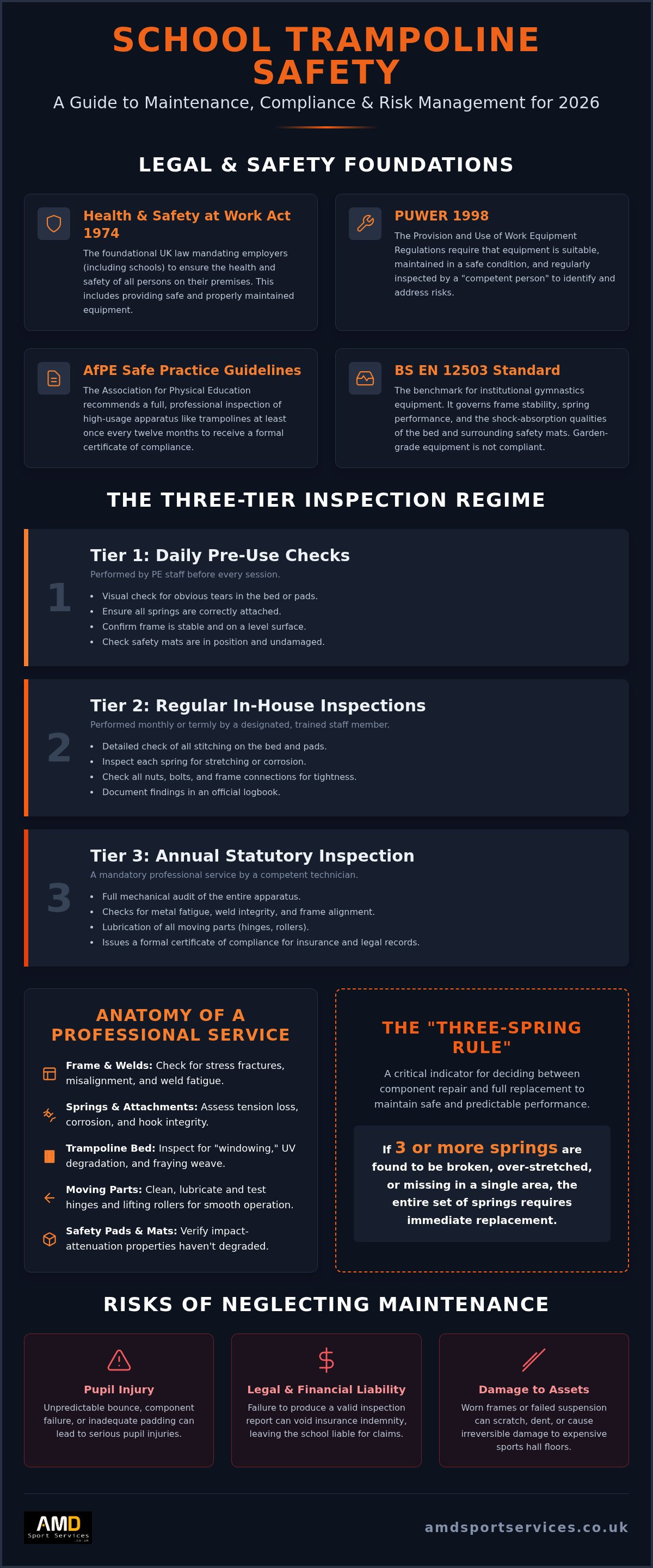
Effective equipment management relies on a structured, three-tier inspection regime. This approach ensures that trampoline maintenance school standards are upheld throughout the academic year. By categorising checks into daily, termly, and annual cycles, schools create a comprehensive safety net for both pupils and staff. Integrating these specific checks into your wider indoor inspection and maintenance programme allows for better budget forecasting and resource allocation.
Daily Pre-use Checks: Conducted by PE teachers before every lesson. These focus on immediate hazards like loose padding, surface debris, or obvious bed damage.
Termly Operational Checks: Performed by the site manager or a designated safety officer. These involve a more detailed look at floor protectors, hinge lubrication, and spring tension.
Annual Statutory Inspections: Carried out by a competent specialist contractor to verify structural integrity and provide official certification.
Training staff to perform effective pre-use visual checks is the first line of defence. It isn't enough to simply glance at the equipment; teachers must be confident in identifying the early signs of wear mentioned in previous sections. To streamline your safety protocols, you can book a professional inspection to ensure all apparatus meets the required standards before the new term begins.
The Annual Professional Inspection
A specialist contractor provides a level of technical scrutiny that internal staff cannot match. During a site visit, the technician will perform a full "strip-down" assessment of each unit. They check the frame for weld fatigue, test the elasticity of the suspension system, and evaluate the impact attenuation of all safety padding. Scheduling these inspections during school holidays is the most pragmatic choice. It ensures that any necessary repairs can be completed without disrupting the PE curriculum. Following the visit, the school receives a detailed written report and a certificate of compliance for each piece of equipment.
Record Keeping and Accountability
Maintaining a formal equipment logbook is a non-negotiable requirement for health and safety audits. This document must record the date of every inspection, the name of the person who conducted it, any faults identified, and the specific remedial actions taken. If a piece of equipment fails an inspection, it must be immediately "tagged out" and isolated. This involves attaching a highly visible "Do Not Use" notice and, if possible, moving the unit to a locked storage area. A logbook is the primary evidence of "due diligence" in a safety audit. Without this documented history, a school cannot prove it has met its legal obligations under PUWER or AfPE guidelines.
Professional Trampoline Servicing with AMD Sport Services
Managing a trampoline maintenance school programme requires a partner who understands the specific pressures of the educational sector. At AMD Sport Services, we bring over 20 years of industry experience to every site visit. We don't rely on polished sales pitches; our reputation is built on technical proficiency and direct communication. We are hands-on experts who take pride in solving unique mechanical challenges that standard off-the-shelf products cannot address. Whether you operate a single primary school or oversee a large multi-academy trust, our national UK coverage ensures that every piece of equipment meets the same rigorous safety standards.
We provide bespoke repair solutions for all major gymnastics trampoline brands. Our technicians don't just identify faults; they solve them using manufacturer-specified components. From replacing worn-out beds and stretched springs to refurbishing frame padding, we ensure your equipment is returned to a safe, compliant condition. Following every service, we provide a comprehensive report. These documents are designed to satisfy the strict requirements of Ofsted and local authority health and safety audits, providing a clear evidence trail of your school's commitment to pupil safety.
Why Institutional Clients Trust AMD Sport Services
Schools, colleges, and leisure centres across the UK trust our pragmatic approach. We understand that gymnastics equipment is part of a larger facility ecosystem. That's why we offer a holistic service that can include sports hall netting inspections and repairs alongside your trampoline servicing. Our expertise also extends to external sport equipment installation, allowing us to manage your entire sports asset portfolio with a single, reliable standard of workmanship. We value technical honesty and will always prioritise the long-term safety of your pupils over making a sale.
Book Your School Trampoline Inspection
The process starts with a pragmatic assessment of your current equipment. We provide non-obligation quotes for full facility safety audits, giving you a clear picture of what needs immediate attention and what can be budgeted for the following year. If replacement parts are required, we handle the ordering and installation of beds, springs, and pads to ensure a perfect fit and continued structural integrity. Don't leave your department's compliance to chance or rely on unqualified contractors. Contact AMD Sport Services to arrange your school equipment inspection and ensure your gymnastics apparatus is ready for the new academic term.
Securing Your School’s Sporting Future
Maintaining a safe and compliant gymnastics environment requires more than just a passing glance at your equipment. It demands a structured approach to trampoline maintenance school protocols that balances daily teacher observations with professional annual audits. By adhering strictly to AfPE and BS EN 12503 standards, you don't just tick a regulatory box; you actively protect your pupils and your school's long-term budget from the high costs of negligence or premature equipment failure.
AMD Sport Services brings over 20 years of technical expertise to schools and multi-academy trusts across the UK. We provide a national service that ensures every piece of apparatus is inspected and repaired to the highest professional standards. Our seasoned approach prioritises technical honesty and pupil safety, providing you with the documented evidence needed for any health and safety audit. Don't leave your department's compliance to chance.
Request a Professional Trampoline Inspection Quote today to ensure your facility is fully prepared for the upcoming academic year. With a robust maintenance schedule in place, your gymnastics department can continue to deliver high-quality physical education with total confidence.
Frequently Asked Questions
How often should school trampolines be professionally serviced?
School trampolines must be professionally serviced at least once every twelve months to remain compliant with AfPE guidelines and PUWER 1998 regulations. High-usage facilities often benefit from bi-annual inspections to catch wear early. This frequency ensures that your trampoline maintenance school schedule provides a robust safety net for pupils. Professional servicing includes a full mechanical audit of the frame, suspension, and padding to verify the equipment's continued structural integrity.
Can school staff perform the annual trampoline safety inspection?
School staff cannot perform the statutory annual inspection unless they are specifically qualified as a "competent person" in gymnastics equipment mechanics. While PE teachers and site managers are responsible for daily visual checks and termly operational reviews, the annual audit requires external technical expertise. A professional inspector identifies subtle issues like weld fatigue or spring elasticity loss that internal staff might overlook during routine equipment handling.
What are the most common safety faults found in school trampolines?
The most frequent faults include stretched springs that have lost their "memory" and perished nylon beds showing signs of "windowing." We also commonly find "bottomed out" safety padding where the internal foam has lost its impact-attenuation properties. Worn floor protectors are another critical issue; if these aren't replaced, the steel frame will cause permanent damage to your sports hall floor, leading to significant repair costs.
Is it worth repairing an old gymnastics trampoline or should we replace it?
Refurbishment is a viable option if the steel frame remains structurally sound and free from metal fatigue. Replacing a worn bed and a full set of springs can extend the life of a high-quality unit for several years. However, if our technicians discover stress fractures or compromised welds, we'll recommend a full replacement. Investing in new components for a failing frame is neither safe nor cost-effective for long-term budgeting.
What safety standards apply to school gymnastics equipment in the UK?
UK schools must adhere to BS EN 12503, which governs the design and safety requirements for gymnastics equipment and landing surfaces. Additionally, the AfPE Safe Practice in Physical Education guidelines provide the framework for operational safety and inspection frequency. Following these standards is essential for maintaining your school's insurance indemnity and ensuring that all trampoline maintenance school protocols meet the expected duty of care for pupils and staff.
What should be included in a trampoline safety logbook?
A robust safety logbook must include the date of every inspection, the name of the inspector, and a detailed record of any faults found. It should also document the specific remedial actions taken and when the repairs were completed. This logbook serves as your primary evidence of due diligence during local authority or Ofsted audits. It must be kept up to date to ensure a transparent history of equipment safety.
Can you provide replacement parts for any brand of gymnastics trampoline?
We supply and fit high-quality replacement parts for all major brands of gymnastics trampolines used in the UK. This includes bespoke nylon beds, steel springs, and heavy-duty safety padding. By using manufacturer-specified components, we ensure that your equipment continues to perform within its original engineering tolerances. Our national coverage allows us to source and install these parts efficiently, minimising downtime for your PE department or leisure centre.
Does trampoline maintenance include the safety mats and landing areas?
A professional service always includes an assessment of the safety mats and landing areas. The integrity of the landing surface is just as important as the trampoline itself. We evaluate the foam density and cover condition of all safety surfacing to ensure it provides adequate protection. If the mats have lost their ability to absorb impact, the entire gymnastics setup is deemed non-compliant under current BS EN safety standards.


Comments