
Sports Equipment Safety Inspections UK: The 2026 Compliance Guide

Table of Contents
Understanding Sports Equipment Safety Inspections in the UK
A sports equipment safety inspection is a formal, technical assessment of the structural integrity and functional safety of apparatus within a sports facility. In the UK, facility managers in schools, local authorities, and private leisure centres must move beyond simple visual checks to professional audits conducted by specialists. This proactive approach to maintenance, shifting from "reactive repair" to a planned programme of care, not only ensures user safety but also protects the long-term value of significant infrastructure investments and prevents costly emergency repairs.
The primary stakeholders—from school business managers to operators of commercial leisure venues—are responsible for ensuring that all equipment, from basketball goals to athletics throwing cages, is verifiably safe for use. A formal inspection provides the documented evidence that this responsibility has been met. For venues that also host live or hybrid gatherings, Straight Street Event Services offers the technical production expertise needed to complement a safe and professional environment.
The Regulatory Framework: BS EN Standards and Duty of Care
Whilst general health and safety legislation establishes a broad "Duty of Care" for all facility operators, the practical benchmark for sports equipment is set by specific British Standards (BS) and European Norms (EN). These technical standards provide the detailed, measurable criteria against which equipment is judged. For a facilities manager, compliance with standards like BS EN 1270 for basketball equipment is the most direct way to demonstrate that their Duty of Care to students, athletes, and the public has been fulfilled.
Adherence to these established standards is not merely about compliance; it is the foundation of a safe sporting environment. As these standards evolve, and as the 2026 compliance landscape takes shape, public-sector and private institutions must ensure their inspection programmes are aligned with the latest technical specifications for each type of apparatus.
Why Visual Checks Are Not Enough
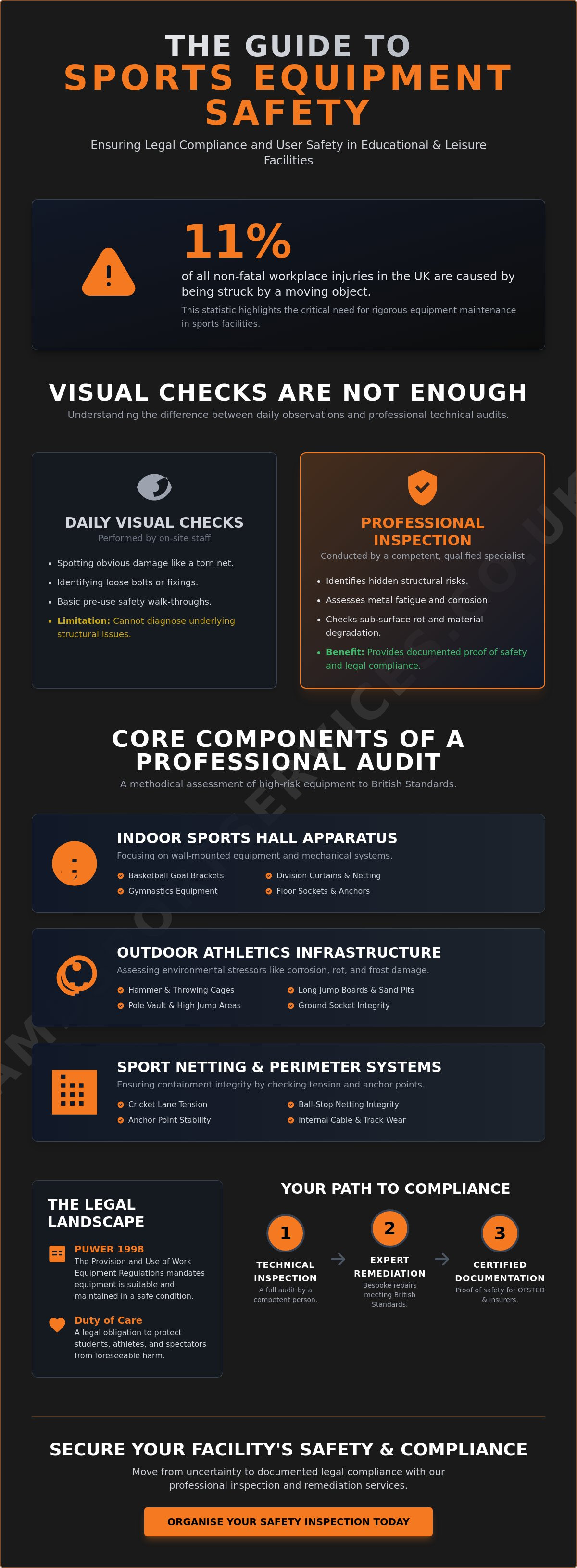
It is crucial to distinguish between two types of checks. The first is the daily "pre-use" check, a brief visual scan conducted by a PE teacher or site staff. The second is the formal, annual inspection carried out by a specialist engineer. Whilst daily checks are important for spotting obvious issues like a torn net, they cannot identify hidden structural risks such as metal fatigue in a wall-mounted basketball boom, internal fraying in a winch cable, or UV degradation in outdoor netting fibres.
These complex assessments require a "competent person," defined as an individual with the specific technical knowledge, training, and experience to detect defects and weaknesses in sports apparatus according to established engineering principles and BS EN standards.
The Core Components of a Professional Safety Inspection
A professional inspection is a systematic process, not a simple walkthrough. It involves a methodical examination of every piece of fixed and portable apparatus, evaluating its condition against official manufacturing standards and safety guidelines. This is particularly important for high-load equipment, such as wall-mounted goals or gymnastics frames, where structural failure could have severe consequences. The inspection includes a detailed assessment of all fixtures, fittings, and mechanical components to ensure they function correctly and are free from wear and tear.
Indoor Sports Hall Apparatus
In a typical UK sports hall, a specialist will follow strict protocols for each piece of equipment:
Wall-Mounted Equipment: Basketball goals, practice hoops, and retractable division curtains are subjected to stress assessments. Inspectors check the integrity of wall anchors, the condition of winch mechanisms and cables, and the stability of backboards and support arms.
Gymnastics and Trampolines: For gymnastics trampolines, the service includes checking bed tension, inspecting every spring for distortion, examining frame pads for adequate impact absorption, and ensuring the structural integrity of the frame itself.
Floor Sockets: The security of floor sockets for equipment like volleyball or badminton posts is paramount. Inspections involve checking for movement, assessing the locking mechanisms, and ensuring the surrounding floor is not compromised.
Outdoor Athletics and Field Infrastructure
Outdoor facilities present unique challenges due to weather exposure and different usage patterns. A comprehensive inspection covers:
Throwing Cages: The structural integrity of hammer, discus, and shot put cages is critical. This involves checking for corrosion or damage to the steel frame, inspecting the tension and condition of all netting, and verifying the safety of gate mechanisms.
Long Jump and Triple Jump Areas: Inspectors evaluate the condition of take-off boards, ensuring they are level and secure. They also assess the sand pit, checking for correct sand depth, adequate drainage, and safe, clearly defined margins.
High Jump and Pole Vault: Landing areas are inspected for deterioration, with specialists checking the foam integrity and cover condition. For pole vault, the trough (or "box") is examined to ensure it is correctly installed and free from damage that could impede a safe pole plant.
Sport Netting and Perimeter Systems
Netting systems, both indoors and outdoors, are a vital safety component that requires expert assessment.
Indoor Cricket and Division Netting: Inspectors check the tension of all guide wires and the security of anchor points in the ceiling and walls. The netting itself is checked for holes or fraying, and the pulley systems for retractable nets are serviced.
Outdoor Ball-Stop Netting: This netting is assessed for UV degradation, which can make fibres brittle over time. Support poles and guy ropes are checked for stability and corrosion, particularly at ground level.
Retractable Systems: Any netting that uses a winch or pulley system requires a mechanical inspection to ensure smooth, safe operation and to prevent sudden failures.
Compliance Standards: AfPE Guidelines and BS EN Specifications
Navigating UK compliance requires an understanding of how different standards and guidelines interact. For schools, the Association for Physical Education (AfPE) provides best-practice guidance, whilst British and European Standards (BS EN) provide the technical specifications for the equipment itself. A robust compliance strategy integrates both. Following these established standards is the most effective way for a facility to protect itself from potential litigation and insurance disputes, as it provides a clear, documented record of due diligence.
This commitment to safety and compliance often extends to the digital realm as well; for facilities seeking to protect their IT infrastructure, CyberOne provides managed detection and response services that ensure operational security is maintained across all platforms.
For non-standard or older equipment where specific standards may not apply, the principle of "bespoke craftsmanship" in repairs becomes important, ensuring any work is carried out by specialists to a certifiably safe standard.
School-Specific Compliance (AfPE)
The AfPE is highly influential in the education sector, and its guidance is considered the benchmark for safety in school sports. OFSTED inspectors, when assessing a school's management of health and safety, will often look for evidence of a documented equipment maintenance programme consistent with AfPE recommendations. This creates a direct link between the physical condition of PE equipment and a school's overall performance rating.
For school business managers preparing for an annual audit, a simple checklist includes:
Confirming the date of the last professional inspection.
Ensuring a written report is on file for all fixed and portable equipment.
Verifying that any remedial actions recommended in the last report have been completed and certified.
Leisure Centre and Professional Club Standards
Commercial leisure centres and sports clubs often face more rigorous demands due to higher footfall and more intensive equipment use. For these facilities, compliance extends beyond general safety to meeting the specific requirements of national governing bodies. For example, an athletics track used for regional competitions must be maintained to standards set by UK Athletics (UKA). This includes not only the track surface but also the condition of throwing cages, jump pits, and hurdles. UKA safety specifications for throwing cages, for instance, are highly detailed and require specialist knowledge to inspect and maintain correctly.
Frequency and Documentation: Organising Your Inspection Schedule
The widely accepted best practice, strongly recommended by AfPE and industry experts, is for a formal specialist inspection to be carried out every 12 months. This interval provides a reliable balance between safety assurance and operational planning. However, facilities with exceptionally high usage, such as large commercial gyms or busy leisure centres, may benefit from more frequent checks on high-wear items. The inspection report is a critical legal document, and a clear system for identifying equipment status—often using tags or colour-coding—is essential for day-to-day operational safety.
Daily, Monthly, and Annual Cycles
A multi-layered approach to inspections is the most effective way to manage risk:
Daily "Pre-Flight" Check: A 30-second visual check by teaching or coaching staff before a session begins. This is designed to spot obvious faults like a deflated ball, a loose bolt, or a tear in a net.
Monthly Visual Inspection: A more detailed visual check carried out by a designated site manager. This involves looking more closely at key components, such as the winch cables on basketball goals or the stability of floor-anchored posts.
Annual Specialist Audit: The formal, in-depth inspection by a qualified engineer. This is the only process that can formally certify equipment as "safe to use" for the following year, as it includes structural and mechanical assessments beyond the scope of a visual check.
The Inspection Report: What to Look For
A professional inspection report is more than a simple pass/fail certificate. It is a detailed diagnostic tool that empowers facility managers to prioritise budgets and schedule repairs effectively. Key elements to look for include:
A Clear Hierarchy: A system that categorises findings as "Pass," "Advisory" (e.g., showing signs of wear but currently safe), or "Fail" (requiring immediate removal from service).
Photographic Evidence: Clear photographs of any identified defects provide indisputable evidence and help maintenance teams or external contractors understand the exact nature of the problem.
Actionable Recommendations: The report should provide clear, jargon-free advice on the necessary remedial work, allowing managers to plan and budget for repairs or replacements in the upcoming financial year.
Expert Remediation: From Inspection to Equipment Repair
An inspection report identifies the problems; expert remediation solves them. This second step is critical, as a report detailing a dangerous defect offers no legal protection if the issue is not promptly and professionally addressed. The "action-result" workflow—moving from an identified fault to a certified-safe piece of equipment—is the hallmark of a complete safety management programme. Using a specialist contractor who can both inspect and repair ensures a seamless, accountable process, especially for bespoke repairs on non-standard or aging apparatus.
Specialist Athletics Surface Repairs
Maintaining outdoor athletics infrastructure requires highly specialised skills and materials.
Tartan Track and Court Markings: Over time, synthetic running surfaces can wear, and markings can fade. Specialists can carry out patch repairs on damaged tartan track segments and professionally renew court markings to meet official competition standards.
Long Jump Runway Refurbishment: A worn or uneven long jump runway can affect performance and safety. Refurbishment involves stripping the old surface, repairing the sub-base if necessary, and laying a new, high-performance surface.
Take-Off Boards and Pole Vault Troughs: These key components are subject to high impact. A specialist can safely replace damaged take-off boards and install new pole vault troughs to the correct specifications, ensuring athlete safety.
Mechanical and Netting Repairs
The mechanical and fabric components of sports equipment are often the first to show signs of wear.
Gymnastics Trampoline Servicing: This goes beyond a simple check, involving the replacement of stretched or broken springs, expert tensioning of the bed for optimal performance, and fitting new frame pads.
Throwing Cage Repairs: Damage to a hammer or discus cage requires expert attention. This can involve replacing damaged or degraded netting with high-strength, UV-resistant materials and, in some cases, carrying out certified welding repairs on the steel frame.
Basketball Goal Maintenance: Specialists can service and repair the complex winch and height adjustment mechanisms on basketball goals, ensuring they operate smoothly and safely for all user groups.
The AMD Sport Services Approach
At AMD Sport Services, we provide a complete, end-to-end solution for sports facility safety. Our work is founded on three principles: durability, adherence to official standards, and expert workmanship. We bridge the gap between regulatory guidance and the physical work required to make equipment safe, functional, and compliant. Our national UK coverage ensures that schools, clubs, and leisure centres across the country can access a consistent, high-quality standard of inspection and repair.
We understand that effective safety management is a technical partnership. From inspecting the integrity of a long jump runway to refurbishing a sports hall's basketball goals, our focus is on providing a clear path from assessment to certified safety.
Book your 2026 sports equipment safety inspection with AMD Sport Services
Frequently Asked Questions (FAQs)
How often should school PE equipment be inspected by a professional? The Association for Physical Education (AfPE) and general industry best practice strongly recommend that all sports equipment undergoes a formal inspection by a competent specialist at least once every 12 months. This should be supplemented by regular visual checks by school staff. What is the difference between AfPE guidelines and BS EN standards? AfPE provides the guidance framework, particularly for educational settings, advising on *why* and *how often* equipment should be inspected to ensure a safe environment. BS EN standards are the technical specifications that define *what* makes a piece of equipment safe, providing the precise engineering and material criteria that inspectors use to pass or fail an item. Do outdoor athletics tracks and long jump pits require formal safety checks? Yes. All fixed athletics infrastructure, including throwing cages, high jump and pole vault landing areas, and long jump runways and pits, requires regular specialist inspection. These checks assess structural integrity, surface condition, and compliance with safety standards set by governing bodies like UK Athletics. What happens if our sports equipment fails a safety inspection? If an item is deemed unsafe and fails the inspection, it must be immediately removed from use and clearly marked as "Do Not Use". The inspection report will detail the specific faults and recommend the necessary repairs or replacement. The equipment can only be returned to service once it has been professionally repaired and certified as safe. Can our own site team carry out sports hall safety inspections? While a knowledgeable site team can and should perform regular visual checks (e.g., monthly), they cannot replace the formal annual inspection. A specialist inspector has the specific training, experience, and equipment to identify issues like metal fatigue, internal cable wear, and structural stress that are not visible to the untrained eye. The formal report from an external specialist is also a critical piece of compliance documentation. Are there specific UK standards for gymnastics trampoline maintenance? Yes, the maintenance and inspection of gymnastics trampolines should follow the manufacturer's guidelines and align with standards such as BS EN 13219. A professional service will check the frame, springs, bed, and frame pads to ensure they meet these safety and performance criteria. How long does a typical sports hall equipment inspection take to complete? The duration depends on the size of the hall and the amount of equipment. A typical secondary school sports hall inspection can take between two to four hours. A larger leisure centre with multiple halls and more complex apparatus will naturally take longer. Is a written report mandatory for sports equipment safety compliance? A detailed written report is an essential component of demonstrating due diligence and safety compliance. It serves as a legal record of the equipment's condition at the time of inspection and provides a clear action plan for any necessary remedial work. It is a vital document for insurance, internal audits, and external bodies like OFSTED.


Comments