
Sports Hall Floor Socket Cap Replacement: The UK Facility Safety Guide

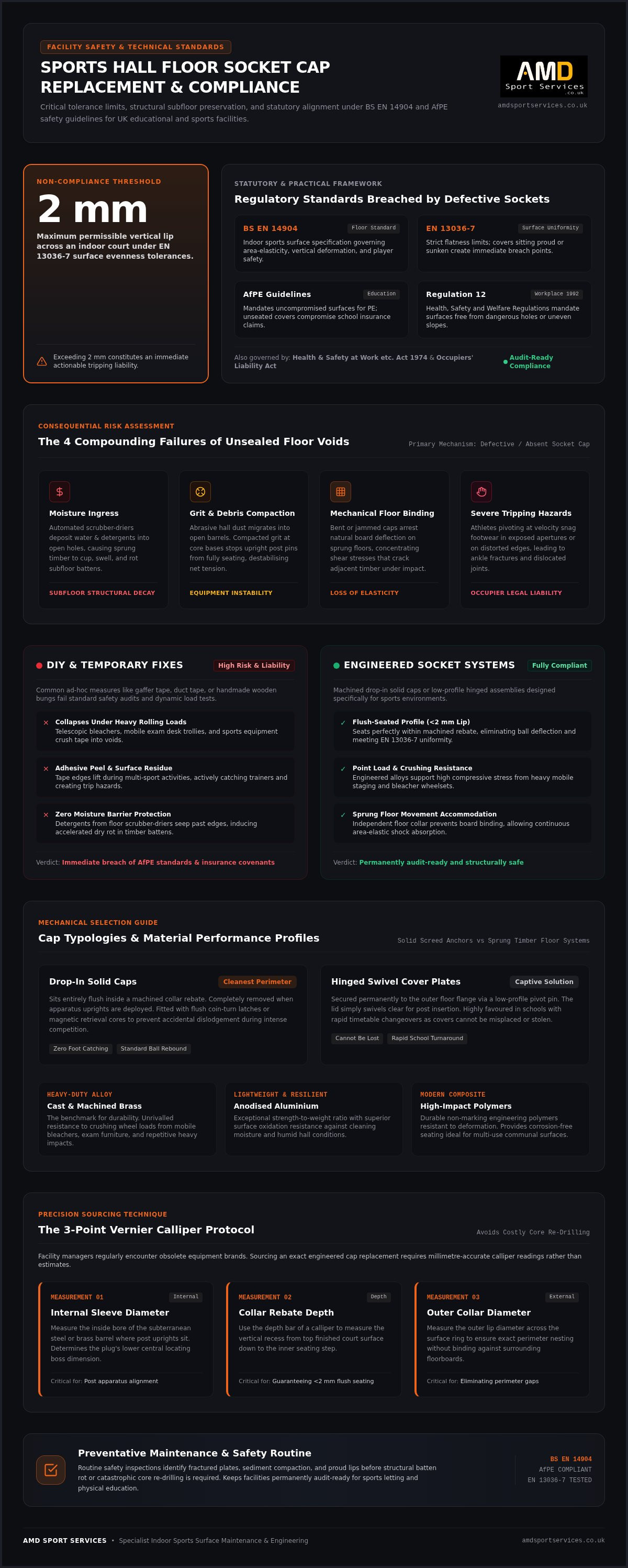
A vertical lip of just 2 millimetres across an indoor court breaches EN 13036-7 surface evenness tolerances, turning an overlooked fitting into an immediate liability. When lids crack, go missing, or sit proud after floor refurbishments, executing a proper sports hall floor socket cap replacement becomes an urgent safety priority. Facility managers frequently find themselves wrestling with obsolete equipment brands, mismatched internal diameters, and temporary fixes like gaffer tape that peel and collapse under rolling loads.
You already know that keeping a busy multi-sport facility safe whilst balancing public lettings and daily physical education is a demanding task. This practical guide shows you how to accurately identify, measure, and replace damaged floor fittings to eliminate tripping hazards and ensure complete compliance with AfPE guidelines and BS EN 14904 standards. We outline exact dimensional measuring techniques, correct fitting procedures for sprung timber and composite floors, and straightforward inspection protocols to keep your hall permanently audit-ready.
Table of Contents
The Hidden Risks of Damaged Sports Hall Floor Socket Caps
Sports hall floor sockets house upright posts for badminton, volleyball, and indoor tennis. These metal barrels must withstand significant dynamic loads during play, but when the apparatus is packed away, their protective lids bear the brunt of everyday hall traffic. Damaged, jammed, or missing caps create severe foot-entrapment and tripping hazards across active zones. Beyond immediate safety risks, distorted lids deflect passing balls and disrupt fair play. Delaying a necessary sports hall floor socket cap replacement exposes school academies and leisure operators to statutory breaches under the Health and Safety at Work etc. Act 1974 and the Occupiers' Liability Act.
Trip Hazards and AfPE Safety Compliance
Guidance from the Association for Physical Education (AfPE) mandates smooth, uncompromised active surfaces for indoor physical education. An exposed socket void or a metal plate protruding by just 2 mm breaches EN 13036-7 surface uniformity limits. Athletes pivoting at speed risk catastrophic joint dislocations or ankle fractures if their footwear snags on an uneven aperture. When facility managers ignore these hazards, standard educational and commercial liability insurance policies can be compromised during personal injury claims. Managing floor fittings through regular indoor inspection and maintenance keeps multi-sport spaces compliant and prevents avoidable legal exposure.
Protecting Sprung Timber Floors from Structural Ruin
Floor sockets installed into modern sprung sports flooring do far more than shield athletes from open holes; they protect complex subfloor architecture from environmental damage. Without a secure, flush seal, serious sub-surface decay occurs:
Moisture ingress: Automated scrubber-driers disperse large volumes of water and detergents. Liquid seeps directly down unsealed socket apertures, causing timber boards to cup, swell, and rot around the subfloor battens.
Debris and grit ingress: Daily dust and abrasive dirt migrate into open metal sleeves, settling at the base of the core. Over time, compacted grit prevents post pins from seating to their correct depth, destabilising net uprights.
Mechanical binding: A bent or jammed cap prevents the sprung boards from deflecting naturally under athlete impact, causing adjacent floorboards to split under shear stress.
Carrying out a timely sports hall floor socket cap replacement preserves both the structural integrity of your sub-base and the functional lifespan of expensive indoor sporting apparatus.
Common Types and Mechanisms of Floor Sockets and Cover Caps
Sports facilities across the UK feature diverse flooring systems, from traditional solid concrete sub-bases with bonded vinyl to modern area-elastic sprung timber. Because of this variety, socket assemblies differ significantly in their mechanical design. Achieving an exact sports hall floor socket cap replacement requires understanding how the capping plate interacts with both the floor's sub-structure and the athletic activity taking place above. Under Regulation 12 of the Workplace (Health, Safety and Welfare) Regulations 1992, facility operators must keep floors free from dangerous holes and uneven surfaces, making the correct mechanical choice an absolute operational requirement.
Drop-In Solid Caps vs Hinged Swivel Plates
Drop-in plugs sit flush within a machined outer rebate and are removed entirely when inserting apparatus posts. Modern versions feature flush coin-turn latches or magnetic retrieval cores to prevent accidental dislodgement during high-friction gameplay. In contrast, hinged swivel plates remain attached to the floor collar via a low-profile pivot pin. While swivel covers eliminate lost lids during rapid equipment changeovers in busy school timetables, drop-in systems provide a cleaner perimeter that cannot catch shoes or distort ball bounce when properly seated.
Materials: Solid Brass, Aluminium, and High-Impact Polymers
The choice of material dictates the plate's resilience under sustained multi-purpose hall traffic:
Cast and machined brass: The standard for durability. Heavy-duty brass resists crushing forces from mobile exam desks, telescopic bleacher wheel loads, and severe point impacts.
Anodised aluminium: Delivers exceptional corrosion resistance against alkaline cleaning detergents and perspiration, making it an ideal choice for high-humidity community leisure centres.
High-impact polymers: Lightweight synthetic nylon plugs provide an economical option for light-duty recreation areas, though they wear faster under rolling machinery.
Sprung Timber Sleeves vs Concrete Cast Collars
Direct concrete sleeves anchor rigidly through the screed slab to manage high-tension loads from volleyball posts. Sprung timber systems, however, require a floating collar design. These two-part assemblies feature an independent outer escutcheon ring secured directly to the top boards, isolated from the subfloor concrete core below. When athletes land, the sprung floor deflects vertically; the socket cover travels with that downward movement. Fitting a rigid, solid-floor plug into a sprung floor locks the boards in place, causing wood split failures and buckled planks as humidity shifts between seasons.
If your facility fittings show signs of wear or binding against the timber, scheduling professional service and maintenance ensures defective sleeves are corrected before structural board damage occurs.
Step-by-Step Guide to Sourcing the Correct Replacement Cap
Sourcing replacement components for older sports halls across the UK presents significant challenges. Many facilities operate with unbranded sockets installed decades ago, where original manufacturer stamps have worn away entirely. Guessing sizes from catalogue photos rarely succeeds; variations of just one millimetre can leave a plate loose or unable to seat. According to Sport England sports hall design guidance, fixed apparatus fittings must seamlessly integrate with multi-court line markings and surface levels. Securing an exact sports hall floor socket cap replacement demands a systematic, dimension-led approach rather than relying on brand names.
Accurately Measuring Socket Geometry
Put away standard tape measures and use digital vernier callipers to record internal tolerances down to the decimal. Take four distinct measurements before sourcing parts:
Internal bore diameter: Measure across the inner barrel at four opposing angles (north-south, east-west, and diagonals) to check whether lateral tension has pulled the tube out of round. Typical UK badminton posts require 34 mm, netball uprights measure 82 mm, and volleyball tubes range between 100 mm and 105 mm.
Outer flange diameter: Measure the width of the top surface plate that rests on the floor rebate.
Rebate depth: Gauge the exact drop from the finished floor surface down to the internal seating shoulder.
Keyway engagement: Check whether the barrel incorporates anti-rotation locating pins, central threaded tie-down points, or perimeter slots.
Accounting for Floor Sanding and Surface Changes
Periodic maintenance on hardwood timber courts introduces dimensional complications. Sanding machines remove wood thickness with each deep refurbishment. As the timber thins, metal socket collars that were once flush gradually sit proud of the playing plane. Dropping a standard factory lid into an altered floor creates an elevated edge that catches footwear and damages equipment. In these cases, replacement plates must be precision-machined or custom-shimmed to match the current floor elevation. Incorporating comprehensive indoor equipment inspection and maintenance into your annual compliance regime helps identify floor-to-fitting height anomalies early, ensuring custom-matched caps restore a perfectly flat surface.
Comparison: DIY Quick Fixes vs Engineered Replacement Systems
When a socket lid is lost during term-time or broken by heavy moving equipment, site staff often face pressure to find an immediate remedy. The temptation to resolve the hazard using workshop supplies is understandable. However, bridging open apertures with temporary measures creates severe legal and physical vulnerabilities. Under the Occupiers' Liability Act 1957, duty holders must ensure visitors and pupils are reasonably safe when using premises. Makeshift measures fail this basic legal test, making a proper sports hall floor socket cap replacement the only defensible solution for responsible facility managers.
Why Makeshift Plugs Always Fail
Temporary repairs introduce hidden hazards that escalate risk rather than eliminating it:
Gaffer and duct tape: Adhesive cloth tape provides no load-bearing capability. Under running friction from dynamic sports, edges peel, curl into sticky ridges, and fail to prevent ankle twist injuries when stepped upon directly.
Softwood bungs and timber offcuts: Timber plugs absorb wash water from automated scrubbers. As the grain swells, the bung wedges solidly into the metal housing, requiring aggressive drilling or chisel work to extract.
Expanding aerosol foam: Injected polyurethane foam fouls internal anchor threads and mechanism pins. Once hardened, it demands mechanical reaming that risks scratching the structural sleeve walls beyond repair.
Performance Benefits of Heavy-Duty Engineered Plates
Factory-engineered replacement plates restore your court floor to its tested safety parameters. Designed to satisfy BS EN 14904 requirements for point and rolling load resistance, certified metal plugs easily support heavy exam furniture layouts, mobile gymnastics equipment, and cherry pickers without bowing or indenting. Integrated neoprene or silicone perimeter gaskets stop liquid detergents from reaching the subfloor, whilst flush coin-turn locking pins prevent inquisitive pupils from tampering with or removing the lid between PE lessons.
Investing in precision-machined brass or aluminium hardware reduces your long-term maintenance costs by eliminating repeated callouts and preventing premature subfloor replacement. If your facility has missing lids or damaged plates that compromise player safety, contact AMD Sport Services to schedule specialist sports equipment safety inspections and ensure your indoor hall complies fully with national sporting standards.
Professional Socket Cap Replacement, Servicing, and Compliance
Remedying compromised floor fittings involves far more than simply dropping generic covers into existing holes. When floor sleeves crack, warp under heavy point loads, or corrode from damp mopping, standard catalogue items cannot resolve the underlying fault. Complex scenarios demand engineering solutions such as diamond core-drilling damaged collars, sleeve re-boring, or custom brass fabrication to match non-standard rebates. Engaging an experienced nationwide contractor ensures that every completed sports hall floor socket cap replacement seats perfectly flush with surrounding sprung timber or composite sports surfaces.
When to Call Professional Sports Maintenance Contractors
Certain structural failures require mechanical intervention rather than simple component sourcing:
Sub-deck barrel fractures: Heavy lateral loads from netball or volleyball posts can crack the structural sleeve below floor level, causing the outer collar to rock loose under foot.
Severe internal bore corrosion: Moisture trapped beneath seized caps oxidises metal sleeves, preventing new locking tabs or bayonet pins from engaging securely.
Differential floor deflection: When older timber settles unevenly around rigid concrete pads, the outer escutcheon binds against adjacent boards, requiring precision re-rebating.
Specialist contractors resolve these defects through bespoke engineering and tailored service and maintenance agreements, restoring full structural integrity without necessitating costly whole-court replacements.
Integrating Socket Repairs into Annual Safety Audits
Floor socket inspections form a mandatory element of statutory sports facility sign-offs. Under the Provision and Use of Work Equipment Regulations 1998 (PUWER), operators must demonstrate that all fixed apparatus and surface anchorages undergo systematic monitoring. Floor fittings should never be evaluated in isolation. Incorporating socket plate assessments alongside wall-mounted equipment and ceiling track reviews provides a joined-up safety overview that protects headteachers and trust executives from negligence claims.
Commissioning comprehensive sports equipment safety inspections delivers written, photo-verified compliance certification that satisfies insurers and local authority auditors. With over two decades of nationwide experience, our technical team identifies height anomalies, jammed spring mechanisms, and hairline sleeve cracks before accidents occur. Contact AMD Sport Services today to schedule an expert facility inspection and keep your school or community leisure centre completely safe for play.
Securing Your Playing Surface for Long-Term Safety
A safe, fully compliant sports hall relies on the smallest details performing under intense daily pressure. Overlooking damaged plates or relying on temporary bungs risks severe player injuries, compromises ball response, and accelerates costly subfloor decay. By carrying out precise dimensional calliper checks, selecting resilient engineered materials, and addressing floor fitting height anomalies promptly, you protect both your subfloor architecture and your players.
Executing an accurate sports hall floor socket cap replacement restores surface uniformity and keeps your facility aligned with strict AfPE and British Standards. AMD Sport Services brings over 20 years of hands-on technical sports facility maintenance experience to schools and leisure centres nationwide. Our specialist engineers assess anchor points, subfloor clearances, and apparatus fittings to pinpoint hazards before accidents occur. Book your sports hall safety inspection with AMD Sport Services today to secure complete statutory compliance and maintain total confidence across every court.
Frequently Asked Questions
Can I replace a missing sports hall floor socket cap myself?
You can fit a replacement yourself if an identical drop-in cap matching the exact bore and rebate depth is readily available. However, if previous floor sanding has altered the timber surface level or the sleeve has warped, standard catalogue caps won't sit flush. In situations requiring re-rebating or custom metalwork, a professional sports hall floor socket cap replacement ensures complete compliance with BS EN 14904 safety standards.
Why are my sports hall floor socket plates sitting proud of the timber?
Socket plates sit proud primarily because repeated sanding refurbishments have reduced the surrounding timber thickness. Commercial sanding machines strip away wood over decades of maintenance, but the fixed concrete-anchored sleeve stays at its original height. Seasonal timber shrinkage can also leave edges exposed. To eliminate dangerous 2 mm trip lips, specialists must machine down the brass collar or install custom-depth replacement plates.
What standard socket sizes exist in UK school sports halls?
UK multi-sport halls rely on three standardised nominal bore diameters to accommodate different equipment uprights. Socketed badminton posts require 34 mm internal diameter sleeves. Netball posts use 82 mm barrels, whilst competition volleyball uprights and heavy dividing post anchors measure between 100 mm and 105 mm. Sprung floor assemblies also feature wider outer floating rings to accommodate natural timber deflection during physical activities.
How do I identify the manufacturer of obsolete sports floor sockets?
You don't need to know the original brand if you measure the existing hardware accurately. Historic UK socket sleeves rarely retain visible manufacturer markings once worn by foot traffic. When undertaking a sports hall floor socket cap replacement for obsolete systems, use digital vernier callipers to measure internal bore, flange width, rebate shoulder depth, and keyway slots. Specialist contractors manufacture bespoke caps directly from these tolerances.
Are floor socket caps checked during annual sports safety inspections?
Yes, floor socket assemblies and blanking plates form a mandatory checkpoint during routine inspections. Under PUWER 1998 and AfPE guidance, engineers inspect every floor anchor for structural cracking, proud edges, and missing components. Certified inspectors record height anomalies and damaged spring plates within your written audit register, providing headteachers and facility directors with documented proof of facility safety compliance.
Can missing socket caps cause water damage under sprung sports floors?
Yes, open socket voids allow cleaning wastewater to drain directly beneath the playing surface. Automated scrubber-driers disperse significant quantities of water and cleaning detergents across the hall floor. Without a sealed, gasketed cap in place, liquid runs down the sleeve collar into subfloor cavities, soaking support battens and elastic pads. This moisture ingress quickly causes localized timber rot, cupping, and expensive floor failure.
How do I remove a seized or stuck brass floor socket lid?
Start by clearing compacted debris from the perimeter groove using an industrial vacuum, then apply a non-staining penetrating lubricant safe for sports lacquer. Tap the plate gently using a rubber mallet to break corrosion bonds within the thread or rebate. Always use the proper turn key, magnetic wand, or heavy-duty suction lifter. Avoid prising edges with screwdrivers, which permanently gouges the surrounding hardwood floor.


Comments