
The Ultimate Basketball Hoop Maintenance Checklist for UK Facilities

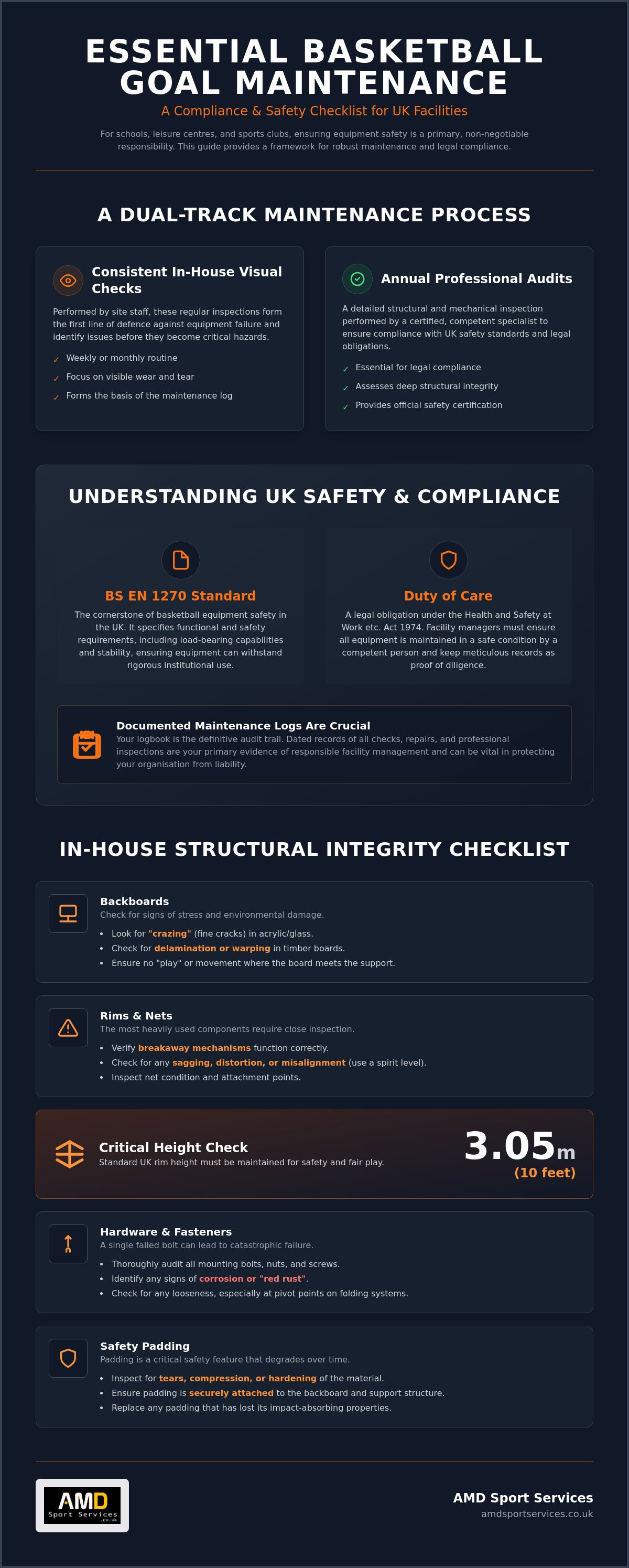
For UK school site managers, leisure centre operators, and sports club volunteers, ensuring the safety and longevity of sports equipment is a primary responsibility. Amongst the most heavily used apparatus in any sports hall or outdoor court are the basketball goals. Frequent use, environmental exposure, and mechanical wear can turn a valuable asset into a significant safety hazard if not properly maintained. Effective basketball hoop maintenance is a dual-track process: consistent in-house visual checks paired with professional structural audits to satisfy UK safety regulations and protect users.
This comprehensive checklist is designed for those responsible for facility safety. It moves beyond simple cleaning tips to provide an institutional-grade framework, covering everything from UK compliance standards and structural integrity audits to the specific challenges of motorised indoor systems and the harsh British weather. By following this guide, you can create a robust maintenance schedule that ensures safety, prolongs the life of your equipment, and provides a clear audit trail of due diligence.
Table of Contents
Understanding UK Basketball Safety Standards and Compliance
Before touching a single bolt, it is crucial to understand the regulatory landscape governing sports equipment in the United Kingdom. Maintenance is not merely about keeping things in working order; it is a fundamental legal requirement designed to prevent injury. For facilities like schools, universities, and public leisure centres, compliance is non-negotiable and requires a structured, documented approach.
Introduction to BS EN 1270: The European standard for basketball equipment safety, which is the recognised benchmark in the UK.
Why regular maintenance is a legal requirement: Understanding the duty of care for UK schools and leisure centres.
The difference between routine visual checks and annual professional inspections: Recognising the scope and limitations of in-house capabilities.
How documented maintenance logs protect your facility: Creating an evidence-based record of safety management and compliance.
The Role of BS EN 1270 in Facility Safety
BS EN 1270 is the cornerstone of basketball equipment safety in the UK. This standard specifies the functional and safety requirements for all types of basketball goals, from portable units to complex, roof-mounted structures. It outlines critical performance criteria, including load-bearing capabilities, stability, and overall design integrity. Adherence to this standard ensures that the equipment can withstand the rigours of institutional use, from school PE lessons to competitive club matches.
Key aspects defined by BS EN 1270 include the specific load-bearing requirements for rims and backboards, ensuring they can handle forces from play without catastrophic failure. It also sets out different safety margins for various types of installations, such as wall-mounted versus portable units, acknowledging their unique stability challenges. Using uncertified equipment, or equipment that has fallen out of compliance due to poor maintenance, poses a significant and unacceptable risk to players, staff, and spectators.
Duty of Care for UK Sports Facility Managers
Under the Health and Safety at Work etc. Act 1974, facility managers have a fundamental "duty of care" to ensure the safety of all users. This legal obligation means that all provided equipment, including basketball goals, must be maintained in a safe, working condition. This responsibility extends to ensuring that inspections and servicing are performed by a "competent person"—an individual who has the requisite knowledge, training, and experience to identify potential hazards and assess the equipment's structural and mechanical safety accurately.
Fulfilling this duty involves creating a robust safety audit trail. This means keeping meticulous, dated records of all checks, maintenance activities, and professional inspections. These logs serve as crucial evidence that you have taken reasonable steps to ensure user safety. In the unfortunate event of an incident, a well-maintained logbook can be your most important document, demonstrating proactive and responsible facility management and protecting your organisation from liability claims.
Structural Integrity: The Essential Backboard and Rim Checklist
The backboard and rim assembly is where most of the action takes place, and consequently, it is where stress and wear are most concentrated. Regular, detailed inspections of these components are the first line of defence against equipment failure. These checks can be integrated into a weekly or monthly routine for your site maintenance team.
Inspecting backboards for stress fractures: Looking for "crazing" in acrylic and glass, or signs of delamination in timber boards.
Checking rim tension: Ensuring the functionality of breakaway mechanisms and checking for any sagging or distortion.
Identifying loose or corroded bolts: A thorough audit of all mounting hardware is essential, as even a single failed bolt can compromise the entire system.
Evaluating the condition of safety padding: Checking for tears, compression, and secure attachment to the backboard and support structure.
Backboard and Rim Alignment
Correct alignment is critical not just for fair play, but for structural safety. A misaligned goal indicates underlying issues with the mounting hardware or the support structure itself. Using a spirit level, verify that the rim is perfectly horizontal. The standard height for a basketball rim in the UK is 3.05 metres (10 feet) from the playing surface to the top of the ring; this should be measured periodically to ensure it has not shifted.
For timber or composite backboards, look carefully for any signs of warping, which can occur due to moisture or temperature changes in a sports hall. Stand directly underneath and look up the face of the board to spot any bowing. Finally, carefully attempt to move the backboard where it connects to the main support bracket. There should be no discernible "play" or movement. Any looseness here suggests that fasteners are failing and require immediate attention.
Hardware and Fastener Audit
The bolts and fasteners holding a multi-kilogram backboard and goal in place are under constant stress. A visual inspection should look for any signs of corrosion, particularly "red rust" which indicates deep-seated decay, not just surface oxidation. Pay close attention to pivot points on folding or adjustable units, looking for "metal-on-metal" wear, which appears as fine metal dust or shavings around the joint.
A common mistake during in-house maintenance is the over-tightening of bolts, especially on tempered glass backboards. This can create concentrated stress points in the glass, leading to spontaneous shattering. It is vital to follow manufacturer torque specifications. If a bolt is found to be loose, it is important to investigate why. It may be a sign of thread wear or vibration-induced loosening. In such cases, simply re-tightening might not be a lasting solution; the hardware should be replaced by a professional.
Mechanical Servicing for Indoor and Motorised Systems
Indoor sports halls in the UK often feature complex basketball goal systems, including roof-mounted folding goals and electrically operated adjustable units. These systems introduce mechanical components that require specialist knowledge to maintain safely. Whilst daily visual checks are still important, the servicing of these mechanical parts demands a more technical approach.
Inspecting winches and pulleys: Checking for smooth operation and signs of wear on roof-mounted folding goals.
Testing safety features: Verifying the correct function of limit switches and safety brakes on all motorised systems.
Lubrication requirements: Applying the correct grade of lubricant to adjustable height mechanisms and pivot points.
Checking secondary supports: Ensuring the integrity of safety chains and secondary support cables, which are designed to prevent the unit from falling in case of primary failure.
Roof-Mounted Goal Safety
Roof-mounted goals are an excellent space-saving solution, but their suspension systems are a critical safety area. The steel wire ropes (cables) must be inspected along their entire length for any signs of fraying, broken strands, or "bird-caging," where the cable unwinds and expands. These are immediate red flags indicating the cable has been compromised and must be replaced by a specialist.
For motorised electric winch systems, it is essential to regularly test the emergency stop function and any manual override mechanism. Ensure that limit switches, which prevent the goal from travelling too far up or down, are functioning correctly to avoid damage to the motor or the building's structure. Many UK facilities are choosing to upgrade older, manual winch systems to motorised ones. This not only improves user convenience but also enhances safety by providing a controlled, smooth operation and reducing the risks associated with manual handling. A professional assessment can determine the viability and benefits of such an upgrade, a process closely related to the initial principles of correct indoor basketball goal fitting.
Adjustable Height Mechanism Care
Adjustable height goals are popular in schools and multi-use centres, but their mechanisms require diligent care. The lead screws, sliding tubes, and gear systems must be kept clean of dust and debris, which can accelerate wear. A regular schedule of cleaning and greasing, using manufacturer-recommended lubricants, is vital for smooth and safe operation.
For systems that use gas-strut assistance, check the struts for any signs of hydraulic fluid leaks, which will appear as an oily residue on the cylinder. If a leak is present, the strut will lose its ability to support the weight of the backboard, making adjustment difficult and potentially dangerous. On all adjustable systems, whether manual or motorised, always ensure that the locking pins or clamps are fully engaged and secure at every height setting before allowing play to commence.
Environmental Factors and Outdoor Maintenance Challenges
Outdoor basketball hoops in the UK face a relentless assault from the elements. The combination of rain, humidity, UV light, and, in coastal areas, salt-laden air creates a uniquely challenging environment for steel and other materials. A maintenance plan for outdoor goals must be more frequent and focus heavily on corrosion prevention and material degradation.
Managing rust and corrosion: Proactively treating steel poles, brackets, and hardware to prevent structural weakening.
Net maintenance: Understanding why standard nylon nets perish quickly in UK sunlight and damp conditions and when to upgrade.
Seasonal care for portable units: Properly managing ballast, checking wheel condition, and preparing units for winter storage.
*The impact of court surface: Ensuring the ground beneath the goal is level and stable to prevent tipping.
Corrosion Prevention in the UK Climate
Rust is the primary enemy of outdoor basketball goals. It is important to distinguish between minor surface oxidation, which can often be cleaned and treated, and deep "red rust," which indicates flaking and a loss of structural integrity. For steel components, a hot-dip galvanised finish offers superior, long-lasting protection compared to a standard powder-coated finish, as the zinc coating protects the steel even if the surface is scratched. This is a key consideration for new installations in exposed locations.
During inspections, pay special attention to welds, joints, and exposed threads on bolts, as these are common starting points for rust. Applying a protective, weatherproof coating or grease to these vulnerable areas can significantly extend their lifespan. Furthermore, ensure that any drainage holes in the base of the main pole remain clear of dirt and debris to prevent water from collecting inside and causing corrosion from within.
Net and Rim Care for Outdoor Courts
A frayed, damaged net is not only unsightly but can also be a minor safety hazard. Standard nylon nets degrade rapidly under UV exposure, becoming brittle and prone to tearing. For high-use public courts, switching to a more durable anti-whip net or even a steel chain net can be a more cost-effective long-term solution, reducing the frequency of replacement.
The rim mechanism on outdoor goals can be susceptible to seizing up due to debris and salt build-up, particularly breakaway rims. The mechanism should be kept clean and checked for smooth movement. Applying a water-resistant lubricant can help protect the internal springs and pivots from the damp UK climate, ensuring the rim functions as intended and does not become a rigid, unforgiving target.
Professional Maintenance: When to Call the Specialists
Whilst regular in-house checks are the foundation of any good maintenance programme, there are tasks that exceed the scope, and safety limits, of standard site maintenance teams. Recognising when to call in professional specialists is a key part of responsible facility management. A professional inspection provides not only technical expertise but also a formal safety certificate, which can be invaluable for insurance and compliance purposes.
Tasks that require specialist expertise: Identifying repairs like welding or backboard replacement that should not be attempted in-house.
The value of a professional safety certificate: How formal certification demonstrates due diligence to insurers and governing bodies.
How AMD Sport Services conducts audits: Understanding the process of a professional structural and mechanical inspection.
Planning for the future: Using professional reports to develop a long-term refurbishment or replacement strategy for ageing facilities.
Identifying Specialist Repairs
Certain issues constitute an immediate "stop play" and require specialist intervention. Any crack found in a support bracket, weld, or rim support structure requires a professional assessment and likely a specialist welding repair. Attempting to patch this in-house is unsafe. Similarly, the replacement of a large tempered glass backboard is a high-risk task that requires specific equipment and expertise to handle safely and prevent injury or damage.
If you identify significant structural corrosion, require a system to be upgraded from manual to motorised, or need to investigate persistent vibration issues, it is time to engage an expert. These are complex problems that often have underlying causes a general caretaker may not be equipped to diagnose. For major work, it is always best to rely on certified technicians, such as those who provide professional basketball goal installation services, as they have the experience to ensure the work is completed to the correct safety standards.
The AMD Sport Services Inspection Process
Engaging a specialist firm like AMD Sport Services provides a comprehensive and documented approach to safety compliance. The process begins with a thorough on-site audit, where trained engineers conduct a detailed examination of every component of your basketball goals. You can see what to expect during an indoor equipment safety inspection, which covers structural fixings, mechanical winch systems, backboard and rim integrity, and all safety features.
Following the inspection, you will receive a detailed written report. This document outlines all findings, clearly categorises any faults or areas of concern with a prioritised traffic-light system (e.g., urgent, recommended, advisory), and provides clear recommendations for any necessary repairs or replacements. This report forms a vital part of your facility's health and safety records. Should repairs be required, AMD Sport Services offers national support for both indoor and external sport equipment installation and refurbishment, ensuring a seamless transition from inspection to resolution.
Frequently Asked Questions (FAQs)
How often should basketball hoops be inspected in a UK school? A simple visual check should be performed by staff before each use. A more detailed in-house inspection by a trained caretaker should occur at least monthly. Critically, a full structural and mechanical inspection by a competent external specialist should be conducted annually as a minimum requirement for compliance and insurance.
Can our school caretaker perform the annual safety inspection? Whilst a knowledgeable caretaker is invaluable for routine monthly checks, the formal annual inspection should be carried out by an independent, certified specialist. This ensures an unbiased assessment and provides the facility with a formal safety certificate, which is often required for insurance and to demonstrate compliance with health and safety legislation.
What is the standard height for a basketball rim in the UK? The standard regulation height, used from secondary school level upwards, is 3.05 metres (10 feet) from the court surface to the top edge of the rim. Many facilities also use adjustable height goals for younger players or different sports activities.
Why is my basketball backboard vibrating excessively after a shot? Excessive vibration or shuddering usually indicates a loss of rigidity in the system. The most common causes are loosened bolts where the backboard attaches to the support arm, or where the support arm attaches to the wall or ceiling structure. It can also be a sign of fatigue or a fracture in the support frame itself and should be investigated immediately.
Do outdoor basketball hoops require different maintenance to indoor ones? Yes, absolutely. Outdoor hoops require more frequent checks, with a specific focus on corrosion (rust), the integrity of plastic or powder-coated components under UV light, and ensuring drainage holes are clear. Lubricants used must be weather-resistant, and net choice is more critical for durability.
What should I do if I find a crack in a glass basketball backboard? Immediately take the goal out of service and clearly mark it as unsafe to use. A crack in a tempered glass backboard compromises its structural integrity and can lead to it shattering unexpectedly. Do not attempt to repair it. Contact a professional service provider to arrange for a safe removal and replacement.
Are motorised basketball goals safer than manual winch systems? Generally, yes. Motorised systems provide a controlled, consistent speed when raising and lowering the unit, eliminating the risks of manual handling injuries or accidental free-fall associated with older, poorly maintained manual winches. They also often come with integrated safety features like automatic brakes and limit switches, making them a safer choice for modern facilities.
How long do professional basketball goal inspections take to complete? The time varies depending on the number and complexity of the units. For a typical school sports hall with two main roof-mounted goals and four cross-court practice goals, a thorough inspection by a two-person team might take between two to four hours. The subsequent report is usually delivered within a few hours.


Comments