
Treadmill Belt Replacement: UK Professional Guide 2026

A frayed or slipping treadmill belt is more than a nuisance; it is a mechanical failure waiting to happen. Left unchecked, this wear leads to permanent motor damage or, worse, a serious injury on the gym floor. For school site managers and leisure centre operators, the need for a treadmill belt replacement often comes with concerns about equipment downtime and liability. It's understandable to feel hesitant about complex repairs when a mistake could lead to safety failures or further damage to expensive internal components.
This guide provides a pragmatic, professional approach to restoring your machines to full working order with confidence. You'll learn how to identify the specific signs of belt fatigue, source the correct commercial-grade 2.3mm belts, and ensure your equipment meets current UK safety standards like EN ISO 20957-6:2021. We'll walk through the technical specifications required for high-use environments and the methodical steps needed to minimise motor strain, whilst keeping your gym floor compliant with official safety inspections.
Table of Contents
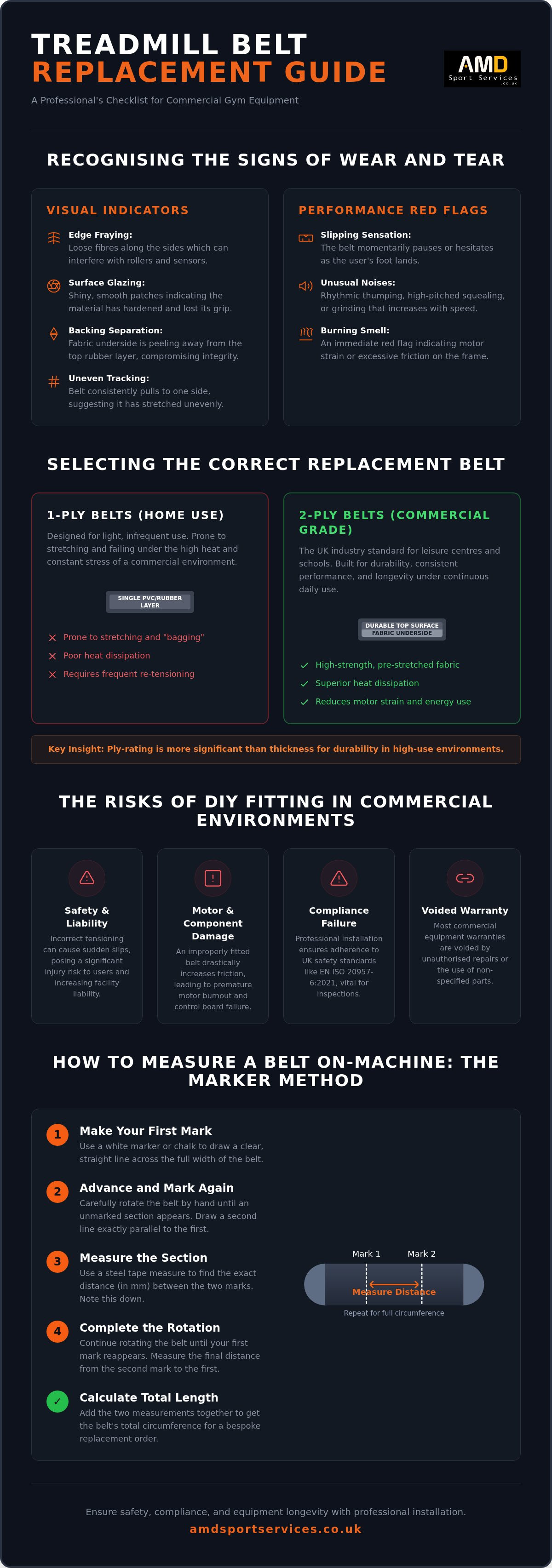
Recognising the Signs of Treadmill Belt Wear and Tear
Facility managers often overlook the gradual decline of gym equipment until a total breakdown occurs. A treadmill belt is a high-contact consumable part that requires regular monitoring to prevent injury and mechanical failure. Gaining a technical overview of treadmill technology reveals that the belt is the primary interface between the user and the drive system. When this interface degrades, the friction coefficient spikes, forcing the machine to draw more power to maintain speed.
Ignoring these early warnings is a costly mistake. High friction generates excessive heat, which is the leading cause of drive motor burnout and control board failure. A timely treadmill belt replacement is a preventative measure that protects the most expensive internal components of your fitness suite. Identifying these signs during a routine indoor inspection and maintenance walk-through can save thousands of pounds in capital expenditure.
Visual Indicators of Belt Degradation
Physical inspections should begin with a close look at the belt's edges and surface texture. Fraying along the sides isn't just an aesthetic issue; those loose fibres can wrap around the rollers or trigger the safety sensors. Look for "glazing," which appears as shiny, smooth patches on the running surface where the original grip has worn away. This indicates the material has hardened and lost its flexibility.
Check the underside of the belt by lifting the edge. You're looking for signs of the fabric backing separating from the top rubber layer or "curling" at the edges. If the belt consistently tracks to one side despite regular adjustment, the internal structure has likely stretched unevenly. Once the fabric's integrity is compromised, the belt can no longer maintain the correct tension required for safe operation.
Performance Red Flags for Facility Managers
Sensory cues often precede visual ones during peak gym hours. Users might report a "slipping" sensation, which feels like the belt momentarily pauses when their foot strikes the deck. This erratic behaviour usually stems from the belt stretching beyond its adjustment limit or the underside becoming too smooth to grip the drive roller. Noise is another critical factor; a worn belt creates a rhythmic thumping or a high-pitched squeal that increases with speed.
The smell of ozone or burning rubber is an immediate red flag. This scent indicates that the motor is overworking or that the belt is rubbing against the frame. Additionally, if pupils or members report frequent static shocks, the integrated anti-static layer within the belt has likely failed. These performance issues signal that a treadmill belt replacement is no longer optional but essential for user safety and equipment longevity.
Selecting the Correct Replacement Belt: 1-Ply vs 2-Ply Commercial Grades
Choosing the wrong specification during a treadmill belt replacement is a frequent cause of premature component failure. Many retail suppliers focus solely on thickness, often citing 1.4mm for home use and 2.3mm for commercial machines. However, the internal ply-rating is a far more critical metric for equipment longevity. A belt's thickness might provide cushioning, but its internal structure determines how it handles the mechanical stresses of a busy fitness suite.
Standard 1-ply belts consist of a single layer of PVC or rubber. These are prone to stretching and "bagging" under the high temperatures generated by continuous use. In contrast, commercial-grade belts feature a multi-layered construction. This includes a durable top running surface and a high-strength, pre-stretched fabric underside that reduces friction against the deck. This structural integrity is what prevents the belt from slipping or requiring constant tensioning adjustments after installation.
Why Commercial Facilities Require 2-Ply Belts
Commercial treadmills in schools or leisure centres often run for 12 hours a day or more. This level of operation creates significant thermal energy. A 2-ply design provides superior heat dissipation, protecting the belt from hardening or cracking over time. High-strength 2-ply belts are the industry standard for durability in UK leisure centres. Using these ensures the machine operates at a consistent speed even during peak usage periods, reducing the strain on the drive motor.
Surface texture also influences performance. Diamond textures offer aggressive grip for high-speed running, whilst sand-blast patterns provide a more uniform feel for general walking or jogging. Professional belts also incorporate anti-static carbon fibres. These layers are vital for dissipating the static electricity that builds up during use, which can otherwise damage sensitive control boards and lead to unprompted emergency stops.
Compatibility and Material Specifications
Selecting a replacement requires matching the belt material to your specific treadmill deck. Some decks are wax-infused and require a "dry" belt, whilst others need a low-friction coating to minimise energy consumption. Adhering to the Provision and Use of Work Equipment Regulations 1998 (PUWER) ensures your maintenance choices don't compromise safety or legal compliance. It's essential that any new belt meets the original equipment manufacturer (OEM) standards to maintain the machine's intended safety profile.
Professional sourcing eliminates the guesswork that leads to "budget" belts failing within months. Ensuring a precise fit and material match is the only way to safeguard your investment. If you're managing a suite of machines, arranging a professional safety inspection can help determine the exact specifications required for your specific treadmill models before procurement begins.
The Risks of DIY Treadmill Belt Fitting in Commercial Environments
Whilst online tutorials often frame treadmill belt replacement as a simple task, these guides are almost exclusively designed for residential machines. In a commercial setting, the stakes are significantly higher. Amateur fitting frequently results in incorrect tensioning, which is the primary cause of secondary mechanical failure. If the belt is too tight, it places an immense load on the drive motor and front rollers. This often leads to snapped drive belts or collapsed bearings. Conversely, insufficient tension causes the belt to slip during high-impact foot strikes, creating a serious trip hazard for the user.
Liability remains the most significant risk for schools and local authorities. If an injury occurs on a machine that hasn't been professionally serviced, insurance providers may refuse to cover the claim. A DIY repair lacks the formal certification required to prove the equipment was maintained to a safe standard. Professional installation ensures that every part of the drive system is inspected, from the deck's surface to the motor brushes. This comprehensive approach identifies underlying issues that a simple belt swap would miss.
Safety and Compliance Considerations
Maintaining a rigorous maintenance log is essential for institutional accountability. Every treadmill belt replacement should be part of a broader service and maintenance programme. This ensures the equipment remains compliant with PUWER regulations. Once the work is finished, a formal safety inspection provides the necessary documentation to satisfy health and safety audits. This creates a paper trail of professional competence that protects both the facility and its users.
Technical Precision in Belt Tracking
Correct belt tracking is a precise mechanical adjustment, not a matter of guesswork. If the belt isn't perfectly centred, it will rub against the side rails, leading to immediate fraying and heat build-up. Beyond physical alignment, the machine's software often requires attention. Calibrating the speed sensor and motor controller ensures the digital readout matches the actual belt speed. Finally, a professional technician will verify that the emergency stop system and lanyard are fully functional. These steps are vital for ensuring the machine is safe for public use.
Step-by-Step: Measuring and Preparing for a New Running Belt
Precision during the preparation phase is what separates a professional treadmill belt replacement from a temporary fix. For schools and leisure centres, the goal is to minimise equipment downtime. Whilst some retail guides suggest removing the old belt to measure it, this approach leaves your machine in pieces whilst you wait for delivery. A seasoned practitioner measures the belt whilst it remains on the machine, ensuring the treadmill stays operational or at least safely assembled until the replacement part arrives on-site.
To calculate the width, measure the distance between the side frames and subtract approximately 15mm to 20mm. This provides the necessary clearance to prevent the belt from rubbing against the plastic trim. If the belt is too wide, it will fray almost immediately; if it's too narrow, it may expose the deck surface, creating a slip risk. Accuracy here is vital because commercial-grade belts are often bespoke orders that cannot be returned if the dimensions are incorrect.
The Accurate Measurement Process
The "marker method" is the most reliable way to determine the total length of a continuous loop without dismantling the drive system. Follow these steps for a precise result:
Place a piece of masking tape or a chalk mark on the belt near the rear roller.
Use a steel tape measure to record the distance from that mark to the front roller.
Rotate the belt manually and continue measuring in segments.
Sum the segments until you return to your original mark.
Double-check the measurement twice to account for any tape slippage.
When specifying the length, check the position of the rear roller adjustment bolts. You want the new belt to sit comfortably whilst leaving enough travel in the bolts for future tensioning as the material settles. If the rollers are already at the end of their travel, the belt is likely stretched beyond its service life.
Deck Inspection and Maintenance
A treadmill belt replacement should never happen in isolation. The running deck is the second half of the friction equation. Inspect the deck surface for "pitting," which looks like small craters, or deep grooves caused by previous debris. If the surface feels rough or shows signs of the black laminate wearing through to the wood, the deck must be addressed. Many commercial decks are double-sided; if the underside is pristine, you can simply flip it to provide a fresh surface for the new belt.
Before fitting the new belt, clean the rollers and the deck thoroughly to remove old wax and rubber dust. Lubrication is the final, critical step. For 2-ply commercial belts, apply a high-grade 100% silicone lubricant across the deck surface. This reduces the initial "break-in" friction and prevents the drive motor from overheating during the first few hours of use. If you are unsure about the specific ply-rating or material compatibility for your fleet, you can book a professional equipment service to ensure every component is correctly prepared.
Professional Treadmill Belt Replacement Services by AMD Sport Services
AMD Sport Services operates as a specialist partner for local authorities, educational institutions, and private leisure providers across the United Kingdom. We understand that a treadmill belt replacement isn't a standalone repair but a critical component of a broader safety strategy. Our national coverage ensures that whether you manage a single school gym or a multi-site leisure portfolio, you have access to technical expertise that prioritises equipment longevity and user protection. We take a no-nonsense approach to maintenance, focusing on tangible results and technical honesty.
We provide bespoke solutions for all major treadmill brands, sourcing high-strength 2-ply belts that match or exceed original manufacturer specifications. Our team brings over 20 years of industry experience to every site, applying the "Seasoned Practitioner" philosophy. This means we focus on the technical integrity of the work rather than polished sales pitches. We ensure that every installation is performed with the precision required to maintain your equipment warranties and satisfy the stringent requirements of insurance providers and safety auditors.
Our Comprehensive Maintenance Approach
Our workflow is designed to be methodical and efficient, guiding you from an initial problem to a fully restored machine. It begins with a thorough site assessment to determine the exact dimensions and material requirements of your fleet. Once the correct parts are sourced, our engineers handle the professional fitting and calibration on-site. This process includes rigorous testing under load to ensure the tensioning and tracking are perfect before the machine is returned to service. You can view our full list of equipment maintenance services to see how we support diverse sports environments.
Initial assessment of belt wear and deck integrity to prevent secondary failures.
Direct supply of commercial-grade, anti-static replacement belts tailored to your specific models.
Professional installation including roller cleaning, debris removal, and deck lubrication.
Post-repair calibration of motor controllers to ensure speed accuracy and user safety.
Full digital reporting for your facility maintenance logs to ensure regulatory compliance.
This structured approach allows us to minimise downtime for schools and leisure centres, ensuring your equipment is back in safe working order as quickly as possible. By coordinating repairs across multiple machines, we help facility managers maintain a consistent standard of safety across their entire fitness suite.
Why Trust AMD Sport Services?
We are more than just a parts supplier; we are versatile problem-solvers. Our engineers possess specialist knowledge in fitness equipment upholstery and mechanical repair, allowing us to address the unique structural challenges of high-use sports halls. We integrate every treadmill belt replacement into a wider safety framework, ensuring your facility remains compliant with all relevant UK regulations. Our commitment to quality craftsmanship means we don't just fix the immediate issue, we look for ways to extend the life of your entire machine.
Our reputation is built on dependable service and a deep understanding of institutional needs. We take pride in solving mechanical challenges that standard retail products cannot address. To see how we manage institutional safety across the country, read more about our indoor inspection and maintenance services. By choosing a professional service, you eliminate the liability risks associated with DIY repairs and ensure that your equipment remains a reliable asset for your pupils or members.
Securing the Longevity of Your Fitness Suite
Maintaining high-use cardio machines requires more than occasional cleaning. As established, identifying early signs of friction and choosing the correct 2-ply specifications are essential steps in protecting your investment. A professional treadmill belt replacement doesn't just restore smooth operation; it safeguards your drive motors and ensures your facility remains fully compliant with UK safety standards. By addressing these mechanical needs proactively, you avoid the liability risks and high costs associated with sudden equipment failure.
AMD Sport Services brings over 20 years of specialist industry experience to every project. We provide national UK coverage for all sports facilities, delivering a comprehensive safety inspection and repair service that handles the technical complexities of commercial maintenance. Our seasoned practitioners are ready to help you minimise downtime and maintain a safe, reliable environment for your members or pupils. Request a Professional Equipment Repair Quote today to ensure your gym floor remains in peak condition.
Frequently Asked Questions
How often should a treadmill belt be replaced in a commercial gym?
A commercial treadmill belt typically requires replacement every two to three years depending on the footfall of your facility. High-traffic leisure centres might see wear sooner; whilst smaller school gyms may extend this interval. Regular treadmill belt replacement is guided by physical wear rather than a fixed calendar date. Monitoring the mileage on the machine's console provides a technical baseline; but visual inspections for fraying or surface glazing remain the most reliable indicators for maintenance.
Can I use a domestic treadmill belt on a commercial machine?
You should never use a domestic belt on a commercial machine. Domestic belts are typically single-ply and 1.4mm thick; designed for light; infrequent use. Commercial environments require 2-ply belts; often 2.3mm thick; which are engineered to dissipate the heat generated during 12-hour operation. Using an under-specified belt leads to rapid stretching; increased motor strain; and premature failure. Always match the belt's ply-rating to the machine's intended usage level to ensure safety.
What happens if I don’t replace a worn treadmill belt?
Failing to replace a worn belt leads to a cascade of mechanical failures and safety risks. As the underside fabric degrades; friction between the belt and deck increases. This forces the drive motor to work harder; drawing excessive current that eventually burns out the motor or the motor control board. Beyond the hardware damage; a worn belt often slips or hesitates during use. This creates an unpredictable running surface that poses a significant trip hazard to your members.
How do I measure my treadmill belt for a replacement?
Measuring for a treadmill belt replacement is best achieved using the "marker method" whilst the belt is still on the machine. Mark a starting point on the belt and measure the distance to the front roller. Manually rotate the belt and continue measuring in segments until you return to the mark. For the width; measure the distance between the side rails and subtract 20mm. This ensures the new belt has enough clearance to track without rubbing the frame.
Does a new treadmill belt require lubrication immediately?
Most new treadmill belts require immediate lubrication during the installation process to minimise initial friction. Whilst some premium belts are pre-lubricated; applying a 100% silicone lubricant to the deck surface is standard practice for 2-ply commercial replacements. This lubrication layer protects the new fabric backing and the drive motor during the "break-in" period. Always check the manufacturer's specification; as certain wax-infused decks require specific "dry" belts that don't need additional liquid silicone.
How much does professional treadmill belt replacement cost in the UK?
The cost of a professional replacement in the UK depends on the machine's make and the specific ply-rating required. High-grade 2-ply commercial belts represent a higher initial investment than domestic alternatives but offer significantly better durability. Professional labour costs reflect the technical expertise required for a full safety inspection and motor calibration. Whilst DIY options might seem cheaper; the value of a professional service lies in preventing expensive motor failures and ensuring your facility remains legally compliant.
Can a worn belt damage the treadmill motor?
A worn belt is the primary cause of drive motor failure in commercial treadmills. When the belt's low-friction backing wears away; the motor must work significantly harder to move the user's weight. This increased resistance causes the motor to overheat and eventually burn out its internal windings. By the time you notice the smell of burning or the motor cutting out; the damage is often irreversible. Timely belt replacement is a cost-effective way to protect the motor.
Is it possible to repair a tear in a treadmill belt?
It is not possible or safe to repair a tear in a treadmill belt. Any attempt to patch or glue a tear will create an uneven surface that disrupts the belt's tracking and creates a dangerous trip hazard. The structural integrity of the internal ply is compromised once a tear appears; meaning the belt can snap under the tension required for operation. If a belt is torn; the machine must be decommissioned immediately until a full replacement is fitted.


Comments