
Basketball Backboard Padding Installation for a Secure Fit

A secure basketball backboard padding installation depends on choosing a pad that fits the board and fixing it firmly to the frame. Fixed padding covers exposed edges and helps create a more protected playing area.
For schools, leisure centres and sports halls, a poor fit can leave parts of the backboard exposed or make the pad sit unevenly. Matching the padding to the board’s dimensions and thickness is essential for a neat, secure fit.
This article explains how backboard padding is fitted, what affects compatibility and what to consider when arranging installation. It also explains how professional fitting can help facilities teams keep basketball equipment properly finished and ready for use.
Basketball backboard padding installation
Backboard padding covers exposed edges that players may come into contact with during play. In school sports halls, leisure centres and academies, a correctly matched pad helps protect the edge while keeping the board ready for regular use. The installation must suit both the backboard and its supporting frame, rather than relying on a general-purpose fit.
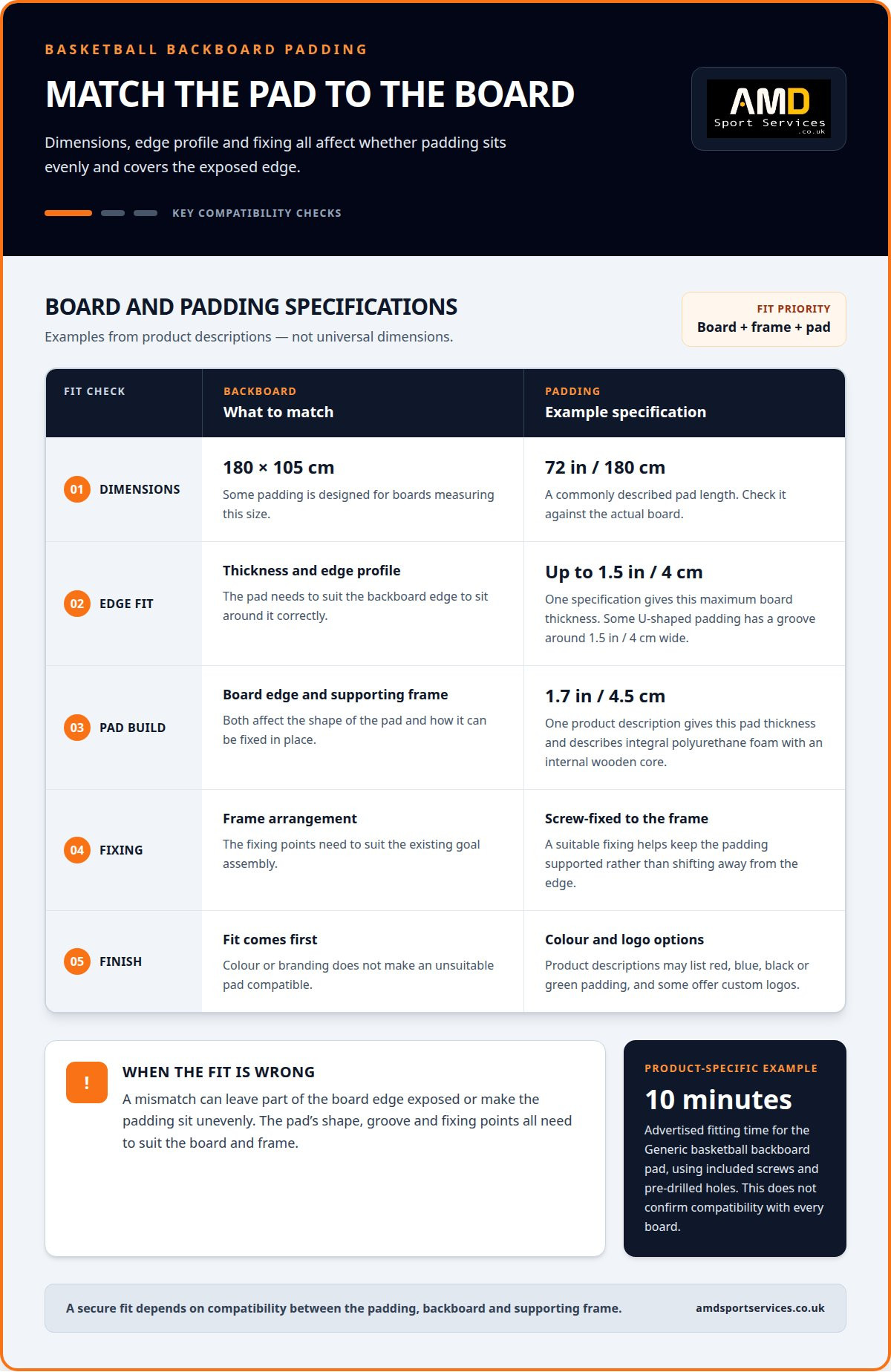
Compatibility depends on the board’s dimensions, thickness and edge profile.
We offer polyurethane padding for Matchplay backboards at 1800mm wide fitment, and practice sized backboards at 1200mm wide. A separate specification gives a maximum board thickness of 1.5 inches, or 4 cm. A
Lot of the older backboards on sites are still the old imperial sized backboards which measure 6ft instead of the 1800mm which we now use. So fitment is not guaranteed, and the backboards should always be measured. These details illustrate why dimensions matter: pads are not automatically interchangeable across different backboards.
Groove width is another fit consideration. Some U-shaped padding has a groove around 1.5 inches, or 4 cm, wide, allowing it to sit around the board edge. The required profile depends on the backboard itself. A mismatch can leave part of the edge uncovered or make the padding sit unevenly, which is why a secure fit is central to the installation work.
Padding suited to the backboard
Heavy-duty polyurethane pads are designed for a secure, durable fit. They screw directly into the steel frame of the basketball goal, helping the padding remain supported during use rather than shift away from the area it is meant to cover. The pad’s shape, groove and fixing points must all suit the existing goal assembly.
Heavy-duty polyurethane pads offer greater durability than cheap foam padding. Cheap foam pads will deteriorate over time and is difficult to remove and replace because it requires adhesive or glue for installation. Some U-shaped polyurethane pads are made with an internal wooden core, and one description gives a pad thickness of 1.7 inches, or 4.5 cm. These are product-specific details, so the suitable option still depends on the board and its frame.
Padding may be available in red, blue, black or green, and some product descriptions offer custom logos. These options can help a facility coordinate equipment with its hall or school identity, but fit comes first. Colour or branding cannot make unsuitable padding a good match for the backboard.
When installation forms part of wider work
Basketball equipment can vary between courts, particularly when boards or goals have been replaced at different times. A sports hall may have boards with different dimensions or frame arrangements. Plan the installation around the equipment in place so the padding fits the actual backboard, not an assumed standard size.
Padding is designed to cover exposed backboard edges and reduce the risk of players contacting a hard edge. It does not repair a damaged board, loose frame or other goal fault. If the wider assembly is in poor condition, consider that alongside the padding work. This helps facilities teams determine whether the job is limited to the board edge or forms part of broader basketball equipment work.
For schools and leisure venues planning sports equipment installation, a secure fit depends on compatibility between the padding, backboard and supporting frame. Clear identification of the equipment helps define the appropriate scope, especially where multiple courts have different board types. The result is padding selected for the equipment in place, with coverage and fixing suited to the backboard rather than a generic assumption.
Where the selected option is the Generic basketball backboard pad, its advertised installation time is 10 minutes, using the included screws and pre-drilled holes. That gives an indication of the fixing approach for this product, but it does not remove the need to check that the pad suits the particular board and supporting frame. The fit considerations remain the board’s edge profile and the way the pad sits around it; a stated installation time should not be treated as evidence that every backboard is compatible. Before fitting, confirm that the supplied fixing points can be used with the intended frame and that the padding covers the exposed edge evenly. The advertised 10-minute installation is specific to the Generic basketball backboard pad and its included screws and pre-drilled holes. For other padding, installation arrangements may differ, so the product details and existing assembly should guide the choice. A secure, compatible fit remains the priority for keeping the edge protected during regular play.
AMD Sport Services
AMD Sport Services installs basketball equipment and carries out sports equipment safety inspections for schools, leisure centres and other facilities. Backboard padding can be considered alongside a new goal installation or an inspection of concerns with an existing board and frame.
That joined-up view helps facilities managers address the backboard and its supporting goal together, rather than treating the pad as an isolated component. AMD Sport Services also carries out indoor sports equipment inspections, which can help identify equipment condition issues across a sports hall.
For help with basketball equipment at your facility, contact AMD Sport Services.
Plan the next step for your basketball equipment
Consider basketball backboard padding installation alongside the court’s wider equipment condition and planned use. When renewing a goal, coordinating the padding with basketball goal installation can help keep the project organised. For existing facilities, a sports equipment safety inspection can identify issues to address alongside the backboard.
AMD Sport Services also installs safety surfacing, supporting facilities with equipment and playing-area projects. The right scope depends on the venue’s needs, from planning an installation to addressing equipment concerns through ongoing maintenance. Schools, leisure centres and facilities teams can discuss their basketball equipment and the work they are planning.
For a practical conversation about your facility’s requirements, contact AMD Sport Services. A clear next step can help you plan the work with confidence.
Comments