
Commercial Trampoline Maintenance: The Ultimate Safety and Compliance Checklist

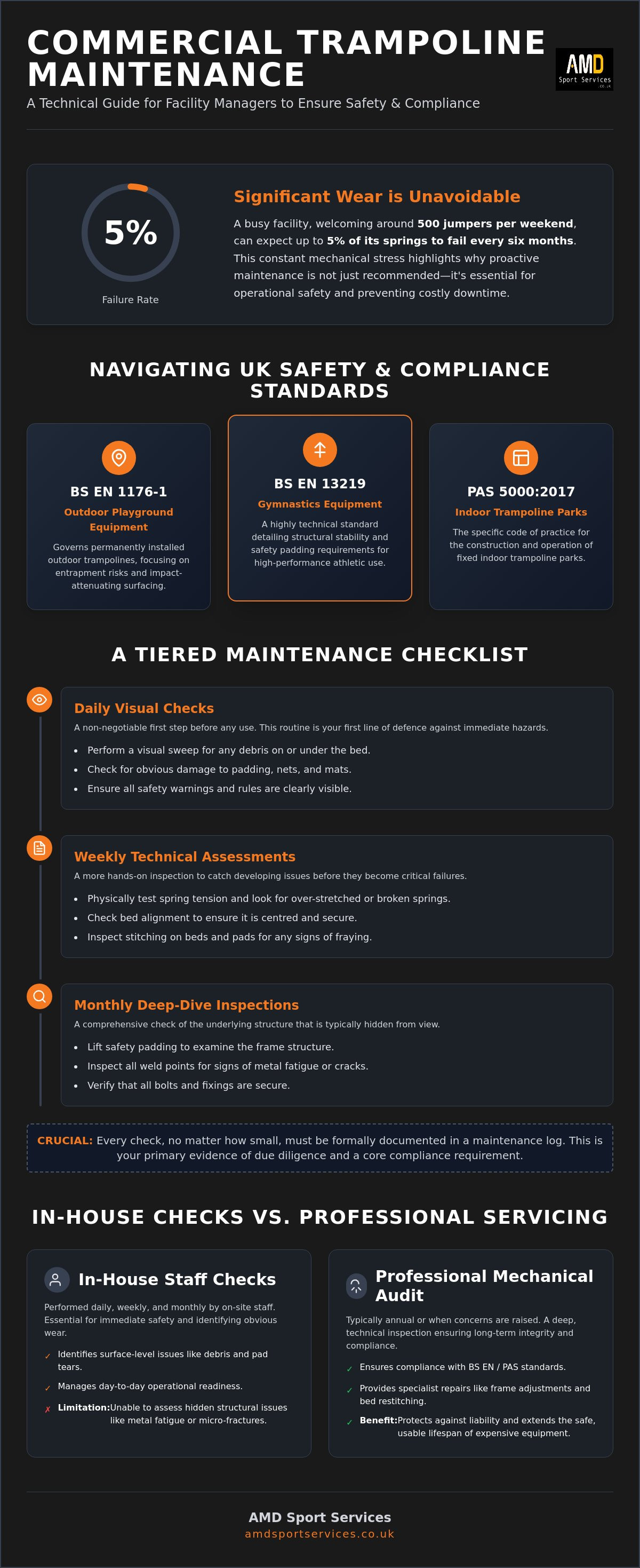
Did you know that a busy facility welcoming 500 jumpers a weekend can expect 5% of its springs to fail every six months? This constant wear highlights why commercial trampoline maintenance is not a task to be left to chance or handled only when a component visibly fails. For facility managers and school administrators, the pressure to balance high throughput with the rigid safety requirements of PAS 5000:2017 is often a source of significant stress. It is a complex challenge to keep equipment operational whilst ensuring every part of the structure meets the technical standards required to protect both the user and the organisation from liability.
We understand that navigating the specifics of UK health and safety regulations can be confusing, especially when equipment fatigue threatens to disrupt your scheduled classes or public sessions. This guide provides a pragmatic, technical roadmap for maintaining your equipment to the highest professional standards. You will learn how to implement an actionable inspection checklist, understand the expected lifespan of critical components like mats and padding, and recognise the specific indicators that signal a need for professional repair. By following this methodical approach, you can extend the life of your gymnastics equipment and maintain a facility that is both safe and fully compliant.
Table of Contents
Understanding UK Commercial Trampoline Safety Standards
Facility managers often mistake general equipment care for a robust compliance strategy. Effective commercial trampoline maintenance requires adherence to specific British and European standards that vary based on the equipment's environment and intended use. For outdoor play areas, BS EN 1176-1 governs the requirements for playground equipment, focusing on entrapment risks and impact-attenuating surfacing. Conversely, gymnastics equipment used in sports halls or schools must meet BS EN 13219. This standard is far more technical, detailing the structural stability and safety padding requirements necessary for high-performance athletic use.
The Association for Physical Education (AfPE) provides the primary framework for schools in the UK. They mandate that all sports equipment, including trampolines, undergoes regular professional inspection to remain fit for purpose. Relying on "domestic grade" maintenance routines is a common but dangerous error. Commercial environments subject equipment to significantly higher traffic and mechanical stress than a backyard setting. For a technical foundation on how these systems operate, a Trampoline safety overview illustrates the complex interaction between frame tension and user force that standards like BS EN 13219 seek to regulate.
BS EN 1176-1: Standards for permanently installed outdoor trampolines.
BS EN 13219: Functional and safety requirements for gymnastics trampolines.
PAS 5000:2017: The specific code of practice for indoor trampoline parks.
Duty of Care and Liability for Facility Managers
You have a clear legal obligation to provide equipment that is safe for public or institutional use. In the event of an accident, your first line of defence is a detailed maintenance log. These records prove that you've followed a structured service and maintenance schedule. Without this documentation, insurance underwriters may refuse to cover injury claims. Beyond liability, poor maintenance leads to unexpected equipment failure, which causes costly downtime in leisure centres and disrupts educational curriculums.
Specific Requirements for SEN and Rebound Therapy
Trampolines used for Special Educational Needs (SEN) and Rebound Therapy require a higher frequency of inspection. Because these sessions often involve users with limited mobility or different weight distributions, the safety padding must meet stringent impact absorption levels. We recommend that adjustable-height frames receive specialist servicing to ensure the mechanical lifting components remain smooth and secure. Maintaining these units isn't just about safety; it's about ensuring the equipment remains inclusive and functional for every user.
The Commercial Trampoline Maintenance Checklist: Daily and Weekly Inspections
A high-traffic sports hall or leisure centre requires a tiered approach to equipment care. Relying on an annual visit from a technician is insufficient for managing the daily wear and tear of institutional use. Effective commercial trampoline maintenance is built on a regime of constant vigilance, moving from simple visual observations to technical structural assessments. This multi-layered strategy ensures that minor component fatigue is identified before it results in equipment failure or user injury.
Daily checks are non-negotiable. Before the first user steps onto the bed, staff must perform a visual sweep to clear debris and check for obvious damage. Weekly assessments should be more technical, involving a physical test of spring tension and bed alignment. Once a month, a deep-dive inspection is required. This involves lifting the safety padding to examine the frame and weld points that are usually hidden from view. If your staff identify structural concerns during these weekly checks, commissioning a professional indoor inspection and maintenance audit ensures that minor issues don't escalate into compliance failures.
Every check must be documented. A formalised inspection regime is a core requirement of the UK Commercial Trampoline Safety Standards, which demand that all identified defects are recorded and addressed before the equipment returns to service. Whether you use a digital system or a physical logbook, these records serve as your primary evidence of safety compliance during audits or insurance reviews.
Surface and Bed Inspection Protocol
Inspect the trampoline bed for "burn holes" caused by friction or unauthorised footwear. These small singes weaken the integrity of the mesh and can lead to sudden tearing under load. You should also examine the bed perimeter for fraying stitching. A bed must remain perfectly centred within the frame; any bias to one side suggests uneven spring tension or a frame that has begun to warp under stress. Ensuring the bed remains taut is essential for both performance and safety.
Spring and Attachment Security
Springs are the hardest-working components of the system. Look for "dead" springs that appear over-stretched or fail to retract fully, as these compromise the uniformity of the bounce. Check the spring hooks for signs of rust or metal fatigue, which are common in humid sports hall environments. Finally, verify that all padding and spring covers are securely fastened. Loose padding is the most frequent failure point in leisure centres and poses a significant risk of limb entrapment between the springs.
Identifying Critical Wear: Springs, Beds, and Frame Integrity
Identifying component failure before it occurs requires an understanding of the technical stressors unique to institutional environments. High-use commercial frames are subject to the science of metal fatigue, where repetitive loading and unloading create microscopic fractures in the steel. Whilst a frame might appear solid, these internal stresses eventually compromise the structural integrity of the entire unit. Effective commercial trampoline maintenance involves looking past surface aesthetics to evaluate the mechanical health of the system.
Safety padding is statistically the most frequent failure point in leisure centres and schools. Unlike the frame, padding is a consumable component that degrades through constant impact and compression. When the internal foam loses its density, it can no longer provide the shock absorption required by UK safety standards. For outdoor installations, the primary threat shifts to UV degradation. Sunlight breaks down the chemical bonds in polymer netting, making it brittle and prone to failure during a fall.
Frame Stress and Weld Integrity
Structural failure often begins at the joints. You should inspect all weld points for hairline cracks, which often present as thin, irregular lines in the paint or powder coating. Corrosion is another critical factor; surface rust is manageable, but deep pitting on the legs or main rails indicates a structural risk that requires immediate service and maintenance intervention.
Safety Padding and Enclosure Systems
Testing the shock-absorption capacity of aged foam is a technical necessity. You can perform a simple thumb test to check for foam memory, but professional audits use impact testing to ensure compliance. Enclosure netting must be correctly tensioned to prevent a user from "bottoming out" against the frame or floor during a fall. We recommend a monthly check of all hardware, including:
Buckle Tension: Verifying that straps haven't stretched or frayed.
Netting Porosity: Checking for snags that could catch fingers or clothing.
Padding Attachment: Confirming bungees or ties haven't perished or lost elasticity, and that cable ties haven’t been fitted.
Evaluating the stability of your equipment also involves checking the surrounding environment. For indoor units, ensure that the floor fixings remain flush with the sports hall surface to prevent trip hazards or frame movement during high-impact sessions.
Professional Servicing vs. In-House Maintenance
Visual staff checks are the first line of defence, but they have inherent limitations. A court monitor or gym teacher can spot a missing spring, but they rarely have the technical training to identify the onset of metal fatigue or the gradual loss of foam density in safety padding. Professional commercial trampoline maintenance involves a calibrated mechanical audit that goes beyond surface aesthetics. A technician examines the structural integrity of every weld and the precise tension of the bed, ensuring the equipment performs exactly as the manufacturer intended.
Major repairs or component replacements must be certified by a competent person to maintain the equipment's safety rating. This technical oversight is what distinguishes a compliant facility from one at risk of liability. Establishing a schedule for commercial trampoline maintenance amongst other facility requirements, such as floor resurfacing or netting inspections, allows for a more efficient use of downtime. It's better to plan for a service than to react to an equipment failure during a peak session.
Managing Facility Liability through Certification
An independent safety certificate provides essential protection for school governors and facility owners. It acts as tangible proof that the equipment meets BS EN standards, which is often a prerequisite for insurance cover. By integrating these checks into broader sports equipment safety inspections UK, you ensure that every asset in your sports hall is accounted for. Professional servicing doesn't just ensure safety; it identifies minor wear before it requires an expensive replacement, effectively extending the lifespan of your equipment by several years.
When to Decommission Equipment Immediately
Red-flag failures demand immediate action. If a frame joint shows a hairline crack or a bed has a tear that compromises the weave, the unit must be taken out of use instantly. We recommend a simple "repair or replace" decision matrix: if the cost of technical refurbishment exceeds 60% of the replacement value on an older frame, investing in a new unit is often the more pragmatic choice. Whilst awaiting professional repair, the equipment should be physically cordoned off or locked in a storage area to prevent accidental use. If you're unsure about the structural health of your equipment, booking a professional gymnastics trampoline service audit is the safest way to determine the next steps.
Specialist Repairs and Refurbishment for Institutional Trampolines
Refurbishing institutional equipment is often a more sustainable and cost-effective strategy than full replacement. Many older gymnastics frames were engineered with a level of durability that modern budget alternatives lack. Specialist commercial trampoline maintenance involves identifying which parts of these legacy systems can be salvaged through bespoke engineering. This process often includes professional bed restitching, where the perimeter is reinforced with industrial-grade webbing to handle the high-tension requirements of competitive or therapeutic use. By reinforcing these stress points, we can restore the structural integrity of a bed that would otherwise require disposal.
Frame integrity is the foundation of any safe facility. For discontinued models where spare parts are no longer available, bespoke frame repairs become essential. This involves technical welding to address fatigue cracks or the custom fabrication of component parts like leg braces and floor protectors. For outdoor units, refurbishment includes the application of weather-resistant powder coatings to prevent the oxidisation that leads to structural thinning. Upgrading safety padding to modern high-density standards is another critical step, ensuring that older frames provide the same impact protection as brand-new installations.
Bespoke Solutions for Schools and Leisure Centres
Institutional environments often have unique spatial constraints that standard off-the-shelf products cannot accommodate. We provide custom-sized safety padding designed specifically for non-standard gymnastics pits or unusually shaped sports halls.
Next Steps: Securing Your Facility
Maintaining a safe facility requires a proactive rather than reactive mindset. Requesting a comprehensive site audit for your gymnastics equipment is the most effective way to identify hidden risks before they lead to accidents or equipment downtime. Establishing a long-term maintenance contract helps to reduce emergency repair costs and ensures that your equipment is always ready for inspection. If you require technical advice or a specialist quote, contacting AMD Sport Services for gymnastics trampoline repairs ensures your equipment remains compliant with all current UK safety standards. Our team focuses on delivering technical honesty and durable workmanship to keep your facility operational and safe.
Maintaining Long-Term Safety and Equipment Integrity
Rigorous commercial trampoline maintenance is the only way to ensure your facility remains compliant with UK safety standards whilst protecting the long-term value of your assets. By implementing the tiered inspection regime discussed in this guide, you move from reactive repairs to a proactive safety strategy. We've established that identifying hairline fractures in welds and monitoring the density of safety padding are essential steps in preventing equipment failure and avoiding costly facility downtime.
Managing institutional sports equipment requires a level of technical precision that daily visual checks simply cannot provide. With over 20 years of technical expertise, we specialise in gymnastics and school equipment servicing with comprehensive national coverage across the UK. Our team provides the mechanical audits and certifications necessary to maintain strict adherence to BS EN 13219 and PAS 5000 standards. Book a Professional Trampoline Safety Inspection with AMD Sport Services to secure your facility's safety certification and extend the life of your equipment. Taking these methodical steps today ensures your trampolines remain a safe, reliable resource for your students and members for years to come.
Frequently Asked Questions
How often should commercial trampolines be professionally inspected?
Commercial trampolines require a professional inspection at least once every 12 months to maintain safety compliance and insurance cover. This annual audit is the minimum standard for schools and leisure centres. Facilities with high user throughput, such as indoor trampoline parks, should consider more frequent quarterly or half-yearly technical inspections. These professional reviews verify the structural integrity of the equipment beyond what is possible during daily staff visual checks.
What are the legal safety standards for trampolines in UK schools?
UK schools must adhere to the safety frameworks established by the Association for Physical Education (AfPE) and the BS EN 13219 standard. These regulations ensure that gymnastics equipment is structurally sound and fit for educational use. Implementing a structured programme for commercial trampoline maintenance is the most effective way to demonstrate that your school is meeting its legal duty of care and protecting its governors from liability.
Can a damaged gymnastics trampoline bed be repaired or must it be replaced?
A damaged bed can often be restored through professional restitching if the wear is limited and the webbing is not excessively worn. This technical refurbishment is a cost-effective way to extend the lifespan of expensive institutional equipment. However, if the main jumping surface has "burn holes" or significant tears in the weave, the structural integrity is lost. In these cases, the bed must be replaced immediately to prevent a total failure during use.
How long do commercial-grade trampoline springs typically last?
High-quality commercial springs generally have a functional lifespan of three to five years in a standard school or sports hall environment. In high-traffic leisure facilities, the failure rate is significantly higher; it's estimated that 5% of springs will need replacement every six months in a busy park. Using budget-grade springs is a false economy, as they often lose their tension or suffer from metal fatigue within just six to twelve months.
What is the difference between BS EN 1176 and BS EN 13219?
BS EN 1176 is the safety standard for trampolines permanently installed in outdoor public playgrounds, focusing on weather resistance and entrapment risks. BS EN 13219 is the specific standard for gymnastics trampolines used in indoor sports environments. You must ensure your maintenance routine follows the correct standard for your equipment's setting, as the requirements for frame stability and safety padding density differ significantly between playground and athletic models.
Do I need to keep a written log of daily trampoline safety checks?
You must maintain a detailed written or digital log of every daily and weekly safety inspection performed at your facility. These records are essential for demonstrating compliance with the PAS 5000:2017 standard and serve as your primary evidence of due diligence during insurance audits. A clear log shows that you've identified and addressed minor defects, such as loose padding or debris, before they could escalate into a safety risk.
What should I do if I find a crack in the trampoline frame?
You must take the trampoline out of service immediately if you discover any cracks in the frame or joints. Even a small hairline fracture in a weld point indicates that the steel has reached its fatigue limit and could collapse under load. Do not attempt an in-house repair; instead, cordon off the equipment and contact a technical specialist to perform a professional weld or component replacement to restore the frame's safety rating.
Is it safe to use a commercial trampoline if the safety padding is torn?
It's never safe to operate a trampoline with torn or degraded safety padding. The padding is a critical safety barrier that prevents users from falling between the springs or impacting the hard steel frame. If the internal foam is compressed or the outer PVC cover is ripped, the impact absorption is compromised. You should decommission the unit until the padding is refurbished or replaced with high-density, compliant materials.


Comments