
Cricket Cage Netting Replacement for UK Schools and Clubs

Cricket netting does more than enclose a practice cage: it contains balls during training and batting practice, and can act as ball-stop netting around a pitch. For UK schools and clubs, cricket cage netting replacement may involve renewing the net alone or refurbishing the entire cage, depending on the condition of the frame and fittings. Worn or damaged netting can leave gaps in the enclosure.
It’s understandable to focus first on the net itself, but the right replacement also depends on how the cage is used, its dimensions and the netting specification. Mesh size and material affect which option suits the facility, while the supporting structure’s condition can determine whether replacing only the net is practical.
This guide explains the role of cricket netting, how materials and mesh sizes affect replacement choices, and what to consider when measuring a cage. It also covers refurbishment options, helping schools and clubs understand when renewing the net may be enough and when the wider cage needs attention.
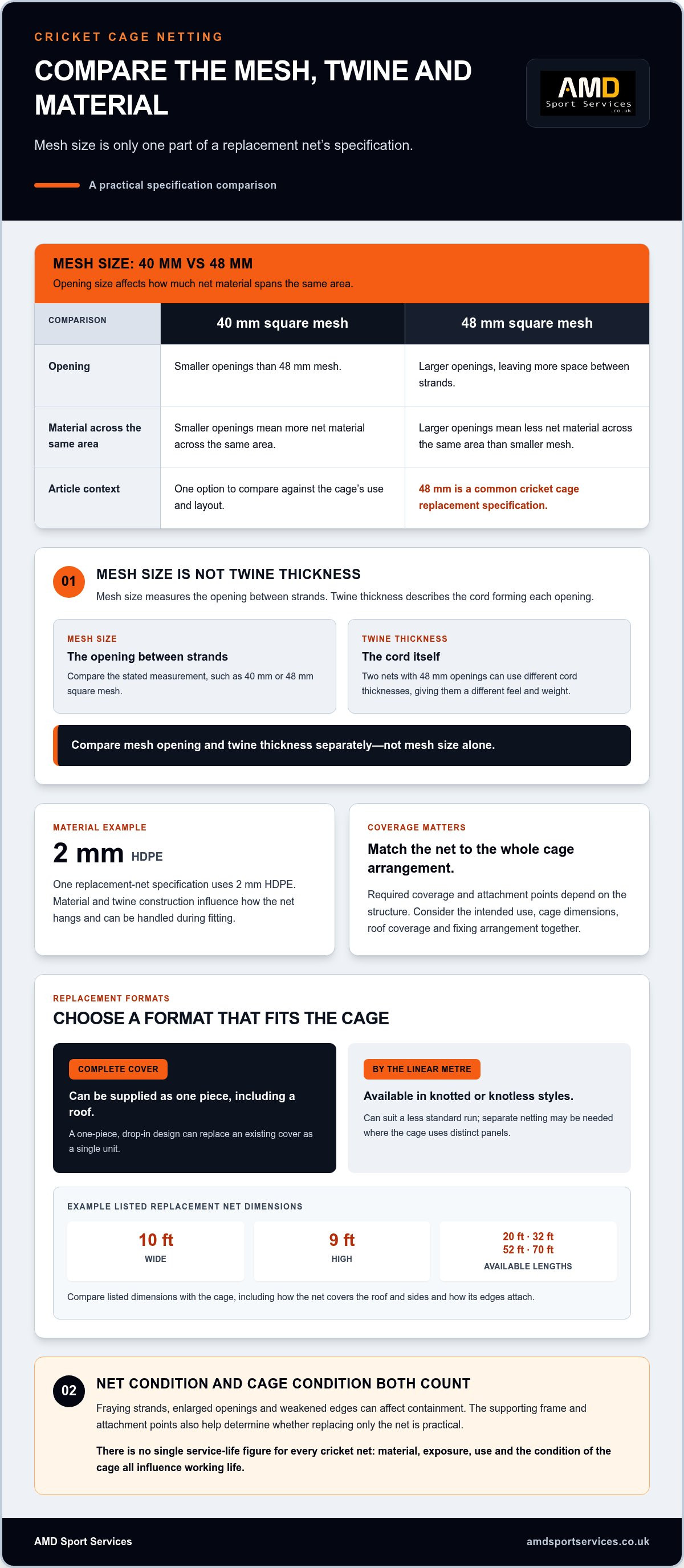
Cricket netting materials and mesh sizes
These details help distinguish differences in mesh, material and twine. A cricket cage netting replacement in the UK should suit the required enclosure and batting use, with mesh, twine and material considered together. Comparing all three helps avoid choosing a net that matches one measurement but differs in another important aspect of its construction.
Replacement cricket cage netting
Replacement netting is available as a complete cage cover or by the linear metre. The right format depends on the existing cage dimensions, roof coverage and fixing arrangement.
Sourcing Replacement Netting
In the UK, AMD Sport Services provides replacement cricket netting and sports netting systems for schools and clubs. AMD Sport Services can supply netting suited to the cage layout and provide installation as part of the service.
Compare the stated net dimensions with the existing cage before selecting a format. A listed replacement net measures 10 ft wide and 9 ft high, with available lengths of 20 ft, 32 ft, 52 ft and 70 ft. A set-size net may suit a matching cage; a linear-metre order can suit a less standard run.
Check how the net covers the roof and sides, and how its edges attach to the structure. A one-piece, drop-in design can replace an existing cover as a single unit, while separate netting may be needed where the cage uses distinct panels. The shape and fixing points matter as much as the stated length and width.
Net Lifespan
There is no single number of years that applies to every replacement cricket net. Its working life depends on the material, exposure, use and condition of the supporting cage. A school cage used regularly for sports sessions may experience different wear from a club facility used less often.
Assess the net’s condition across its full area, not just the section nearest the batting crease. Fraying strands, enlarged openings and weakened edges can affect containment, even when most of the net looks intact. Worn or damaged netting can allow balls to escape the cage, creating a risk for people nearby.
Judge replacement timing by the net’s condition and performance rather than an assumed service-life figure. For example, a net with sound central panels but failing seams still needs attention at the edges. Replacement should restore continuous coverage across the cage, including the roof and sides where fitted.
Factors Affecting Lifespan
Outdoor exposure can affect netting over time. Sunlight, wind and changing weather place ongoing stress on fibres and attachment points. Regular batting adds repeated ball impact, particularly around the areas facing the striker. The frequency and intensity of use therefore influence how quickly wear develops.
Fit and installation also matter. A net that rubs against a frame, catches on a projection or hangs unevenly can wear faster at contact points. Weak or damaged fixings may allow movement, increasing strain along the net’s edge. These local problems can shorten the useful life of otherwise serviceable panels.
For a practical assessment, compare the material and dimensions with the cage, then consider usage, exposure and visible wear together. A 20 ft cover and a 70 ft cover serve different cage lengths, but neither size alone indicates lifespan. The condition of the whole assembly, including the supporting frame and attachment points, helps determine whether net-only replacement is appropriate.
Replacement net sizes for one- to four-bay cricket cages
Replacement net dimensions depend on the cage’s length, width, height and bay arrangement. Practice cages enclose training areas, while pitch-perimeter systems provide ball-stop coverage beyond the cage setting.
Mesh Options
Replacement netting can be supplied as a complete cover or by the linear metre in knotted or knotless styles. Choose based on whether the cage needs one integrated cover or separate sections. For a multi-bay enclosure, consider how the net will meet the dividing frames and whether it needs to cover one bay or the full run.
Look at the planned coverage as well as the number of bays. A one-piece replacement designed for a cage measuring 3.2 m by 3.6 m by 7.2 m demonstrates how precise the relationship between net size and frame dimensions can be. Bay count alone does not determine the net’s required length or roof coverage.
Measuring a Cricket Cage
Record the frame’s overall length, width and height, then identify which sides and roof areas need netting. For a cage with several bays, note whether the replacement spans the whole structure or only one section. Include attachment points and any separate roof panels, as these affect the net’s shape and fit.
Measure the frame rather than relying on a nominal cage or bay description. A cage can have unusual proportions even if its bay count matches another facility’s. The example of a 3.2 m by 3.6 m by 7.2 m enclosure shows why all three dimensions matter when matching a replacement.
Cricket cage netting and pitch-perimeter netting serve distinct purposes. Cage netting encloses a practice area for batting or bowling; perimeter netting forms a ball-stop barrier around a pitch. A large-scale ball-stop system illustrates the scale of a perimeter installation, which is not the same product as a cage cover.
Other installations have different dimensions. A typical fixed ball-stop net might measure 40 metres long and 5 metres high, while another larger system can reach 12 metres high. These examples show how perimeter requirements vary by site, rather than setting standard sizes for one- to four-bay cages.
Freestanding mobile cages can be moved between training locations, so replacement netting must suit the particular frame and required coverage. Record the assembled cage dimensions and distinguish the net area from the frame footprint. A mobile cage used for bowling still needs netting shaped for its structure, including any roof section.
Cricket cage refurbishment
Individual damaged panels can be replaced when the cage has separate sections and the remaining netting is still serviceable. A complete replacement is more suitable when wear affects connected areas or the existing cover cannot be separated without compromising coverage.
Refurbishment starts by establishing how the cage is assembled and where the damage is. A tear in a side panel requires a different scope from failing seams across several sections. The aim is to restore continuous containment, not simply cover the most visible defect.
Panel replacement depends on how the existing sections connect. A new panel must join securely to neighbouring netting and align with the cage frame. If its edges cannot be connected cleanly, the repair may leave a gap or strain the surrounding material. A wider replacement area may then be needed.
The supporting structure also affects the work. A cage frame that has shifted or become distorted can prevent replacement netting from sitting correctly. Attachment points may need attention if they no longer hold the net in position. Addressing these issues during refurbishment helps renewed sections fit the structure rather than simply sit over the damaged area.
Consider how the cage is used when deciding the extent of refurbishment. For example, damage concentrated around the batting area may require a different repair scope from deterioration on a side exposed to frequent ball impact. The net should provide consistent coverage across the active area, roof and boundaries required by the facility.
Refurbishment can be staged when only isolated sections need renewal and the remaining panels are sound. This lets a school or club focus work on affected areas while retaining serviceable parts. If damage is widespread, replacing several separate panels may create multiple joins and inconsistent coverage. A complete new net can then be the more straightforward solution.
Installation quality matters to the finished result. The replacement must follow the cage’s shape, meet adjacent panels and remain secured at its fixing points. A poor fit can leave openings or cause rubbing where the net contacts the frame. The work should therefore account for the connections between renewed sections and the existing enclosure.
The practical decision depends on panel condition, join compatibility and frame integrity. Localised damage with sound surrounding netting can allow panel replacement; connected deterioration, incompatible joins or a compromised overall cover point towards full renewal. This assessment keeps refurbishment focused on restoring the cage as a complete enclosure.
Where can I buy replacement cricket cage netting in the UK?
AMD Sport Services supplies replacement cricket cage netting and sports netting systems for UK schools and clubs. AMD Sport Services offers netting planned around the facility, including supply and installation for replacement covers, panels and wider cage refurbishment requirements.
AMD Sport Services replacement netting
AMD Sport Services can help identify the appropriate replacement format, whether the cage needs a complete cover, replacement panels or netting made to suit an existing frame. The service considers the cage dimensions, roof and side coverage, bay arrangement and fixing points.
AMD Sport Services provides indoor and outdoor sports netting systems, including cricket netting, with installation. This gives schools and clubs one specialist company for the replacement netting and the work required to fit it to the facility.
Prepare the order details
Before contacting AMD Sport Services, record the cage’s length, width and height, the surfaces needing coverage and the location of attachment points. Photographs showing the frame and existing netting can also clarify the layout, particularly where the roof joins the side panels.
Also identify the intended use, such as batting practice or a training cage, and whether the cage has one bay or several. The cage layout, intended use and required coverage inform the replacement specification and installation plan.
For a sound purchasing decision, compare the measured cage with the required net format and coverage. AMD Sport Services can discuss the project requirements and provide a replacement netting solution for the school or club’s cricket facility.
AMD Sport Services: Sports equipment safety inspections
AMD Sport Services carries out sports equipment safety inspections for schools and clubs. All equipment should undergo a thorough visual inspection at least every 12 months; some sites arrange inspections biannually when equipment experiences heavy use.
These inspections give facility managers information about equipment condition and help them plan maintenance across the site. Contact AMD Sport Services to discuss sports equipment safety inspections.
Plan the next stage of your cricket facility
Cricket cage netting replacement in the UK is an opportunity to consider how the enclosure will support future training, not just address visible wear. For a school or club, a clear record of the cage layout, net specification and areas needing attention can help guide maintenance planning and future decisions.
Keep the replacement scope connected to the wider facility. If other sports equipment needs attention, coordinating the work can help decision-makers plan priorities across the site. AMD Sport Services provides sports equipment safety inspections, basketball goal installation and safety surfacing, alongside its work with sports facilities.
Whether you’re planning a net replacement or reviewing broader facility needs, the next step is a practical conversation about the work required. Discuss your sports facility requirements with AMD Sport Services, and move forward with a clear plan for your school or club.
Frequently Asked Questions
What is cricket netting used for?
Cricket netting helps contain balls during practice and can protect nearby areas from stray shots. A school might use an enclosed lane for batting drills, while a club may install ball-stop netting beside a pitch. The layout depends on the purpose: an enclosed cage surrounds a practice space, whereas perimeter netting forms a boundary beyond the playing area.
Which materials are best for outdoor cricket cage netting in the UK?
No single material is best for every outdoor cage. Choose netting specified for outdoor sports use, then match its construction to the cage’s exposure, frequency of play and fitting arrangement. A school cage used regularly needs a specification suited to repeated ball impact, while an intermittently used club facility may have different demands. Compare material, twine and mesh as a complete specification.
What UK safety standards or regulations apply to cricket cage netting?
A mesh measurement alone doesn’t establish whether a cricket cage is suitable for its setting. Requirements may relate to the facility, installation and intended use, so don’t treat a net specification as proof of compliance. Sports equipment safety inspections can record the condition of cricket netting, identify defects and provide recommendations. They help facility managers understand equipment condition, but don’t replace consideration of site-specific requirements.
Which UK suppliers offer custom-made cricket cage replacement nets and delivery?
AMD Sport Services provides indoor and outdoor sports netting systems, including cricket netting, with installation. This suits schools and clubs seeking a netting solution planned around their facility rather than a generic net alone. The service combines supply and installation. The cage layout, intended use and required coverage inform the project specification.
How do I replace cricket cage netting step by step?
Measure the cage’s length, width and height, and note which sides and roof areas need coverage, including the fixing points. Check the existing mesh, twine and material, then choose netting that matches the required coverage and attachment arrangement. Assess the frame and fixings to determine whether net-only replacement is suitable.
Comments