
Sports Hall Protection Netting for Ball Safety

Ball safety in a sports hall depends on placing netting where balls could reach spectators, lights or adjoining activity areas. A sports hall protection netting installation uses bespoke, heavy-duty knotless netting secured to a tension-wire system with cable ties. The design can also include removable sections to provide access to lights for maintenance. For schools, leisure centres, gyms and cricket facilities, the challenge is fitting protection around the way each space is used. Court layouts, divider-net tracks and access requirements all affect the design. This article explains how netting is planned and installed, where it can help protect hall interiors and viewing galleries, and how maintenance access can be built into the arrangement. It also covers the details that shape a suitable solution, so you can understand what to consider for your facility before progressing with a project.
Applications in sports halls, gyms and cricket facilities
Sports halls use overhead protection, viewing-gallery netting and division nets, selected according to the balls and areas involved. UK safety requirements depend on the building and the netting’s purpose. Gallery netting contains balls, not people, so compliant edge protection must be installed below it.
Sports hall and gym protection
In sports halls and gyms, protection netting can help keep balls away from lights, spectators and adjoining activity areas. Division nets separate courts so different activities can take place at the same time. The layout must account for court positions, net tracks and the routes used to deploy or retract each net, preventing one system from obstructing another.
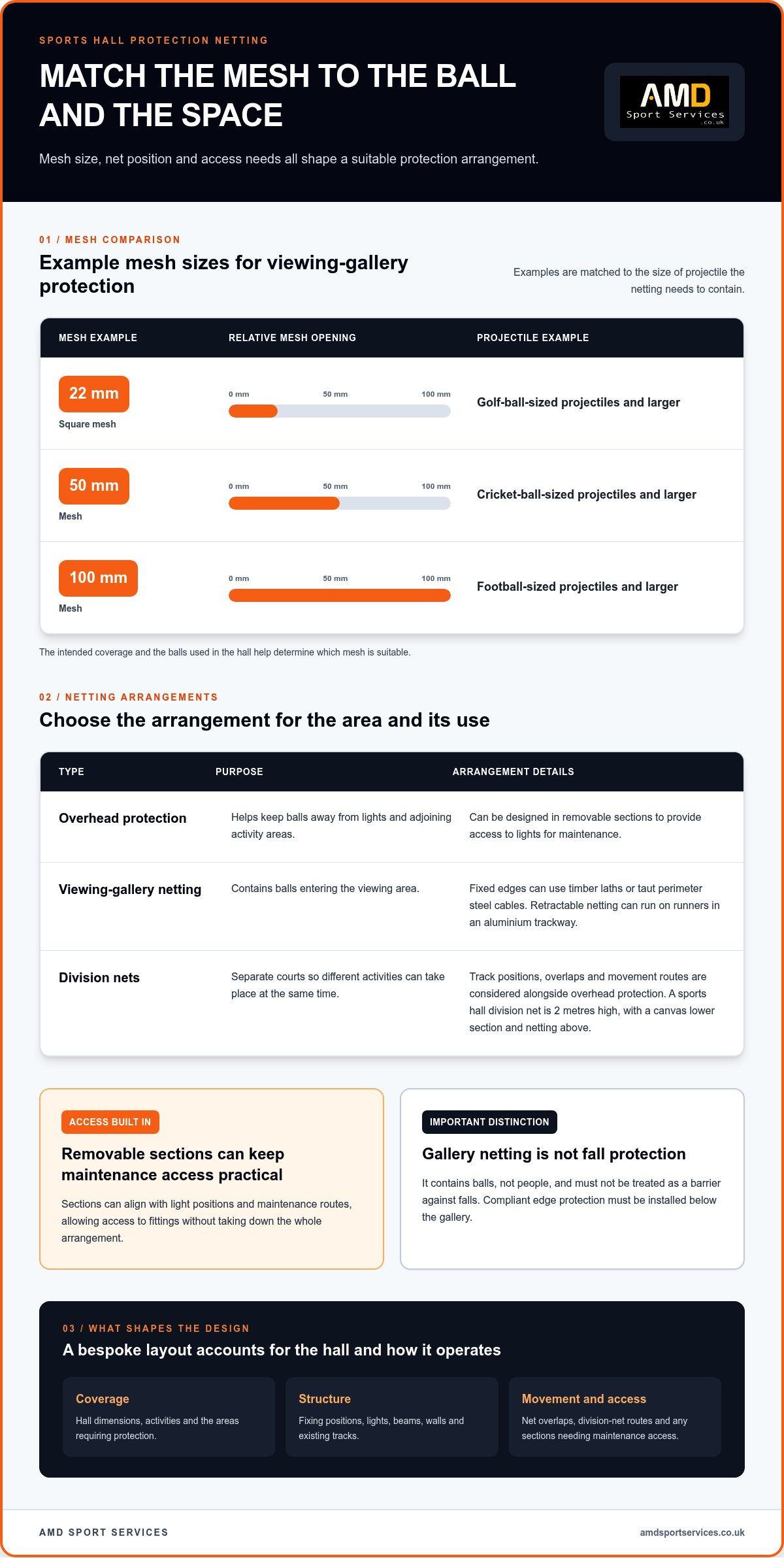
Viewing-gallery protection is another application. Mesh size can be matched to the projectiles the netting needs to contain: examples include 22 mm square mesh for golf-ball-sized projectiles and larger, 50 mm for cricket-ball-sized projectiles and larger, and 100 mm for football-sized projectiles and larger. The intended coverage and the balls used in the hall help determine which mesh is suitable.
Netting types and safety requirements
Netting types include overhead protection, gallery protection and division nets, with the mesh and layout tailored to the activities. Gallery netting contains balls entering the viewing area; it is not a barrier against falls. It must not be treated as a substitute for compliant edge protection below the gallery.
A sports hall protection netting installation also needs to suit the way the hall operates. Division-net tracks, fixing points and overlaps affect how division nets move beneath overhead protection. Where lights need maintenance access, protection netting can be designed in removable sections. This makes it possible to reach the fittings without leaving the whole arrangement inaccessible.
Indoor cricket facilities need protection around the training area as well as the gallery. Cricket balls can travel beyond the practice zone, so netting can help contain them and protect nearby users and hall features. Indoor cricket nets define the practice space; surrounding protection addresses balls that pass beyond it. Educational facilities across the country regularly commission indoor cricket facility updates that include specialised division netting.
High-level cricket netting servicing is relevant when netting or its supporting arrangement needs attention above the playing area. The access plan should account for hall lighting, net positions and the movement of division nets. In UK venues, the building and equipment layout also shape sports equipment installation work, particularly where cricket practice and other hall activities share space.
Maintenance access and sectioned net designs
Fixed netting stays in position, retractable netting moves along a track, and division nets separate activity areas. Retractable gallery netting can have its top edge attached to runners in an aluminium trackway. The bottom edge may hang loose, use removable sausage weights or be temporarily secured with VELCRO® Fasteners.
Fixed viewing-gallery netting can be secured at the edges with timber laths or supported by taut perimeter steel cables. One- or two-part laths trap the net edges where the perimeter structure is suitable. Taut cables offer another option if the structure cannot support laths. The fixing arrangement affects the finish and how the net meets surrounding surfaces.
Sectioned protection netting can provide access to sports hall lights without removing the whole system. Each removable section should align with the lighting location and maintenance route. This can let you reach a fitting while keeping other areas covered, rather than taking down a continuous span across the hall.
Before installation, the design considers fixing positions, access routes and how each net moves. A section that catches on a fitting or part of the structure may be difficult to remove or replace. The layout should also suit the hall’s operating pattern, including which areas need protection during different activities.
Netting maintenance may involve the fabric, fixings or trackway. Common track problems include misaligned or uneven joins, bent sections, crossover issues and broken trolleys that get stuck. Balls, hammers or similar objects can bend a track. These faults can stop trolleys running freely and make retractable nets difficult to move.
Most track faults can be repaired with tools once high-level access to the trackway is in place. In severe cases, the damaged section can be cut out and replaced with a piece matching the existing track profile or a compatible profile from another supplier. Net fabric, cable ties, runners and fixings may also need repair if damage affects how the system sits or moves.
Sports hall maintenance planning should include the netting and its supporting trackway. A sectioned design can preserve access to lights, while suitable fixings make removable panels practical to handle. This creates a system that supports routine facility maintenance without requiring every section to come down.
Planning the divider arrangement includes considering sports hall divider net tracks, fixing points and net overlaps so divider nets can be deployed and retracted while overhead protection remains effective. Sports hall divider nets can separate courts and help users take part in sporting activities without interruption. The sports hall division net is 2 metres high and has a canvas lower section with netting above.
Retractable viewing-gallery netting has its top edge fixed to runners in an aluminium trackway. Its bottom edge can hang loose, be weighted with removable sausage weights or be temporarily secured with VELCRO® Fasteners. The upper-edge support and lower-edge treatment are specified separately, so the design makes clear how the net is supported at the top and held at the bottom.
Bespoke sports hall net design and installation
A bespoke layout begins with the hall’s dimensions, activities and existing structure. These details determine the net coverage, fixing arrangement and access needed for installation.
To measure a sports hall, record the span and height of the area to protect, then note lights, beams, walls, tracks and other obstructions. The design should also account for net overlaps, moving division nets and any sections that need to be removable for maintenance access.
Netting materials and mesh sizes
Mesh selection depends on the balls used and the openings that need protection. The examples above show why a mesh suitable for one activity may not suit another. Heavy-duty knotless netting can be secured to a tension-wire system with cable ties. The material and opening size should match the intended coverage and facility use.
Fixing netting to existing structures
Depending on their position and configuration, suitable existing walls, ceilings or roof structures can support the netting. The design identifies usable fixing points and considers how the net will sit against the structure. Where the perimeter lacks a suitable fixing surface, taut steel cables can support the netting. Fixings must also work with the tracks and any required net movement.
Existing structures affect both coverage and the installation sequence. Beams, lighting and other features can interrupt a direct span, so the layout may need separate sections or adjusted fixing lines. For a sports hall protection netting installation, the design should show where each section starts and ends, and how maintenance access is preserved.
Installation timing and venue access
Installation time depends on the area covered, fixing points, access equipment and number of net sections. Working at height and complex track arrangements can add steps compared with a straightforward span. A venue does not automatically need to close completely; the work area and access route determine whether activities can continue elsewhere in the facility.
Before work begins, the installation plan coordinates netting with lighting, court use and existing tracks. If a section needs to be removable, its fixings must allow access without disturbing adjacent protection. Retractable sections also need a clear route through the trackway, with overlaps positioned to avoid snagging.
These decisions shape a practical, site-specific result. A measured layout helps ensure the coverage fits the hall, while compatible fixings and tracks support its intended use. The finished arrangement can protect the playing space and preserve maintenance access without assuming every facility has the same structure.
Protecting sports hall interiors from ball damage
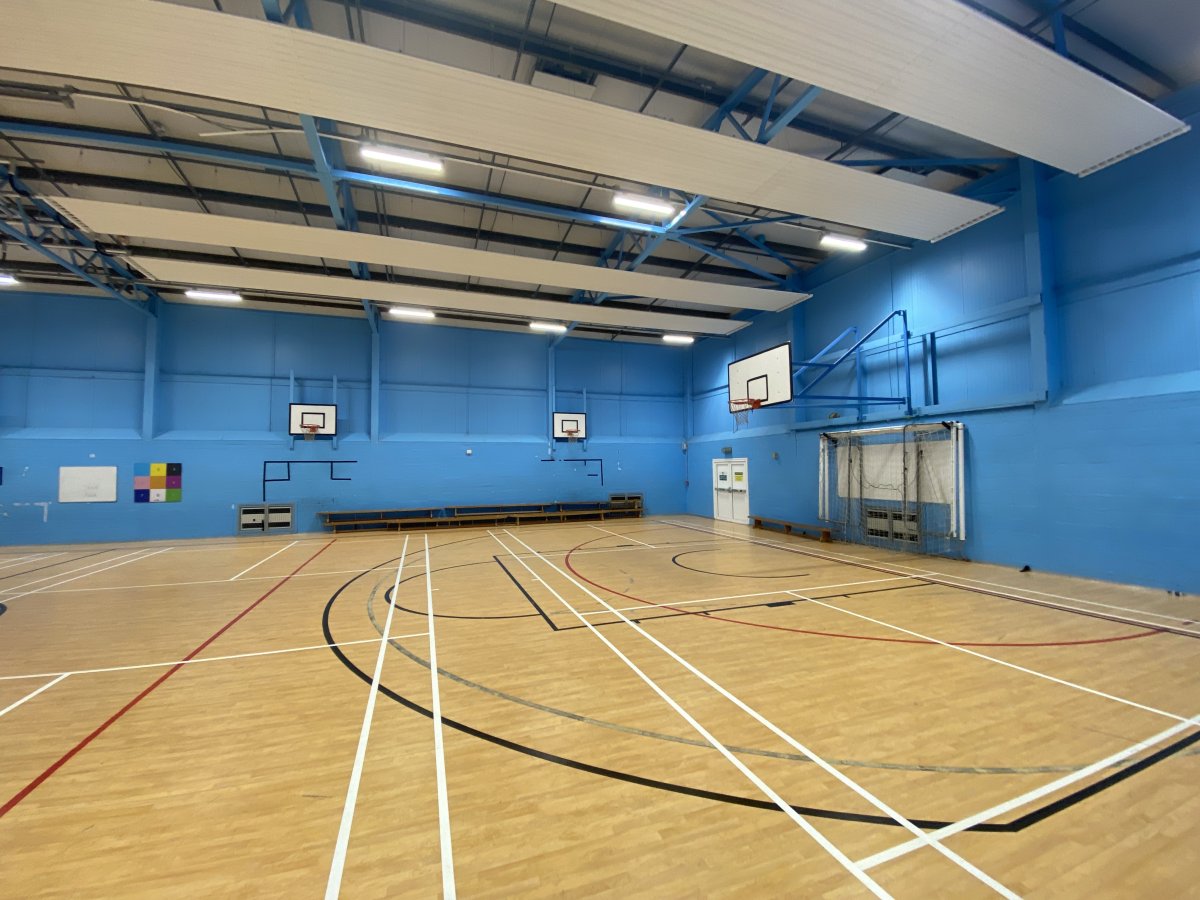
A ball leaving a court can strike lighting, glazing, wall finishes or stored equipment. In indoor sports, protection netting can help prevent direct contact between play and these exposed features. Plan coverage around likely ball routes, not simply along a convenient wall line. Basketball, for example, can send balls above the goal area, while cricket practice can send them towards the far end of a hall.
Start planning protection by considering each activity separately. Basketball, football and cricket produce different ball paths, and a shared sports hall may host all three. Court markings, goal positions and practice areas help identify where impacts are most likely. This makes it easier to define the areas at risk instead of installing netting where exposure is low.
The building’s interior also affects the layout. A hall with glazing beside a playing area has different protection needs from one with solid walls and high-level lighting. Netting can cover vulnerable openings or features while keeping the main activity space usable. Where several features are close together, one continuous protected area may suit the layout better than separate small panels.
Visibility matters in schools and leisure centres. Staff need to observe activities across the hall, and spectators may need a clear view from a gallery. Consider the netting’s position and material alongside sightlines and the hall’s normal use. A cricket practice area near a viewing space, for example, creates different viewing needs from a basketball court beside a blank wall.
Protection planning should also account for equipment and fixtures that move or change position. A basketball goal may be stored or repositioned, while a school hall can switch between lessons and clubs. Coverage needs to remain relevant across these arrangements. Identify which features are exposed when equipment moves, so the layout suits the facility’s actual pattern of use.
Once the coverage area is defined, netting can be made to fit the hall’s shape and the features requiring protection. Bespoke dimensions can accommodate unusual openings, sloping roof lines and interrupted wall spans. The finished arrangement should address the ball routes that matter for each activity, protect vulnerable features and preserve practical sightlines for staff and users.
Treat gallery coverage as ball containment, not fall protection. Viewing-gallery protection netting is intended to stop balls entering the gallery, not to prevent people falling from it. Building Regulations-compliant edge protection must be installed below the netting. Keeping these functions distinct ensures netting is not mistaken for a substitute for edge protection, while still containing balls near spectators.
Fixtures also affect where protection is needed. The company's wall-mounted hinged basketball goals can project up to 4.2m from the wall, so the protection layout should account for the space they occupy when positioned for play. The company's high-level badminton posts have uprights made from 40mm-diameter steel; their placement can be included when identifying exposed interior features and maintaining clear sightlines. Considering these elements alongside court activity helps keep coverage aligned with the hall's actual use.
Sports hall netting for schools and leisure centres
Schools and leisure centres often use one hall for several activities. Netting must suit that changing use, rather than protect only one court. A school, for example, may need the hall for football, basketball and indoor cricket, while a leisure centre may run separate sessions across marked courts. Plan coverage around the activities that share the space.
In a school hall, the timetable affects how protection and division nets work together. A net separating two classes needs to move without leaving areas above the playing zones exposed. Fixing positions and overlaps must suit the court arrangement, lighting and access requirements. This helps the hall accommodate different lessons without division-net movement interfering with overhead protection.
Leisure centres face a similar challenge when courts host different users throughout the day. A retractable division net can separate activities, while fixed protection addresses balls travelling towards vulnerable hall features. Each system has a different purpose. Coordinate their tracks and fixing points so deploying a court divider does not interfere with the protection net above.
Cricket and football illustrate why ball type and direction matter. Indoor cricket practice can send balls towards galleries or adjoining areas, while football may affect a wider part of the hall. The coverage plan should identify where each activity takes place and which areas lie in its likely ball path. This gives schools and centres a clearer basis for choosing net position and coverage.
Shared halls also need usable sightlines. Netting beside a viewing gallery should contain balls, not be treated as protection against falls. Staff need clear views across activity areas, and access to lighting must remain practical. If sections need to move for maintenance, plan their route and how they meet adjacent netting.
Before finalising a scheme, consider the hall as a working facility. Court markings, changing activities, the gallery, lights and existing tracks all affect the arrangement. A school hosting lessons and clubs may need a different layout from a leisure centre running simultaneous court bookings. Bespoke planning connects these operational needs to net positions, sectioning and movement.
The distinction is straightforward: protection netting helps contain balls, while division nets organise activity areas. Neither automatically replaces the other. For schools and leisure centres, the right design accommodates the actual sports, preserves maintenance access and works with the hall’s changing use.
AMD Sport Services: Sports equipment safety inspections
AMD Sport Services carries out sports equipment safety inspections for schools, leisure centres and other sports facilities. After netting work, an inspection can assess the condition of the equipment and identify issues affecting its safe use. All equipment should undergo a thorough visual inspection at least every 12 months; sites with heavy use may arrange inspections biannually.
Where a facility needs related work, AMD Sport Services also installs basketball goals and long jump runways, and provides safety surfacing. These services can support a wider sports facility project, with each item of equipment assessed on its own merits.
For information about sports equipment safety inspections or related facility work, visit AMD Sport Services.
Plan the next stage for your facility
The next step is to turn your facility’s priorities into a clear project scope. Identify the activities the hall needs to support, how the space is used, and where protection must allow for maintenance access. This gives the design a practical starting point and keeps operational needs in view throughout a sports hall protection netting installation.
AMD Sport Services also provides sports equipment safety inspections, basketball goal installation and safety surfacing. These services can support broader work across a school or leisure centre when netting is part of a wider facility project.
For a considered next step, contact AMD Sport Services about your sports facility requirements. A clear project conversation can help you set priorities and plan work around how your hall is used. Your facility can then move towards a netting solution shaped by its actual needs.
Frequently Asked Questions
How is sports hall protection netting installed and secured?
Installation begins by setting out the coverage and fixing positions to suit the hall’s structure. Netting may be secured to a tension-wire system with cable ties, while tracks and runners support retractable sections. The fixing method depends on the available walls, roof structure and perimeter. For example, taut steel cables can support gallery netting in a hall with limited perimeter fixing points.
How should sports hall protection netting be inspected, cleaned and maintained?
A sports equipment inspection can assess the net fabric, seams, ties, fixings and supporting track for damage or movement. A torn section or snagging trolley, for example, may affect containment or access. AMD Sport Services carries out sports equipment safety inspections and repairs. Cleaning methods should suit the net material and its manufacturer’s guidance to avoid damage from unsuitable products or equipment.
What UK safety standards or regulations apply to sports hall netting?
UK safety requirements depend on the building and the netting’s purpose. Viewing-gallery netting contains balls, not people, so compliant edge protection must be installed below it.
Comments