
Gymnastics Trampoline Servicing in the UK: Inspection and Maintenance

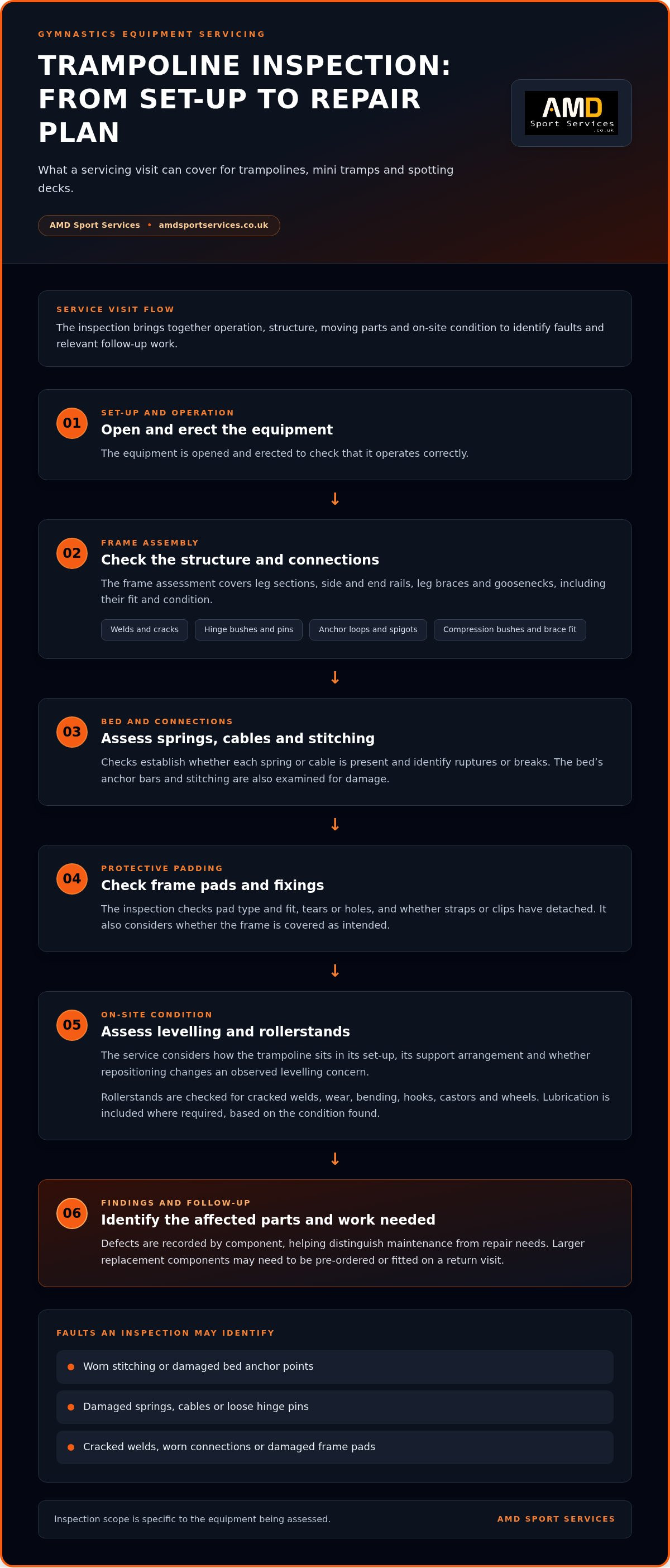
For schools and leisure centres, gymnastics trampoline servicing in the UK includes inspections of trampolines, mini tramps and spotting decks. A service inspection checks the equipment’s structure and moving parts, including the bed, springs or cables, frame, rails, braces, hinges and rollerstands. It also involves opening and erecting the equipment to check that it operates correctly.
Keeping equipment in working order takes more than a quick visual check. Worn stitching, damaged springs, loose hinge pins or cracked welds can affect performance. A thorough inspection helps identify faults that need attention.
This guide explains what an inspection covers, which common faults may be found and how maintenance supports safe operation in busy school and leisure settings. It also outlines what to expect from a servicing visit, so you can understand how inspection and repair work fit into ongoing equipment care.
Inspection of frames, rails and braces
For school and leisure-centre equipment, a service inspection examines the trampoline’s frame assembly and protective parts. It checks individual components and their connections, then records defects that may need maintenance or repair. The checks are specific to the equipment being assessed, rather than assuming one standard applies to every site.
The frame inspection covers leg sections, side rails, end rails, leg braces and goosenecks. Cracked welds can indicate damage at a structural joint, while wear around hinge bushes or anchor loops may affect how parts connect. Inspectors check that compression bushes are present and tight, and that braces fit correctly into their leg sections.
Side rails: Inspect welds, roller stand bosses, leg bosses and anchor loops for wear or damage.
End rails: Check straightness, hinge and spigot-pin wear, and whether rails sit parallel with the floor or tilt slightly upwards.
Braces and goosenecks: Check welds, fit and wear, then tighten Allen screws where needed.
Frame pads are checked for correct type and fit, tears, holes, and detached straps or clips. A 25 mm thickness is commonly cited as the industry-standard minimum for trampoline frame pads. The inspection also considers whether padding covers the frame as intended. A split pad or loose strap can leave part of the frame exposed.
Spring and cable checks establish whether each connection is present and whether any spring or cable has ruptured or broken. The inspection also examines the bed’s anchor bars and stitching, because damage at an attachment point differs from wear across the fabric. These observations identify the affected component and help determine the repair, rather than treating every bed fault alike.
Frame repairs depend on the location and nature of the damage. A worn hinge bush, loose compression bush and cracked weld each involve different parts of the assembly. Larger replacement components may need to be pre-ordered or fitted on a return visit. The inspection records the fault and its location, giving the facility a clear basis for planning follow-up work.
Checking connected parts together matters: a rail, brace and anchor loop all contribute to the assembled frame. Findings from these checks can be recorded as part of a sports equipment service and maintenance inspection, helping identify where repair work is needed.
A close inspection of side rails checks for cracked welds and wear on rollerstand bosses, leg bosses and anchor loops. It confirms that compression bushes are present and tight, since a missing or loose bush can affect the connection between frame components. Leg braces are checked for cracked welds and a proper fit in the leg section, with adjustments made if necessary. These checks distinguish a fault in a specific connection from broader frame damage and clarify which parts may need attention.
Repair tasks illustrate that follow-up work can involve different components. The examples show why inspection notes should identify the affected parts: a frame-parts job and spring repairs call for different work.
On-site levelling, maintenance and lubrication
On-site levelling considers how a trampoline is supported in its installed position. The inspection assesses whether the equipment sits evenly and whether its support arrangement contributes to an imbalance. This helps distinguish a levelling concern from a fault elsewhere in the assembly, rather than treating every uneven position as the same issue.
Assessment takes place in the equipment’s actual setting. Floor contact and the trampoline’s position provide context for the findings. A service inspection can record where an imbalance occurs and whether it remains consistent across the equipment. This gives maintenance work a defined focus without assuming the floor or equipment is automatically at fault.
For movable equipment, the assessment considers the support arrangement in relation to its position. A trampoline stored or repositioned between sessions may present a different levelling issue from equipment that stays in one place. The inspection records the observed condition so follow-up work reflects the actual site and setup.
Position: Assess the trampoline where it is set up for use.
Support: Consider whether the support arrangement contributes to uneven positioning.
Movement: Note whether repositioning changes the observed levelling concern.
Maintenance: Identify work appropriate to the condition found on site.
Lubrication is included where required as part of on-site maintenance. It is based on the relevant component’s condition and movement, not applied routinely as a substitute for assessment. The service distinguishes a maintenance task from a repair need, so lubrication is not treated as a solution to every operational concern.
These findings help facilities plan work around their equipment’s condition and use. For example, a levelling concern linked to the installed position calls for a different response from a movement issue requiring maintenance. Recording that distinction supports a practical maintenance history for schools and leisure centres, particularly where equipment is moved between storage and use.
Where an on-site assessment identifies a levelling or lubrication requirement, the service visit can include the relevant maintenance work. A sports equipment maintenance inspection can bring the assessment and required follow-up into the same service process.
The inspection also checks trampoline rollerstands for cracked welds, wear, bending, hooks, castors and wheels, and lubricates them if required. These component-level checks consider the support arrangement alongside the rollerstands’ condition, rather than relying on position alone. Any lubrication is based on the condition found during the visit.
For maintenance planning, keep observations distinct: levelling describes how equipment sits in its installed position, while rollerstand checks identify the condition of specific parts. This helps facilities record what was observed and what work was considered, without assuming lubrication addresses a concern unrelated to rollerstand movement. When equipment is assessed in place, the inspection can connect site-specific findings with relevant component checks. Follow-up can then reflect the observed condition, including whether rollerstand lubrication is required, rather than being applied automatically.
Common trampoline faults
Some faults concern the connections that control tension, rather than the bed or frame. Chains and adjusters may need adjustment to the correct tension, while lock nuts and D shackles need to be tight. An inspection considers these fittings together because they form part of the same connection system.
A tension issue is not assessed in isolation. The inspection checks the condition of the chain, adjuster, lock nut and D shackle, then records which part needs attention. This identifies whether the required work is an adjustment or a repair to a damaged fitting. It also gives staff a clearer description than a general note that the trampoline feels different.
Operational faults can also become apparent during erection. Resistance or difficulty as the trampoline opens gives the inspection a specific point to assess. The finding is recorded alongside the equipment’s assembled condition, helping distinguish a setup-related concern from a problem that occurs during normal operation.
Tension fittings: Chains and adjusters may need adjustment; lock nuts and D shackles are checked for tightness.
Erection concerns: A fault that appears while opening the trampoline can be recorded for assessment.
Multiple findings: Each affected connection or operation issue is documented separately.
Follow-up work: The recorded fault helps define whether adjustment or repair is required.
Recording faults separately matters when an inspection finds more than one concern. A tension adjustment and an operational problem may have different causes and require different work. Clear records link each finding to the relevant part or stage of operation, helping a school or leisure centre plan follow-up without treating the whole trampoline as one undifferentiated fault.
Service findings establish what was observed during the visit. If a similar concern is reported later, the facility can compare it with the earlier record and see whether the same connection or operational issue has returned. This is useful for equipment shared across sessions, where staff may notice changes at different times.
A useful fault record names the affected connection or describes when the issue occurs. For chains, adjusters, lock nuts and D shackles, identify the fitting requiring attention. For an erection concern, record the stage at which operation is affected. That detail gives maintenance or repair work a defined starting point.
General operation and erection checks
A service inspection includes opening and erecting a trampoline or mini tramp to check that it operates correctly. This functional check complements the visual assessment: it shows how the equipment behaves once assembled, not just how individual parts appear while stationary.
The inspection follows the equipment from its stored or folded position to its erected configuration. This matters for folding trampolines, where hinges and locking connections are part of the assembly. A component may look intact at rest but still affect operation during erection. The assessor records any issues that arise during this process.
For a mini tramp, the check focuses on the complete unit in its assembled state. Its bed, frame and supporting parts must function together as intended. The same principle applies to a full-size gymnastics trampoline, although its configuration and components differ. The inspection is specific to the equipment being assessed, not a generic check applied identically to every model.
Opening and erection: Confirm the trampoline or mini tramp can be set up and operates correctly once assembled.
Movement during setup: Identify binding, resistance or an issue that prevents the equipment reaching its working position.
Assembled condition: Relate any operational problem to the relevant connection or component for assessment.
Inspection outcome: Record the fault and whether it needs maintenance or repair before normal use.
Operational findings need to be considered alongside the equipment’s physical condition. For example, resistance during erection may point to a hinge or connection, while an issue after assembly may involve how components fit together. Successful setup does not prove that every part is free from wear: visual and functional checks answer different questions.
This distinction is useful in schools and leisure centres, where equipment may be folded, moved or stored between sessions. A service visit establishes whether the unit opens and operates correctly in its intended configuration. If a fault appears during erection, recording when it occurs helps identify the affected area and define the necessary repair.
If a trampoline cannot be erected or operated correctly, address the finding before it returns to routine use. The fault determines the work: a connection may need attention, while a damaged component may require repair or replacement. After a repair, an operational check assesses the completed work with the equipment assembled, not just as a separate part.
Including this step in gymnastics trampoline servicing connects inspection findings with actual operation. The resulting record shows how the trampoline or mini tramp performs when assembled, alongside any issues requiring maintenance or repair.
Trampoline servicing for schools and leisure centres
For schools and leisure centres, planned servicing takes account of inspection needs, equipment condition and operational requirements. The points below explain what a service visit involves and how to prepare.
Inspection and Servicing Frequency
All equipment should receive a thorough visual inspection at least every 12 months. Some sites arrange inspections biannually when equipment experiences heavy use. Annual servicing can cover trampolines, mini tramps and spotting decks, with the inspection scope reflecting the equipment’s condition and use. A busy leisure centre may need a different schedule from a school with lighter use.
Servicing Costs
The cost of gymnastics trampoline servicing in the UK depends on the scope of work and is provided in a quote. Factors include the number and type of trampolines, their condition, the work required, access and whether replacement parts are needed. A visual inspection alone differs from a visit that includes repairs or replacement components.
Costs and availability can vary with the scope of work and the practical arrangements for attending a site. There is no useful regional comparison without considering the equipment, location and required work together. Large replacement items may need pre-ordering or fitting during a return visit, which can affect scheduling.
Preparing for a Service Visit
A gymnastics club can prepare by arranging clear access to each trampoline, mini tramp or spotting deck. Make the equipment available in its usual stored or assembled state, and note known faults such as a sticking hinge or damaged bed stitching. Sharing the equipment list and relevant fault history helps focus the visit on the site’s actual needs.
If trampolines are stored separately, make sure the service team can reach them. A named site contact can explain how the equipment is used and where faults have occurred.
Provider Qualifications and Insurance
When choosing a service provider, look for relevant experience inspecting and repairing sports equipment. A clear written scope should identify the equipment covered, inspection tasks and how findings or repairs will be recorded. Check that the provider’s insurance documentation covers the work being undertaken at the facility.
For a school or leisure centre, these records help establish what the visit covers and who is responsible for the work. Compare the stated scope with the trampolines and associated equipment on site, including mini tramps and spotting decks, so the service arrangements match the facility’s needs.
AMD Sport Services: Sports equipment safety inspections
AMD Sport Services carries out sports equipment safety inspections for schools and leisure centres that need a clear assessment of their equipment’s condition. After reviewing the inspection scope and findings in this guide, an inspection can help identify issues requiring attention and support decisions about maintenance or repair.
For facilities managing several types of sports equipment, a planned inspection offers a practical way to assess condition across the site. It helps staff prioritise follow-up work based on recorded faults, rather than treating every item as if it had the same needs.
To discuss sports equipment safety inspections for your facility, visit AMD Sport Services.
Plan the next inspection with confidence
For schools and leisure centres, the next step is to turn inspection findings into a clear maintenance plan. Records of equipment condition help staff identify items needing attention and coordinate repairs around facility use. Gymnastics trampoline servicing in the UK can support this process, particularly when several pieces of sports equipment need assessment.
AMD Sport Services offers sports equipment safety inspections, basketball goal installation and safety surfacing. These services can help schools address equipment and facility needs through one practical point of contact, while keeping the specific work each item requires in focus.
To discuss an inspection or related sports facility work, contact AMD Sport Services. A clear conversation about your equipment and priorities is a constructive place to begin.
Frequently Asked Questions
What’s Included in a Service Inspection?
A service inspection assesses a trampoline’s condition and operation, then records findings that need attention. For facility managers, a written report helps track faults between visits and plan follow-up work. AMD Sport Services provides detailed digital inspection reports with photographs, itemised defects and recommendations. For example, a report can distinguish a fault requiring repair from an observation to monitor during ongoing equipment maintenance.
Which UK companies service and repair gymnastics trampolines?
AMD Sport Services provides gymnastics trampoline servicing and repairs for facilities across the UK. The service is relevant to schools, leisure centres and sports clubs managing gymnastics equipment. It includes sports equipment inspections and maintenance, with repairs carried out on site during an inspection visit where possible. A clear description of the equipment helps define the scope and work required.
What does gymnastics trampoline servicing include?
Gymnastics trampoline servicing includes equipment condition inspections, operational checks and maintenance or repair work where required. The service can cover trampolines, mini tramps and spotting decks. For a facility with several equipment types, the visit can assess each item and record relevant findings. This gives staff a practical basis for scheduling work around facility use, rather than treating every item as needing identical attention.
Do UK trampoline service providers offer inspections, repairs, and replacement parts?
AMD Sport Services carries out sports equipment safety inspections and gymnastics trampoline repairs. Inspection findings help identify whether a fault calls for repair or further work on a component. Repairs can be completed on site during an inspection visit where possible. Replacement parts may be needed, and larger items can require pre-ordering or a return visit for fitting, depending on the component.
What are the signs a gymnastics trampoline needs repair or should be taken out of use?
Visible damage or a change in operation can indicate that a trampoline needs professional assessment. Examples include a torn bed, damaged stitching, a missing or broken spring, a loose hinge pin, a cracked weld or a shifted frame pad. If a structural part is damaged or the trampoline cannot be erected and operated correctly, keep it out of use until the fault has been assessed and addressed.
Comments