
Expert Sports Hall Floor Socket Installation Guide

A safe socket installation starts with the floor, not the socket. With sport hall floor socket installation, the first question is whether the existing construction can support the fittings without damaging the playing surface or leaving a trip hazard.
Floor build-up, available depth and concealed services can all affect the installation. The sockets must also suit the games posts and activities the hall needs to support. Checking these details before setting out positions helps protect the floor and makes the finished fittings practical to use.
This guide explains what to assess, how installation progresses from floor review to fitting, and how to plan socket positions around court layouts and games posts. It also covers common selection and planning mistakes to avoid.
Table of Contents
What sports hall floor sockets do and when facilities need them
Choosing sports hall floor sockets for the floor, posts and activities
How sports hall floor socket installation works, step by step
Planning floor socket installation around facility use and safety
Arrange sports hall floor socket installation with AMD Sport Services
What sports hall floor sockets do and when facilities need them
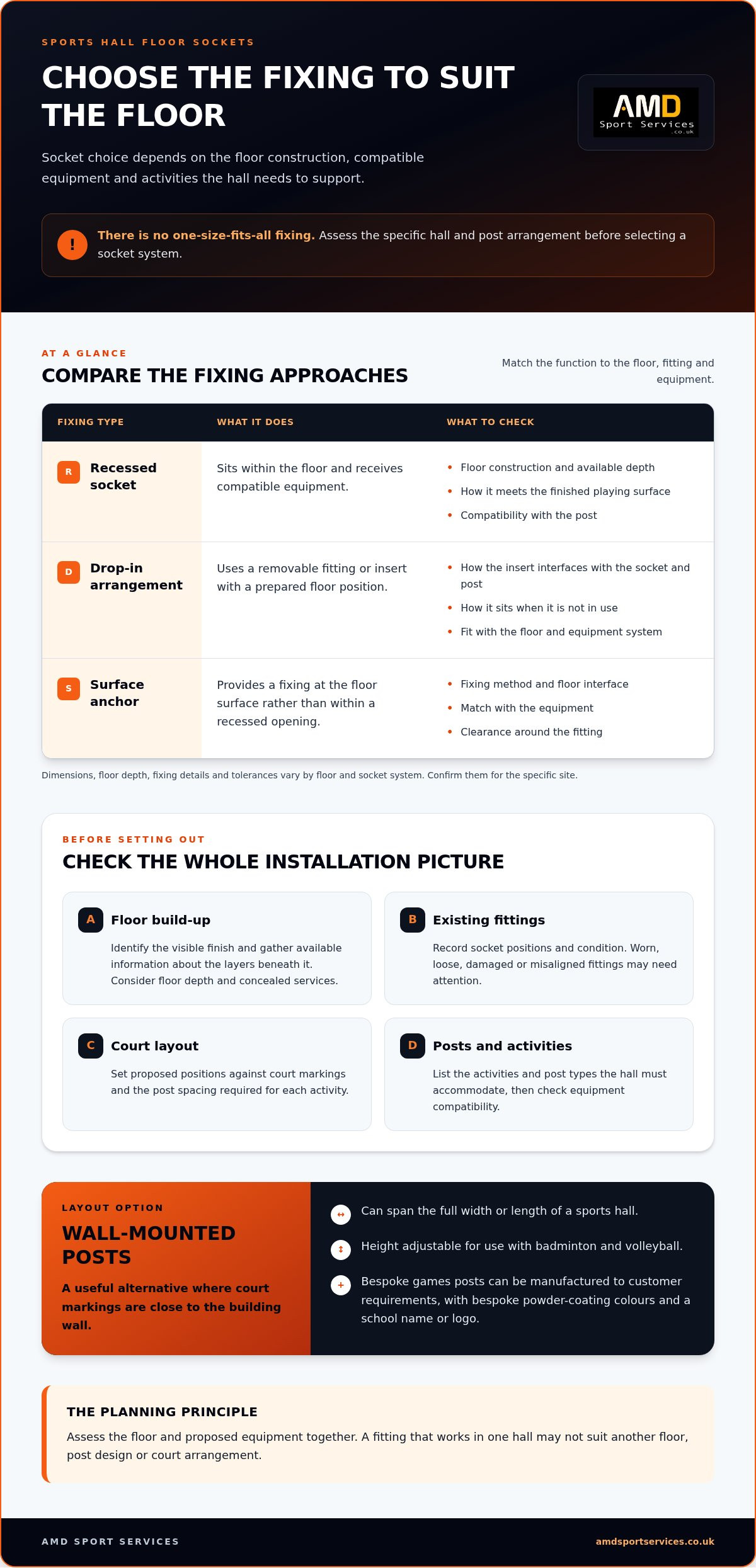
A sports hall floor socket is a prepared fixing point in the floor for compatible sports equipment. For games posts, it provides a defined position on court and helps locate the post during set-up. The right arrangement depends on the floor, the equipment and the activities planned. No single fixing type suits every hall.
How floor sockets support sports hall activities
Compatible posts fit into sockets positioned to match the court layout and intended post spacing. This allows the equipment to be set up where an activity requires it. Volleyball is one example: the posts support the net across the court. The sport’s basic gameplay is outlined in Volleyball. For more equipment context, see our guide to professional volleyball post installation.
Recessed sockets sit within the floor when not in use, while surface-mounted anchors provide a fixing above the floor surface. Neither is automatically right for every facility. The floor construction, playing surface, post design and planned court arrangement all inform the choice. AMD Sport Services plans sports equipment installation around the hall and the equipment it needs to accommodate.
When existing halls may need socket installation or repair
A facility may need new sockets when it introduces an activity that requires fixed post positions or replaces equipment with a different socket arrangement. Existing fittings may also need attention if they are worn, loose, damaged or no longer aligned with the planned court layout.
A socket that moves or sits out of alignment can affect how securely and consistently a compatible post locates. Assess the fitting and its condition before deciding whether it needs repair or replacement. Recessed sockets and surface-mounted anchors also meet the playing surface differently, so the solution should suit the hall rather than simply copy an existing arrangement.
For sport hall floor socket installation, the key first step is to consider the floor and intended equipment together. This helps establish whether existing fittings remain suitable or whether the hall needs a different arrangement for its activities.
Choosing sports hall floor sockets for the floor, posts and activities
Socket selection is a compatibility decision, not a choice between a universally better recessed or surface fixing. The floor build-up, existing fittings, post design and planned court arrangement all affect which approach is suitable. Do not assume a specification that works in one hall will suit another.
Dimensions, floor depth, fixing details and tolerances vary by floor and socket system. Establish them for the specific site before work proceeds. For sport hall floor socket installation, assess the floor and proposed equipment rather than selecting a fitting from a product description alone.
What to assess in the existing sports hall floor
Start by identifying the visible floor finish and gathering available information about the layers beneath it. Record the positions and condition of existing sockets, mark proposed locations against the court layout, and consider access below the floor surface. These checks help establish what each fixing needs to connect to and where the installation could interact with the floor construction.
Do not assume a floor is suitable based on its surface alone. Its construction and the requirements of the socket system need to be assessed together. Accurate information at this stage can help avoid choosing a fitting that does not suit the floor or setting out positions that conflict with the intended court layout.
How equipment and sport affect socket layout
List the activities and post types the hall needs to accommodate before setting out socket positions. Compare the proposed locations with court markings and the equipment configuration, including the spacing required for each activity. AMD Sport Services manufactures bespoke games posts to customers’ requirements, so the post design and socket layout can be planned around the activities the hall supports.
Wall-mounted games posts can span the full width or length of a sports hall. Because they are height adjustable, they can be used for badminton and volleyball. They are particularly useful when court markings sit close to a building wall. Posts can have bespoke powder-coating colours and incorporate a school name or logo. For more context, see our guide to professional volleyball post installation.
AMD Sport Services tailors installation planning to the hall, floor and intended equipment. Explore our sports equipment installation work for more information.
How sports hall floor socket installation works, step by step
A controlled installation follows the floor and socket system rather than applying one method to every hall. Assessment and accurate set-out help limit unnecessary disturbance to the playing surface and reduce the risk of a fitting sitting proud, loose or out of position. The sequence is planned around the intended posts and facility layout.
Assessment, setting out and preparing the work area
Before work begins, the installation team reviews available information about the floor, existing fittings and planned equipment. Court markings and the agreed post arrangement guide the socket set-out. This stage helps identify layout conflicts and informs how the opening and fixing should suit the floor construction.
The work area is prepared so the relevant part of the hall can be accessed and the surrounding playing surface protected as appropriate. Clearing equipment and coordinating access keeps the work area usable and avoids unnecessary disruption to other hall activities.
Fitting, finishing and checking the sockets
The fitting method depends on the floor layers and socket system. Where an opening is required, it is formed to suit the assessed installation, then the socket is secured using a method appropriate to the construction. There is no universal drilling approach or depth. Those details must be determined for the specific project. This is central to sport hall floor socket installation, particularly where protecting the surface and underlying floor is a concern.
Once fitted, the socket should sit securely and finish at a level that works with the surrounding playing surface. Final checks should confirm that:
the socket is aligned with the set-out position and intended court layout;
the fitting is stable and the surrounding surface is in suitable condition;
the intended compatible equipment locates correctly in the socket.
Functional checks help identify alignment or fit issues before the hall returns to use. Assess socket and post compatibility, along with any project-specific installation details, for the equipment being installed. The result should be a fitting positioned for its intended activity, with the floor surface and practical use of the hall considered throughout.
Planning floor socket installation around facility use and safety
Good planning helps fit the work around the hall’s daily operation and gives the installation team a clear picture of how the space will be used. Before sport hall floor socket installation begins, bring together the layout, equipment and access details so the work can be planned in context.
Preparing a school, club or leisure centre for the work
Nominate a facility contact to coordinate access and share arrangements with staff, club users and other affected groups. Agree timing around lessons, bookings and other hall use. The work period and any disruption depend on the project scope and site conditions, so plan the schedule for the specific installation rather than assuming the hall can return to normal use at a fixed time.
Useful preparation includes:
sharing the court layout, markings and intended activities;
identifying existing sockets and the post equipment they serve;
clearing stored equipment from the work area and keeping access routes available;
agreeing which parts of the hall need to remain accessible during the work.
This information helps coordinate the set-out with facility use and reduces avoidable clashes between installation work, equipment storage and hall access. AMD Sport Services carries out sports equipment installation planned around each facility’s requirements. Discuss your sports hall installation.
Handover and ongoing socket condition
At handover, keep a record of socket locations and the equipment configuration they are intended to support. A marked-up court plan with notes on the relevant post arrangement helps staff identify which fittings belong to each activity and supports future maintenance planning.
Keep relevant installation information provided at handover with the facility’s equipment records. If a socket later becomes loose, damaged or obstructed, have its condition assessed before relying on it for continued use. A fitting that no longer locates equipment properly may affect the post’s stability or position on court.
For related support with indoor facility equipment, see AMD Sport Services’ indoor inspection and maintenance information. Clear records and a prompt response to visible fitting issues help staff manage sockets as part of the hall’s ongoing equipment upkeep.
Arrange sports hall floor socket installation with AMD Sport Services
Floor sockets need to work as part of the hall, not as isolated fittings. AMD Sport Services carries out sport hall floor socket installation, from facility assessment through fitting and functional checks. The approach is tailored to the floor construction, court layout, planned activities and compatible games equipment.
What a facility-focused installation should deliver
The finished arrangement should reflect how the hall is used. Plan socket positions in relation to court markings and the posts required for each activity. This helps the intended equipment locate in the fittings without assuming one socket layout is suitable for every sport or facility.
Careful fitting also matters at the playing surface. The installation method is selected for the site, with attention to the stability and position of each fitting and how it meets the surrounding floor. Functional checks help establish whether the sockets align with the planned arrangement and accept the intended compatible equipment. These checks are part of completing the installation.
AMD Sport Services undertakes sports facility equipment installations tailored to the project. You can view examples and further information on our sports equipment installations page.
Move from planning to installation
Start by establishing which sports the hall needs to support and what post equipment those activities require. The floor and existing fittings can then be assessed, socket positions planned against the layout, and the installation method determined for the site. Consider technical choices in relation to both the floor and the equipment rather than making assumptions in advance.
Useful details to have ready include the hall layout, court markings, existing socket positions, available information about the floor and the intended post configuration. This connects the installation plan to the facility’s actual use and helps coordinate work around access and bookings.
If you are planning new sockets, replacing fittings or adapting a hall for different games posts, speak with AMD Sport Services about your sports hall floor socket installation project. The team can take the work from assessment through installation and functional checks, with planning shaped around your facility.
Plan your next sports hall installation with confidence
A successful sport hall floor socket installation begins with understanding the floor and the activities the hall needs to support. Socket positions should suit the court layout and compatible games posts, while the fitting method must be planned for the specific site. Assessment, accurate set-out and functional checks bring these requirements together.
For schools, councils, leisure centres and sports clubs, coordination also helps fit the work around facility use and keeps useful records for future maintenance. AMD Sport Services provides specialist sports equipment installation and maintenance across the United Kingdom.
Whether you are planning new sockets or reviewing existing fittings, start with a clear picture of the floor, layout and intended equipment. Discuss your sports hall floor socket installation with AMD Sport Services.
Frequently Asked Questions
What is a sports hall floor socket used for?
A sports hall floor socket provides an in-floor fixing point for compatible socketed sports equipment, such as games posts. It helps locate a post at a planned position on court and supports the intended equipment arrangement. Socket positions and type should be considered alongside the hall layout, floor construction and equipment that will fit into them.
Can floor sockets be installed in an existing sports hall floor?
Yes. AMD Sport Services installs floor sockets in existing halls after assessing the floor construction and site conditions. The assessment considers the visible surface, available information about the floor beneath it, existing fittings and intended socket positions. The installation method is selected for the particular floor and socket system, rather than relying on a universal drilling method or assumed floor depth.
Are sports hall floor sockets suitable for volleyball and badminton posts?
They can be suitable when the socket and post are a compatible system. The intended activities, post arrangement and court markings help determine the required positions. A socket that suits one post should not automatically be assumed to suit another. Assessing the equipment and layout together helps establish whether existing fittings are appropriate or a different socket arrangement is needed.
Do sports hall floor sockets sit flush with the floor?
The finished level depends on the socket design and installation arrangement. Some fittings are recessed within the floor, while surface-mounted anchors sit above it, so a flush finish should not be assumed for every type. The fitting needs to suit the floor and intended equipment, with the surrounding surface considered during installation. A project-specific assessment establishes how the chosen socket should finish in relation to the playing surface.
Can floor socket installation damage a sports hall floor?
Any work that alters a floor can affect the surface if the method does not suit its construction. Assessment, accurate set-out and an appropriate fitting method help manage this risk and avoid unnecessary disturbance. The floor build-up and socket system determine how the work should proceed, so generic drilling or depth instructions are not appropriate. Check the finished fitting and surrounding surface before the hall returns to use.
How long does sports hall floor socket installation take?
There is no reliable fixed duration for every installation. The time required depends on the project scope, floor construction, number and position of fittings, access to the work area and socket system. Reviewing these factors helps plan the work around lessons, bookings and other hall use. Set the timing for the specific site and installation rather than relying on a general rule.
Can damaged sports hall floor sockets be repaired?
A damaged socket can be assessed for repair, but the right action depends on its condition and how it is fixed into the floor. Do not treat a loose, damaged or poorly aligned fitting as ready for use. An assessment establishes whether repair is suitable or replacement is more appropriate. Check post and socket compatibility too, so the completed fitting works with the intended equipment.
Comments