
Fitness Machine Cable Crimping and Swaging for Gyms

AMD Sport Services’ core service is repairing fitness equipment and installing replacement parts. We supply and fit new cables for all forms of fitness equipment, complete with new crimped cable ends to match the existing specifications. We also provide fitness machine cable crimping and swaging, forming or renewing cable ends and securing fittings to create cable assemblies suited to the equipment. The appropriate repair depends on the cable’s condition, length, diameter and end fittings.
Worn coatings, frayed wire or loose fittings can affect how a cable moves through a machine. It is reasonable to look for a repair that addresses the fault, not just its symptoms. This article explains crimping and swaging, when a cable may need replacing, and what information helps match a replacement cable to the equipment.
You’ll also learn how cable work fits into wider gym maintenance, what can affect the scope of a job, and when replacement gym cables may be more suitable. The aim is a practical overview of how to keep fitness equipment in service while accounting for fit and function.
Gym cable machine maintenance
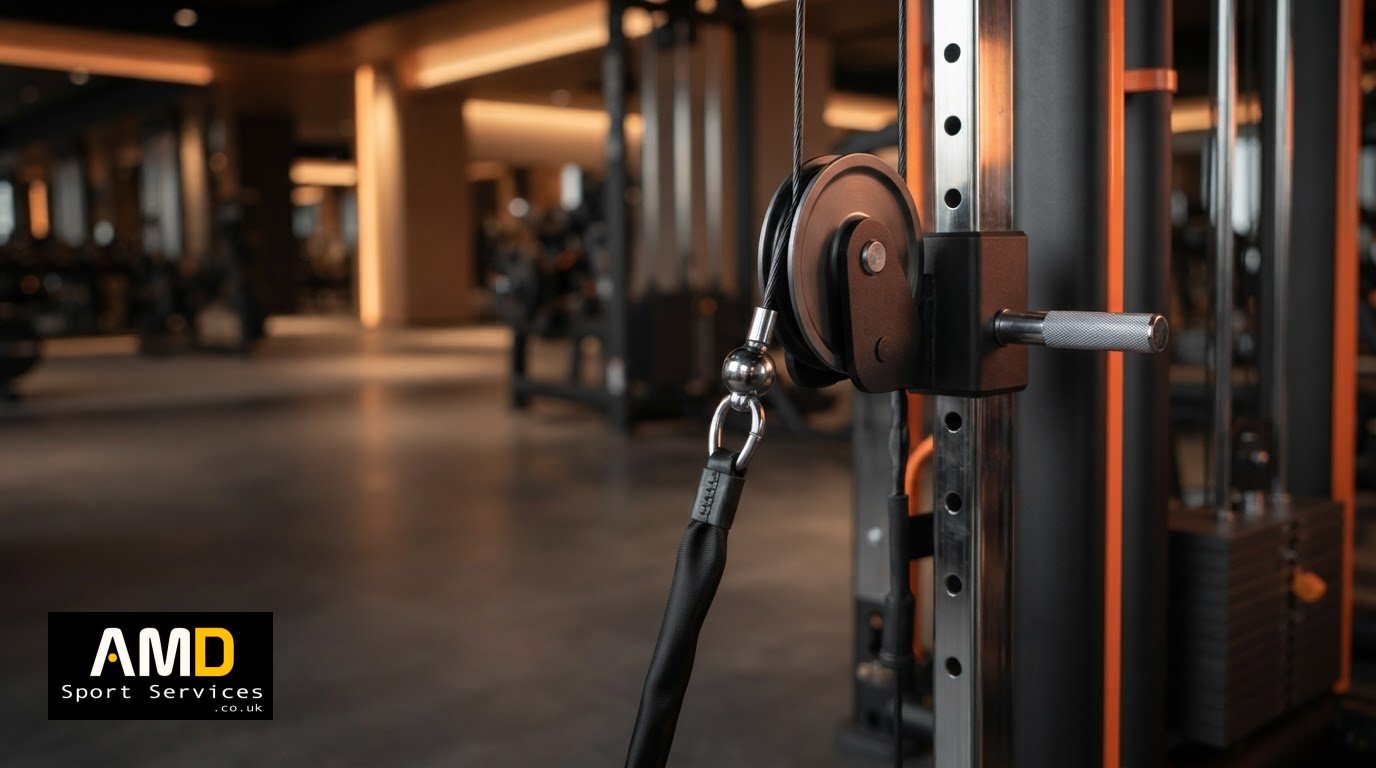
Gym cable machine maintenance considers how the complete mechanism operates, including the cable path, pulleys and weight stack. A fault may appear in one place but originate elsewhere. For example, a cable that catches during movement could point to pulley alignment or the cable route, rather than damage to one section alone. A specialist assessment considers these connected components together.
A condition assessment can document visible cable wear, such as coating damage or exposed wire strands. It also considers whether the cable ends are attached securely and whether the cable moves freely through the pulleys. These observations help distinguish cable deterioration from faults elsewhere in the mechanism. The machine’s use, condition and layout all inform the maintenance assessment.
If replacement is needed, recording the existing cable route on video can provide a useful reference through each pulley. This is especially helpful on equipment with a complex path, where the cable passes behind guides or around several moving parts. The recording supports accurate reinstatement during maintenance, rather than relying on memory during reassembly.
Pulley bearings also need attention as part of ongoing machine care. Supplier guidance recommends lubrication every 2-3 months. It distinguishes silicone lubricant spray for pulleys from 3-in-1 oil for weight rods, and advises against WD40. These different requirements show why maintenance is equipment-specific: a product suited to one component is not automatically appropriate for another.
Cable condition: assessment identifies coating damage and visible wire fraying.
Connections: the cable ends and their attachment points form part of the review.
Movement: the cable’s travel through pulleys helps indicate whether the assembly operates freely.
Lubrication: pulley bearings and weight rods have distinct maintenance requirements.
Maintenance findings help establish whether a machine needs routine attention, further repair or a replacement cable. Lubrication cannot restore damaged coating or frayed wire, and a cable fault may not explain every movement problem. A specialist review relates the cable’s condition to how the machine operates, helping identify the work needed instead of treating each symptom in isolation.
Facilities managing several types of sports equipment can consider machine care alongside broader sports equipment services. For fitness machines, a recorded cable path and documented maintenance findings can provide useful context for subsequent servicing. They also help distinguish recurring pulley or movement concerns from visible cable deterioration, supporting a clearer record of the work carried out on the equipment.
A useful review checks whether cable ends are attached securely, the coating is intact, wire is not frayed through the coating, and the cable moves freely through the pulleys. Together, these checks cover attachment, visible condition and movement. Recording them separately helps describe what has been observed without treating one positive finding as proof that the whole cable is in good condition. Secure ends alone do not show that the coating is intact, just as an intact-looking coating does not show that the cable moves freely through the pulleys. A clear assessment records each observation and relates it to the relevant part of the cable’s condition.
These checks keep attention on the cable as it operates within the machine, not just on its appearance. If an observation raises concern, describe it specifically: does it relate to attachment, coating, visible wire or free movement? If no concern is seen in one area, record that finding without assuming other areas are also clear. This measured approach gives maintenance decisions a clearer basis, whether the review leads to further work or continued monitoring. It also helps communicate the condition to those responsible for the machine, while leaving assessment of the wider mechanism to an appropriate specialist.
What are the risks of DIY crimping or using an incorrectly rated gym cable?
A gym cable termination needs a compatible combination of wire rope, ferrule and crimping tool. If these components do not match, the connection can be weak or misshapen, even if it looks secure. Under repeated machine movement, a poorly formed termination may shift or fail, affecting the cable attachment and the machine’s operation.
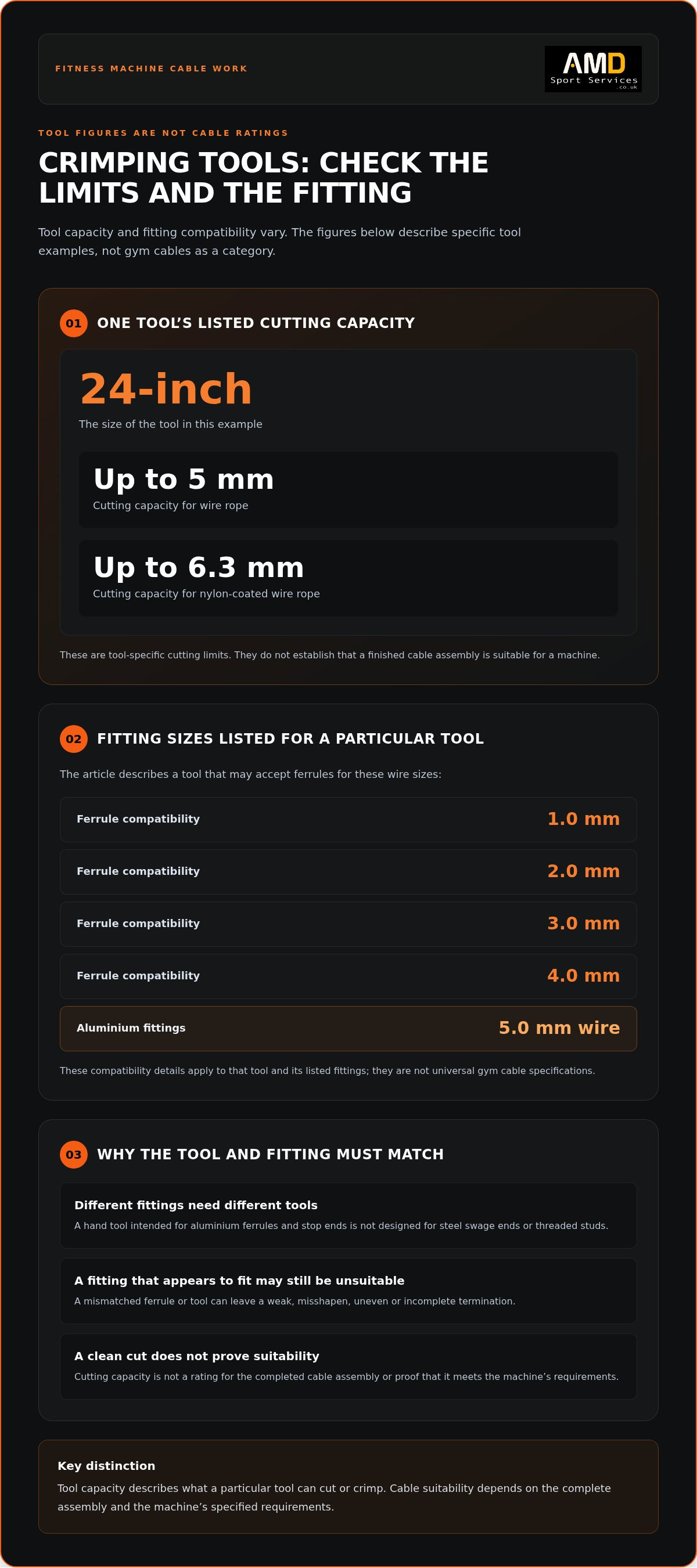
Crimping tools are designed for specific fittings and materials. For example, a hand tool intended for aluminium ferrules and stop ends is not designed for steel swage ends or threaded studs. Some tools can crimp aluminium or copper fittings for non-critical use, but that does not make them suitable for every gym machine application. The tool’s intended use matters as much as whether it appears to fit.
Diameter compatibility is another concern. A particular tool may accept ferrules for 1.0 mm, 2.0 mm, 3.0 mm and 4.0 mm wire, with aluminium fittings for 5.0 mm wire. Those figures apply to that tool’s compatible fittings, not to gym cables as a category. A crimp formed with a mismatched ferrule may not hold the wire rope correctly, while an unsuitable tool may leave an uneven or incomplete connection.
Cutting capacity also varies. One 24-inch tool lists cutting capacity up to 5 mm for wire rope and up to 6.3 mm for nylon-coated wire rope. These are tool-specific limits, not a rating for the completed gym cable assembly. A clean-looking cut does not establish that the cable or its termination suits the machine’s operating requirements.
Fitting mismatch: ferrule material and design must suit the cable and termination application.
Tool mismatch: a tool made for aluminium ferrules is not interchangeable with equipment for steel swage ends.
Incorrect cable rating: an assembly unsuited to the machine’s intended loading may not perform reliably.
Misleading capacity figures: a tool’s cutting range does not verify the finished cable’s suitability.
An incorrectly rated cable creates a separate risk from a poor crimp. A cable that does not meet the machine’s specified requirements may be unsuitable, even when its end fittings appear sound. Choosing components by appearance or a tool’s maximum capacity can overlook the demands on the complete assembly during repeated use.
The machine’s design and specified cable assembly determine which components are suitable. Crimping is appropriate only when the cable, termination and tooling match the application. If a cable is damaged or the correct assembly is uncertain, a replacement gym cable matched to the equipment avoids relying on an improvised combination of parts. Compatibility across the entire connection matters, not simply whether a fitting can be attached.
How do cable crimping services compare with complete cable replacement for gym equipment?
Crimping and replacement address different parts of a gym machine’s cable assembly. Crimping renews or secures a termination, while complete replacement removes the existing cable assembly. This affects the scope of work: a local connection repair retains the cable, whereas replacement renews it as a whole. Neither option is automatically right for every machine fault.
A termination repair may suit a problem confined to an end connection when the rest of the cable remains serviceable. For example, a selectorised machine may have an issue where its cable joins a handle or another fitting. In that case, the repair focuses on the termination, while the condition of the remaining assembly still informs the decision.
Complete replacement is a broader intervention. It may be the clearer option when deterioration extends beyond the termination or a local repair would leave a known fault elsewhere. The old assembly is removed and replaced with one suited to the machine. This avoids treating an end connection as though it resolves a problem affecting the entire cable.
Crimping: addresses a termination while retaining the existing cable assembly.
Replacement: renews the full assembly rather than only its connection.
Repair scope: depends on whether the fault is isolated or affects more of the cable.
Equipment context: the machine’s condition and operating layout inform the appropriate work.
The practical comparison involves more than the component being changed. An assessment considers the scale of the fault, the condition of the parts that would remain in service and the work needed to return the machine to operation. In a facility with several machines, this can also help distinguish an isolated repair from a wider maintenance need, without treating every cable issue the same way.
The scope of work depends on whether the job involves a termination repair or full replacement, which cable assembly is needed and what work the equipment requires. These factors vary between machines, so a single figure would not provide a useful comparison across different repair needs.
Crimping is a focused option when the termination needs attention and the remaining assembly is suitable to retain. Replacement is more appropriate when the cable itself needs renewing. The decision should reflect the fault and the machine’s condition, rather than treating crimping as the default repair or replacement as an automatic upgrade. A clear assessment defines the work before the equipment returns to use.
The quality of a termination repair also depends on how the crimp is made. Hand crimping should be completed in several bites so the jaws close fully and produce a safe splice with a round finish. This is a practical consideration alongside deciding whether the fault is confined to the cable end: the termination must be formed appropriately to address the connection. Crimping therefore concerns both the scope of the repair and how the splice is made. The rest of the assembly still matters, since careful work on an end does not change the distinction between retaining and renewing a cable.
The 24-inch steel wire rope crimping and swage tool with cutter is listed for wire rope sizes from 1.5 mm to 5 mm. That specification provides a stated size range for the listed tool; it does not, on its own, establish that a particular machine’s cable or repair should be handled with it. The equipment and the fault still need to guide the choice between a termination repair and complete replacement. In practical terms, a crimping quote can be considered alongside the assembly’s condition and the work required, while replacement remains the broader option when renewal of the cable is called for. This keeps the comparison focused on the job needed rather than treating a tool specification as a diagnosis or as a universal answer for every cable assembly.
Which UK regions and cities have specialist fitness equipment cable repair services?
Fitness equipment cable repair services may vary in their coverage and the support they provide. Some work nationally, while others cover selected areas or arrange different support for on-site repairs and replacement cable supply. Start with the facility’s full postcode and describe the job, as a broad claim of UK coverage does not explain how a particular repair will be handled.
Location matters differently for each repair. A replacement cable matched to the machine may be supplied without an on-site visit. A repair that requires access to the machine, its pulleys or cable attachments needs a suitable visit to the facility. The site and the nature of the fault help establish which type of support is relevant.
For facilities with several sites, list each postcode separately rather than describing the estate as one location. A school group, leisure operator or sports club may have equipment across different parts of the country. A site-by-site schedule helps distinguish a single-machine fault from a wider maintenance need, without assuming one visit or arrangement covers every building.
Geography alone does not determine whether a cable repair is suitable. The machine type, access to the equipment and the fault also shape the work. A cable issue on one machine in a large leisure facility, for example, differs from replacement requirements across several fitness rooms. Providing the exact site and affected equipment gives a clearer picture than a broad regional label.
Single facility: provide its postcode and identify the room or fitness area containing the machine.
Multiple sites: separate each address and note which equipment has a cable issue.
Replacement cable: identify the machine and cable assembly, including its fittings and route.
On-site repair: describe the fault and where the equipment is installed.
These details also help distinguish a supply request from work that involves attending the facility. A replacement cable request needs enough information to identify the correct assembly, while a machine that catches during movement may need its cable path and equipment assessed together. A postcode answers the location question, but does not establish what repair the machine needs.
AMD Sport Services provides sports equipment inspections, maintenance and repair for facilities across the UK. Include the postcode, facility type, affected machine and a concise description of the cable problem in your enquiry. For a multi-site organisation, provide these details for each location. This gives the repair enquiry a clear operational starting point, while the site and work determine the appropriate arrangement.
AMD Sport Services: Sports equipment safety inspections
AMD Sport Services carries out sports equipment safety inspections to help facilities assess equipment condition and identify maintenance needs. A thorough visual inspection should take place at least every 12 months; sites with heavily used equipment may arrange inspections biannually. These checks can form part of a wider maintenance plan, alongside attention to faults such as worn components or damaged equipment.
For gym cable concerns, an inspection can help identify visible wear and flag equipment requiring further attention. It does not replace cable-specific repair or replacement where the cable itself is damaged. Contact AMD Sport Services to discuss sports equipment safety inspections for your facility, or visit the AMD Sport Services website.
Keep your next maintenance decision focused
Let the equipment’s condition guide the next step: a damaged cable may need replacing, while wider facility concerns can call for a broader maintenance review. Fitness machine cable crimping services are relevant when a cable termination needs attention, but the cable’s overall condition should shape the repair decision.
AMD Sport Services also carries out sports equipment safety inspections, basketball goal installation and safety surfacing. These services support facilities managing different equipment and maintenance needs across their sites.
For a practical discussion about your facility’s sports equipment needs, contact AMD Sport Services. A clear description of the equipment and issue gives the conversation a useful starting point, helping you move towards an appropriate next step with confidence.
Frequently Asked Questions
Which UK companies repair or replace gym machine cables and crimp fittings?
AMD Sport Services supplies replacement gym cables and carries out sports equipment repairs for facilities across the UK. The appropriate work depends on whether the cable needs replacing or another part of the equipment needs repair. To describe the issue, include the machine make and model, the fault and the cable arrangement. These details help identify the equipment and establish the work required.
What safety standards and load ratings apply to gym equipment cables and crimps in the UK?
There is no single load rating that applies to every gym machine cable and crimp. The correct specification depends on the machine’s design and manufacturer’s requirements. The cable material, diameter, end fitting and connection must suit the equipment as a complete assembly. A fitting’s stated capacity alone does not establish whether it is suitable for a particular machine. Use the equipment documentation to identify the specified components, rather than assuming one rating applies to different machines.
How do technicians measure and specify a replacement fitness machine cable?
Specify the cable’s overall length and diameter, along with its end fittings. A video following the existing cable through the machine and past each pulley can also help document the route.
Comments