
Gymnastics Equipment Servicing UK: The Professional Safety & Maintenance Guide 2026

Ensure your facility remains compliant and your athletes stay safe with our expert guide to gymnastics equipment inspections and specialist repairs.
Table of Contents
The Critical Role of Gymnastics Equipment Servicing in the UK
Specialist gymnastics equipment servicing is a technical discipline involving the detailed inspection, tensioning, repair, and certification of high-impact apparatus. Unlike standard fitness machines found in a commercial gym, gymnastics equipment is subjected to intense, dynamic loads that create unique and significant safety challenges. Apparatus such as trampolines, asymmetrical bars, and vaulting horses must absorb and manage immense forces during use, leading to accelerated material fatigue and stress on structural components.
This high-intensity use, common in schools, leisure centres, and dedicated clubs, places a heavy demand on joints, fixings, springs, and padding. Without a structured maintenance programme, the integrity of this equipment can degrade rapidly, posing a direct risk to users. Regular, professional servicing is therefore not just a matter of best practice; it is a fundamental component of facility management, directly impacting athlete safety, extending the lifespan of valuable assets, and ensuring long-term budget stability for UK institutions.
Understanding the Duty of Care for Facility Managers
For facility managers, school bursars, and local council operators, managing sports facilities carries a significant duty of care. Under UK health and safety law, those in control of premises have a legal obligation to ensure that the environment and the equipment within it are safe for all users. This responsibility is particularly acute in environments used by children and young athletes.
Engaging a professional contractor for regular equipment servicing is a critical step in fulfilling this duty. It formally mitigates liability by demonstrating a proactive and responsible approach to safety. In the unfortunate event of an athlete injury or equipment failure, a documented history of professional inspections provides a robust defence. Maintaining a clear audit trail of these inspections, remedial actions, and certifications is essential for satisfying the compliance requirements of local authorities, insurance providers, and governing bodies.
Identifying Common Signs of Wear in Gymnastics Apparatus
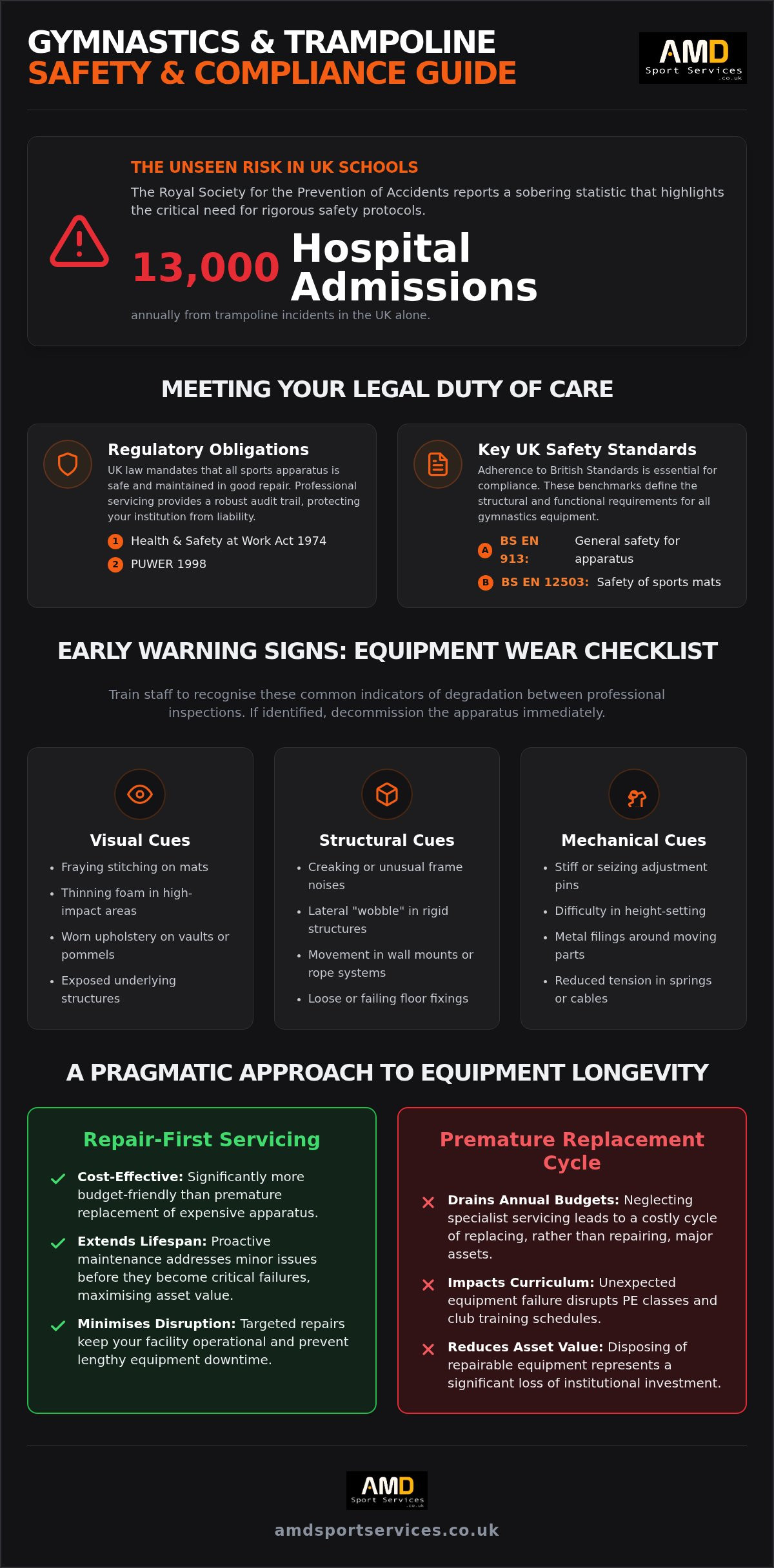
While an annual professional inspection is vital, facility staff can play a key role in day-to-day safety by identifying early signs of degradation. Recognising these cues allows for prompt action before a minor issue becomes a critical failure.
Visual Cues: Look for fraying stitching or tears on landing mats, worn or cracked upholstery on vaulting horses and pommel tops, and surface rust on metal frames. For trampolines, check for any signs of abrasion or broken threads on the bed surface.
Structural Cues: Be alert to any movement or loosening of floor fixings for apparatus like bars or beam supports. Listen for unusual creaking or groaning sounds from wall-mounted frames, climbing ropes, or beam structures during use, as this can indicate metal fatigue or loose bolts.
Mechanical Cues: Pay attention to the functionality of moving parts. Adjustment pins that have become stiff, bent, or difficult to engage are a clear warning sign. Tensioning cables on bar systems that show signs of fraying or corrosion require immediate professional attention.
UK Safety Standards and Compliance for Gymnastics Apparatus
Navigating the regulatory landscape is a primary concern for facility managers. In the UK, gymnastics equipment safety is governed by a framework of British and European Standards (BS EN). These standards provide detailed specifications for the design, manufacture, and maintenance of apparatus to ensure it is fit for purpose and safe for use.
Key standards include BS EN 12503, which covers sports mats, including gymnastics landing mats, specifying their shock absorption properties, and BS EN 913, which outlines the general safety requirements applicable to a wide range of gymnastics equipment. Adherence to these standards is not merely a suggestion; it is the benchmark against which your facility's safety is measured. Furthermore, guidance from the Association for Physical Education (afPE) provides a crucial framework for equipment management specifically within the school environment. It is important to distinguish that professional inspections go far beyond the daily pre-use checks performed by teaching staff, involving technical assessments of structural integrity that require specialist expertise.
The Inspection Hierarchy: Daily, Weekly, and Annual Checks
A comprehensive safety strategy relies on a multi-layered approach to inspections, ensuring that potential hazards are identified at the earliest opportunity.
Daily Pre-Use Checks: PE teachers and coaches are the first line of defence. Before each session, they should perform a visual check of the apparatus being used, looking for obvious faults like loose bolts, damaged surfaces, or instability. This routine is designed to catch issues that may have developed overnight or during a previous class.
Weekly/Monthly Operational Checks: A more detailed internal check should be scheduled regularly. This might involve a designated member of staff methodically reviewing all equipment, checking the function of adjustable parts, and documenting any minor wear and tear for monitoring.
Annual Professional Safety Inspection: This is the cornerstone of your compliance strategy. An annual inspection by a qualified, specialist engineer is non-negotiable and often a requirement for insurance policies in the UK. This comprehensive assessment examines structural integrity, material fatigue, and compliance with current standards, resulting in a formal report that guides necessary remedial action. Documenting the findings from all levels of inspection is crucial for meeting local authority and HSE audit requirements.
Certification and Compliance Documentation
Following a professional inspection, the documentation you receive is as important as the service itself. A thorough report from a reputable contractor like AMD Sport Services provides a clear, actionable summary of your facility's equipment status. This report should categorise each item with a clear pass, fail, or advisory status, detailing any remedial work required and prioritising it based on risk.
This documentation serves as your 'certificate of conformity', a vital record for your insurance providers that demonstrates due diligence. It proves you have taken reasonable steps to ensure a safe environment. We recommend storing these records digitally, allowing for easy access and retrieval during safety audits, HSE inspections, or in response to any queries from governing bodies. This creates a transparent and defensible history of your commitment to safety.
Specialist Maintenance for Gymnastics Trampolines and Large Apparatus
The maintenance of complex gymnastics apparatus demands a level of technical skill far beyond general handyman services. A school trampoline safety inspection, for example, is a highly specialised task that assesses the intricate relationship between the bed, springs, and frame. The tension across a competition-grade trampoline bed must be uniform to ensure a predictable and safe rebound, a parameter that can only be measured and adjusted by an expert.
Similarly, upholstery repairs for vaulting boxes, pommel horses, and balance beams require more than just cosmetic work. The materials used must meet specific fire and impact standards, and the foam density must provide the correct level of shock absorption. For fixed apparatus, such as wall bars and rope frames, the integrity of wall fixings and pulley systems is paramount. These components are subject to material fatigue and must be professionally assessed to prevent catastrophic failure. The stability of all floor-mounted equipment relies on the condition of the floor sockets, a critical check-point in any comprehensive sports hall inspection.
Trampoline Servicing: Beyond the Surface
A professional gymnastics trampoline service is a deep, technical process that goes far beyond a simple visual check. Our engineers conduct a multi-point inspection to ensure every component functions safely and effectively.
Bed Inspection: We meticulously examine the trampoline bed for UV damage (if exposed to sunlight), which can make the webbing brittle. We also check for micro-tears, abrasion, and stitching integrity, especially around the anchor points, as these are common failure points.
Spring Tension and Condition: Each spring is individually assessed for signs of stretching, corrosion, or distortion. It is crucial to know when to replace individual springs whilst maintaining a balanced tension across the entire bed. An imbalanced bed can cause an unpredictable rebound and increase the risk of injury.
Frame Integrity: The steel frame and legs are carefully inspected for stress fractures, particularly around weld points. We ensure all locking mechanisms are secure and that the frame stands perfectly level and stable. For a complete overview of our process, learn more about our dedicated gymnastics trampoline service.
Bespoke Upholstery and Padding Repairs
For many schools and local authorities, budgets are tight. Replacing entire pieces of apparatus due to worn upholstery is often an unnecessary expense. 'Smart repairs' and professional re-upholstery provide a highly cost-effective and sustainable alternative. By targeting only the damaged sections, we can restore equipment to a safe, compliant state for a fraction of the cost of a new unit.
We use high-durability, flame-retardant vinyl and specialist impact-absorbing foam that are specifically designed for demanding gymnastics environments. This ensures that repaired equipment not only looks professional but also meets all relevant UK fire and safety standards. Critically, we ensure all padding meets the necessary impact attenuation values, providing essential protection for athletes, particularly younger students, during training and practice.
Organising a Maintenance Schedule for Your Facility
Establishing a proactive maintenance schedule is the most effective way to manage safety, minimise downtime, and control costs. The process begins with a comprehensive audit of every piece of gymnastics and PE equipment on your site, including items in storage which are often overlooked. This inventory should note the age, condition, and last inspection date of each item.
Once you have a clear picture, liaise with key stakeholders—such as the PE department head, club coaches, and local authority contacts—to plan the servicing to cause minimal disruption. The school summer holidays or half-term breaks are ideal windows for major inspections and repairs. When budgeting, it is wise to separate the fixed cost of the inspection from a contingency fund for potential remedial works. This ensures that high-priority repairs identified in the report can be actioned without delay.
Step-by-Step: From Audit to Certification
Implementing a robust servicing programme can be broken down into four clear, manageable steps:
Conduct an Internal Audit: Start by creating a detailed inventory of all gymnastics apparatus. Note the manufacturer, age, and any visible signs of wear or damage. This provides a valuable baseline for the professional inspector.
Book a Professional Inspection: Engage a specialist contractor for a site-wide safety inspection. Choose a company with proven expertise in gymnastics equipment, not just general fitness machines.
Review and Prioritise: Once you receive the engineer's report, carefully review the findings. Immediately address any items identified as high-risk or condemned. Use the report to plan and budget for other necessary remedial actions.
Execute and Certify: Complete the recommended repairs and refurbishments. Upon completion, the contractor should issue a final compliance certificate for your records, closing the loop and confirming your facility meets UK safety standards.
Maximising Equipment Lifespan Between Professional Visits
The longevity of your gymnastics equipment is significantly influenced by how it is handled and stored day-to-day. Simple best practices can prevent premature wear and reduce long-term repair costs.
Proper Storage: Ensure mats are stored flat or on appropriate mat trolleys to prevent creasing and foam degradation. Portable apparatus should be kept in a clean, dry storeroom to avoid moisture damage and rust.
Staff Training: Train all PE staff and coaches on the correct manual handling, setup, and breakdown procedures for each piece of equipment. Mechanical damage is often caused by improper adjustment or transportation.
Environmental Control: Manage the sports hall environment. High humidity can accelerate corrosion on metal parts and promote mould growth on mats and upholstery. Stable temperature and good ventilation are key to preserving your assets.
Why AMD Sport Services is the UK's Choice for Gymnastics Servicing
With over two decades of hands-on experience in UK sports facility maintenance, AMD Sport Services has established itself as a trusted specialist for schools, leisure centres, and councils. We offer comprehensive national coverage, delivering expert technical services to institutions across the United Kingdom. Our reputation is built on a pragmatic, no-nonsense approach to repairs; where others might suggest expensive replacements, we focus on providing high-quality, cost-effective refurbishments that extend the life of your existing assets.
We are not a generalist fitness company. Our engineers possess specialist knowledge of gymnastics apparatus, from the precise tensioning of trampoline beds to the structural requirements of partition netting. This technical focus ensures that every inspection and repair is conducted with an understanding of the unique demands placed on this type of equipment.
Our Pragmatic Approach to Repairs
Our core philosophy is to provide technical honesty and value for money. We understand the budget constraints faced by public sector facilities and prioritise repairs and refurbishment wherever possible. This approach not only saves our clients significant capital expenditure but also represents a more sustainable way of managing equipment. Working with a specialist who truly understands the mechanics of gymnastics apparatus means you receive solutions, not just sales pitches. We diagnose the root cause of a problem and provide a durable, compliant repair. You can view our latest gymnastics projects to see the quality of our workmanship and our commitment to revitalising existing equipment.
National Service, Specialist Knowledge
From our base of operations, we serve clients across the entire United Kingdom, ensuring that every school, club, and leisure centre has access to the highest standards of workmanship. When you contact AMD Sport Services, you communicate directly with our expert team, receiving straightforward advice grounded in years of industry experience. This direct line to technical expertise ensures your needs are understood and met efficiently. Our commitment to total sports hall safety extends beyond gymnastics; we also provide expert guidance on essential infrastructure like sports hall netting systems and even the installation of multi-sport equipment such as basketball goals. For a comprehensive assessment of your gymnastics equipment, contact us to schedule a professional inspection.
Frequently Asked Questions (FAQs)
How often should gymnastics equipment be professionally serviced in the UK?
It is industry best practice and often an insurance requirement for all gymnastics equipment to undergo a professional safety inspection at least once every 12 months. Equipment under very heavy use may benefit from more frequent checks.
Is an annual gymnastics equipment inspection a legal requirement for schools?
While not a specific law in itself, schools operate under a legal duty of care as defined by UK Health and Safety legislation. An annual inspection by a competent professional is the universally accepted method of demonstrating due diligence and fulfilling this legal obligation.
Can you repair old gymnastics trampolines or do they need replacing?
In many cases, older trampolines can be fully refurbished and brought up to current safety standards. We specialise in replacing components like beds, springs, and frame pads, which is significantly more cost-effective than purchasing a new unit. We will only recommend replacement if the core frame is structurally compromised.
What is included in a professional gymnastics equipment safety report?
A comprehensive report should include a full inventory of the equipment inspected, a clear pass/fail/advisory rating for each item, photographic evidence of any faults, detailed descriptions of the issues found, and prioritised, actionable recommendations for any remedial work required.
Do you provide gymnastics equipment servicing for private clubs as well as schools?
Yes. We provide our specialist inspection and repair services to a wide range of clients across the UK, including private gymnastics clubs, leisure centres, community halls, and military facilities, in addition to our extensive work with schools and colleges.
What British Standards apply to gymnastics mats and landing areas?
The primary standard is BS EN 12503. This standard specifies the safety requirements for sports mats, including their critical shock absorption capabilities, which are essential for preventing impact injuries in gymnastics landing zones.
How long does a typical gymnastics equipment inspection take to complete?
The duration depends on the quantity of equipment. A typical secondary school sports hall inspection can usually be completed within a few hours, whilst a large leisure centre or dedicated gymnastics facility may take a full day. We work efficiently to minimise any disruption to your operations.
Can you provide upholstery repairs for worn vaulting horses and beams on-site?
Yes, we can often perform high-quality upholstery repairs on-site to minimise equipment downtime. We use regulation-compliant, durable materials to restore worn surfaces on vaulting horses, pommels, and beams, ensuring they are safe and ready for use as quickly as possible.


Comments