
Gymnastics Trampoline Bed Replacement: A Professional Guide for UK Facilities

A single frayed string on a high-performance trampoline bed isn't just a minor maintenance task; it's a significant safety liability that can compromise your facility's adherence to BS EN 13219 standards. You likely recognise the constant pressure of maintaining equipment to British Gymnastics requirements whilst managing the practicalities of a busy sports hall. It's common to feel uncertain when a gymnastics trampoline bed replacement becomes necessary, especially when dealing with older frames or the physical demands of high-tension fitting.
This guide provides the technical clarity you need to manage your equipment with confidence. You'll learn how to identify critical wear-and-tear thresholds and accurately measure beds for older models to avoid costly ordering errors. We'll also break down the differences between 6mm competition web and durable polymesh materials. By the end, you'll have a clear understanding of the step-by-step process for a safe installation and know exactly when a specialist contractor is required to ensure the long-term integrity of your facility's equipment.
Table of Contents
Identifying the Critical Signs That Your Gymnastics Trampoline Bed Requires Replacement
Selecting the Right Material: Web Beds vs Polymesh Specifications
How to Measure Your Trampoline Frame and Bed for a Precise Replacement
A Step-by-Step Guide to Safely Replacing a Gymnastics Trampoline Bed
Ensuring Long-Term Safety and Compliance After Bed Installation
Identifying the Critical Signs That Your Gymnastics Trampoline Bed Requires Replacement
Maintaining a safe environment in a sports hall or gymnastics club requires a methodical approach to equipment monitoring. Over time, the synthetic fibres in your equipment degrade through mechanical friction and photo-oxidation from UV exposure. Whilst the history of the modern trampoline has seen significant advancements in material durability, no bed is permanent. Identifying the need for a gymnastics trampoline bed replacement before a failure occurs is a fundamental duty for facility managers.
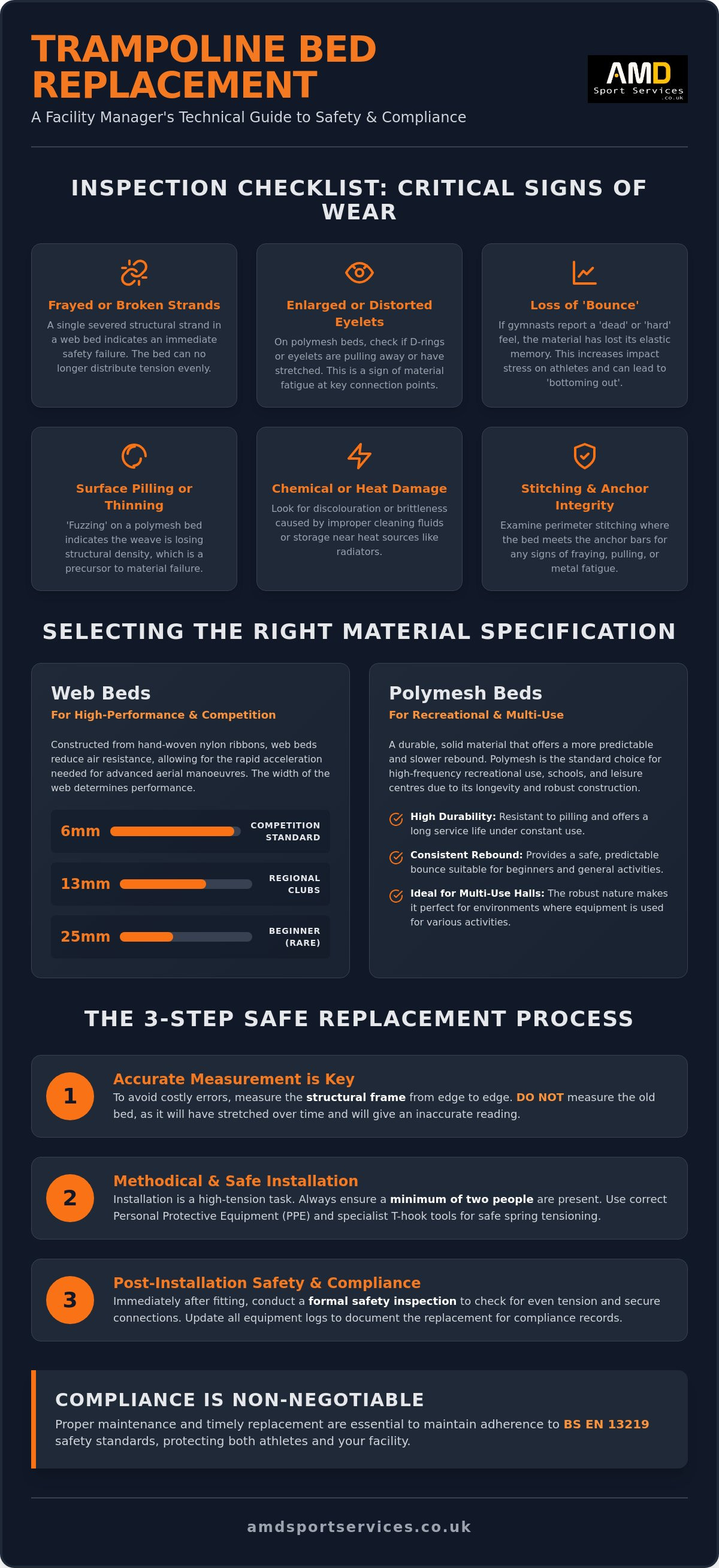
Structural red flags often appear at the edges and the centre first. You should look for broken nylon strands in web beds or enlarged, distorted eyelets in polymesh models. These issues indicate that the material can no longer distribute tension evenly. When elasticity fails, the bed stops behaving like a dynamic spring and starts acting like a rigid sheet. This shift transfers dangerous levels of impact stress directly into the gymnast's ankles, knees, and spine, increasing the risk of acute injury.
According to UK equipment standards, a bed reaches its safety-critical threshold when any single structural strand is severed or when the material has stretched to the point that it can no longer maintain the required clearance from the floor or frame during use.
Visual Inspection Checklist for School and Club Trampolines
A thorough physical assessment should be part of your regular indoor inspection and maintenance routine. Focus on these specific areas:
Surface Pilling: Check for 'fuzzing' or thinning on polymesh beds, which suggests the weave is losing its structural density.
Anchor Bars and Stitching: Examine the perimeter where the bed meets the springs. Look for frayed stitching or metal fatigue in the anchor bars.
Contamination: Spot signs of chemical damage from inappropriate cleaning fluids or heat damage from storage near radiators.
Connection Integrity: Verify that all D-rings and eyelets are secure and show no signs of pulling away from the main bed body.
Performance Triggers: When the "Bounce" Becomes Unsafe
Sometimes a bed looks acceptable but performs poorly. If gymnasts report that the trampoline feels 'dead' or 'hard', the material has likely lost its internal memory. This loss of structural tension leads to 'bottoming out', where the bed dips too low and risks striking the floor. Uneven tension across a worn bed doesn't just affect the user; it creates asymmetrical loads that can lead to permanent frame warping over time. If the bed cannot be tensioned to its original specification, a gymnastics trampoline bed replacement is the only viable solution to protect both the users and the equipment's longevity.
Selecting the Right Material: Web Beds vs Polymesh Specifications
Selecting the correct material for a gymnastics trampoline bed replacement is a technical decision that impacts both athlete safety and facility budgets. The choice isn't merely about price; it's about matching the equipment's response to the skill level of the users. All professional installations must adhere to BS EN 13219:2008 safety requirements, which dictate the functional performance and safety margins of the equipment. Choosing an inappropriate material can lead to premature wear or, worse, an unsafe training environment for your gymnasts.
Web beds are constructed from individual nylon ribbons. These are hand-woven and secured with galvanised anchor bars. In the UK, where sports halls can be prone to humidity and temperature fluctuations, these galvanised components are essential. They prevent corrosion and ensure the connection points don't weaken over time. The width of these ribbons defines the trampoline's performance and its suitability for different age groups and skill levels.
Understanding Web Width and Performance
The 6mm and 4 x 6mm web beds are the recognised standard for competitive gymnastics and high-performance training. Its narrow ribbons create a higher percentage of open space. This significantly reduces air resistance during the bed's travel, allowing for the rapid acceleration required for advanced aerial manoeuvres.
Conversely, 25mm beds provide a much larger surface area. These used to be a common choice for school PE and beginners because they offer a more predictable, slower rebound. This helps novices develop spatial awareness without the risk of excessive height. But they are becoming a lot more rare nowadays.
The 13mm bed acts as a versatile middle ground, often found in regional clubs where a balance of performance and durability is required.
Polymesh and Solid Beds for Recreational Use
For multi-use sports halls and recreational centres, polymesh beds are frequently the most pragmatic choice. Unlike webbed versions, polymesh is a solid, woven fabric that is exceptionally resistant to the high-frequency use typical of public leisure sessions. These beds are easier to maintain and less susceptible to the 'snagging' damage that can occur when users wear inappropriate clothing. When planning a gymnastics trampoline bed replacement, it's vital to verify that the new bed is compatible with your existing frame pads and spring configurations. If you're unsure which material suits your facility's specific usage profile, a professional service and maintenance assessment can help clarify your requirements. Matching the right material to your specific environment ensures the longevity of the equipment and the safety of every user.
How to Measure Your Trampoline Frame and Bed for a Precise Replacement
Ordering a gymnastics trampoline bed replacement based on the dimensions of the existing material is a common error that leads to poor tensioning and safety failures. Over years of intensive use, nylon and polymesh fibres stretch significantly. A bed that originally measured 426cm may now measure 435cm, making it an entirely unreliable reference point. Instead, you must measure the structural steel frame to ensure the new bed achieves the correct 'draw' and tension required by British safety standards. This ensures the apparatus provides the predictable rebound characteristics gymnasts rely on for safe landings.
The 'spring-to-spring' measurement technique is the industry standard for determining the correct bed size. This involves measuring the distance between the lug holes on opposite sides of the frame. For older or legacy equipment where the manufacturer's labels have worn off or become illegible, the frame's external footprint serves as your primary identifier. A 'Grand Master' frame typically measures 520cm by 305cm, whilst a 'Master' model is usually 460cm by 275cm. Identifying these dimensions is the first step in ensuring you don't order a component designed for a different era of equipment.
Measuring the Internal Frame Dimensions
Precision is vital when assessing high-tension apparatus. Follow this methodical process to gather accurate data:
Use a Steel Tape: Avoid fabric tapes that can stretch or sag over long distances.
Measure the Internal Aperture: Record the length and width from the inside edge of the frame rails, not the outside.
Account for Corner Radii: Older gymnastics equipment often features more pronounced, rounded corners. Note if the frame has a sharp 90-degree angle or a curved profile, as this affects the bed's corner reinforcements.
Check for Frame Warping: Measure the diagonals. If the two diagonal measurements differ by more than 2cm, the frame may be warped, which will prevent a new bed from tensioning correctly.
Identifying Spring Count and Configuration
The number of springs is the most reliable way to verify bed compatibility. Physically count every lug hole on both the long and short sides of the frame. A standard competition trampoline often utilises 118 springs, but school and regional models vary. You should also measure the length of a single, unstretched spring from hook-to-hook. Different spring lengths (e.g., 25cm vs 30cm) require different bed widths to maintain the correct gap between the bed edge and the frame. If your measurements do not align with standard modern specifications, you likely have a bespoke or legacy frame. In these instances, professional service and maintenance support is recommended to avoid the logistical and financial burden of an ill-fitting gymnastics trampoline bed replacement.
A Step-by-Step Guide to Safely Replacing a Gymnastics Trampoline Bed
Executing a gymnastics trampoline bed replacement is a high-tension operation that demands technical precision and strict adherence to safety protocols. This is not a task for a single person. You must ensure at least two competent individuals are present to manage the physical load and maintain control over the frame. Before starting, equip your team with appropriate Personal Protective Equipment (PPE), including heavy-duty work gloves to prevent skin pinches and impact-resistant eye protection to guard against the unlikely event of a spring failure.
The most critical tool for this process is a dedicated T-hook spring tool. Attempting to tension springs with makeshift levers or pliers is dangerous and often leads to equipment damage or personal injury. To maintain the structural integrity of the apparatus, you must employ a diagonal tensioning sequence that distributes the load evenly across the frame and prevents permanent metal distortion. Throughout the installation, remain vigilant regarding spring recoil and finger entrapment zones; never place your hands between the spring coils or near the frame's anchor points whilst the bed is under tension.
Preparation and Safe Removal of the Old Bed
Before de-tensioning the existing bed, secure the frame to the floor or use heavy weights to prevent the structure from shifting or lifting as the balance of tension changes. Remove the springs in a symmetrical pattern, working from the centres of the long sides towards the corners to keep the frame under even stress. Once the old bed is removed, take this opportunity to conduct a thorough inspection of the frame rails for hairline cracks and check every spring for signs of 'gapping' or loss of recoil. If you identify compromised springs, they should be replaced alongside the bed to ensure the entire system meets safety standards.
Installation Sequence for the New Replacement Bed
Position the new bed within the frame, ensuring it is correctly oriented. Follow this methodical sequence to achieve a safe and professional fit:
Establish Corner Anchors: Attach the four corner springs first. This centres the bed and provides the initial structural alignment.
The Opposite Side Rule: Work in pairs to attach springs on opposite sides of the frame simultaneously. For example, if one person attaches a spring on the north rail, the second person should immediately attach the corresponding spring on the south rail.
Final Seating Check: Once all springs are fitted, use your T-hook tool to verify that every anchor bar is seated perfectly within the spring hooks and that no strands of the bed are twisted or caught.
After the physical installation is complete, it is essential to verify the work against your facility's indoor inspection and maintenance records. If the tension feels inconsistent or the frame appears misaligned during the process, stop immediately and seek professional assistance. For facilities that require a certified installation to maintain insurance validity, you can book a professional gymnastics trampoline service to ensure your equipment is fully compliant and safe for use.
Ensuring Long-Term Safety and Compliance After Bed Installation
Completing a gymnastics trampoline bed replacement is a significant technical achievement, but it doesn't mark the end of your responsibilities. For facility managers, the period immediately following installation is critical for establishing a baseline for future inspections. You must conduct a formal post-installation safety check to verify that the bed's tension is uniform and that the frame remains perfectly level under load. This isn't a mere formality; it's a vital step in protecting your facility from liability and ensuring the equipment delivers the rebound performance gymnasts expect.
Updating your equipment log is the next priority. Every gymnastics trampoline bed replacement should be documented with the date of work, the specific material used, and the details of the technician who performed the installation. This record provides a clear audit trail for insurance providers and local authorities whilst allowing you to track the service life of the material accurately. There's a direct correlation between maintained bed tension and frame longevity. A bed that's allowed to slacken or becomes unevenly tensioned through neglect will eventually pull the frame out of alignment, leading to expensive structural failures that a simple maintenance routine would've prevented.
British Standards and Compliance (BS EN 13219)
The BS EN 13219 standard is the benchmark for professional gymnastics equipment in the UK. It mandates specific safety margins and functional requirements that must be maintained throughout the apparatus's life. Attempting a DIY installation without the correct tools or technical knowledge can compromise these standards and may invalidate your facility's liability insurance. For schools and public-sector centres, obtaining a professional certification of the work is often a mandatory requirement. This certification proves that the apparatus has been serviced by a competent person and meets all current regulatory demands, providing essential peace of mind for staff and parents alike.
Ongoing Maintenance Routine
To maximise the return on your investment, you must implement a rigorous maintenance schedule. Web beds are particularly susceptible to grit abrasion. Fine particles of dust and chalk can act like sandpaper between the nylon strands, leading to premature fraying and loss of strength. Regular vacuuming and gentle cleaning with approved solutions are essential. You must also monitor spring fatigue closely during the first few weeks after fitting a new bed. The increased tension of a fresh replacement can highlight weaknesses in older springs that weren't apparent under a stretched, worn bed. For a comprehensive guide on managing these tasks, refer to our indoor inspection and maintenance resources. Consistent care is the only way to ensure your new bed survives its full intended service life without compromising user safety.
Maintaining Excellence in Gymnastics Equipment Safety
Managing a gymnastics trampoline bed replacement is a technical process that extends far beyond simply swapping materials. It requires a methodical approach to frame measurement and a clear understanding of material specifications. Precision is non-negotiable. By prioritising technical accuracy over guesswork, you ensure that your facility remains a safe environment for every gymnast. Don't leave compliance to chance. Accurate documentation and post-installation inspections are the final steps in maintaining equipment that is both durable and compliant.
With over 20 years of industry experience in sports equipment safety, AMD Sport Services provides comprehensive national coverage for schools and leisure centres throughout the UK. Our team specialises in BS EN 13219 compliance and equipment longevity; we ensure your apparatus meets the highest professional standards. If you require technical support or a certified installation, you can contact AMD Sport Services for professional trampoline inspections and bed replacements. Investing in expert maintenance today protects your athletes and your facility's reputation for years to come.
Frequently Asked Questions
How often should a gymnastics trampoline bed be replaced in a school environment?
A gymnastics trampoline bed typically requires replacement every five to seven years in a standard school setting. This timeframe varies based on the frequency of PE lessons and the quality of climate control in your sports hall. You should prioritise a gymnastics trampoline bed replacement immediately if a formal safety inspection identifies frayed webbing, thinned polymesh, or any structural compromise that breaches BS EN 13219 standards.
Can I replace a 25mm web bed with a 6mm bed on the same frame?
You can usually swap bed types provided the frame dimensions and spring counts are identical. However, you must consider the performance shift. Moving from a 25mm to a 6mm bed significantly increases rebound height and acceleration. This change is often inappropriate for beginner school PE sessions and may require updated risk assessments and additional safety matting to accommodate the increased flight time of the gymnasts.
Is it possible to repair a small tear in a gymnastics trampoline bed?
Yes! Small areas of stitching can be repaired on site. For larger areas, or failed sections of webbing, the bed has to be removed and repaired on a specialist loom. You can remove the bed yourself and send it to us, or we can remove it for you, often being able to leave you with a loan bed whilst yours is being repaired. We would then come back and swap them over for you.
Unfortunately not all beds can be repaired. Some are just far too excessively worn to make a repair an economically viable choice.
What tools are required for a professional trampoline bed replacement?
The primary tool required is a dedicated T-hook spring tool designed for high-tension gymnastics equipment. You also need a steel measuring tape for frame verification and appropriate PPE, such as heavy-duty gloves and eye protection. Because of the physical force needed to tension the springs, the process always requires at least two competent people to ensure the frame remains stable and the bed is centred correctly.
How do I know if my trampoline springs also need replacing with the bed?
Check your springs for 'gapping' where the coils no longer sit flush against each other in a relaxed state. You should also measure the unstretched length of several springs; if they are more than 5mm longer than a new spring, they've lost their elastic memory. Installing a new bed on exhausted springs will result in poor performance and can cause uneven tension that leads to premature bed failure.
Does a new trampoline bed require a "bedding-in" period before full use?
There is no formal bedding-in period, but the tension will naturally settle during the first few hours of use. It's standard practice to re-inspect the apparatus after the first week of sessions to ensure all springs are still seated correctly and that the bed hasn't shifted. This initial settling is normal for a gymnastics trampoline bed replacement and shouldn't affect the equipment's immediate availability for scheduled classes.
What are the insurance implications if I replace the bed myself?
Self-installation can complicate liability claims if an accident occurs on the equipment. Most UK insurers require evidence that safety-critical maintenance has been performed or at least inspected by a competent person. If you choose to fit a bed internally, you should still book a professional sports equipment safety inspection to certify that the installation meets BS EN 13219 requirements and is safe for public or school use.
How can I identify the brand of my trampoline if the labels are missing?
You can identify the model by measuring the external frame footprint and counting the total number of spring lugs. For example, a frame measuring 520cm by 305cm with 118 springs is typically a Grand Master model. If your measurements don't match standard modern footprints, you likely have a legacy frame. In these cases, providing the exact lug-to-lug measurements to a specialist is the only way to ensure a compatible fit.


Comments