
Gymnastics Trampoline Service UK: The Complete Guide to Maintenance and Safety Compliance

A single hairline fracture in a trampoline frame or a micro-tear in a high-tension bed can transform a high-performance training session into a serious liability risk in seconds. As a facility manager or head coach, you understand that the margin for error with elite gymnastics equipment is non-existent. You likely already recognise that maintaining these specialised units involves more than a quick visual check; it requires a rigorous adherence to the Health and Safety at Work Act 1974 and specific British Gymnastics standards to protect both your athletes and your institution's reputation.
This comprehensive guide provides the technical clarity required to manage your gymnastics trampoline service UK schedule with confidence. We'll help you move past the uncertainty of equipment lifespans by detailing exactly what to look for during routine checks. You will learn the critical distinctions between minor repairs and necessary replacements, understand the latest safety compliance requirements, and see how a professional annual inspection protects your facility from equipment failure. We have structured this information to give you a clear, actionable roadmap for maintaining peak equipment performance and ensuring long-term safety for every user.
Table of Contents
Why Professional Gymnastics Trampoline Servicing is Essential
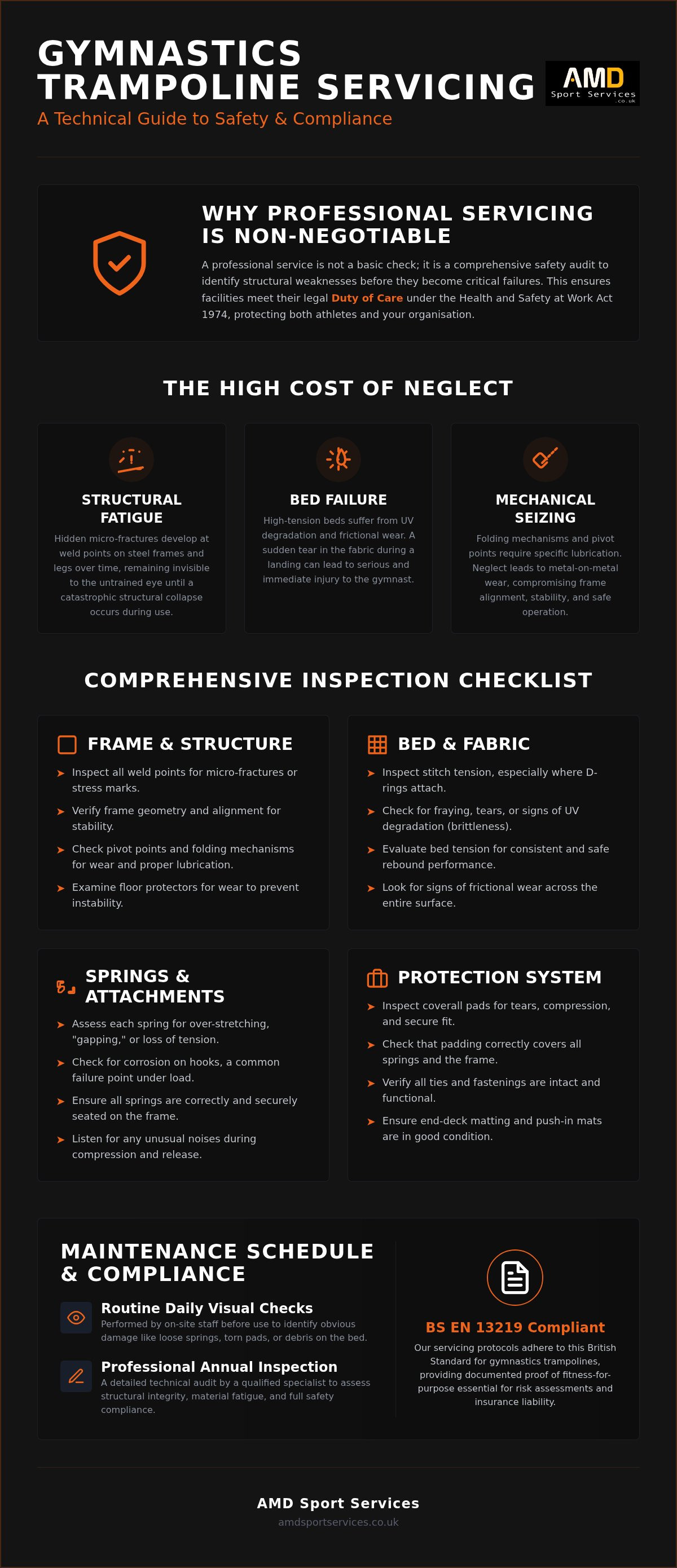
Professional gymnastics equipment represents a significant capital investment for any facility. Unlike standard garden play equipment, competitive units are engineered to withstand extreme physical forces. A specialist gymnastics trampoline service UK goes far beyond a cursory look; it is a methodical safety audit designed to identify structural weaknesses before they become critical failures. Regular servicing ensures that schools and leisure centres meet their legal duty of care whilst significantly extending the usable life of the apparatus.
Maintaining high-performance equipment requires a deep understanding of the mechanical stresses involved in Trampoline Gymnastics. When a technician conducts a service, they aren't just looking for obvious damage. They are performing a technical assessment of frame geometry, spring fatigue, and textile integrity. This level of detail is necessary because high-performance beds generate much higher rebound forces than domestic alternatives, meaning even minor defects can escalate quickly under load.
Health and Safety Compliance in the UK
Educational and public-sector facilities must operate within strict regulatory frameworks. The Association for Physical Education (AfPE) provides clear guidelines for safe practice in school sports, which include the requirement for regular, documented equipment inspections. Our service and maintenance protocols are built around these specific UK requirements.
BS EN 13219: This British Standard specifies the safety requirements and test methods for gymnastics trampolines. Compliance is a fundamental requirement for institutional providers.
Risk Assessments: Professional annual inspections form a core part of a facility's health and safety documentation, providing proof that equipment is fit for purpose.
Insurance Liability: Having a clear audit trail of professional servicing is vital for protecting an organisation against liability claims in the event of an accident.
The Risks of Neglecting Regular Maintenance
The forces generated during advanced routines put immense strain on every component. Neglecting a scheduled gymnastics trampoline service UK often leads to progressive degradation that is invisible to the untrained eye. Proactive care is always more cost-effective than reactive repair.
Structural Fatigue: Steel frames and legs can develop micro-fractures at weld points over time. Without professional visual stress testing, these remain hidden until a structural collapse occurs.
Bed Failure: High-tension nylon or 2-string beds are subject to UV degradation and frictional wear. A sudden failure during a landing can result in catastrophic injury.
Mechanical Seizing: Pivot points and folding mechanisms require specific lubrication to prevent metal-on-metal wear that can compromise the frame's alignment and stability.
Technical honesty is at the heart of a good maintenance programme. By identifying and replacing individual fatigued springs or worn floor protectors early, you prevent the "knock-on" effect that damages more expensive components like the main frame or the bed itself.
Key Components of a Comprehensive Trampoline Inspection
A professional gymnastics trampoline service UK involves a systematic breakdown of the apparatus into four primary categories: the frame, the bed, the springs, and the protection system. Each component plays a specific role in the mechanical safety and performance of the unit. We don't just look for obvious damage; we conduct a technical audit of the stresses placed on the equipment during high-level use.
Springs are the engine of the trampoline. We assess every individual spring for over-stretching or "gapping," where the coils no longer sit tight against each other. This loss of tension directly impacts the gymnast's control and the bed's responsiveness. Corrosion on the hooks is another common failure point that can lead to a spring snapping under high load. The bed itself requires a tactile inspection. We look for fraying at the edges and check the stitch tension where the metal D-rings attach to the fabric. UV damage is particularly relevant for equipment stored near windows, as it can cause the fibres to become brittle and lose their tensile strength. Following UK Government Trampoline Safety Guidelines ensures that these checks are not just superficial but part of a robust safety culture within your facility.
Structural Frame and Welding Analysis
The main frame is the structural foundation of the equipment. A seasoned practitioner focuses heavily on the weld points, particularly where the legs meet the main rails and at the corners of the frame. These areas are subject to constant vibration and high-impact torque. We check for hairline fractures in the powder coating or paint, which often indicate an underlying structural issue in the steel. Floor protectors must be intact to prevent the frame from "walking" across the floor during use, which can lead to dangerous misalignment and floor damage. The folding mechanism and hinges are lubricated and checked for smooth operation; a stiff hinge can cause a coach to apply excessive force during setup, potentially bending the frame members or causing a trapping hazard.
Safety Padding and Surround Systems
Padding is the only barrier between a gymnast and the steel frame or springs. We evaluate the impact-absorption qualities of the high-density foam within the pads to ensure it hasn't "bottomed out." Over time, the internal foam can break down, losing its ability to cushion a fall effectively even if the outer PVC cover looks in good condition. We also verify the buckle and strap security to ensure pads do not shift during training sessions. The condition of end decks and safety mats is equally vital; we look for tear-free surfaces and secure attachment points. Ensuring these components are in top condition is a core part of our indoor inspection and maintenance services, helping you maintain a safe environment for every athlete.
Evaluating Bed Tension and Spring Performance
The interaction between the trampoline bed and the spring system determines both the quality of the rebound and the safety of the gymnast. During a professional gymnastics trampoline service UK, we move beyond a visual inspection to assess the mechanical responsiveness of these components. Environmental factors, particularly humidity levels in indoor sports halls, can significantly affect the friction between bed strings and the rate of spring corrosion, necessitating a methodical approach to maintenance.
Nylon web beds are the standard for most UK schools and clubs due to their balance of durability and performance. However, elite training centres often utilise 2-string high-performance beds. These provide less air resistance, allowing for greater height, but they are more susceptible to frictional wear and require precise tensioning to prevent sagging that can compromise a gymnast's landing position. A seasoned practitioner knows that the feel of the rebound is as important as its height; an inconsistent bed can lead to unpredictable travel across the apparatus.
When to Seek Gymnastics Trampoline Bed Replacement
Identifying "dead spots" is a critical skill for any facility manager. These are areas where the bed material has lost its elastic memory, resulting in a dull, inconsistent rebound that can throw a gymnast off-balance. During our technical audits, we specifically look for:
Frictional Wear: Thinning of the nylon strings where they cross each other, often caused by dust and grit.
UV Degradation: Brittle fibres that snap easily under light pressure, common in halls with large windows.
Stitch Elongation: Pulling or tearing of the thread at the D-ring attachment points.
A trampoline bed is no longer safe for competitive use the moment its structural fibres show visible thinning or when the stitch lines at the D-ring attachment points begin to elongate.
Spring Maintenance and Fatigue Monitoring
Springs should be viewed as a collective system rather than individual parts. When one spring fails, it's often a sign that the entire set has reached its fatigue limit. Replacing springs in complete sets ensures even tension across the frame, preventing the bed from pulling to one side and causing frame distortion.
Coil Gapping: If light is visible between the coils when the spring is at rest, it has been over-stretched and must be replaced immediately.
Hook Integrity: We check the hooks for "opening up," which can cause the spring to fly off the frame under high load.
Lubrication: Applying a specialist dry lubricant prevents the corrosive squeaking that occurs when metal-on-metal friction is left unchecked.
Our approach to
prioritises these technical details to ensure your equipment remains responsive and safe for every session.
Maintenance Schedules and Compliance for UK Facilities
Establishing a rigorous maintenance schedule is the only way to ensure institutional compliance and athlete safety. In the UK, the Health and Safety Executive (HSE) and the Association for Physical Education (AfPE) emphasise that equipment must be maintained in a condition fit for purpose. For most schools, this means a professional gymnastics trampoline service UK should occur at least once every twelve months. However, high-traffic leisure centres or clubs with competitive squads often require termly inspections to account for the increased mechanical fatigue on springs and frames.
Between professional visits, your on-site team plays a vital role. PE staff and site managers should conduct daily visual assessments before any equipment is used. These checks don't replace a technical service; they act as an early warning system. A simple checklist should include:
Daily: Checking that frame pads are securely tied and that the bed is free from debris or sharp objects.
Weekly: Inspecting the floor protectors for wear and ensuring the folding mechanism isn't stiff or obstructed.
Monthly: A more detailed look at spring tension and a check for any loose bolts on the leg assemblies.
Annual vs. Termly Safety Checks
The frequency of your professional inspections depends entirely on the volume of use. Whilst an annual visit is the baseline for standard school PE, any equipment used for more than 15 hours per week should be moved to a six-monthly or termly schedule. There's a clear distinction between a "competent person" check performed by staff and a specialist service. Our engineers conduct non-invasive stress tests and technical measurements that go far beyond what a visual check can reveal. To minimise sports hall downtime, we recommend scheduling these intensive inspections during half-term or summer holidays.
Documentation and Record Keeping
A service is only half the job; the other half is the paperwork. In the event of an accident, your equipment logbook is your primary legal defence. It proves you've met your duty of care. Every professional service certificate must detail the specific work carried out, including itemised part replacements and the engineer's signature. This documentation is essential for local authority audits and insurance renewals. If you need assistance in establishing a compliant logbook system, our team provides comprehensive service and maintenance support tailored to UK educational standards. You can book your next safety audit by contacting us through our indoor inspection and maintenance page today to ensure your facility remains fully compliant.
Expert Trampoline Maintenance from AMD Sport Services
At AMD Sport Services, we approach every gymnastics trampoline service UK with the pragmatic mindset of a seasoned practitioner. We understand that institutional budgets are finite and facility schedules are tight. Our goal isn't to sell unnecessary replacements but to ensure your equipment is structurally sound and fully compliant with British safety standards. With nationwide coverage, we support schools, local councils, and private gymnastics clubs across the country, providing a level of technical proficiency that only comes from decades of hands-on experience.
Professional On-Site Repairs and Servicing
Our engineers operate from fully equipped mobile workshops, allowing us to carry out complex repairs directly at your facility. This methodical approach is specifically designed to minimise downtime; we aim to have your equipment back in service as quickly as the technical requirements allow. Technical honesty is a cornerstone of our business. If a trampoline bed has reached the end of its safe operational life, we'll provide a clear, evidence-based recommendation for replacement. However, if a series of minor stitch repairs or a partial spring set swap can restore the unit to peak performance, that's the route we'll take. Detailed digital reports, including photographic evidence of defects and completed work, are provided after every visit to support your indoor inspection and maintenance records.
The AMD Sport Services Difference
With over 20 years of experience in the sports equipment industry, we've encountered almost every structural and mechanical challenge imaginable. We specialise in bespoke solutions for older apparatus that may no longer be supported by original manufacturers. Whether it's custom welding for a legacy frame or sourcing high-tension springs for a discontinued model, we take pride in our role as versatile problem-solvers. Our DBS-checked engineers work with a no-nonsense, safety-first attitude, ensuring that every bolt, hinge, and weld is scrutinised before we sign off on a certificate of compliance. This comprehensive focus on facility safety is why many clients also trust us to manage their Professional sports hall netting systems and other fixed apparatus.
Choosing a veteran contractor provides the reassurance that your facility's safety is in the hands of experts who value durability and technical accuracy over polished sales pitches. We don't just provide a service; we foster a partnership built on accountability and the shared goal of protecting every athlete who uses your equipment.
Securing Your Facility’s Future with Professional Oversight
Professional maintenance is more than a legal obligation; it’s a technical necessity that protects your athletes and your budget. By identifying weld fractures and spring fatigue early, you prevent the structural failures that lead to facility closures and liability claims. Comprehensive documentation ensures you remain audit-ready whilst maintaining the high-performance standards your gymnasts expect. Partnering with a specialist for your gymnastics trampoline service UK needs ensures every component, from the folding hinges to the high-tension beds, is inspected with technical precision.
AMD Sport Services brings over 20 years of industry experience and national UK coverage to every project. We specialise in institutional compliance for schools, councils, and leisure centres, providing the technical honesty required to keep your equipment operational. Contact AMD Sport Services for professional gymnastics trampoline servicing to ensure your facility meets British safety standards. Reliable equipment is the foundation of every successful gymnastics programme, and we’re here to help you maintain those standards for years to come.
Frequently Asked Questions
How often should a gymnastics trampoline be serviced in a UK school?
A gymnastics trampoline in a UK school should be professionally serviced at least once every twelve months to comply with AfPE guidelines. This annual inspection ensures the apparatus remains fit for purpose under the Health and Safety at Work Act 1974. If the equipment is used for extracurricular clubs or community lettings, increasing this frequency to a termly or six-monthly schedule is advisable to account for the additional mechanical fatigue on the frame and springs.
What are the safety standards for gymnastics equipment in the UK?
The primary technical standard for gymnastics trampolines in the UK is BS EN 13219, which specifies safety requirements and test methods. Additionally, facilities must adhere to the Health and Safety at Work Act 1974, ensuring all equipment is maintained in a safe condition. British Gymnastics also provides a Trampolining Code of Practice that outlines the necessary hall heights, safety matting requirements, and equipment setup protocols for institutional and competitive environments.
Can a damaged gymnastics trampoline bed be repaired?
Minor damage to a gymnastics trampoline bed, such as loose stitching at the D-ring attachment points or small snags, can often be repaired by a specialist technician. However, if the bed shows signs of significant UV degradation, large tears, or thinning of the nylon web strings, it must be replaced. Attempting to patch high-tension beds is generally unsafe as the structural integrity required for high-performance rebounding cannot be guaranteed once the primary fibres are compromised.
What is included in a professional gymnastics trampoline safety inspection?
A professional gymnastics trampoline service UK includes a comprehensive audit of all structural and mechanical components. Technicians perform a detailed check of the steel frame for weld fractures, inspect the bed for frictional wear and UV damage, and test every spring for over-stretching. The inspection also covers the impact-absorption qualities of the safety padding, the security of all attachment straps, and the smooth operation of the folding mechanism and leg hinges to ensure total compliance.
How do I know if my trampoline springs need replacing?
You can identify springs that need replacing by looking for "gapping" between the coils when the spring is at rest. If the coils don't sit tight against each other, the spring has lost its elastic memory and no longer provides the necessary tension. Other signs include visible corrosion on the hooks, "opening up" of the hook ends, or a noticeable decrease in the bed's responsiveness. We recommend replacing springs in complete sets to maintain even tension across the frame.
Is an annual service enough for high-use gymnastics clubs?
Whilst an annual service is the minimum requirement, high-use gymnastics clubs typically require more frequent professional oversight. If your equipment is used for more than 15 hours per week, a termly or six-monthly inspection is recommended to manage the accelerated wear on high-performance beds and springs. Regular technical audits help identify fatigue points before they lead to equipment failure, ensuring the safety of athletes performing advanced routines and high-impact landings.
What documentation do I need for sports equipment safety compliance?
For sports equipment safety compliance, you must maintain a comprehensive equipment logbook that includes itemised service certificates and records of all repairs. This documentation should detail the date of inspection, the specific work carried out, and the signature of a qualified engineer. These records are essential for local authority audits, insurance renewals, and providing a legal audit trail that proves your facility has met its duty of care under UK health and safety legislation.
Who is considered a "competent person" for trampoline safety checks?
A "competent person" is defined as someone with the necessary technical knowledge, training, and experience to identify existing and predictable hazards. For daily visual checks, a trained PE teacher or site manager is considered competent. However, for the mandatory annual gymnastics trampoline service UK, a specialist technician with industry-specific qualifications and experience in structural stress testing is required. This ensures that hidden faults, such as hairline weld fractures, are identified using professional diagnostic methods.


Comments