
Indoor Court Markings for Schools: Standards and Renewal

Did you know that under Sport England guidelines, indoor court markings must adhere to a strict tolerance of within 0.1% of official dimensions? For many schools, the reality is a confusing web of faded, overlapping colours that no longer meet these technical standards. It's common for site managers to feel frustrated by a "spaghetti junction" of lines that leads to refereeing disputes and safety hazards. You need a facility that works for everyone, from Year 7 PE to local league basketball, without the risk of damaging the expensive timber or vinyl substrate during a renewal.
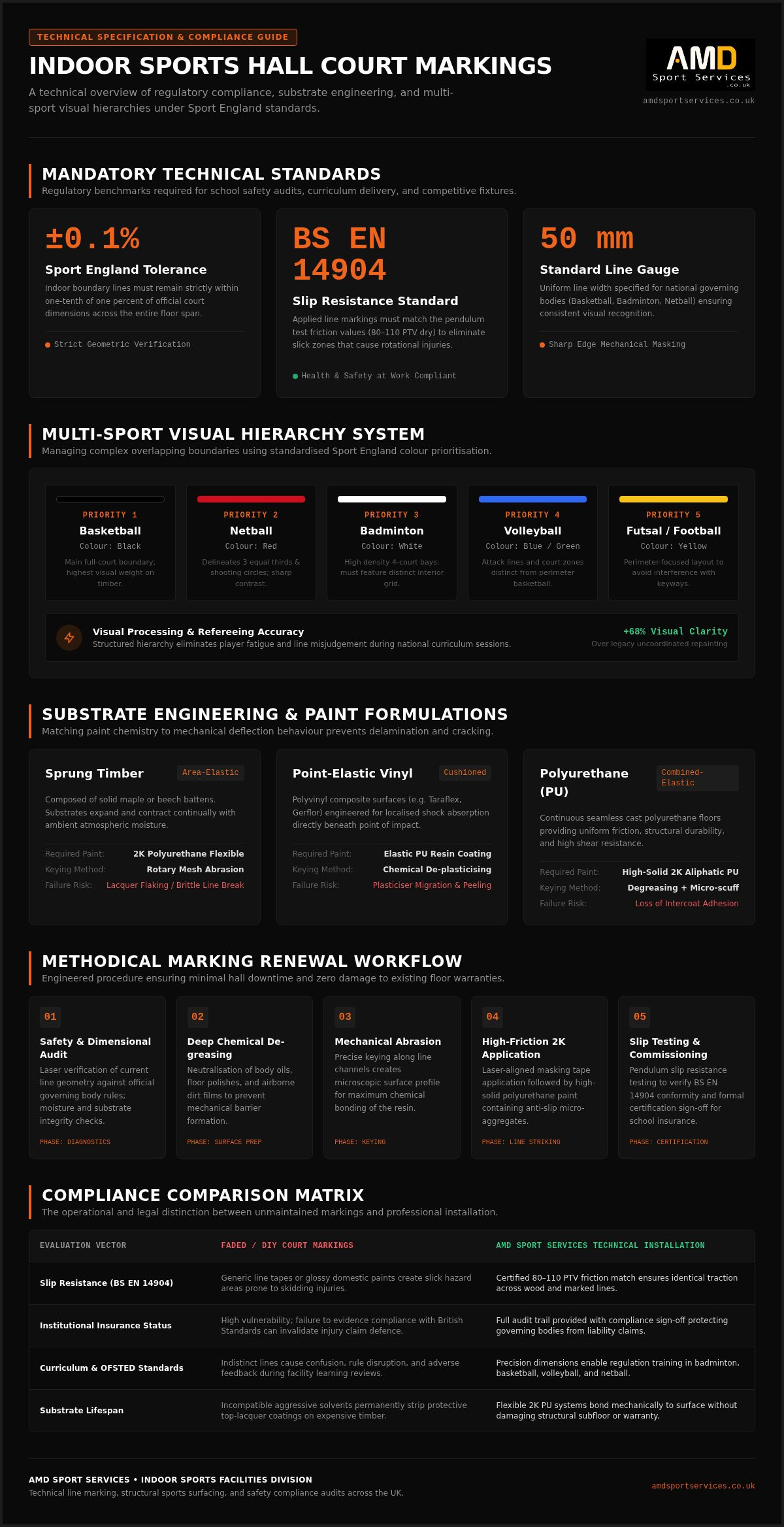
This guide explains how to achieve professional-standard indoor court marking school facilities that ensure safety, full compliance, and multi-sport versatility. We'll detail the specific Sport England colour hierarchies, the importance of BS EN 14904 slip resistance, and the methodical process of renewing lines with minimal hall downtime. By following a structured approach to maintenance, you can ensure your sports hall remains a high-performance asset for both the curriculum and the wider community.
Table of Contents
Why Professional Indoor Court Marking Matters for Schools
Professional indoor court marking for schools involves the precision application of specialist, high-friction paints used to define specific play areas for various sports. It isn't just a cosmetic upgrade for the sports hall. Clear, accurate lines are fundamental to pupil safety and the prevention of collisions during high-energy PE lessons. When markings are laid to professional standards, they provide the necessary structure to deliver the national curriculum for sport. This ensures students can learn the rules of netball, badminton, and football in a realistic, regulated environment. Schools must ensure these facilities are maintained, as well-managed surfaces are frequently reviewed during safety audits and OFSTED inspections to verify a safe learning environment.
The Impact of Faded Lines on Play Quality
Faded markings often lead to unnecessary disputes and poor sportsmanship amongst pupils because boundary calls become subjective. This "visual noise" causes significant fatigue for students and officials alike. In a multi-sport hall, the brain must filter out competing colours; if those lines are indistinct, the task becomes much harder. Clear, vibrant markings facilitate better coaching and skill development. They allow students to understand positioning and basketball court dimensions and markings without hesitation, which is vital for competitive fixtures. High-quality lines ensure that the focus remains on the game, not on arguing over whether a ball was "in" or "out" during a fast-paced match.
Compliance with UK Safety Standards
Under the Health and Safety at Work Act 1974, school governors and local authorities have a legal duty to provide a safe environment. This duty extends to the sports hall floor. A professional **AMD Sport Services** project must use paints that meet BS EN 14904 standards for slip resistance. Many generic "DIY" kits or basic line tapes fail to provide the required friction, creating slick spots that increase the risk of injury. Using non-compliant materials can also compromise institutional insurance policies. Insurers require evidence that maintenance and markings meet official safety specifications to defend against potential liability claims. Integrating line renewal into a wider indoor inspection and maintenance schedule is the most reliable way to ensure ongoing compliance and pupil protection.
Surface Compatibility: Wood, Vinyl, and Polyurethane
The success of an indoor court marking school project depends entirely on understanding the specific substrate of the hall. Applying paint to a sports surface isn't a one-size-fits-all task; different materials expand, contract, and react to chemicals in unique ways. To prevent premature flaking or a loss of slip resistance, the technical specification of the paint must be matched to the floor's material. Applying a rigid paint system to a flexible surface is a common error that leads to the markings failing within months of application.
Surface preparation is the most critical stage of the entire renewal process. We begin by identifying and removing contaminants that have accumulated over years of school use. Floor polishes, body oils, and airborne dust create a barrier that prevents paint from bonding. We utilise mechanical cleaning and specialised de-greasing agents to strip back these layers. This thorough "keying" process ensures that the new markings bond properly with the existing surface, providing a durable finish that can withstand the friction of rubber-soled trainers during daily PE lessons.
Marking Sprung Timber Floors
Sprung timber floors, typically constructed from beech or maple, are living materials that react to changes in humidity and temperature. For markings to remain intact, the paint must possess high elasticity. We avoid rigid, solvent-based products as they often fail to bond and can chemically damage the expensive floor lacquer. Instead, we focus on water-based or two-part polyurethane (2K PU) systems that move in harmony with the wood. To ensure maximum adhesion on highly polished surfaces, we carefully abrade the area before application. This creates a mechanical bond that prevents the lines from peeling away under the stresses of competitive sport.
Synthetic and Multi-Purpose Surfaces
Selecting paints for synthetic surfaces requires a deep understanding of chemical compatibility. Point-elastic vinyl floors, such as Gerflor or Taraflex, are designed for impact absorption. This means the surface deflects under a player's weight, and the markings must be able to flex without cracking or delaminating. Older polyurethane (PU) floors present a different challenge because they often become increasingly porous as they age. This porosity can cause paint to sink into the surface, which dulls the colour and affects the floor's texture. Following the Sport England sports hall design guidance ensures the chosen system maintains required friction pendulum test values. This keeps the hall safe for everything from high-speed futsal to primary school gymnastics.
If you're unsure about the current condition or material of your hall, a professional service and maintenance assessment can identify the best paint system for your specific requirements.
The Multi-Sport Challenge: Managing Overlapping Lines
Designing an indoor court marking school layout involves solving a complex geometric puzzle. Most UK sports halls must accommodate a minimum of four sports within a single footprint. This density creates a high risk of visual confusion, where overlapping lines of similar shades make it impossible for referees to call a game accurately. A professional layout prevents this "visual noise" by establishing a clear hierarchy of sports. We work with school leads to determine which sport takes precedence, usually based on the primary curriculum needs or high-level community lets. If a school is a regional hub for basketball, that court's boundaries must be the most prominent in the visual field.
Future-proofing is equally vital during the planning phase. We often advise schools to consider volleyball post installation even if the sport isn't currently on the curriculum. Installing the floor sockets during a court marking renewal is significantly more cost-effective than retrofitting them later. This forward-thinking approach ensures the facility remains versatile as sporting trends change. It also allows the hall to be marketed to a wider range of community groups, increasing potential revenue for the institution.
Sport England Line Colour Standards
Adhering to the Sport England sports hall design guidance is mandatory for achieving a professional finish. This guidance sets a specific colour hierarchy to ensure maximum clarity for players. Badminton lines are typically white and 40 mm wide, providing the sharpest contrast for the fastest-moving object. Basketball markings are usually black, whilst netball utilises red lines. Volleyball is traditionally marked in blue or green, and five-a-side football or futsal typically uses yellow. Following these national standards ensures that visiting teams and officials find the environment familiar and compliant. When handling non-standard sports, we select shades that sit outside this primary palette to avoid clashing with established boundaries.
Designing for Multi-Functional Use
Managing the intersection of these lines requires technical precision. We use a "broken line" technique where secondary sports lines stop and start around the primary court boundaries. This prevents a solid block of colour at intersections, which can be disorienting for players in fast-paced matches. We also use contrasting colours to differentiate between the active court and the safety run-off areas. A well-organised hall also accounts for physical infrastructure, such as sports hall netting systems. The markings must align perfectly with the path of the division nets to ensure that divided courts are safe and functionally independent during multi-class PE sessions.
The Court Marking Renewal Process: Step-by-Step
The transition from layout planning to physical execution requires a methodical, technical approach. Every indoor court marking school project begins with a comprehensive indoor inspection and maintenance audit. This initial assessment allows us to identify any structural floor issues or surface degradation that might compromise the longevity of the new markings. We check for loose timber boards or delaminating synthetic layers before any paint is applied. Once the surface is deemed sound, we proceed with mechanical cleaning and de-greasing. This process involves industrial scrubbing machines and specialised agents that strip away years of ingrained grime, body oils, and old floor polishes.
After the surface is chemically and mechanically prepared, we move to the precision tape-out phase. We utilise laser-guided measurement tools to ensure every boundary line is accurate to within the 0.1% margin required by Sport England. Once the layout is taped, we apply specialist two-pack polyurethane (2K PU) or acrylic sports paints. These systems are selected for their high-friction properties and extreme durability. Curing times are a vital consideration; the hall needs controlled ventilation and a period of 24 to 48 hours before it's ready for light foot traffic. Rushing this stage can lead to "tacky" lines that attract dust and fail prematurely.
Removing or Over-Painting Old Lines
Deciding whether to choose complete floor sanding or a simple line renewal depends on the age and condition of the substrate. If the floor lacquer has worn through to the raw material, full sanding is usually necessary. However, if the finish is intact, we can focus on over-painting. We use technical masking and block-out methods to eliminate "ghost lines" from previous markings. This prevents the confusing visual echo of old boundaries appearing through the new paint. We ensure the new paint system is chemically compatible with the old finish to guarantee a permanent bond.
Precision Application Techniques
Whilst machine-spraying is common in outdoor settings, we find that hand-painting is often superior for indoor detail. It provides greater control over line thickness and ensures a sharp, bleed-free edge. We strictly adhere to the 50mm standard for most UK sports, whilst maintaining the narrower 40mm requirement for badminton. Our final inspection involves a manual verification of all dimensions against National Governing Body (NGB) rules. This rigour ensures your facility is capable of hosting official competitive fixtures without the risk of disqualification. To book a professional site survey for your facility, contact us for a court marking renewal consultation.
Maintaining Your Markings and Hall Safety
The longevity of an indoor court marking school installation depends heavily on the cleaning regime implemented after the paint has cured. Whilst specialist sports paints are designed for durability, they aren't indestructible. Incorrect maintenance is the leading cause of premature fading and loss of slip resistance. Establishing a clear, documented cleaning protocol ensures that the markings remain vibrant and functional for their expected five-to-seven-year lifespan. This proactive approach also protects the school's investment in the floor substrate itself.
Using the wrong chemicals can have disastrous results for both aesthetics and safety. Harsh, solvent-based cleaners or high-alkaline degreasers can chemically strip the top layer of the markings. This process doesn't just dull the colour; it alters the surface texture, often making it dangerously slick. Maintaining the correct friction level is essential for preventing pupil injuries during fast-paced PE activities. Integrating these checks into your regular school PE equipment safety checks ensures that the floor and the equipment are managed as a single, safe environment.
Daily and Weekly Care Routine
Effective maintenance starts with the right equipment. We recommend using microfibre mops or professional scrubber-dryers fitted with soft pads. It's vital to use pH-neutral cleaners specifically formulated for sports surfaces. These solutions lift dirt without leaving a soapy residue that can trap dust and reduce traction. Consistency is key to preventing the buildup of abrasive particles.
Avoid using rotary buffing machines directly over painted lines, as the heat generated can cause the paint to delaminate.
Sweep the hall daily to remove grit that acts like sandpaper under foot traffic.
Monitor high-wear areas, such as the "D" in netball or the baseline in basketball, for early signs of thinning.
Identifying these issues early allows for localised touch-ups rather than a full hall renewal. This targeted maintenance keeps the visual clarity high and prevents the need for more invasive repairs later.
Annual Professional Inspections
A comprehensive annual safety audit should encompass more than just the mechanical fixtures. It must include a technical assessment of the floor's condition and the accuracy of the markings. As markings age, their slip resistance can change. We utilise the Pendulum Test (BS EN 14904) to verify that the floor remains within the safe range of 80 to 110. This data is crucial for the school's health and safety records and insurance compliance.
Coordinating line repairs with other maintenance tasks is the most efficient way to manage a facility. For instance, if you're scheduling basketball goal installation services or repairs, it makes sense to audit the court markings at the same time. This alignment minimises hall downtime and ensures that the physical equipment and the floor markings are perfectly synchronised. A well-maintained hall projects a standard of excellence that benefits students, staff, and the wider community who utilise the space.
Securing the Future of Your School Sports Hall
Maintaining a high-quality sports environment requires more than just occasional cleaning. It demands a technical understanding of Sport England standards and a commitment to surface-specific maintenance. By prioritising precise line hierarchy and choosing compatible paint systems, you ensure your hall remains safe and compliant for years. Professional indoor court marking school projects succeed when they are part of a wider safety strategy that includes regular audits and equipment servicing. This integrated approach prevents the "visual noise" of overlapping courts and ensures every boundary meets National Governing Body requirements.
AMD Sport Services provides a UK-wide national service for educational institutions. As specialist equipment repair contractors with expertise in both athletics surfacing and indoor hall maintenance, we ensure every project meets rigorous technical benchmarks. We handle the complexities of multi-sport layouts so you can focus on delivering the curriculum with confidence. Take the first step toward a safer, more versatile facility. Book a professional sports hall safety inspection and line marking audit today to guarantee your markings perform as well as your athletes. We look forward to helping you revitalise your sports hall.
Frequently Asked Questions
What is the standard colour for netball court markings in UK schools?
Red is the standard colour for netball court markings in UK schools. According to Sport England and England Netball guidelines, these lines should be 50 mm wide to ensure compliance with official rules. Using red provides high visual clarity against the white of badminton or the black of basketball. This selection is part of a national hierarchy designed to assist players and officials in identifying court boundaries quickly during fast-paced school matches.
How long do indoor court markings typically last before needing renewal?
High-quality indoor court marking school installations typically last between five and seven years under standard school usage. We utilise durable two-part polyurethane (2K PU) paint systems that withstand the constant friction of rubber soles. The exact lifespan depends on the frequency of use and the cleaning regime employed. Using pH-neutral cleaners and avoiding abrasive equipment helps preserve the line clarity and slip resistance for as long as possible for your pupils.
Can you add new court lines to an existing wooden sports hall floor?
You can add new court lines to an existing wooden sports hall floor, provided the surface is properly prepared. We use mechanical de-greasing and light abrasion to ensure the new paint bonds to the existing lacquer. This process allows schools to update their facilities for emerging sports like pickleball or futsal without a full floor sand. However, the new paint must be chemically compatible with the original finish to prevent delamination.
How long does the sports hall need to be closed for line marking renewal?
Most indoor court marking school projects require the hall to be closed for approximately 48 to 72 hours. This timeframe includes the initial mechanical cleaning, precision tape-out, and paint application. Crucially, the paint requires 24 to 48 hours of curing time before it is safe for light foot traffic. Rushing this window can result in tacky lines that attract dust or scuff easily. We recommend scheduling these works during half-term breaks for minimal disruption.
Do indoor court markings need to be slip-resistant?
Yes, indoor court markings must be slip-resistant to comply with BS EN 14904 standards. The painted lines should maintain a friction pendulum test value between 80 and 110. This range ensures that the floor isn't too slick, which causes slips, nor too "sticky," which can lead to ankle and knee strain. Using specialist sports paints is vital for meeting the UK Health and Safety Executive (HSE) low-risk slip criteria.
What are the Sport England dimensions for a standard primary school sports hall?
Sport England design guidance suggests that a standard primary school sports hall should ideally measure 18 m x 10 m for a single-court space. For larger four-court facilities used for community lets, the standard dimension is 34.5 m x 20 m. These measurements include necessary safety run-off zones around the court boundaries. Adhering to these dimensions ensures the facility is suitable for both the PE curriculum and regional competitive fixtures across the United Kingdom.
Can you mark out multiple sports on the same area without it being confusing?
You can mark multiple sports on a single floor by following the Sport England colour hierarchy and using the "broken line" technique. This method ensures that secondary sports lines stop and start at the intersections of primary court boundaries. By using contrasting colours like white for badminton and red for netball, we reduce visual noise. This professional layout allows referees and pupils to distinguish between different play areas without hesitation during busy sessions.
Is it better to sand the whole floor before applying new markings?
It is only necessary to sand the whole floor if the existing lacquer has worn through or the timber is damaged. If the floor's finish is structurally sound, a professional line renewal using mechanical de-greasing and over-painting is a more cost-effective solution. Sanding removes roughly 0.8 mm of wood each time; most timber floors can only endure five to six lifetime sandings. We assess each floor individually to determine the most sustainable approach.


Comments