
Leisure Centre Safety Inspections: A Guide to Basketball Goal Repair and Compliance

For any leisure centre manager, the constant thud of basketballs and the rattle of the ring are sounds of a thriving, active community. Yet, beneath this daily activity lies a significant responsibility: ensuring the structural and mechanical integrity of the basketball goals. In high-traffic facilities, this equipment is subjected to immense stress. A proactive approach to safety inspections and professional repair is not just a matter of compliance; it is fundamental to protecting users and managing the facility's operational risk.
This guide provides a detailed, no-nonsense look at the process of leisure centre basketball goal repair. We will move beyond simple checklists to explore the technical nuances of mechanical wear, the specific requirements of UK safety standards, and the pragmatic decision-making process between repairing existing apparatus and investing in a full replacement. It is a resource for facility managers who need to ensure their equipment is safe, compliant, and ready for continuous use, safeguarding both their community and their organisation's reputation.
Table of Contents
The Critical Role of Leisure Centre Safety Inspections in 2026
Identifying Common Faults in Leisure Centre Basketball Goal Systems
Assessing Basketball Goal Repair vs. Full Equipment Replacement
The Technical Process of Professional Basketball Goal Repair
Securing Your Facility with Specialist Sports Equipment Maintenance
The Critical Role of Leisure Centre Safety Inspections in 2026
A professional sports equipment safety inspection is a systematic, technical assessment conducted by a qualified engineer. For a UK leisure centre, this goes far beyond a quick visual check. It involves a deep dive into the mechanical systems, structural fixings, and material condition of your basketball goals, ensuring they perform safely under the pressures of frequent, public use. This process is central to fulfilling your legal 'Duty of Care'—the obligation to take reasonable steps to prevent foreseeable harm to anyone using your facility.
Understanding Your Duty of Care: In practical terms, this means you are responsible for maintaining a safe environment. High-frequency use in a public leisure centre dramatically accelerates equipment wear compared to a private or school facility. A frayed winch cable or a fatigued wall bracket is not just a maintenance issue; it is a significant liability. Regular, documented inspections by a specialist are your primary evidence of having taken reasonable safety measures.
The Impact of High-Frequency Use: Unlike equipment in a school that may be used a few times a week, leisure centre goals are often in constant action. This intensive use places continuous strain on winches, cables, pulleys, and backboards. What might be a minor issue in another setting can quickly become a critical failure point in a busy sports hall.
Annual Inspections as a Minimum: For insurance purposes and to demonstrate robust health and safety management, annual professional inspections are the absolute minimum. This regular assessment identifies gradual wear and tear before it leads to catastrophic failure, allowing for planned, cost-effective leisure centre basketball goal repair rather than emergency, disruptive replacements.
BS EN 1270 and UK Safety Standards
Compliance is not a matter of opinion. For basketball equipment, the governing standard is BS EN 1270. This British and European standard sets out specific safety requirements, test methods, and functional specifications for basketball goals. A professional inspection verifies that your equipment, whether new or old, adheres to these critical benchmarks.
Load-Bearing and Safety Fixings: BS EN 1270 dictates the load-bearing capacities of rings, backboards, and support structures. It ensures the equipment can withstand the dynamic forces of play, including players hanging from the ring. A key component of this is the requirement for safety secondary fixings—typically steel chains or wires—that act as a fail-safe, preventing the unit from falling in the event of a primary mounting failure.
The Role of Documentation: Following an inspection and any necessary repairs, you should receive detailed documentation. This report is not just a receipt; it is a vital legal document. It serves as proof of your proactive safety management during health and safety audits and is essential for validating your insurance cover. It should clearly state that the equipment has been inspected in accordance with BS EN 1270.
Identifying Risks in Multi-Use Sports Halls
Basketball goals rarely exist in isolation. In a modern leisure centre, the sports hall is a complex environment where multiple pieces of equipment must coexist safely. An integrated inspection approach is crucial to identifying potential conflicts and compound risks.
Interactions with Other Equipment: The operation of sports hall partition netting, indoor cricket nets, and other ceiling-mounted apparatus can interfere with the safe retraction and lowering of basketball goals. An inspection must assess the entire system, ensuring clear, unobstructed movement paths for all equipment.
Retractable Seating and Roof Apparatus: The proximity of retractable seating units to wall-mounted goals presents a risk of collision and structural damage. Similarly, roof-mounted goals must be assessed in the context of the roof's structure, lighting rigs, and other suspended equipment.
An Integrated Maintenance Approach: A piecemeal approach to safety is inefficient and dangerous. Viewing the sports hall as a single, integrated system is essential. A comprehensive programme for indoor inspection and maintenance ensures that all equipment, from basketball goals to floor sockets, is managed under one cohesive safety strategy.
Identifying Common Faults in Leisure Centre Basketball Goal Systems
Years of hands-on experience reveal that basketball goal failures are rarely sudden. They are the result of progressive wear on key components. Knowing where to look is the first step in preventative maintenance. A specialist engineer focuses on the high-stress areas that a general caretaker might overlook, identifying subtle signs of impending failure.
Mechanical Wear: For retractable goals, the winch and pulley systems are the heart of the operation. Constant winding and unwinding leads to wear on internal gears, bearings, and cable guides.
Structural Fatigue: The brackets and support frames, especially on wall-mounted units, endure immense and repeated dynamic loads. Over time, this can lead to metal fatigue, cracked welds, or loosening of wall anchors.
Hidden Dangers: Frayed wire cables and worn nylon rollers are often hidden from view but represent two of the most critical failure points. A single worn roller can shred a new cable in weeks, whilst a frayed cable is a sign of imminent breakage.
Backboard Integrity: From hairline cracks originating from bolt holes to loose mounting hardware causing excessive vibration, the backboard itself requires careful inspection to ensure it remains secure and safe for play.
Winch and Cable Fatigue
The winch and cable assembly does the heavy lifting, and it's where many of the most serious mechanical faults develop. In a busy leisure centre, a winch cable may complete thousands of cycles a year, far exceeding the usage in a typical school environment.
Signs of Cable Fraying: The most dangerous sign is 'bird-caging', where a cable untwists and the strands open up like a cage. This indicates internal breakage and means the cable has lost its structural integrity. Any sign of fraying, broken strands, or kinking requires immediate replacement.
Winch Failure: Manual winch handles are often the first component to fail due to improper use or sheer fatigue. The internal gears can also wear down, making it difficult or impossible to raise the goal. This is a primary driver for centres considering an upgrade to professional motorised basketball goals, which removes manual handling risks for staff.
Backboard and Ring Fixings
The point of play is also a point of significant stress. The connection between the ring, the backboard, and the support structure must be flawless to ensure safety and fair play.
Pressure-Release Rings: These rings are designed to flex under a player's weight to prevent backboard shattering. However, the spring mechanism can weaken over time. An inspection involves testing this tension to ensure it meets the manufacturer's specifications for both safety and performance.
Backboard Padding: Padding on the bottom and sides of the backboard is a mandatory safety feature to protect players from impact injuries. This padding can become detached, perish, or harden over time, losing its protective qualities.
Glass Backboard Risks: Whilst traditional glass provides excellent rebound, the risk of shattering is a major concern. Any chip or crack can compromise the entire board. This has led many facilities to move toward more durable, shatter-resistant polycarbonate or acrylic alternatives during refurbishment.
Assessing Basketball Goal Repair vs. Full Equipment Replacement
Facility managers often face the difficult decision of whether to invest in a comprehensive leisure centre basketball goal repair or a full replacement. This choice shouldn't be based on initial cost alone, but on a pragmatic analysis of long-term safety, compliance, and value.
Cost-Benefit Analysis: A repair is often the most cost-effective solution if the core structure—the main steel framework—is sound. Replacing high-wear parts like cables, winches, and backboards can extend the life of the apparatus for many years. However, if multiple major components are failing and the system is obsolete, the cumulative cost and disruption of repeated repairs can outweigh the one-time investment in a new, compliant system.
Evaluating the Structural 'Bones': A specialist engineer can assess the fundamental structural integrity of your existing goals. If the main masts and wall brackets are free from corrosion and fatigue, refurbishment is a highly viable and safe option.
Sustainability Benefits: Repairing and refurbishing existing equipment is an environmentally responsible choice. It reduces landfill waste and the carbon footprint associated with manufacturing and transporting heavy new steelwork.
Upgrading for Safety and Convenience: The decision point is also an opportunity to upgrade. Motorising existing roof-mounted goals, for example, can be done as part of a refurbishment project, significantly improving operational efficiency and reducing manual handling risks for staff.
The Case for Specialist Refurbishment
When the core structure is viable, a specialist refurbishment can bring an older system up to modern standards of safety and performance, often at a fraction of the cost of replacement.
Modernising Materials: A common and highly effective upgrade is replacing old timber or damaged perspex backboards with modern, durable materials like polycarbonate, which offer excellent performance and a longer lifespan.
Compliance Upgrades: An older system may lack the secondary safety fixings required by current BS EN 1270 standards. These can be retrofitted during a refurbishment to ensure full compliance.
A Complete Hall Refresh: A goal refurbishment project is the perfect time to carry out other hall maintenance, such as renewing court markings, to provide users with a completely refreshed and professional-standard facility.
When Replacement is the Only Safe Option
There are clear red lines where repair is no longer a safe or financially sensible option. A reputable service provider will provide honest, technically-grounded advice when a system has reached the end of its operational life.
End-of-Life Structural Corrosion: Significant corrosion, particularly in outdoor goals or indoor facilities with damp or humid environments (e.g., near swimming pools), can compromise the steelwork beyond safe repair.
Obsolete Parts: For some older winch mechanisms or bespoke systems, replacement parts may no longer be available. Attempting to fit non-standard parts can compromise the safety and functionality of the entire unit.
Modern Compliance Needs: If the fundamental design of the existing goals cannot be adapted to meet modern standards, a full replacement is necessary. This is where engaging with professional basketball goal installation services ensures the new system is fully compliant from day one.
The Technical Process of Professional Basketball Goal Repair
A professional repair service is a methodical engineering process designed to restore the safety and functionality of your equipment. It is a precise, hands-on task that follows a strict protocol to ensure nothing is missed. Understanding this process gives facility managers confidence in the quality and thoroughness of the work being carried out.
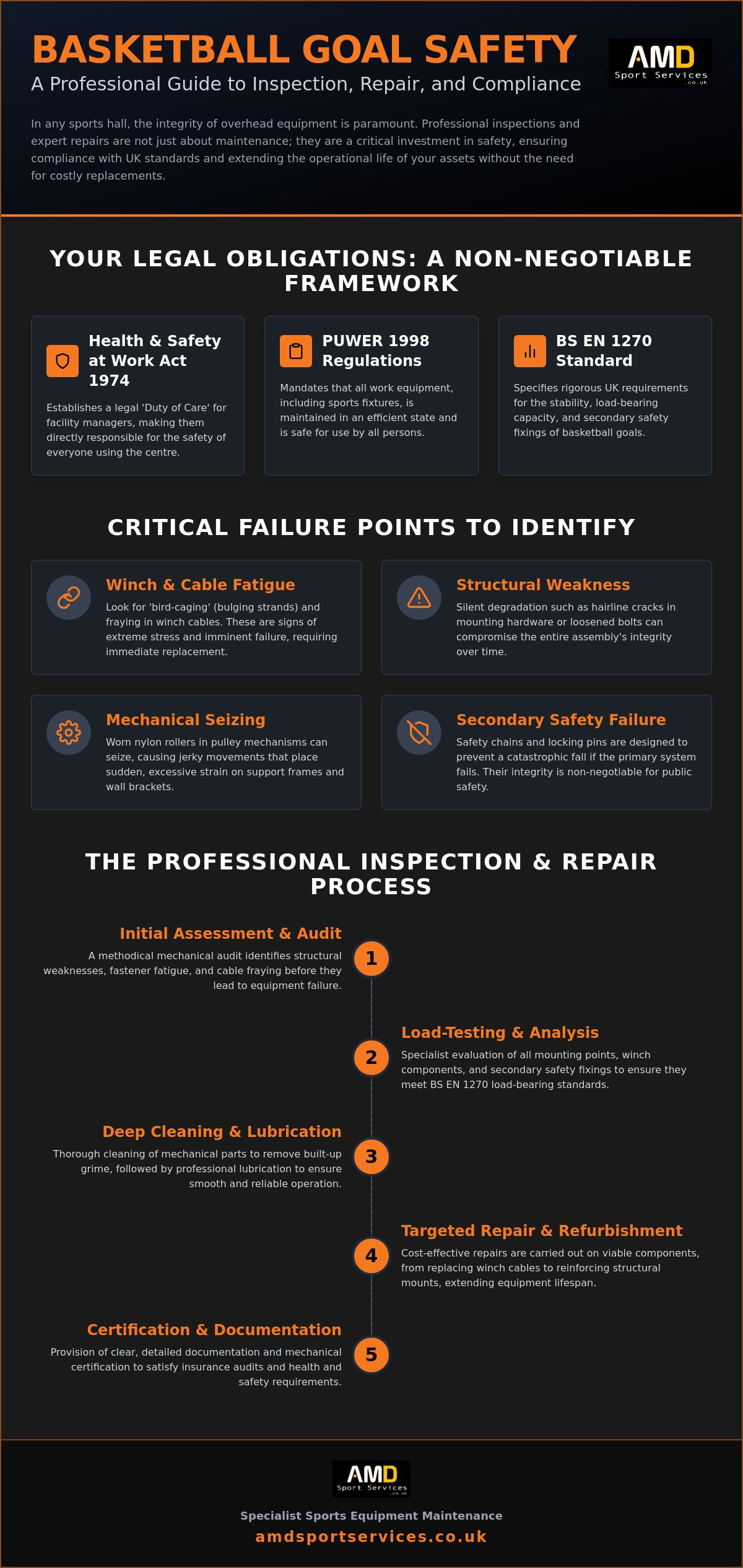
Initial Structural Assessment: The process begins with a comprehensive inspection of the entire apparatus. Engineers assess all mounting points, welds, and structural components for signs of stress, fatigue, or corrosion. This includes load-testing key fixings to verify their integrity.
Mechanical Disassembly and Servicing: The winch, pulleys, and other mechanical components are carefully disassembled. Each part is deep-cleaned to remove old grease and debris, allowing for a detailed inspection of gears, bearings, and rollers. Components are then lubricated with the correct grade of industrial lubricant before reassembly.
Precision Replacement of High-Wear Parts: Any parts identified as worn, damaged, or nearing the end of their service life are replaced. This typically includes wire ropes (cables), pulleys, winch handles, and sometimes the backboard or ring. All replacement parts must match or exceed the original manufacturer's specification.
Final Certification and Logging: After reassembly and testing, the engineer performs a final operational check, ensuring the goal moves smoothly and locks securely into position. A safety certificate is issued, and the work is documented in the facility's maintenance log, providing a clear audit trail for compliance purposes.
Step-by-Step Mechanical Servicing
The mechanical heart of a retractable goal is its winch and cable system. This is where the most detailed work takes place.
Winch Inspection: Engineers open the winch housing to inspect the internal gears for worn or broken teeth. For electric winches, this also includes checking the motor, gearbox, and electrical connections.
Cable Re-stringing: When replacing a wire rope, it must be strung through the pulley system with the correct tension. This ensures the goal hangs perfectly level and retracts without snagging, preventing premature wear on the new cable.
Fail-Safe Mechanism Testing: On roof-mounted systems, the 'fail-safe' or secondary safety brake is a critical component. This is tested to ensure it will engage correctly and arrest the goal's descent in the unlikely event of a primary cable failure.
Structural Integrity and Wall Fixings
The connection to the building itself is the foundation of the system's safety. Verifying these fixings is a non-negotiable part of any professional service.
Verifying Wall Anchors: Depending on the wall construction, engineers may use a calibrated torque wrench to test the tightness of wall anchors. This ensures the fixings have not loosened over time due to vibration and dynamic loads from gameplay.
Addressing Frame Movement: Any 'play' or excessive movement in the support frame is investigated and addressed. This often involves tightening fixings or reinforcing the mounting to eliminate vibration that can lead to long-term structural fatigue.
Checking Secondary Safety Chains: All secondary safety chains and wires are checked to ensure they are correctly tensioned, properly rated for the load, and securely attached at both ends. They should be slack enough not to interfere with normal operation but tight enough to engage immediately if a primary failure occurs.
Securing Your Facility with Specialist Sports Equipment Maintenance
Ensuring the safety of your leisure centre's basketball goals is an ongoing responsibility, not a one-off task. Partnering with a specialist provider for your equipment maintenance provides peace of mind, ensures compliance, and delivers long-term value by maximising the lifespan of your assets. It shifts the burden of technical oversight from your internal team to dedicated experts.
The Value of a National Partner: For leisure centre operators with multiple sites, a national maintenance partner provides consistency, efficiency, and a single point of contact for all equipment safety matters.
Developing a Bespoke Schedule: A true specialist works with you to develop a bespoke service and maintenance schedule that reflects your facility's specific equipment and usage levels, ensuring inspections are timely and effective.
Technical Honesty Saves Money: The right partner provides 'no-nonsense' advice grounded in technical reality. This honesty—advising a cost-effective repair over an unnecessary replacement—builds trust and saves facilities significant money in the long term.
Next Steps: The first step towards securing your facility is to book a professional safety audit and equipment review. This provides a clear, documented baseline of your equipment's condition and a pragmatic roadmap for any necessary remedial work.
The AMD Sport Services Difference
We are not just suppliers; we are hands-on engineers and problem-solvers. Our approach is founded on deep technical expertise and a commitment to providing the most appropriate and cost-effective solution for every client.
Solving Unique Challenges: We specialise in addressing complex structural challenges, particularly in older sports halls where standard, off-the-shelf solutions may not be suitable.
Proficiency Over Sales Pressure: Our reputation is built on technical proficiency, not high-pressure sales tactics. We provide clear, transparent advice to help you make informed decisions about your equipment.
Proven Expertise: Our portfolio of completed projects showcases our experience in handling complex basketball goal refurbishments and installations across the UK, demonstrating our capability and commitment to quality.
Planning Your Maintenance Calendar
Proactive planning is key to minimising disruption and maintaining a seamless compliance record. A structured approach to maintenance ensures your sports hall remains safe and available for your community.
Minimising Disruption: We work with leisure centres to schedule inspections and repairs during off-peak hours, holidays, or planned shutdown periods to avoid impacting your bookings and revenue.
The Importance of a Digital Paper Trail: We provide comprehensive digital reports and certifications for all work carried out. This creates an easily accessible and permanent record for your health and safety files, crucial for demonstrating due diligence.
Contact Our Specialist Team: To get a pragmatic assessment of your basketball goals and other sports hall equipment, contact our team today. We can arrange an initial site visit to review your needs and provide a clear, no-obligation proposal for ensuring the long-term safety and compliance of your facility.
Frequently Asked Questions (FAQs)
How often should leisure centre basketball goals be inspected?
A thorough inspection by a qualified specialist should be conducted at least once a year. However, for exceptionally high-use leisure centres, a six-monthly inspection may be advisable. Staff should also perform regular visual checks for obvious faults like frayed cables or loose bolts as part of their opening procedures.
Can we repair a basketball goal ourselves to save money?
Whilst it may seem cost-effective, DIY repairs are strongly discouraged. Using non-specialist staff for repairs on load-bearing equipment creates significant liability risks. A professional engineer has the correct tools, certified replacement parts, and technical knowledge to ensure the repair is safe, compliant with BS EN 1270, and properly documented for your insurance and safety records.
What are the most common signs that a basketball goal winch is failing?
The most common signs include grinding or clicking noises during operation, the handle becoming excessively difficult or stiff to turn, the goal slipping or dropping slightly after being wound up, and visible damage or corrosion on the winch housing or handle.
Is it possible to motorise our existing manual roof-mounted goals?
Yes, in many cases it is possible to retrofit an electric winch system to existing manual goals. This is a common upgrade that improves staff safety by eliminating manual handling and ensures consistent and correct operation. A structural assessment is required to confirm the suitability of the existing framework.
Do you provide safety certification after a basketball goal repair?
Absolutely. After any inspection or repair work is completed, we provide a detailed report and a certificate of conformity. This document confirms that the equipment has been professionally serviced, is in a safe condition, and complies with relevant safety standards, forming a crucial part of your health and safety documentation.
What happens if our basketball goals fail a safety inspection?
If a goal fails an inspection, our engineer will immediately inform you of the findings and the associated risks. The equipment should be taken out of use straight away. We will then provide a detailed report with a no-obligation quotation outlining the necessary repairs or, if required, recommending replacement to bring it back to a safe and compliant standard.
Are there specific regulations for basketball goals in schools versus leisure centres?
The core safety standard, BS EN 1270, applies to basketball equipment in both environments. The key difference is the intensity of use. Equipment in a public leisure centre is generally subject to much higher frequency of use and a wider range of users, which necessitates a more rigorous and frequent inspection and maintenance regime to manage the accelerated wear and tear.
How long does a typical basketball goal repair take to complete?
The timeframe depends on the nature of the repair. A straightforward cable replacement or winch service on a single goal can often be completed in a few hours. A more complex refurbishment involving backboard replacement or structural work may take a full day. We always aim to schedule work to minimise disruption to your centre's operations.


Comments