
Leisure Centre Sports Hall Floor Maintenance: The Essential Safety & Compliance Guide

The integrity of your sports hall floor is the single most important factor in the stability of your fixed equipment and the safety of your users. When surfaces become slick and lines begin to fade, the risk of injury increases and the quality of play diminishes. Investing in a professional leisure centre court marking renewal is not merely a cosmetic upgrade; it's a technical necessity that ensures your facility remains compliant with BS EN 14904:2006 standards and the evolving safety expectations of 2026.
We understand that facility managers face constant pressure to maintain high standards whilst avoiding lengthy periods of downtime. It's a challenging task to keep every court vibrant and every surface slip-resistant under heavy daily use. This guide provides a pragmatic maintenance framework designed to restore surface performance and equipment stability. You'll discover how to implement a clear maintenance schedule, restore essential grip, and achieve compliant markings that meet the rigorous demands of modern multi-sport environments.
Table of Contents
Why Leisure Centre Sports Hall Floor Maintenance is a Safety Priority
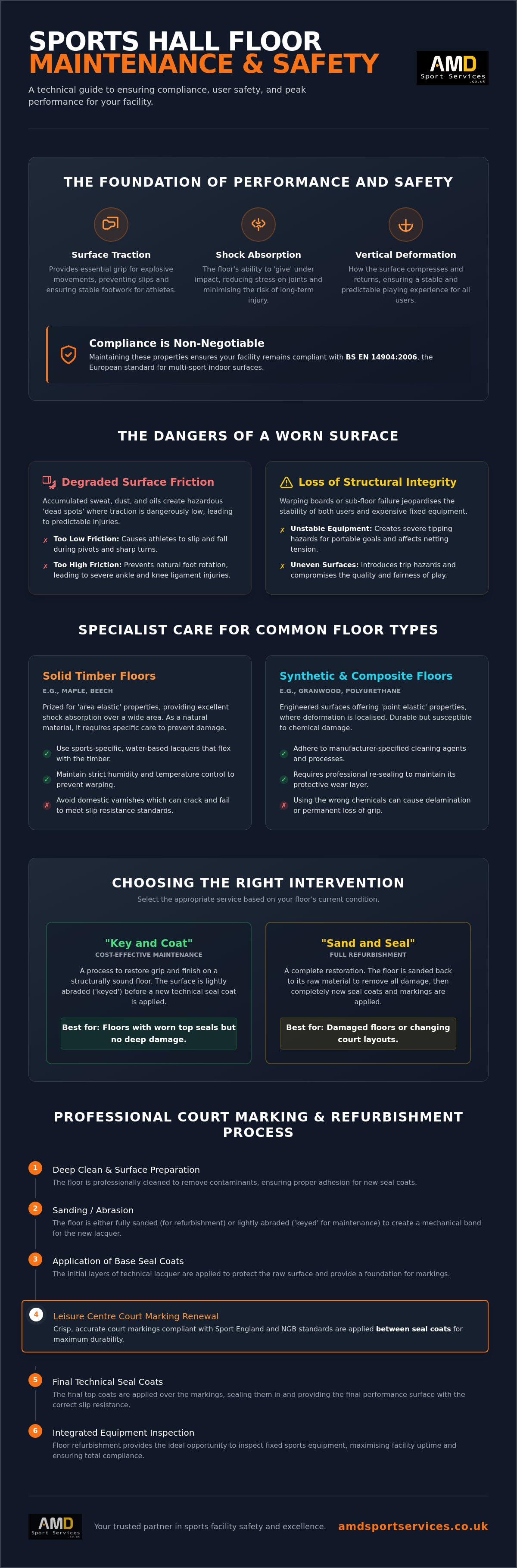
Effective sports hall floor maintenance is about more than aesthetics. It is a technical process of preserving traction, shock absorption, and vertical deformation. These three factors define how a surface reacts under the feet of an athlete. When a floor is properly maintained, it provides the necessary "give" to protect joints whilst offering enough grip for explosive movements. Neglecting these mechanical properties turns a high-performance surface into a significant hazard.
Adherence to BS EN 14904 is the benchmark for any professional facility. This European standard sets strict requirements for the performance and safety of indoor multi-sports surfaces. Failing to meet these standards doesn't just impact the quality of gameplay; it compromises the safety of every user in the hall. Regular indoor inspection and maintenance is the most effective way to document your compliance and mitigate the risk of litigation following an accident.
Beyond user safety, the condition of the floor directly impacts your facility's bottom line. Poorly maintained surfaces act like sandpaper on expensive sports footwear, leading to complaints from club members. Additionally, grit and exposed fibres from worn floors can damage the base of equipment or snag on sport hall protection netting. A consistent maintenance schedule, including periodic leisure centre court marking renewal, prevents this premature wear and extends the operational life of both the floor and the equipment used upon it.
The Impact of Surface Friction on Athlete Safety
High-impact sports such as basketball and netball require specific slip resistance levels to function safely. If the friction coefficient is too low, players will slide during pivots; if it is too high, the floor won't allow for the natural foot rotation required, leading to ankle and knee injuries. Over time, sweat, dust, and skin oils accumulate on the surface. These contaminants create dangerous "dead spots" where traction is non-existent. Professional deep cleaning and technical resealing are required to strip away these layers and restore the surface to its intended performance level.
Structural Integrity and Equipment Stability
The floor serves as the foundation for all your fixed and portable assets. Many modern UK facilities rely on sprung floor systems to provide the shock absorption necessary for high-level sport. However, if the sub-floor begins to fail or the surface boards warp, portable basketball goals can become unstable. This creates a severe tipping hazard during use or transport. Similarly, sports hall netting systems require a level plane to maintain correct tension and alignment. Watch for "hollow" sounds when walking across the hall or visible dips in the timber. These are early warning signs of structural failure that must be addressed before they become hazardous. Integrating a leisure centre court marking renewal into your wider maintenance plan allows technicians to identify these sub-floor issues before they require a full, costly replacement.
Common Sports Hall Surfaces and Their Maintenance Requirements
Every sports hall floor presents unique mechanical properties and maintenance challenges. Whether you manage a traditional timber hall or a modern synthetic facility, the surface material dictates the technical approach required for cleaning, sealing, and leisure centre court marking renewal. Using the wrong chemical or process can lead to delamination, loss of grip, or permanent structural damage. A seasoned practitioner knows that a "one-size-fits-all" cleaning regime is the fastest way to ruin a high-value asset.
Specialist Care for Timber Sports Floors
Solid timber floors, such as beech or maple, are prized for their area elastic properties. This means the floor deflects over a wide area when an athlete lands, providing excellent shock absorption. However, wood is a live material. It reacts to humidity and temperature fluctuations within the leisure centre. To maintain performance, you must use sports-specific, water-based lacquers. Unlike domestic varnishes, these are designed to flex with the timber and meet the HSE slip resistance guidelines for athletic use. Proper moisture control and periodic resealing are vital to prevent the boards from cupping or crowning, which can create dangerous trip hazards and uneven playing surfaces.
Maintaining Synthetic and Composite Surfaces
Synthetic Polyurethane (PU) surfaces offer a point-elastic response, meaning they compress directly under the point of impact. These floors are durable but prone to embedding scuff marks and grime within their textured surface. Regular deep cleaning with pH-neutral solutions is necessary to maintain traction. If you notice minor tears or gouges in the PU, these must be repaired immediately. Left unaddressed, they become trip hazards and allow moisture to seep into the sub-floor, leading to bubbling and total surface failure. This flexibility is what makes them popular, but it also makes them vulnerable to sharp equipment edges.
For older facilities, Granwood block flooring remains a staple. This unique composite of wood, cement, and linseed oil is exceptionally hard-wearing and fire-resistant. However, it requires specialist approved contractors for blockwork repairs and sealing. Because Granwood is non-porous compared to timber, the sealants used must be specifically formulated to bond with the composite material. If blocks become loose or the seal fails, it compromises the entire playing surface and can lead to uneven areas that affect ball bounce and athlete stability.
Vinyl and linoleum are common in multi-use community halls due to their versatility and relatively low initial cost. Whilst easier to clean, they still require a professional eye to identify issues like weld failure or adhesive breakdown. Regardless of the surface, any refurbishment must include a leisure centre court marking renewal using compatible technical paints to ensure the lines don't peel or blur. If you're unsure about the current condition of your flooring, a professional sports floor assessment can identify specific risks before they escalate into costly repairs.
Refurbishment vs. Maintenance: Choosing the Right Intervention
Deciding between a routine deep clean, a "key and coat" treatment, or a full sand and seal is a technical decision that impacts both safety and your maintenance budget. A common mistake in the sector is assuming that a slippery floor always requires full sanding. In many cases, the timber is structurally sound, but the surface is contaminated by skin oils and dust. Choosing the wrong intervention can lead to unnecessary expenditure or, conversely, a failure to address deep-seated safety issues. Don't wait for an accident to dictate your maintenance schedule.
A "key and coat" is a mid-life intervention that bridges the gap between cleaning and full refurbishment. This process involves a light mechanical abrasion of the top seal layer to create a bond for a new technical lacquer. It's a cost-effective way to restore slip resistance and provide a fresh base for leisure centre court marking renewal without the downtime associated with sanding back to bare wood. If your floor is less than five years old but showing signs of surface wear, this is often the most pragmatic choice.
When to Opt for a Professional Deep Clean
Surface contamination is the primary cause of "dead spots" where traction is lost. Daily mopping often fails to remove the build-up of sweat and microscopic grit that settles into the floor's texture. A professional deep clean uses pH-neutral chemicals specifically formulated to break down these biological contaminants without stripping the protective lacquer. This process is a vital prerequisite for leisure centre court marking renewal; applying new lines over a contaminated surface will inevitably lead to premature peeling and poor adhesion. Regular deep cleaning should be a quarterly priority for high-traffic leisure centres. Grip is non-negotiable.
The Full Refurbishment Workflow
A full sand and seal is required when the floor surface is uneven, deeply scratched, or the existing seal has worn through to the bare material. This is an intensive process that involves sanding the floor back to its original state, removing all previous coatings and imperfections. Once the timber is level and clean, we apply multiple coats of high-durability technical seal. This workflow typically follows a 5 to 10-year cycle, depending on usage levels and the quality of interim maintenance. Scheduling this work requires careful planning to minimise lost revenue, but the result is a surface that performs as it did on the day of installation. It looks new. It plays new.
Ultimately, assessing the lifecycle of your floor requires a no-nonsense look at its structural integrity. If you're seeing signs of sub-floor failure, as discussed in our safety priority section, even a full sand won't solve the issue. In these rare cases, complete replacement is the only compliant path forward. For most centres, a disciplined mix of daily cleaning and professional service and maintenance will keep the hall safe and vibrant for decades.
Professional Leisure Centre Court Marking Renewal and Equipment Integration
A sports hall is a complex environment where floor performance and equipment safety intersect. When we perform a leisure centre court marking renewal, we don't just look at the paint; we assess how those markings interact with your physical assets. Line markings must comply with specific Sport England and National Governing Body (NGB) standards. For instance, court dimensions must be accurate within a +/- 2mm tolerance to remain eligible for official tournaments. This level of precision is impossible to achieve with DIY methods or generic tape solutions.
The technical success of line renewal depends on the science of paint adhesion. We apply court lines between the technical seal coats. This "sandwich" method protects the paint from the abrasive forces of foot traffic and equipment dragging, ensuring the markings remain vibrant for years. It also maintains a uniform friction coefficient across the entire floor, preventing the "skipping" effect that occurs when players move from a sealed surface onto a painted line. If you are planning a facility upgrade, you can book a comprehensive indoor inspection to ensure your floor and equipment are treated as a single, safe system.
Professional Line Painting Standards
Bespoke Accuracy: We use precision equipment to ensure every court, from basketball to badminton, meets exact regulatory dimensions.
Colour Hierarchy: In multi-use halls, we prioritise high-contrast colours for primary sports like netball and basketball to reduce visual confusion for players.
Durability: We utilise high-grade, two-part polyurethane paints that bond chemically with the floor seal to prevent peeling and chipping.
Syncing Floor Care with Equipment Safety
Refurbishing the floor provides the perfect opportunity to inspect the sub-surface hardware. We check that all floor sockets and anchors are flush with the new surface. Ill-fitting socket covers are a common cause of ankle injuries and must be adjusted or replaced during the maintenance process. It is also vital to ensure that sports hall netting systems are correctly aligned with the renewed floor markings. Misalignment can lead to safety netting obstructing the field of play or failing to stop stray balls effectively.
We also verify that any basketball goal installation remains secure on the refurbished surface. Changes in floor height after multiple sandings can affect the stability and height of portable units. By integrating your leisure centre court marking renewal with a full equipment safety audit, you ensure every component of your hall works in harmony. To maintain your facility's compliance, contact AMD Sport Services for a professional consultation today.
The AMD Sport Services Approach to Sports Hall Excellence
Managing a busy sports facility requires a partner who understands the mechanical realities of the environment. At AMD Sport Services, we provide a no-nonsense assessment of your facility's current safety and compliance status. We operate nationwide, delivering specialist services to schools, local authorities, and private leisure centres across the United Kingdom. Our goal is to ensure your hall remains a high-performance space that meets every regulatory requirement without unnecessary expenditure.
We take a holistic view of your facility. A leisure centre court marking renewal shouldn't be a standalone task. By integrating floor maintenance with sports equipment safety inspections, we identify risks that others might miss. Whether it's a loose floor socket or a misaligned netting track, we solve these technical challenges during the same site visit. This joined-up approach reduces facility downtime and ensures that every component of your hall works in perfect harmony. We take pride in solving unique structural or mechanical challenges that off-the-shelf products simply cannot address.
Why Experience Matters in Sports Maintenance
We leverage over 20 years of hands-on expertise in the sports facility sector. This experience has taught us the value of technical honesty. We won't recommend a full sand and seal if a deep clean and a fresh technical lacquer will suffice. Our reputation is built on providing pragmatic advice that prioritises the long-term health of your floor over a quick sale. You can view our previous projects to see the quality of our workmanship and the variety of facilities we've restored. We act as a veteran presence in the industry, dependable and committed to the highest standards of workmanship.
Your Partner for Long-Term Facility Compliance
Compliance is a continuous process, not a one-off event. We offer ongoing maintenance contracts designed to keep your centre safe and vibrant year-round. Beyond the sports hall, our expertise extends to athletics surfacing and external equipment installation. We help you manage the lifecycle of your assets, from the initial leisure centre court marking renewal to the repair of external throwing cages or long jump runways. This comprehensive support allows you to focus on facility management whilst we handle the technical details of safety and performance. When you're ready to secure your facility's future, you can book your next professional inspection and maintenance session with our team. We're here to keep your athletes safe and your equipment compliant.
Securing the Future of Your Sports Facility
Maintaining a safe and compliant sports hall requires a technical understanding of how floor surfaces and equipment interact. We've explored how disciplined maintenance and the correct choice between a "key and coat" or a full sand and seal can preserve your facility's performance for decades. By prioritising a professional leisure centre court marking renewal, you ensure your courts meet strict NGB standards whilst providing athletes with the traction they need to stay safe.
With over 20 years of specialist industry experience, AMD Sport Services provides national coverage for educational and leisure facilities. We ensure your hall remains in full compliance with UK safety and performance standards through our integrated inspection approach. Book your professional sports hall floor and equipment inspection with AMD Sport Services today. Taking proactive steps now prevents costly structural failures and protects your users. Your facility is a valuable community asset; let's keep it performing at its best.
Frequently Asked Questions
How often should a leisure centre sports hall floor be professionally cleaned?
A leisure centre sports hall floor should receive a professional deep clean every 3 to 6 months. Whilst daily mopping removes surface dust, it doesn't strip away the accumulation of body oils and sweat that create dangerous dead spots. High-traffic facilities hosting back-to-back sessions often require a quarterly schedule to maintain the slip resistance required for competitive play. This regularity prevents the build-up of contaminants that can degrade the floor's technical finish prematurely.
What is the difference between a Key and Coat and a full sand and seal?
The primary difference lies in the depth of the treatment. A Key and Coat involves lightly abrading the existing top layer of seal to create a bond for a new coat of technical lacquer. It's a maintenance step. A full sand and seal involves grinding the floor back to bare wood to remove deep scratches and level the surface. We recommend a leisure centre court marking renewal during either process to ensure your lines remain sharp and compliant.
Can we change the court markings during a floor refurbishment?
Yes, a floor refurbishment is the ideal time to update or change your court layouts. As we sand the surface back to bare wood or abrade the existing seal, we can remove obsolete lines and apply new markings that meet current Sport England or NGB guidelines. This ensures your facility remains versatile and capable of hosting official tournaments. It's a practical way to modernise your hall without a complete floor replacement.
How long does a sports hall floor take to dry before it can be used again?
Most sports hall floors require 24 to 48 hours of drying time for light foot traffic. However, you shouldn't return heavy equipment, such as portable basketball goals or bleacher seating, to the surface for at least 72 hours. This allows the technical seal to reach its full chemical hardness. Factors like humidity and ventilation in the hall will affect these timescales. We provide a specific re-entry schedule following every site visit to ensure the surface isn't damaged.
Are there specific slip-resistance standards we must meet for netball or basketball?
All multi-sport surfaces must meet the friction requirements set out in BS EN 14904. For high-impact sports like netball and basketball, the surface must provide enough grip to prevent sliding whilst allowing for natural foot rotation. We use a pendulum test to verify slip resistance levels. Maintaining these standards is a core part of your duty of care. It ensures that athletes can perform explosive movements without the risk of traction-related injuries.
What happens if we find damaged floor sockets during the maintenance process?
Damaged floor sockets are identified during our initial assessment and should be repaired or replaced before the floor is sealed. If a socket cover doesn't sit flush, it creates a significant trip hazard for users. We ensure all hardware is correctly aligned and functional as part of our integrated maintenance approach. Ignoring these structural details during a leisure centre court marking renewal compromises the safety of the entire playing area.
Do you provide sports hall floor maintenance for schools as well as leisure centres?
We provide national maintenance and inspection services for schools, colleges, and local authority leisure centres across the United Kingdom. Educational facilities often have multi-use requirements that differ from commercial gyms. We adapt our maintenance schedules to fit around term times and school holidays to minimise disruption. Our team handles everything from primary school halls to specialist university sports hubs, ensuring every site meets national safety standards.
Can you repair synthetic PU floors or only timber surfaces?
We provide maintenance and repair services for both synthetic PU floors and traditional timber surfaces. Synthetic floors require specific deep-cleaning protocols and specialised resins to repair gouges or tears. Timber floors, on the other hand, require mechanical sanding and lacquering. Each material has distinct mechanical properties. We use the correct technical approach for your specific surface to ensure the repair is durable and doesn't affect the floor's overall performance or safety.


Comments