
Long jump sand pit cover replacement: a UK buyer’s guide

Updated: Oct 2
A worn surface doesn’t automatically mean a long jump runway needs complete replacement. The right long jump runway refurbishment starts by assessing the runway, take-off area and landing pit together, then defining work around the facility’s condition and intended use. For schools, councils, leisure centres and sports clubs, this helps make the scope practical and account for access and disruption.
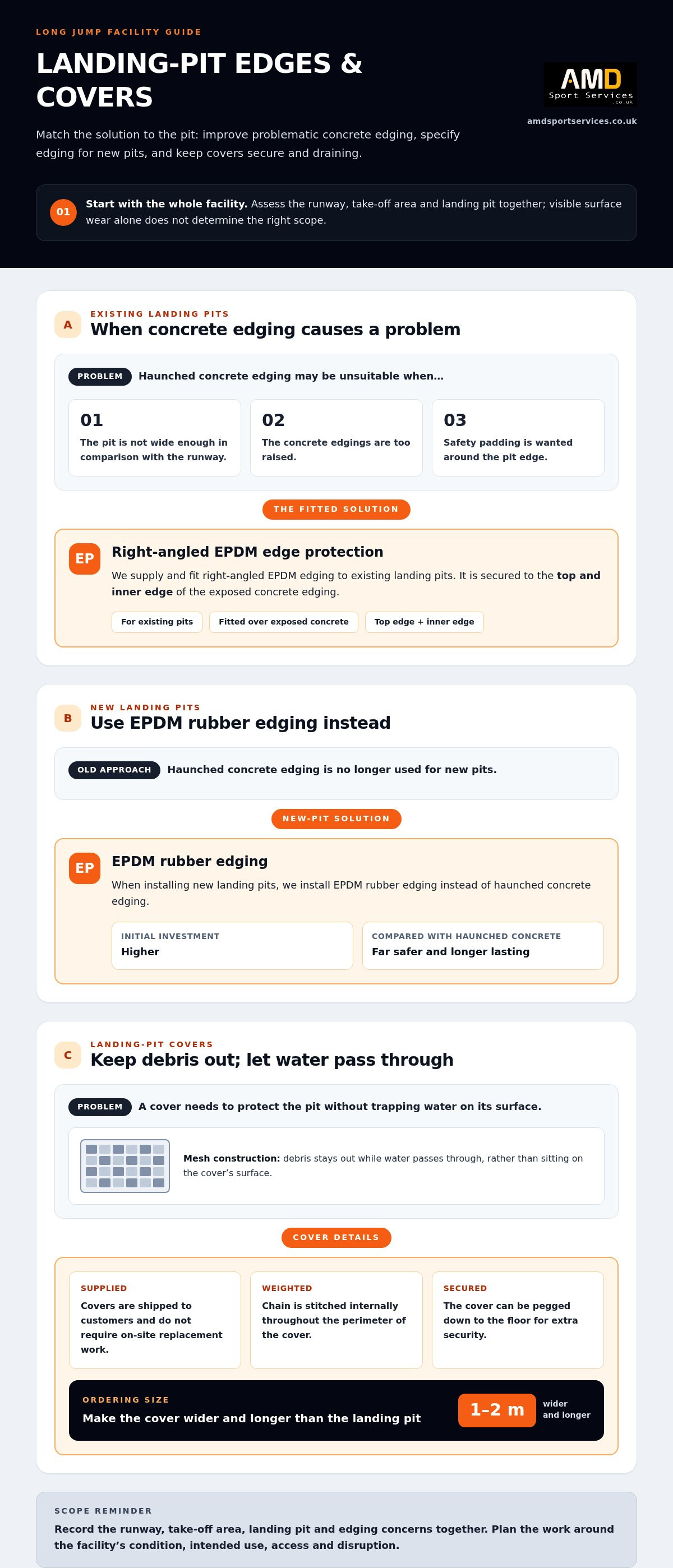
Visible wear can make it difficult to tell whether a repair, refurbishment or full replacement is appropriate. This guide explains what to include in an assessment and how to plan runway and landing-pit improvements as one project. It also covers existing concrete edging: where raised haunches, a pit that is too narrow compared with the runway, or the need for padding causes a problem, right-angled EPDM edging can be fitted to the top and inner edge. New pits use EPDM rubber edging instead of haunched concrete. It has a higher initial investment, but is far safer and longer lasting.
Landing-pit covers are shipped to customers and don’t require on-site replacement work. Their mesh keeps debris out while allowing water to pass through instead of sitting on the surface. Chain stitched internally throughout the perimeter weights the cover, and it can be pegged down to the floor for extra security. Order a cover 1 to 2 m wider and longer than the pit.
Table of Contents
When does a long jump runway need refurbishment?
The first decision is whether to restore the existing runway or plan a wider renewal. Visible wear is a reason to arrange an assessment, but appearance alone doesn’t establish the right scope. A sound long jump runway refurbishment assessment considers the runway, take-off area, landing pit and their interfaces together, then matches the proposed work to the facility’s condition.
A photograph or single visible defect can record a concern, but can’t establish whether a runway is safe to use or whether it needs replacement. A project decision calls for a wider review of the components and how they relate. The long jump depends on the runway and landing area working as one facility, so the assessment should look beyond the surface itself.
What should an initial condition review look at?
Record what you can see and where it is. Note surface wear, cracks, lifting or areas that appear uneven, without assuming that one observation determines the remedy. Include the connected features too:
Take-off area: note the condition and position of the take-off board, runway markings and transitions to surrounding surfaces.
Landing pit: record its condition and how it sits in relation to the runway.
Edging and width: look at the concrete edging, whether it is raised or exposed, and how the pit width compares with the runway.
These notes help separate surface concerns from issues at the board, transitions or pit perimeter. They also give the specialist assessing the facility a clear starting point for defining the work.
Why does refurbishment need a facility-wide view?
The runway and landing pit work together during use. A plan focused only on the runway surface could overlook a restrictive pit width or raised edging that needs separate attention. These concerns don’t prove that the whole runway needs renewal, but they belong in the same project review.
Keep observations about the runway surface distinct from concerns about the take-off board, pit and edging. This makes it easier to define suitable work instead of treating every visible issue as the same problem. For wider context on planning an athletics facility, read the guide to sports facility installations.
If dimensions or technical standards affect the decision, check them against current authoritative guidance before setting the project specification. This keeps the assessment grounded in the facility’s condition and flags any points that need technical review, rather than relying on assumptions based on appearance alone.
How is long jump runway refurbishment assessed and planned?
A clear plan turns condition notes into a defined scope of work. Start by assessing the existing facility, identify which components need attention, coordinate related work, then review the completed work against the agreed scope. The methods and extent of work should follow the runway’s condition, rather than a standard package applied to every facility.
Refurbishment scope depends on the condition and requirements of the existing runway. Separate local repair needs from wider surface work, and include connected assets that could affect the project.
From site assessment to a defined refurbishment scope
Assess the runway surface and adjoining components together. Record which areas need attention, then establish whether the issue is local or points to a broader need for refurbishment. Include the take-off board, markings, transitions and landing pit so the scope reflects the facility as it is.
Choose technical methods, including any surface preparation or renewal, to suit the assessed project rather than assuming them in advance. If dimensions or standards affect the specification, consult current authoritative guidance such as the World Athletics Facilities Manual.
How should work be sequenced around facility use?
Plan access and coordination around how the school, club or leisure facility operates. Identify the areas that need to be available, the work that is linked, and how the runway and pit should be considered together. Agree the work sequence and access arrangements for the specific project rather than assuming a fixed duration or universal process. For context on installation work, see AMD’s athletics installation services.
Include the landing pit in the plan. Existing haunched concrete edging may need protection if it is raised, restrictive in relation to the runway width, or requires padding. AMD supplies and fits right-angled EPDM edging, secured to the top and inner edge of the exposed concrete. For new pits, AMD installs EPDM rubber edging instead of haunched concrete. EPDM has a higher initial investment, but is far safer and longer lasting.
Plan any landing-pit cover separately from fitted edge protection. Covers are shipped to customers and don’t require on-site replacement work. Their mesh keeps debris out while allowing water to pass through. Chain stitched internally throughout the perimeter weights the cover, which can also be pegged down to the floor for extra security. Order a cover 1 to 2 m wider and longer than the pit.
When the work is complete, review the finished areas against the agreed scope and record any remaining items for future planning. AMD tailors installation and refurbishment work to the existing facility and its requirements.
Refurbishment or replacement: how should a facility decide?
Choose between refurbishment and replacement after assessing what can be retained and what the facility needs to achieve. Refurbishment isn't automatically a temporary cosmetic fix, and visible wear or cracking alone doesn't prove that full replacement is necessary. Base the scope on the condition of the existing construction and the work needed to achieve the intended outcome.
When might refurbishment be the appropriate route?
First establish whether the existing runway can be retained. If it can support the intended work, a defined refurbishment scope may address the surface and relevant interfaces without treating the whole facility as a new build. The assessment should identify which elements can remain and which need attention.
Cracks, wear and other visible defects are observations, not conclusions. Their presence alone doesn't determine whether refurbishment or replacement is appropriate. A clean-looking surface doesn't prove that the underlying construction suits the planned outcome either. Base the decision on the condition review, rather than a single surface symptom.
When should replacement enter the discussion?
Consider replacement if an assessment identifies wider reconstruction needs or if the facility's intended outcome calls for changes that work to the existing runway can't deliver. The decision should reflect both the findings and the planned use of the facility. Don't base it simply on refurbishment sounding less extensive or replacement appearing to offer a clean start.
For context on planning a new facility, read the guide to long jump runway installation. AMD Sport Services' runway refurbishment service can be scoped around the condition and requirements of the existing facility.
How do landing-pit edging and covers fit into refurbishment?
A runway project should include the landing pit as a connected asset, but edging and covers address different needs. Edge protection is fitted to address a problem with existing concrete edging. A cover is shipped to protect the pit when it isn’t in use. Including both in the project brief helps distinguish permanent changes to the pit edge from its removable cover.
When is landing-pit edge protection useful?
Edge protection can be added to an existing pit where haunched concrete edging causes an issue. This can include a pit that is too narrow in comparison with the runway, edging that is too raised, or a requirement for safety padding. These are pit-edge issues to assess alongside the runway, not reasons on their own to replace the whole facility.
AMD supplies and fits right-angled EPDM edging, secured to the top and inner edge of the exposed concrete. For new landing pits, AMD no longer uses haunched concrete edging and instead installs EPDM rubber edging. It has a higher initial investment, but is far safer and longer lasting.
Fitted edge protection is different from a landing-pit cover. The edging is installed on the concrete, while the cover is shipped to the customer and doesn’t require on-site replacement work.
What should a landing-pit cover do?
A cover should keep debris out without trapping rainwater on its surface. Mesh lets water pass through, while chain weighting helps hold the cover in place. The chain is stitched internally throughout the perimeter, and the cover can also be pegged down to the floor for extra security.
Measure the pit before ordering. Choose a cover 1 to 2 m wider and longer than the landing pit, so it extends beyond the pit edges. Covers are shipped to customers, so replacing one doesn’t require on-site work as part of a long jump runway refurbishment.
In the project scope, state whether you need fitted protection for exposed concrete, a replacement cover, or both. This keeps the work focused on the pit’s actual requirements and avoids treating a cover as a substitute for resolving an edging issue.
For runway refurbishment or landing-pit edge protection, discuss your facility requirements with AMD.
What are the next steps for a long jump runway refurbishment?
A useful project brief doesn’t need to diagnose the runway. It should give the specialist enough context to assess the facility, understand how it is used and identify the concerns that need attention. For a long jump runway refurbishment, include the runway and landing pit in the same brief so connected issues aren’t missed.
What information helps define the project?
Record the basics and describe what you have observed. This checklist is a practical starting point:
Facility and use: note whether the site is a school, club or leisure facility, and how the runway is used.
Runway condition: describe visible wear, cracks, lifting, uneven areas, or concerns around the take-off board and markings.
Landing-pit concerns: include the pit’s condition, exposed or raised edging, and any water-management issues you have noticed.
Operational needs: record access constraints and periods when the facility is in use, without assuming a fixed project timetable.
Where possible, identify the location of each concern and include photographs as supporting records. Treat them as observations, not a diagnosis. An assessment can consider the existing facility and turn your notes into a tailored scope, distinguishing runway work from related pit or edging improvements.
How does AMD Sport Services support the refurbishment journey?
AMD Sport Services specialises in athletics surfacing, long jump runway refurbishment and related installation work. The recommended scope is shaped around the existing facility, its condition and its intended use. This gives the project a clear basis for deciding which elements need work and how related requirements should be coordinated.
Browse AMD Sport Services’ completed athletics projects to see examples of completed work. The wider range of sports facility services can also provide context if the project involves related athletics-facility work.
Prepare notes on facility use, runway condition, pit and edging concerns, and access needs. Then discuss your runway refurbishment with AMD Sport Services to define a project scope suited to your facility.
Plan the right work for your facility
A sound long jump runway refurbishment plan starts with an assessment, not an assumption based on surface appearance. Review the runway, take-off area, landing pit and edging together, then decide whether defined refurbishment or wider replacement best fits the facility’s condition and intended use.
Remember that fitted edge protection and a landing-pit cover address different needs. AMD supplies and fits right-angled EPDM edging to exposed concrete where existing haunched edging causes an issue. Covers are shipped to customers and don’t require on-site replacement work. Their mesh keeps debris out while allowing water to pass through.
AMD specialises in long jump runway installation and refurbishment, with landing-pit improvements and support for sports facilities across the UK. A clear brief covering facility use, visible concerns and access requirements helps shape a practical project scope.
Ready to plan the next step? Discuss your long jump runway refurbishment with AMD.
Frequently Asked Questions
Can a long jump runway be refurbished instead of replaced?
Yes. Refurbishment may be suitable if an assessment finds that the existing runway can support the planned work. The decision depends on its condition, construction and the facility’s requirements, not visible wear alone. A defined scope might address the surface or its interfaces with adjoining components. If inspection identifies wider reconstruction needs, replacement can be considered. Assess the runway and related areas before deciding on either option.
What does long jump runway refurbishment involve?
Long jump runway refurbishment involves assessing the existing facility, agreeing which areas need attention, planning related work and reviewing the result. Depending on the assessment, the scope may include the runway surface and connected elements such as the take-off area or landing-pit interfaces. There isn’t one process that suits every runway. Plan the work around the existing construction, the facility’s intended use and the improvements required.
How do I know when a long jump runway needs refurbishment?
Arrange an assessment if you observe surface wear, cracking, lifting or areas that appear uneven, or have concerns about the take-off area or adjoining pit. These observations are useful to record, but none alone proves the runway needs refurbishment or replacement. A photograph can document a concern, but cannot establish the facility’s condition. Review the runway, take-off board, transitions, landing pit and edging together before deciding on a scope.
Can landing-pit edge protection be added to an existing pit?
Yes. Edge protection can be added where existing haunched concrete edging causes an issue, such as raised edges, a pit that is too narrow in comparison with the runway, or a need for padding. AMD supplies and fits right-angled EPDM edging, secured to the top and inner edge of exposed concrete. This fitted protection addresses the pit edge; it isn’t a replacement for a landing-pit cover.
How does a meshed long jump landing-pit cover work?
The mesh keeps debris out while allowing water to pass through instead of sitting on the cover. The cover is chain weighted, with chain stitched internally throughout the perimeter, and can be pegged down to the floor for extra security. Landing-pit covers are shipped to customers and don’t require on-site replacement work. Measure the pit before ordering so the cover extends beyond its edges.
How much larger should a landing-pit cover be than the pit?
Order a cover 1 to 2 m wider and longer than the landing pit it covers. Measure the pit’s width and length, then add the required extra to each corresponding measurement when selecting the cover size. This gives the cover an overhang beyond the pit edges. Landing-pit covers are shipped to customers, so replacement doesn’t require on-site work.
Is EPDM rubber edging suitable for a new landing pit?
Yes. AMD installs EPDM rubber edging for new landing pits instead of haunched concrete edging. It has a higher initial investment, but is far safer and longer lasting. For an existing pit, the solution may differ: right-angled EPDM edging can be supplied and fitted to the top and inner edge of exposed concrete when the haunch causes a problem or padding is wanted. An assessment helps define the appropriate work.


Comments