
Long Jump Sand Pit Maintenance: A Specialist Guide for UK Facilities

A long jump pit that hasn't been properly raked or turned in a month isn't just an eyesore; it's a significant injury risk waiting to happen. You likely recognise the frustration of watching premium silica sand compact into a surface as hard as the runway itself, or dealing with the persistent issue of debris and animal waste contamination. Maintaining a high-standard facility requires more than a quick rake before a meet. It demands a systematic approach to long jump sand pit maintenance that prioritises athlete safety and technical compliance.
We understand that managing these assets is a balance of daily upkeep and long-term structural investment. This guide provides the practical steps you need to keep your facility compliant with the UK Athletics (UKA) rules effective from April 2026. You'll learn how to establish a reliable maintenance schedule, identify when sand needs a full replacement, and spot the early signs of deteriorating take-off boards. We'll also cover the professional refurbishment standards that ensure your facility passes every safety inspection with confidence.
Table of Contents
Why Long Jump Sand Pit Maintenance is Critical for UK Facilities
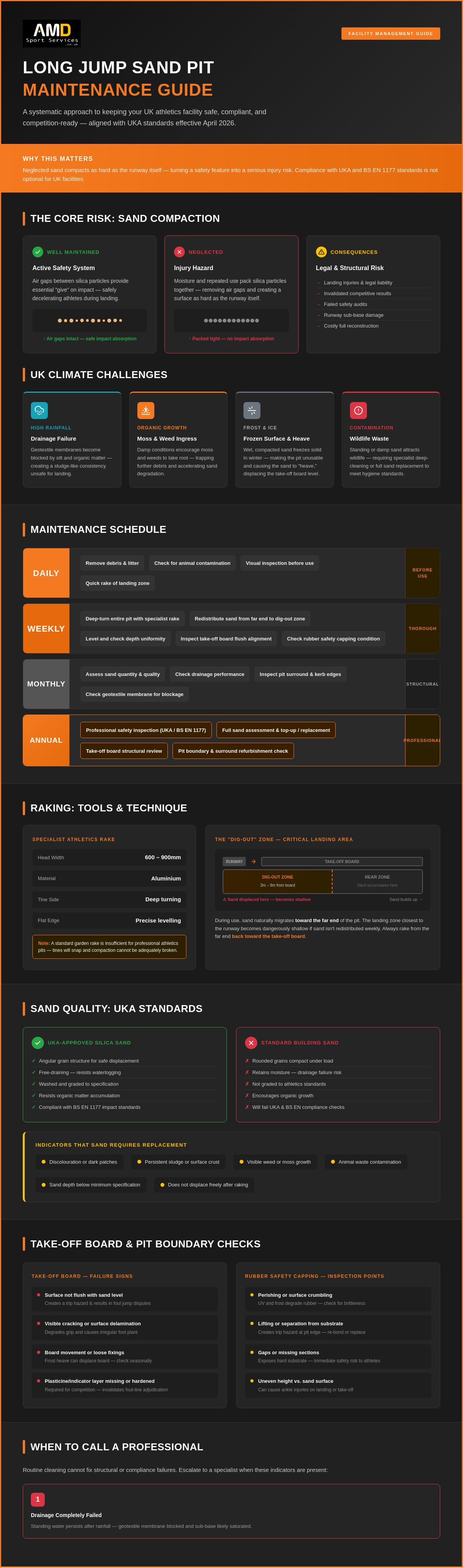
Effective maintenance of a Long jump facility is a matter of liability as much as it is performance. A landing pit serves a single primary function: to safely decelerate an athlete. When long jump sand pit maintenance is neglected, the sand loses its ability to displace on impact, effectively turning a safety feature into a hazard. This degradation isn't always visible to the naked eye, making a structured approach to upkeep essential for any facility manager.
For UK facilities, compliance isn't optional. UK Athletics (UKA) has established specific standards for landing areas, effective from April 2026, which mandate specific dimensions and sand quality. Additionally, facilities must often adhere to BS EN 1177 standards regarding impact-attenuating surfacing. Failing to meet these benchmarks can invalidate competitive results and, more significantly, expose facility managers to legal risk if an injury occurs during use. Regular audits ensure that your pit remains a safe environment for training and competition alike.
Consistent care also extends the functional life of the long jump runway installation. When a pit is allowed to overflow or drain poorly, sand migration and water ingress can damage the sub-base of the adjacent runway. This often leads to "bubbling" or delamination of the synthetic surface, resulting in costly structural repairs that could have been avoided through basic preventative measures. Investing in routine refurbishment is always more cost-effective than a total site reconstruction.
Meeting Safety and Performance Standards
Sand compaction is the most frequent cause of landing-related injuries. Over time, moisture and repeated use pack the silica particles together, removing the air gaps that provide necessary "give." In school environments, a forgiving landing surface is vital for younger athletes whose joints are still developing. From a competitive standpoint, an uneven or poorly maintained pit can lead to inaccurate measurements or foul jumps, undermining the integrity of the event and the efforts of the participants.
Common Pit Problems in the UK Climate
The British climate presents unique challenges for long jump sand pit maintenance. High rainfall can lead to drainage failure if the geotextile membrane becomes blocked by silt or fine organic matter. This creates a sludge-like consistency that is impossible to jump into safely.
Organic Growth: Damp conditions encourage moss and weeds to take root, which trap further debris and accelerate sand degradation.
Frost and Ice: Compacted, wet sand can freeze solid during winter months, making the pit unusable and causing the sand to "heave," which displaces the level of the take-off board.
Contamination: Standing water or damp sand attracts local wildlife, leading to waste contamination that requires specialist deep-cleaning or full sand replacement to resolve.
Daily and Weekly Maintenance: Raking and Levelling Techniques
Consistency is the foundation of effective long jump sand pit maintenance. It isn't enough to simply tidy the surface before a competition; the sand must be managed to ensure it remains an "active" safety system. Following the SAPCA Code of Practice ensures your facility meets industry-recognised standards for athletics construction and upkeep. Without a disciplined routine, the landing area will quickly become a liability rather than an asset.
Selecting the right tools is your first priority. A standard garden rake is insufficient for professional pits. You require a specialist athletics sandpit rake, typically featuring a wide aluminium head between 600mm and 900mm. These rakes are designed with sturdy tines on one side for deep turning and a flat edge on the reverse for precise levelling. Using the correct equipment prevents the tines from snapping and ensures you can reach the necessary depths to break up compaction.
Facility managers must pay close attention to the "dig-out" area. This is the zone where the majority of landings occur, typically situated between three and nine metres from the take-off board. During use, sand is naturally displaced toward the far end of the pit. If this sand isn't redistributed weekly, the landing area closest to the runway becomes dangerously shallow. Regular long jump sand pit maintenance involves manually moving this sand back to the front of the pit to maintain a uniform depth of at least 300mm.
Documentation is equally critical for compliance. We recommend implementing a simple logbook system to track every maintenance session. Recording the date, the operative's name, and the specific actions taken provides a clear audit trail. This evidence is invaluable during annual safety inspections or in the event of an insurance claim, proving that the facility has been managed with due diligence.
The Step-by-Step Raking Process
Success lies in a methodical approach. Start by removing any visible debris, such as leaves, twigs, or stones, from the surface. Once clear, use the tined side of the rake to turn the sand to a depth of 300mm. This is essential for aerating the silica and preventing the "crusting" that leads to hard landings. Finally, use the flat side of the rake to level the surface from the centre outwards. Ensure the sand is perfectly flush with the pit boundaries and the take-off board to prevent trip hazards.
Debris Removal and Hygiene
Hygiene is a major concern for UK schools and public parks. Animal waste and organic growth can quickly ruin high-quality silica sand. Installing a heavy-duty, weighted sand pit cover is the only reliable way to prevent contamination when the pit is not in use. If you suspect hidden hazards like glass or sharp stones, sieving the sand is necessary. For facilities that have been neglected, a professional safety inspection can determine if the sand requires a deep chemical clean or a full replacement to restore hygienic standards.
Sand Quality and Replenishment: Meeting UK Athletics Standards
The choice of sand is the most critical technical decision in long jump sand pit maintenance. It isn't merely a matter of aesthetics; the physical properties of the sand determine the facility's safety and its compliance with international competition rules. Following the SAPCA Code of Practice for Athletics Tracks, UK facilities must use a non-staining, medium-coarse washed silica sand. Using inferior alternatives, such as standard building sand, is a common mistake that leads to rapid compaction and drainage failure.
Building sand contains high levels of clay and silt. These fine particles fill the voids between sand grains, creating a surface that hardens quickly after rain and stains athletes' kit. In contrast, UKA-approved silica sand is washed to remove these fines, ensuring the pit remains free-draining even during heavy UK winters. If your sand feels "greasy" or leaves a heavy residue on the skin, it's likely contaminated or of the wrong grade, necessitating a professional assessment to determine if a full replacement is required.
Maintaining the depth is equally vital. UK Athletics rules effective from April 2026 require a landing area filled with soft sand to a minimum depth of 300mm. Sand is naturally lost through "carry-out" on athletes' feet and wind erosion. As a rule of thumb, one tonne of silica sand covers approximately two square metres at the required 300mm depth. If you can feel the geotextile membrane or the stone sub-base with a rake, the pit is dangerously shallow. This membrane acts as a vital barrier; if it's torn during maintenance, the sand will mix with the stone base, ruining the drainage and requiring a full specialist refurbishment.
Identifying High-Quality Athletics Sand
The shape of the sand grain matters as much as the material. We specify sub-angular silica sand because the grains have slightly rounded edges. Unlike sharp sand, which interlocks and compacts into a hard mass, sub-angular grains roll against each other. This creates the "forgiving" landing surface required for safety. Washed white sand is the industry standard for professional facilities because it provides high visibility for officials marking jumps and doesn't absorb as much heat as darker sands during the summer months.
The Replenishment Process
When topping up a pit, don't simply dump new sand on top of the old layer. This creates "stratification," where a soft top layer hides a hard, compacted base. The correct process involves turning the existing sand thoroughly before integrating the new material. Once the pit is replenished to the 300mm minimum, the surface should be levelled and tested for "softness" using a probe or a deep rake. This ensures the entire depth of the pit, not just the surface, is fit for purpose and compliant with safety standards.
Maintaining Pit Boundaries and Take-off Boards
A comprehensive approach to long jump sand pit maintenance must extend beyond the sand itself to the structural interfaces where the runway meets the landing area. These boundaries are high-wear zones that directly impact athlete safety and the validity of competition results. If the edging or the take-off board fails, the entire facility becomes unusable, regardless of sand quality. Professional facilities require these elements to be inspected weekly to ensure they remain stable and flush with the surrounding surfaces.
The transition between the synthetic runway and the sand pit is the most critical point of the installation. Any gap or height difference here creates a significant trip hazard for athletes at peak velocity. During routine long jump sand pit maintenance, you should ensure the gap between the take-off board and the pit edge is kept clear of sand and debris, as this allows for the natural expansion and contraction of materials without causing structural heave. For detailed technical specifications on board dimensions and materials, refer to our guide on long jump take-off board replacement.
Boundary Integrity and Safety Capping
Exposed concrete edges are a major cause of injury during awkward landings. Most modern UK facilities utilise rubber safety capping to mitigate this risk. However, this rubber can perish or split over time due to UV exposure and physical impact. You should check for any sections where the capping has become loose or detached from the concrete sub-structure. Algae growth on these surfaces is another common issue in the UK climate; regular cleaning with a stiff brush prevents the capping from becoming a slip hazard during wet weather. Additionally, monitor the pit walls for signs of structural movement or bowing, which can indicate a failure in the original groundworks.
Take-off Board Alignment
A loose or uneven take-off board isn't just a performance issue; it's a major litigation risk. If the board is not perfectly flush with the runway, it can cause ankle injuries during the final phase of the jump. We recommend lifting the board monthly to clean the galvanised steel tray beneath it. Debris and sand often accumulate here, blocking drainage holes and causing the board to sit at an angle. Whilst the board is removed, check that the plasticine or indicator strip holders are in good condition and correctly positioned. Ensuring the board is securely locked back into place is vital for maintaining the integrity of the take-off line.
If your pit edges are perishing or your boards no longer sit flush, our team can provide a specialist safety inspection and repair service to restore your facility to full compliance.
Professional Refurbishment and Safety Inspections
Routine long jump sand pit maintenance can only delay the inevitable effects of weathering and heavy usage. Over a period of years, even the best-managed pits will experience a decline in drainage efficiency and structural stability. Knowing when to move from daily raking to a professional refurbishment is essential for maintaining facility compliance and protecting your athletes. A specialist audit isn't just a cleaning exercise; it's a technical assessment of the entire landing system, from the sub-base upwards.
For educational institutions and local authorities, a professional sports equipment safety inspection provides the documented evidence required for insurance and health and safety audits. These inspections ensure your facility meets the updated UK Athletics (UKA) standards and BS EN regulations. Relying on an undocumented internal check can leave a facility manager vulnerable in the event of an injury claim. A specialist report identifies latent risks, such as sub-surface compaction or failing geotextile membranes, that aren't apparent during daily raking.
Signs Your Pit Needs Professional Refurbishment
There are clear indicators that your landing area has reached the end of its current lifecycle. If you observe any of the following, routine maintenance is no longer sufficient:
Persistent Drainage Failure: If "puddling" occurs on the sand surface after rain, it indicates the drainage layer or the geotextile membrane is blocked by silt and fine particles.
Irreversible Contamination: When organic matter, such as moss or soil, has mixed deeply with the silica sand, it cannot be sieved out. This destroys the sand's "forgiving" properties and requires a full replacement.
Structural Failure: Cracking in the pit walls or perishing rubber safety capping creates sharp edges and trip hazards. Similarly, if the runway transition has sunk or heaved, the facility is no longer safe for use.
The AMD Sport Services Approach
We apply over 20 years of industry experience to every audit and refurbishment project. Our process starts with a methodical assessment of the pit's current condition, including sand depth measurements and a check of all boundary interfaces. We don't believe in a one-size-fits-all solution; we provide bespoke refurbishment plans that address the specific mechanical or structural challenges of your site. Whether it's restoring the stone sub-base, replacing the sand with UKA-approved silica, or installing new rubber safety capping, our work is focused on long-term durability.
Our team organises national safety inspections for schools, councils, and private clubs, ensuring that every facility we touch is compliant and high-performing. We take pride in solving the unique challenges that standard maintenance cannot address, positioning ourselves as a dependable partner for facility managers across the UK. To ensure your landing area is fit for the next season, book your professional safety inspection today and secure a clear plan for your facility's future.
Securing Your Facility’s Long-Term Safety and Compliance
Maintaining a high-standard landing area requires a technical understanding of how materials behave under repeated impact. Consistent long jump sand pit maintenance protects athletes from avoidable injuries caused by sand compaction and ensures your facility stays compliant with the latest UK Athletics standards. By implementing a disciplined raking schedule and monitoring the alignment of take-off boards, you can protect the structural integrity of the entire runway installation whilst providing a forgiving surface for every jump.
Whilst daily upkeep is vital, routine care should be supported by expert oversight to identify sub-surface risks that aren't visible to the untrained eye. As specialist athletics contractors, we offer comprehensive safety audits and use UKA-approved materials to restore neglected pits to their peak condition. Taking a proactive approach to refurbishment today prevents the need for costly full reconstructions and keeps your facility ready for competitive use. Your commitment to these standards ensures a safer, more professional environment for every athlete.
Enquire about our Long Jump Pit Maintenance and Inspection Services to ensure your site remains fit for purpose.
Frequently Asked Questions
What is the best type of sand for a long jump pit?
The most effective material is UKA-approved, non-staining, medium-coarse washed silica sand. This specific grade is essential because the sub-angular grains prevent the surface from interlocking into a hard mass. Unlike standard sands, high-quality silica remains free-draining and provides the forgiving landing required by safety standards. It's the industry standard for competitive facilities across the UK because it doesn't stain kits or hold excessive moisture.
How often should a long jump sand pit be raked?
You should rake the pit after every training session or competition to maintain a level surface. For facilities in schools or public parks, a minimum weekly deep-turn is necessary to prevent the sand from crusting. Regular long jump sand pit maintenance ensures that sand is redistributed from the back of the pit to the dig-out area, keeping the landing depth consistent and safe for every user.
Why is my long jump pit sand getting hard and compacted?
Compaction occurs when moisture and fine organic particles fill the voids between sand grains, essentially gluing them together. This process is accelerated if the pit isn't turned regularly or if the wrong grade of sand was used during installation. Over time, heavy rain and frost pack the material down, creating a surface that fails to displace on impact, which significantly increases the risk of athlete injury.
Do I really need a cover for my long jump sand pit?
A high-quality, weighted cover is essential for any outdoor pit to prevent contamination and organic growth. It stops animal waste from entering the sand and prevents wind-blown seeds from taking root in the damp silica. Without a cover, your maintenance workload increases as you'll spend more time sieving debris and treating moss. It also protects the sand from the worst of the UK weather, helping to maintain its drainage properties.
How deep should the sand be in a standard UK long jump pit?
A standard UK long jump pit must maintain a minimum sand depth of 300mm throughout the landing area. This depth is a safety requirement specified by UK Athletics to ensure sufficient impact absorption for athletes. If the sand levels drop below this point, users risk striking the hard sub-base or the geotextile membrane. You should check these levels monthly and replenish the sand as soon as the depth begins to dwindle.
Can I use normal play sand for a long jump pit?
You shouldn't use normal play sand for a professional or school long jump facility. Play sand is typically too fine and lacks the specific grain size distribution required for rapid drainage in outdoor environments. It tends to hold moisture and compact very quickly, leading to a hard landing surface that doesn't meet athletics safety standards. Always specify UKA-approved silica sand to ensure long-term performance and safety compliance for your long jump sand pit maintenance programme.
How do I remove weeds and moss from the sand pit?
Moss and weeds should be removed manually as soon as they appear to prevent their roots from binding the sand together. For persistent growth, you can use a specialist, non-residual herbicide that won't damage the synthetic runway or harm athletes. Once the organic matter is cleared, a deep turn of the sand and the consistent use of a pit cover will help prevent future growth by blocking sunlight and seeds.
When should I replace the take-off board?
You should replace the take-off board if it shows signs of perishing, deep splits, or if it no longer sits flush with the runway surface. A board that rocks or has rounded edges is a significant trip hazard and can lead to foul jumps during competition. Most boards require replacement every few seasons depending on usage levels, but a professional safety inspection can determine if the internal tray requires cleaning or if a full replacement is necessary.


Comments