
Motorising Basketball Goals: Benefits and Installation Guide

Could a basketball goal motor make changing your sports hall layout simpler? If operating a roof-mounted goal manually is inconvenient, the practical questions are whether the existing equipment can be motorised and how it will move safely. The answer depends on the complete goal system, not just the motor.
Motorisation can make it easier to raise and lower a goal in a hall used for different activities. Before work begins, the existing structure, lifting components and movement path need to be considered together. A professional assessment helps establish what work is suitable and how the finished system should operate.
This guide explains how a basketball goal motor works, how powered operation compares with a manual arrangement, and what to consider before motorising a roof-mounted goal. It also covers installation, handover and ongoing inspections, so you can assess whether motorisation fits your facility’s needs.
Table of Contents
What does a basketball goal motor do in a sports hall?
A basketball goal motor is the powered mechanism that raises or lowers a moving basketball goal. In a roof-mounted system, the motor works with a lifting mechanism and the goal structure, moving the assembly between its playing position and a raised position. It changes how the goal is operated, not the hoop itself.
That distinction matters when planning a change. Motorisation modifies the moving goal system, rather than simply replacing the ring or backboard. The basketball backboard is one part of a larger assembly, which may be suspended from the roof and connected to equipment that supports and moves it. The whole installation needs to be considered together.
How does a motorised basketball goal move?
The operator uses the controls installed for that system to activate the motor. The motor drives a lifting mechanism, which moves the connected goal structure. When the goal reaches the required position, movement is stopped using the system’s controls. Components and operating instructions vary, so don’t assume that different installations use the same parts or settings.
This differs from a fixed wall-mounted goal, which stays in one position, and a freestanding goal, which is supported independently rather than suspended from the roof. Motorisation is for goals designed to move. It does not make every fixed or freestanding arrangement retractable.
Which facilities might benefit from motorising a goal?
A motorised goal may suit an indoor hall where the court layout changes or the playing area needs to be cleared between activities. A school might use the hall for basketball and assemblies, whilst a leisure centre or sports club may need to configure shared space for different indoor sports. Councils managing community facilities may also need to accommodate varied uses.
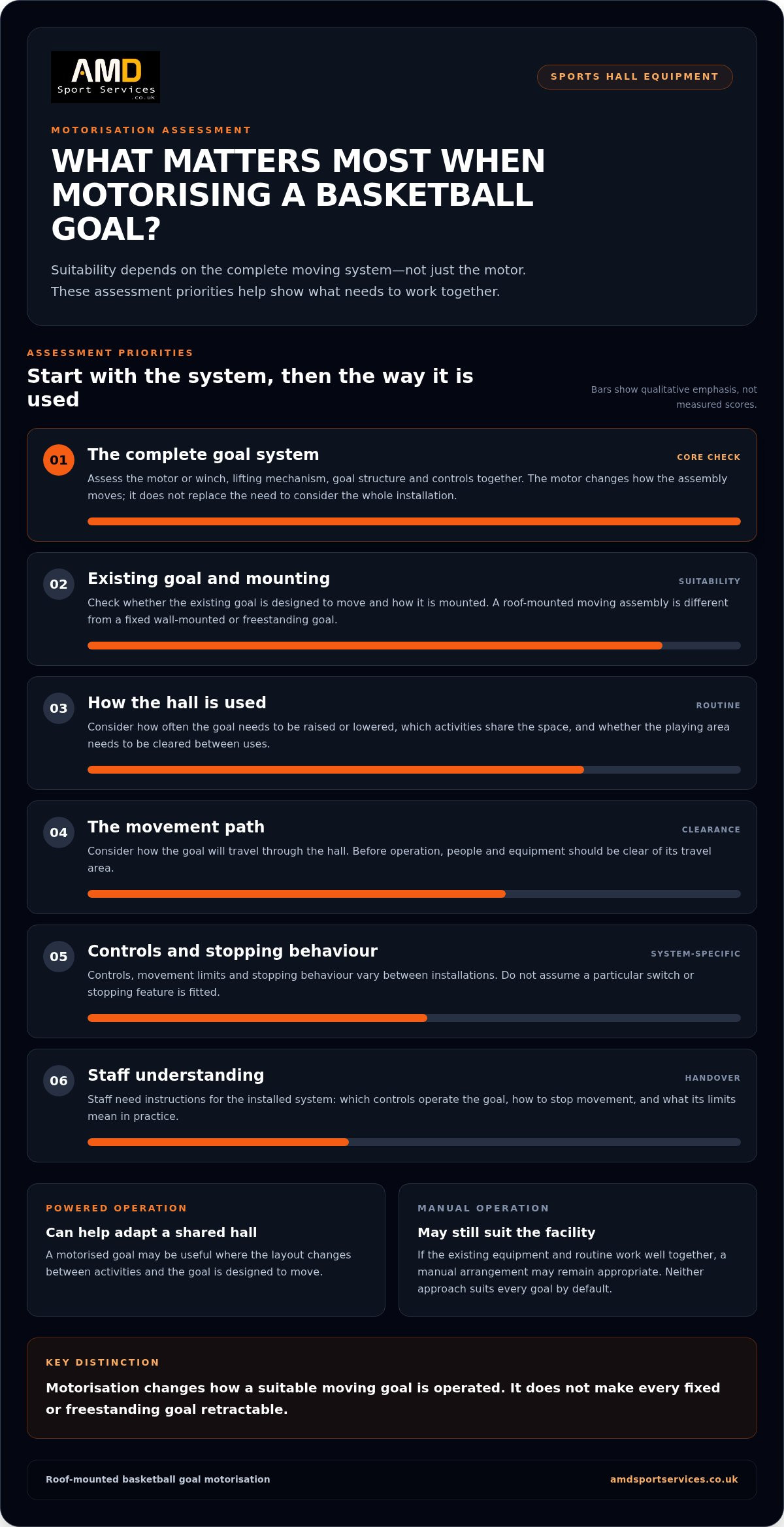
Start with the hall’s routine. How often does the goal need to be raised or lowered? Which activities share the space? Is the existing goal designed to move? These questions help clarify whether powered operation would be useful. Suitability still depends on the existing goal and its mounting arrangement, so an assessment should consider the structure and its movement, not just the motor.
For facilities planning new or replacement equipment, basketball goal installation is part of fitting sports equipment to suit a venue. Motorising a roof-mounted goal likewise requires attention to the existing assembly and the hall around it. The next sections explain how to compare powered and manual operation and what an installation assessment involves.
How a basketball goal motor and operating controls work together
A motorised goal combines powered movement with operating controls. The basketball goal motor provides the drive, but the full arrangement matters: the motor or winch, lifting mechanism, goal structure and control interface all affect how the assembly moves. The equipment in the hall determines the components and how they operate.
Staff should not assume that every system works in the same way. Controls, movement limits and stopping behaviour are specific to the installation. Understanding how the equipment works is part of using it consistently and following its operating instructions.
What parts make up a motorised goal system?
The motor or winch drives the lifting arrangement, which transfers movement to the goal structure. The control interface lets an operator start and manage that movement. Each part has a distinct role, but the components must work together: the lifting arrangement needs to suit the goal, and the controls need to operate the installed system as intended. Specifications for one system should not be treated as universal.
How do staff operate a motorised basketball goal?
Staff responsible for the goal should follow the instructions for that particular system. Before moving it, clear people and equipment from the goal’s travel area. During operation, use the specified controls and watch the goal’s movement. Once it reaches the required position, follow the system’s instructions before returning the hall to use. Don’t rely on a sequence learned from a different installation.
Why are movement limits and controls important?
Controls start and manage movement, whilst any fitted movement limits relate to where the goal is intended to stop. Their design and operation vary. Avoid assuming that a goal has a particular switch, stopping feature or access-control arrangement. During handover, staff need to know which controls operate the goal, how to stop movement and what the system’s limits mean in practice.
Clear instructions help staff use equipment consistently, particularly when responsibility is shared across a school, leisure centre or club. The National Federation of State High School Associations discusses the broader role of sports equipment safety standards, maintenance and installation in facility management. For a motorised goal, focus on the equipment in your hall: its controls, movement and operating instructions.
AMD Sport Services motorises roof-mounted basketball goals and provides basketball goal installation, repair and inspection support. The work considers the goal system as a whole, including the equipment already in place.
Motorised or manual basketball goal: which arrangement suits your hall?
The right arrangement depends on how the goal is mounted and how the hall is used. A basketball goal motor may be practical where a roof-mounted goal is moved as part of regular space planning. A manual arrangement may continue to suit a facility if the equipment and routine work well together. Neither approach is suitable for every goal by default.
When might motorised operation be the practical choice?
Consider motorisation if staff regularly move a roof-mounted goal to reconfigure the hall or clear the playing area for other activities. In a shared school, leisure centre or club space, powered operation can be part of a plan for managing different uses. It is a project-specific decision, not an automatic upgrade. Its value depends on the existing equipment and the role the goal plays in the hall.
When might a manual arrangement remain suitable?
If the current arrangement meets the facility’s needs, there may be no practical reason to change it. Manual operation is not inherently unsuitable; the key questions are whether the equipment fits its intended use and whether it is maintained. Any proposed change should account for the whole goal system, not only its method of operation.
What affects compatibility with an existing basketball goal?
An assessment should consider the goal type, how it is mounted, its lifting mechanism and the condition of the equipment. A roof-mounted moving goal differs from a fixed wall-mounted goal. A motor cannot be assumed to suit every existing installation. If you are comparing fixed options, A Professional Guide to Wall Mounted Basketball Goals for UK Facilities may help you consider whether a wall-mounted arrangement better suits the hall layout.
Before planning a motorisation project, assess the installed equipment as a complete system. It is also a good time to consider how ongoing inspection and maintenance will fit the facility’s arrangements. ASTM International provides information on ASTM standards for gym equipment; applicable requirements depend on the equipment and context. AMD Sport Services carries out basketball goal installation and motorisation work, tailoring the approach to the existing goal and sports hall.
What happens during basketball goal motor installation and inspection?
Motorising a roof-mounted goal is a planned change to the complete equipment system. The basketball goal motor is only one part of the work. Before installation is planned, the existing goal, its supports, lifting arrangement, movement path and the conditions in the hall all need to be considered.
The work follows a practical sequence:
Assess the existing goal. Review its condition, supports, mounting arrangement and lifting components.
Plan the work. Consider the selected system, movement path, hall layout and relevant site conditions.
Install the motorised arrangement. Fit the equipment as part of the goal system, tailoring the project to the installation.
Test and hand over. Check that the goal moves in a controlled way, then explain its operation to responsible staff.
Electrical and structural details depend on the selected system and the site. A product’s requirements should not be treated as universal, and the scope or duration of installation will vary with the equipment and hall.
What is assessed before motorisation?
The assessment considers the goal, its supports and lifting arrangement, and the route it follows as it moves. Clearances matter: the movement path needs to be considered in relation to the hall and its fixtures. The condition of the existing equipment also informs the plan. If defects need attention before motorisation, basketball goal repair can form part of the work.
How are installation and handover approached?
Once the work is planned, the motorised arrangement is fitted to suit the goal and site. The completed installation is checked through controlled goal movement, giving staff the opportunity to understand how the system operates. Handover should explain the installed controls and operating instructions to the people responsible for the hall equipment. This helps staff operate the system consistently without assuming every installation follows the same sequence.
What should routine checks focus on?
Inspection and maintenance should reflect the equipment installed and how the facility uses it. Staff should look out for visible damage, unusual movement or changes in operation, and arrange appropriate attention if they notice them. For elevated equipment, scheduled high level inspections can assess components that aren’t readily visible from floor level. Inspection findings can inform maintenance planning, rather than treating the motor separately from the goal and its supports.
AMD Sport Services carries out roof-mounted basketball goal motorisation, considering the existing goal and sports hall together. To plan the work, discuss your basketball goal installation with our team.
How AMD Sport Services motorises roof-mounted basketball goals
Motorising a roof-mounted goal is a project-specific installation, not simply a matter of adding a motor. AMD Sport Services considers the existing goal and sports hall together, then plans the work around the equipment, its mounting arrangement and the facility’s intended use. This means the basketball goal motor is considered as part of the complete system.
A project-led approach to motorising roof-mounted goals
The first step is to understand the equipment already in place and how the hall needs to function. The assessment considers the goal, its supports and lifting arrangement, the route it follows when moving, and the conditions within the space. These details inform the installation plan. The work is tailored to the project, rather than based on an assumed specification or a one-size-fits-all arrangement.
For a school, council, leisure centre or club, the hall’s intended use is part of the planning. Staff may need the goal raised to clear the playing area for other activities, or lowered for basketball. Considering these routines alongside the physical installation helps plan how the equipment will be used after the work is complete. Facilities planning broader professional basketball goal installation services can also consider how the equipment fits the sports hall as a whole.
Planning for safe operation after installation
After installation, staff responsible for the equipment need to understand its controls and operating procedure. Handover should explain how the particular system is operated, how movement is managed and which instructions apply to that goal. Staff should keep the movement area clear whilst the goal is in operation and follow the guidance for the installed system, rather than relying on experience with another model.
Ongoing inspection and maintenance are also part of managing the equipment. The appropriate scope depends on the system and its use. Unusual movement, visible damage or a change in operation should be addressed, with the goal assessed as a complete assembly rather than the motor in isolation.
Discuss a basketball goal motorisation project
If your indoor facility is considering motorisation, start with the type of goal currently installed, how the hall is used and when the goal needs to move. These details help define the project and its requirements. The installation can then be planned around the existing equipment and the space it serves, rather than assuming every roof-mounted goal needs the same work.
AMD Sport Services works with schools, councils, leisure centres and sports clubs on roof-mounted basketball goal motorisation. Discuss your motorisation project with AMD Sport Services to outline your facility’s requirements.
Plan your next sports hall upgrade with confidence
Consider motorisation alongside the wider plans for your sports hall. If you’re changing how the space is used or reviewing its equipment, think about how a moving goal would fit the facility’s routine. A basketball goal motor should be considered as part of the complete installation, with the hall’s needs guiding the project.
AMD Sport Services carries out roof-mounted basketball goal motorisation for sports facilities across the UK. A useful starting point is to outline how your hall is used and what you need the goal to do. This gives the project a practical direction and helps account for the differences between facilities and equipment.
Ready to explore the next step for your facility? Discuss roof-mounted goal motorisation with AMD Sport Services. Tell us how your hall is used and what you need the goal to do.
Frequently Asked Questions
Can an existing basketball goal be fitted with a motor?
Sometimes. Suitability depends on the existing goal, its supports and its lifting arrangement. A roof-mounted goal in suitable condition may be assessed for motorisation, but not every existing system can be adapted. An assessment should establish whether the goal, supports and movement path suit the proposed work. If you’re planning other equipment changes, consider them alongside motorisation.
How does a motorised basketball goal work?
A motorised basketball goal uses powered equipment to move the goal assembly between positions. The operator uses the controls provided for that installation, and the lifting arrangement transfers the drive to the goal. Components and control methods differ between systems. Staff should follow the instructions for their equipment, rather than assume a sequence or control layout based on another sports hall.
What is the difference between a basketball goal motor and an electric winch?
The terms are often used to describe parts of the same powered lifting arrangement. The motor supplies the drive, whilst the winch applies that drive to the lifting system. In everyday discussion, “basketball goal motor” may refer to the powered assembly as a whole. Terminology can vary, so installation details should identify the equipment fitted to the particular goal.
Can a motorised basketball goal be operated by remote control?
That depends on the equipment installed. Some systems may use controls at a fixed operating point, whilst other arrangements can differ. Don’t assume a remote is included or suitable for a particular goal. The control interface should be identified during installation and explained to responsible staff, including how the system operates and which instructions apply in that facility.
Is a motorised basketball goal suitable for every sports hall?
No. Suitability depends on the goal, its mounting and lifting arrangement, the hall layout and how the space is used. A facility that often reconfigures its indoor space may have different needs from one that keeps its goal in a fixed position. Assess the complete equipment system and its movement path before deciding whether motorisation is appropriate.
What should be checked before using a motorised basketball goal?
Follow the instructions for the installed system and check that the area around the goal’s movement path is clear of people and equipment. Look for visible damage or anything that appears out of place. If the goal behaves differently from usual, don’t treat that change as normal operation. Arrange for the equipment to be assessed before relying on it again.
How often should a motorised basketball goal be inspected?
High level inspections are generally recommended every one to two years, depending on the equipment’s age and use. The interval should reflect the goal’s condition and how frequently the facility operates it. Checks can include the lifting mechanism, cables, controls and attachment hardware. Address visible damage or changes in movement between scheduled inspections rather than waiting for the next planned visit.
Comments