
Pin Select Gym Machine Cable Maintenance: The Complete Safety Checklist

A flawless outer nylon jacket often conceals the exact structural wire fatigue that snaps a weight stack cable mid-lift. When selectorised equipment operates under continuous tension throughout busy peak hours, surface-level visual checks simply aren't enough to protect your lifters. Mastering thorough pin select gym machine cable maintenance is the only reliable way to catch internal strand breaks before a high-load failure causes catastrophic member injury.
You already know how disruptive unscheduled downtime can be for your gym floor. But the legal liability and anxiety surrounding an unexpected cable snap, particularly under strict UK safety obligations like PUWER 1998, demand far more than reactive repairs. You need complete certainty every time a member loads a pin into a weight stack.
Master pin select gym machine cable maintenance with our comprehensive inspection checklist, safety protocols, and servicing guide. We'll walk you through systematic tactile audits, early fatigue indicators, and proper cable replacement standards to keep your facility fully compliant and your members safe.
Table of Contents
Understanding Pin Select Gym Machine Cable Mechanics and Risk
Selectorised weight stations rely on coated aircraft cables operating under constant mechanical tension. Every repetition transfers kinetic energy through multi-pulley channels, multiplying dynamic friction across guide rods and weight stack terminations. Standard commercial use introduces cyclic fatigue that weakens internal wire strands long before outer jacket defects become visible. Without disciplined pin select gym machine cable maintenance, friction and mechanical load quietly degrade your equipment from the inside out.
Anatomy of a Commercial Gym Machine Cable
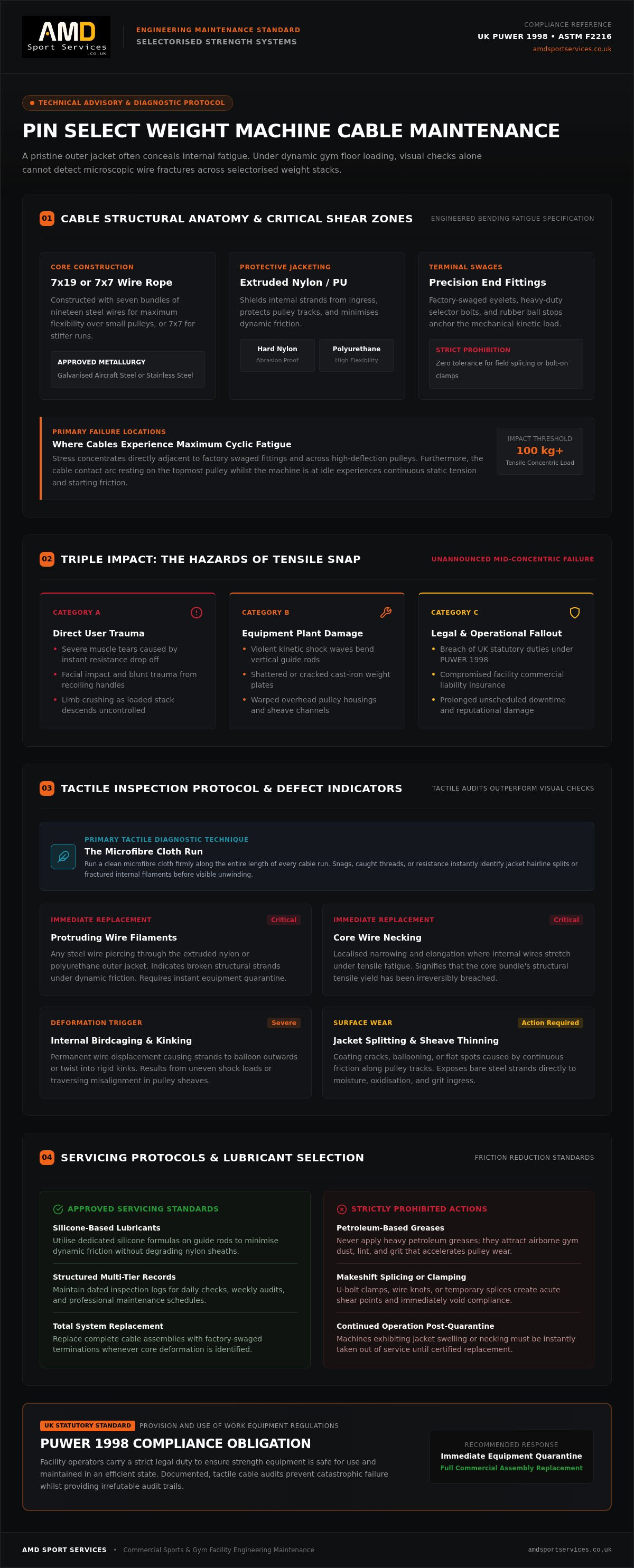
Commercial gym cabling is not simple wire rope; it's a precision assembly engineered for repetitive bending fatigue. In a selectorised weight machine, the system typically relies on specific structural layers:
Core Construction: Most stations utilise 7x19 strand configuration (seven bundles of nineteen wires) for maximum flexibility over small pulleys, though some setups employ stiffer 7x7 cable. Material choices centre on galvanised aircraft steel or corrosion-resistant stainless steel.
Outer Jacketing: Extruded nylon or polyurethane jackets shield internal strands from grit, protect pulley grooves, and reduce friction. Polyurethane offers exceptional flexibility, whilst hard nylon provides high abrasion resistance.
End Fittings: Factory swages secure terminal points using heavy-duty eyelets, threaded selector bolts, or rubber ball stops.
The highest stress concentration zones always sit directly adjacent to swaged fittings and over high-deflection pulleys. These junction points experience severe angular shearing that initiates microscopic wire fracture.
The Real Hazards of Neglected Weight Stack Cables
A neglected cable failure rarely gives a polite warning. Catastrophic tensile snaps typically occur during the peak concentric phase of a lift, right when internal tension peaks under maximum user effort. When a cable snaps under 100 kilograms of resistance, the immediate recoil whips through the pulley track.
The resulting hazards impact three distinct areas of your facility:
Direct User Trauma: Severe muscle tears, facial impact from recoiling handles, and crushing injuries as limbs drop uncontrolled under load.
Structural Equipment Damage: Shock waves bend guide rods, shatter cast-iron weight plates, and warp overhead pulley housings.
Operational and Legal Fallout: Equipment failure compromises facility insurance policies, exposes management to statutory enforcement under PUWER 1998, and forces costly operational downtime.
Relying on scheduled commercial service and maintenance ensures that structural micro-fractures are identified and resolved before equipment reaches critical failure thresholds on your gym floor.
Essential Pin Select Cable Inspection Checklist
A quick glance across the gym floor won't reveal fatigue hidden beneath outer coatings. A structured inspection protocol must combine close visual tracking, functional assessments, and tactile audits. Running a clean microfibre cloth along the entire span provides an immediate diagnostic indicator. Any snag, snagged thread, or resistance instantly pinpoints split jacketing or broken core strands.
Pay close attention to where the cable rests on top pulleys while the weight stack sits at idle. This static contact arc absorbs continuous resting tension alongside starting friction, making it a primary failure point during daily operations. Consistent pin select gym machine cable maintenance isolates these high-wear points before equipment breaks mid-set.
Tactile and Visual Diagnostic Checklist
Engineered to meet rigorous standards such as ASTM F2216 for selectorised strength equipment, commercial cabling requires specific dimensional stability. Audit the following mechanical points:
Outer Coating Integrity: Look for splits, localized thinning, cracking, or ballooning along pulley sheaves.
Core Strand Geometry: Check for internal birdcaging, severe kinking, or core necking, which occurs when internal wires stretch and narrow under excessive tension.
Protruding Wire Filaments: Any steel filament piercing the nylon or polyurethane outer layer demands immediate withdrawal of the unit from service.
Selector Bolt Engagement: Ensure the top-plate threaded selector stem bolt has complete thread depth engagement, with the locking jam nut torqued securely against the top plate.
Weight Stack and Selector Pin Interface Checks
The mechanical interface between the stack and the cable hardware dictates safe weight selection. A bent stem or misaligned plate increases torsional drag on the cable run, speeding up metal fatigue.
Selector Pin Movement: Insert the magnetic pin through every individual plate from top to bottom. It must glide smoothly without sticking, binding, or requiring force.
Stem Alignment: Inspect the central selector stem for lateral warping or micro-cracks around the pin holes.
Base Cushioning: Audit the heavy-duty rubber bumper cushions seated beneath the weight stack. Worn or missing bumpers cause heavy metal-on-metal slamming that shocks the cable assembly.
If your team identifies damaged strands or compromised fittings during these checks, book specialist sports equipment safety inspections to safely assess, rectify, and certify your machinery.
Routine Preventative Maintenance Procedures for Cable Systems
Rigorous daily cleaning and calibration keep selectorised apparatus operating smoothly whilst shielding internal assemblies from premature wear. A cable system functions as an integrated mechanical loop. When one component binds, friction spikes across the entire line. Effective pin select gym machine cable maintenance demands a structured protocol addressing every moving surface the wire touches.
Guide Rod Cleaning and Lubrication Protocol
Guide rods attract airborne dust, sweat droplets, and abrasive chalk that form a grinding paste inside weight stack bushings. This buildup introduces lateral drag, forcing the cable to pull unevenly across top sheaves.
Degrease the Columns: Wipe both guide rods from top to bottom using clean microfibre cloths soaked in mild citrus degreaser. Strip away all blackened residue.
Apply Proper Lubricant: Coat rods lightly with a 100% pure silicone spray or dry Teflon-based lubricant. Never apply wet motor oils, heavy automotive grease, or WD-40; these petroleum mixtures trap airborne debris and destroy nylon bushings.
Cycle the Stack: Move the top plate through its entire vertical range twelve to fifteen times to spread lubricant evenly across internal sleeve bearings.
Pulley Alignment, Sheave Inspection, and Tensioning
Pulleys directly govern how cables bend and dissipate load. If a pulley bearing wears unevenly, the wheel tilts. This forces the cable to drag against aluminium or nylon side flanges rather than tracking dead centre. That rubbing shreds outer jackets in weeks, quickly exposing underlying aircraft wire to excessive lateral fatigue.
Assess Bearing Play: Grip each pulley wheel and check for lateral wobble around the centre axle. Any play exceeding one millimetre demands instant bearing replacement.
Examine Sheave Grooves: Look for internal flattening or asymmetric grooving where mismatched cables have gouged the track.
Calibrate Running Tension: Tighten or loosen the selector bolt so the top plate rests completely flush on the underlying stack. Never over-tension a cable to remove slack; lifting the top plate even two millimetres prevents selector pins from seating fully into lower plates, introducing significant drop risks.
Partnering with dedicated professionals for indoor inspection and maintenance keeps complex mechanical tensions calibrated across high-traffic leisure suites.
Repair vs Replacement: Critical Cable Failure Thresholds
Field repairs on commercial weight stack cables are never acceptable. In an institutional or commercial gym environment, you cannot patch, splice, or clamp an aircraft cable once its integrity falters. Sound pin select gym machine cable maintenance draws an uncompromising line between minor operational adjustments and mandatory equipment retirement.
Definitive Condemning Criteria for Machine Cables
Every commercial cable has an absolute mechanical lifespan. Operators must immediately quarantine a selectorised station and remove the assembly from service if any of these conditions appear during inspection:
Stripped Outer Coating: Any jacket split that exposes bare steel wires across pulley tracks creates immediate friction points and accelerated core wear.
Structural Core Deformity: Kinking, severe permanent bending, or visible birdcaging (where outer strands flare away from the core) indicate that internal tensile loads are unbalanced.
Broken Filaments: Even a single fractured steel wire sticking through the protective sheath compromises the working load limit.
Terminal Hardware Distortion: Slipped factory swage ferrules, hairline fractures in cast eyelets, or stripped selector stem bolt threads require full condemnation.
Facility managers can audit station integrity and resolve structural component wear by scheduling professional service and maintenance across their facility.
Why Makeshift Cable Repairs Breach Commercial Safety
Budget hardware kits often market screw-together clamps, wire thimbles, or hand-crimped ferrules as fast DIY fixes. Installing these on selectorised equipment creates an acute hazard on your gym floor:
Strand Crushing: U-bolt saddles and generic screw clamps pinch the steel core, cutting deep into exterior wire strands. This creates a severe mechanical shear point right at the fastening interface.
Dynamic Shock Vulnerability: Hand-swaged connections may hold a static load, but they pull apart when a lifter drops a stack from lockout, generating dynamic shock spikes that exceed the clamp's grip.
Insurance Invalidation: Commercial public liability insurers explicitly require equipment to match original manufacturer specifications. Uncertified, aftermarket cable splices instantly void coverage if a member suffers an injury.
Eliminate catastrophic operational liabilities before equipment fails under load. Request professional replacement gym cables to ensure your selectorised machinery features factory-grade, precision-swaged assemblies built for commercial compliance.
Establishing a Facility Maintenance Schedule and UK Compliance
Operating a compliant fitness facility requires more than occasional spot checks when a machine begins to rattle. UK health and safety legislation places a direct duty of care on duty holders to maintain work and leisure apparatus in a safe state. Integrating pin select gym machine cable maintenance into a scheduled logging system transforms safety from reactive panic into an auditable operational routine.
Recommended Gym Cable Maintenance Intervals
Effective upkeep combines rapid front-line observations with deep engineering reviews. Structuring your schedule into set frequencies ensures wear never outpaces intervention:
Daily Screening: Complete a morning walk-through of the gym floor. Check high-frequency selectorised machines like lat pulldowns and functional trainers for smooth plate descent, cable alignment, and magnetic pin seating.
Weekly Servicing: Clean accumulated grime from guide rods, lubricate column shafts with dry silicone, and check pulley track grooves for signs of lateral cable chafing.
Monthly Mechanical Audit: Examine terminal eyelets, verify bolt engagement into selector stems, tighten jam nuts to specified torque, and test pulley bearings for excessive axle play.
Annual Certification: Perform comprehensive structural integrity testing across all frames, replacing high-traffic cables proactively before cyclical metal fatigue sets in.
Compliance with Health and Safety and PUWER Standards
Commercial gym machinery falls squarely under the Health and Safety at Work etc. Act 1974 and the Provision and Use of Work Equipment Regulations 1998 (PUWER). Under PUWER, equipment provided for use must be suitable, safe, and maintained by a competent person. The Health and Safety Executive enforces these standards rigorously; where inspectors identify a material breach, the HSE issues statutory notices and recovers operational costs via Fee for Intervention rates.
Documented proof remains your primary legal safeguard. Keep a permanent equipment register recording the date, machine asset ID, technician notes, and specific corrective actions taken for every tension adjustment or cable replacement. In the event of a member incident reportable under RIDDOR, an unbroken log of preventative maintenance proves statutory due diligence.
Combining internal facility screening with independent, professional sports equipment safety inspections confirms your cables, pulleys, and structural frames meet recognized standards like BS EN 957. Qualified nationwide specialists provide the independent engineering oversight needed to certify full statutory compliance.
Secure Your Facility with Rigorous Cable Servicing
Catching internal wire fatigue before a sudden snap occurs protects your members from acute injury and shields your business from disruptive downtime. Proactive pin select gym machine cable maintenance bridges the gap between daily tactile screening and statutory UK compliance. When you pair disciplined guide rod care with zero tolerance for damaged strands, your selectorised equipment remains dependable, smooth, and safe.
Makeshift fixes and deferred servicing introduce unnecessary operational liability to your floor. Backed by decades of hands-on expertise in UK sports and leisure facility equipment servicing, our nationwide team delivers thorough safety inspections ensuring full regulatory compliance across fitness facilities. We provide the specialist supply and installation of commercial-grade replacement gym cables to keep your machinery running exactly as intended.
Book your professional sports equipment safety inspection today to ensure your weight stacks meet the highest mechanical standards and keep your members training with total confidence.
Frequently Asked Questions
How often should pin select gym machine cables be inspected?
Pin select gym machine cables require a tiered inspection regime to prevent sudden failure. Front-line staff should conduct tactile and visual checks on high-use machines daily before opening. Shift supervisors should perform detailed weekly track inspections, whilst a formal mechanical audit of terminations and pulley bearings must occur monthly. Annual safety certifications by qualified engineering specialists complete this preventative schedule.
Can you repair a frayed gym cable or must it be replaced?
A frayed gym machine cable can never be repaired and must be replaced immediately. Splicing damaged wire or taping stripped outer jackets compromises structural integrity and drastically lowers the safe working load limit. Any sign of exposed wire cores, broken strands, or deformed end fittings requires instant equipment isolation and the prompt installation of a certified commercial-grade replacement cable.
What causes gym machine cables to strip their outer plastic coating?
Stripped outer coatings usually stem from misaligned pulleys, worn internal bearings, or improper cable routing. When a pulley bearing fails, the wheel tilts off-axis. This forces the running cable to grind against the hard outer sheave flange rather than tracking dead centre through the groove. Debris accumulation on guide rods can also create severe drag, overheating and peeling the jacket.
What lubricant should be used on selectorised gym machine guide rods?
You should exclusively use a 100% pure silicone spray or a dry Teflon-based lubricant on selectorised guide rods. Apply the lubricant to a clean microfibre cloth and wipe down the polished columns. Never use WD-40, mineral oils, or automotive greases; these petroleum products attract dust, sweat, and chalk, creating a grinding paste that damages internal stack bushings.
How do you know when a gym cable is tensioned correctly?
A gym cable is tensioned correctly when the top weight plate rests completely flush on the stack without slack in the line. The selector pin must slide smoothly into every weight plate, including the top plate, without catching or requiring force. If the top plate floats above the stack, the cable is over-tensioned and requires immediate adjustment at the selector stem bolt.
What happens if you use off-the-shelf hardware store cables on gym machines?
Using generic hardware store cables on commercial gym machines creates an acute risk of catastrophic failure. Standard wire ropes lack the specialized 7x19 fatigue-resistant aircraft steel cores and extruded nylon jackets required for repetitive travel over small pulleys. Furthermore, generic DIY bolt-on clamps crush internal strands and inevitably slip under the intense shock loads generated by dropping weight stacks.
Is annual professional sports equipment safety inspection mandatory in the UK?
Yes, regular professional inspection is required to satisfy UK statutory duties under the Health and Safety at Work etc. Act 1974 and PUWER 1998. Commercial facility operators must prove that equipment is maintained in a safe condition by a competent person. Formal annual inspections provide auditable certification, ensuring compliance with British Standards such as BS EN 957 and protecting your liability insurance.


Comments