
Playground Safety Surfacing: A Guide to UK Standards

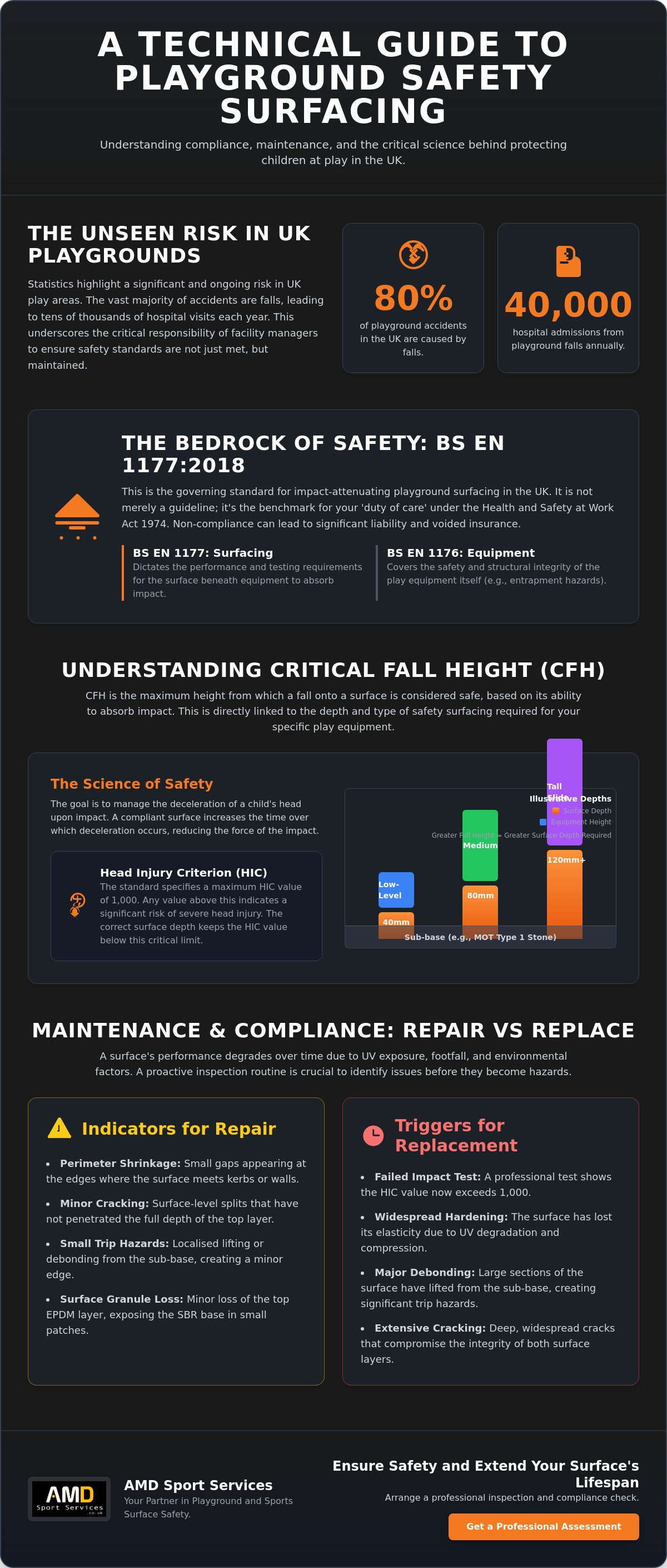
Statistics from 2025 show that falls account for 80% of all playground accidents in the UK, resulting in approximately 40,000 hospital admissions annually. For local authorities and school administrators, these figures highlight the heavy responsibility of managing public play areas. You likely already know that playground safety surfacing is your first line of defence, yet maintaining compliance with strict BS EN 1177 standards is often easier said than done. Between managing surface shrinkage and balancing initial installation costs with long-term repairs, the technical demands can be significant.
This guide provides a pragmatic framework to help you master the technical requirements and maintenance standards of playground safety surfacing. We'll clarify the complexities of Critical Fall Height (CFH) and the Head Injury Criterion (HIC) to ensure your facility remains fully compliant. You'll also learn how to choose between wet pour, mulch, and mats whilst establishing a reliable inspection routine that prevents trip hazards before they develop.
Key Takeaways
Understand the mandatory BS EN 1177:2018 standards to ensure your facility remains compliant and legally protected.
Master the technical relationship between Critical Fall Height (CFH) and impact attenuation to specify the correct surface depth for your equipment.
Evaluate the performance differences between wet pour, rubber mulch, and mats to balance long-term durability with initial budget requirements.
Learn to identify critical maintenance issues, such as perimeter shrinkage and debonding, to determine if your playground safety surfacing requires a minor repair or a full replacement.
Recognise the value of professional inspections in maintaining safety standards and extending the functional lifespan of your play area.
Table of Contents
The Role of Playground Safety Surfacing in UK Facilities
Playground safety surfacing is a technical, impact-attenuating system designed to absorb kinetic energy during a fall. Its primary function is to reduce the severity of head injuries by managing the deceleration of a child's head upon impact. In the past, UK play areas often relied on natural grass or tarmac. Whilst these materials are familiar, they fail to provide the consistent, year-round protection required for modern equipment. The transition to high-performance synthetic polymers, such as EPDM rubber and polyurethane-bonded mulch, represents a shift towards engineered safety. These Playground surfacing materials are tested to ensure they maintain their cushioning properties even under heavy use and varying weather conditions.
For school governors and local authority officers, the governing framework is BS EN 1177:2018. This standard isn't just a technical manual; it's a benchmark for safety that dictates how surfaces must perform. While some debate exists regarding whether specific surfacing is a strict "legal requirement" in every scenario, the "duty of care" established by the Health and Safety at Work Act 1974 makes it essential. If an injury occurs on a surface that doesn't meet these standards, the facility manager faces significant liability risks and potential insurance voidance. Professional Playground safety surfacing installation ensures that your facility meets these rigorous expectations from day one.
Understanding BS EN 1177 and BS EN 1176 Standards
It's vital to distinguish between the two primary standards governing play areas. BS EN 1176 focuses on the equipment itself, covering aspects like entrapment hazards and structural integrity. In contrast, BS EN 1177 applies specifically to the surfacing beneath that equipment. Compliance isn't a one-time event at the point of installation. Factors like UV degradation, heavy footfall, and environmental contamination can reduce a surface's effectiveness over time. Regular testing and certification are necessary to confirm that the material still provides the required level of protection, especially in unsupervised public parks where equipment might be used more aggressively than in a controlled school environment.
Duty of Care and Liability for Facility Managers
The Health and Safety Executive (HSE) takes a pragmatic view of playground safety, expecting providers to manage risks "so far as is reasonably practicable." Professional inspections are your primary defence against negligence claims. By maintaining a documented history of surface checks and repairs, you demonstrate an active commitment to user safety. This evidence is crucial if a liability claim arises. In the context of UK safety law, impact attenuation refers to the ability of a surface to reduce the shock of an impact by increasing the time over which the deceleration occurs, thereby lowering the Head Injury Criterion (HIC) value to a safe level.
Calculating Critical Fall Height (CFH) and Impact Absorbency
Critical Fall Height (CFH) represents the technical threshold of any safety installation. It is the maximum height from which a user can fall onto a surface while maintaining acceptable impact attenuation. To determine this, we use the Head Injury Criterion (HIC). An HIC value of 1,000 is the upper limit allowed under BS EN 1177:2018; exceeding this number indicates a significant risk of severe head injury. The required depth of your Playground safety surfacing is directly proportional to this height. For instance, equipment with a 3.0m fall height requires a significantly thicker shock-absorbing layer than a low-level spring rocker.
Sub-base preparation is equally critical. Installing surfacing over a solid tarmac base provides a stable foundation but offers zero natural absorbency, meaning the synthetic layer must do all the heavy lifting. Conversely, an MOT Type 1 stone base allows for some natural drainage and slight compression, yet the final CFH rating still depends on the certified depth of the rubber. For those managing existing sites, arranging sports equipment safety inspections can help verify if your current surfacing still meets these technical depth requirements.
The Mechanics of Impact Attenuation
Modern systems typically consist of two layers: a shock-absorbing SBR (Styrene Butadiene Rubber) base and a durable EPDM (Ethylene Propylene Diene Monomer) top layer. These granules work together to create a cushioning effect that remains effective amongst shifting weather conditions. Over time, UV exposure and environmental debris can cause these layers to harden. These "hard spots" represent a critical failure point. They lose their ability to compress, effectively turning a safety surface into a rigid floor that no longer meets HIC standards.
Measuring Fall Heights for Different Apparatus
Accurate measurement is the only way to ensure compliance. For swings, the fall height is calculated from the centre of the seat at a 60-degree angle. For climbing frames, it is the highest part of the equipment intended for use. According to RoSPA guidance on play area surfacing, you must also consider the "Extents of Surfacing" rule. This dictates how far the safety area must spread beyond the equipment footprint, usually at least 1.5 metres. A common error on sloped sites is measuring the fall height from the equipment to the ground directly beneath it, rather than to the lowest point of the potential fall zone.
Comparing Surface Types: Wet Pour, Rubber Mulch, and Grass Mats
Selecting the right material for Playground safety surfacing involves balancing usage levels, site aesthetics, and maintenance budgets. Whilst loose-fill materials like bark or sand are traditional, synthetic options have become the standard for high-traffic UK facilities due to their consistent performance. According to RoSPA guidelines on playground surfacing, each material has specific performance characteristics that must align with the equipment's fall height. The choice amongst these systems depends on the specific needs of the site, from accessibility requirements to the natural environment of the play area.
Synthetic surfaces generally offer a better long-term return on investment than loose-fill options. Bark and sand require constant raking and regular "topping up" to maintain the required depth for safety. In contrast, unitary surfaces like wet pour or bonded mulch stay in place, providing a permanent safety layer that doesn't migrate or hide hazardous debris like broken glass. This reliability is why most modern schools and local authorities have moved away from loose materials in favour of engineered rubber solutions.
Wet Pour Surfacing: Technical Specifications
Wet pour is often considered the gold standard for accessibility and durability. It consists of a two-layer system that is mixed on-site and poured in place to create a seamless finish. The base layer is typically made of SBR (Styrene Butadiene Rubber), which provides the essential shock absorption. The top layer is EPDM (Ethylene Propylene Diene Monomer), a virgin rubber that offers UV resistance and high-impact durability.
Polyurethane Binder: The quality of the binder is the most frequent point of failure; low-grade resins can lead to the surface becoming brittle and "granuling" prematurely.
Porosity: These surfaces are designed to be porous, allowing water to drain through to the sub-base.
Maintenance: To prevent moss and algae build-up, which can block drainage and create slip hazards, the surface needs periodic pressure washing and debris removal.
Rubber Mulch and Grass Matting Applications
Bonded rubber mulch is a pragmatic alternative for rustic settings. It resembles traditional wood bark but is bonded with a resin so it doesn't wash away. It's particularly useful for areas with established tree roots, as it can be installed over a geotextile membrane without the need for deep excavation that might damage the trees. It isn't as smooth as wet pour, but it offers excellent impact attenuation for a lower initial cost.
Rubber grass mats are the most cost-effective way to provide basic fall protection whilst maintaining a green aesthetic. They're ideal for lower fall heights, but they have limitations. On high-traffic sites, the grass can struggle to grow through the holes, and without a proper mesh underlay, the mats can eventually "disappear" or sink into the soil. They're a versatile tool for Playground safety surfacing, but they require a stable ground condition to remain effective over several years.
Maintenance and Compliance: When to Repair vs Replace
Effective management of Playground safety surfacing requires a shift from viewing the floor as a finished product to treating it as a technical safety asset. Over time, environmental stressors and heavy footfall inevitably lead to wear. The most frequent issues we encounter include perimeter shrinkage, "granuling" of the top EPDM layer, and debonding where the rubber separates from the sub-base. Perimeter shrinkage is particularly critical. When the rubber pulls away from the concrete or timber edging, it creates a significant trip hazard. Under BS EN 1177, any gap that can catch a child's foot effectively voids the compliance of the entire area.
Proactive maintenance is always more cost-effective than reactive replacement. A minor repair to a shrinking edge or a small patch-fix for a worn area under a swing can extend the life of a surface by several years. Ignoring these small failures often leads to water ingress, which further degrades the binder and base layers. In many cases, a targeted repair can prevent the need for a full site replacement costing tens of thousands of pounds. To stay ahead of these issues, facility managers should adhere to RPII (Register of Play Inspectors International) standards, which mandate both annual and post-installation safety inspections. If you have concerns about the current state of your site, you can book a professional sport equipment repair or inspection to assess the integrity of your surfacing.
Identifying Surface Degradation
Identifying hardening is a key part of the inspection process. A simple "Screwdriver Test" involves pressing a flat-head screwdriver into the surface; if the material is too rigid to allow even a slight indentation, it has likely lost its impact-attenuating properties. UV degradation often manifests as a "chalky" appearance or a change in colour, indicating the polyurethane binder is failing. Additionally, keep a close eye on any "dips" or puddles. These often signal sub-base failure or ground movement beneath the rubber, which can lead to rapid surface cracking and eventual debonding.
Professional Repair Techniques
Restoring a surface requires more than just filling a hole. For shrinkage gaps, the professional approach involves "cutting back" the existing rubber to a stable point and re-filling the void with fresh material and high-strength binder to ensure a seamless bond. In some instances, over-coating—installing a new EPDM layer over an existing, stable base—is a viable way to refresh a site at a fraction of the cost of a full excavation. Whilst DIY repair kits are available, they often lack the industrial-grade binders required for long-term durability and rarely meet the rigorous safety standards needed for public liability insurance.
Professional Installation and Inspection Services
Selecting a contractor for Playground safety surfacing requires more than a simple comparison of quotes. Because these surfaces are technical safety systems, the installer's depth of experience directly impacts the long-term compliance of your facility. A specialist who understands the nuances of material ratios and binder quality will deliver a surface that resists granuling and shrinkage for years. For facility managers, the goal is to find a partner who views the playground as a integrated part of the wider sports and leisure environment, rather than an isolated installation project.
At AMD Sport Services, we take a pragmatic, safety-first approach to every project, whether it's a minor repair or a full-scale installation. We understand that schools and leisure centres often manage multiple surfacing types across a single site. By choosing a seasoned practitioner, you ensure that your play area meets the same rigorous standards as your competitive sports surfaces. If you're currently managing a site with aging equipment or worn flooring, the first step towards compliance is booking a comprehensive audit. We provide clear, technical assessments that help you decide whether to refurbish or replace, ensuring your budget is spent where it's most needed.
Integrating Play and Sports Surfacing
Consistency across a facility is vital for both aesthetics and maintenance efficiency. Many of our clients manage play areas that sit adjacent to Multi-Use Games Areas (MUGAs) or athletics facilities. Our expertise in long jump runway refurbishment and court marking renewal informs how we approach playground projects. For instance, the precision required for a tartan track installation ensures that our playground borders are more secure and our sub-base preparations are more robust.
Cohesive Design: We can align the colours and textures of your play area with adjacent sports courts for a professional, unified look.
Organised Play: Renewing line markings and safety borders helps to organise play behaviour, keeping high-energy activities in the correct zones.
Technical Synergy: Using the same high-grade binders across different facility surfaces ensures consistent wear patterns and simplifies your cleaning routines.
The AMD Sport Services Commitment
Our "Seasoned Practitioner" persona isn't just a label; it's a commitment to technical honesty and high standards of workmanship. We specialise in solving the unique structural challenges that standard products often can't address, such as installing Playground safety surfacing around complex equipment or on difficult terrain. With national coverage, we support schools, leisure centres, and sports clubs across the UK in maintaining safe, compliant environments.
We don't believe in polished sales pitches. Instead, we rely on direct communication and a proven track record of physical installation and repair excellence. Whether you need a one-off repair or a routine compliance check, we're here to help. Contact us today to organise a professional sports equipment safety inspection or to request a detailed surfacing quote for your facility.
Securing Your Facility's Long-Term Safety Compliance
Maintaining a compliant play area requires a technical understanding of BS EN 1177 standards and a pragmatic approach to surface integrity. You've seen how depth-matching and precise Critical Fall Height (CFH) calculations are the foundation of user safety. Whether you're managing a school's wet pour installation or a leisure centre's bonded mulch, regular inspections are the only way to identify shrinkage and hardening before they become hazardous. Proactive repairs to your Playground safety surfacing don't just protect users; they protect your maintenance budget by preventing total surface failure.
With over 20 years of specialist industry experience, AMD Sport Services provides national UK coverage for educational and leisure facilities. Our expertise in both athletics tracks and playground safety compliance allows us to manage complex structural challenges that standard providers often miss. We're committed to technical honesty and high-quality workmanship in every project we undertake. You can contact AMD Sport Services for professional surfacing inspections and repairs to ensure your site remains safe for years to come. Taking the right steps today guarantees a more durable, compliant facility for the future.
Frequently Asked Questions
Is playground safety surfacing a legal requirement in the UK?
While no specific statute mandates the use of rubber materials, the Health and Safety at Work Act 1974 and the Occupiers' Liability Act 1957 establish a strict duty of care for facility managers. Following the BS EN 1177:2018 standard is the primary way to demonstrate you have taken reasonable steps to prevent head injuries. Failure to provide compliant playground safety surfacing can lead to successful negligence claims and may void your public liability insurance if an accident occurs.
What is the best surface for a school playground with high footfall?
Wet pour is the most resilient choice for school environments experiencing heavy daily traffic. Its seamless, unitary construction prevents the displacement issues seen with loose-fill bark and the wear patterns common in rubber grass mats. Because the EPDM top layer is chemically bonded, it resists intense footfall whilst maintaining consistent impact absorbency. This durability makes it a reliable long-term solution for primary schools and urban play areas.
How often should playground safety surfacing be inspected?
You should implement a three-tier inspection regime to ensure ongoing facility compliance. This includes weekly visual checks by site staff to identify obvious hazards, quarterly operational inspections to assess surface wear or shrinkage, and a mandatory annual main inspection conducted by an RPII-accredited professional. Documenting these checks is vital for maintaining your safety record and defending against potential liability claims.
Can wet pour surfacing be repaired, or does it always need replacing?
Wet pour can be effectively repaired through a process of cutting back and re-filling damaged sections. If you identify perimeter shrinkage or granuling early, a specialist can remove the affected area and install a fresh rubber patch that bonds to the existing surface. This targeted approach is significantly more cost-effective than a full replacement. However, if the sub-base has failed or the entire surface has hardened due to age, a full refurbishment is necessary.
What is the maximum fall height for rubber grass mats?
Rubber grass mats are typically certified for a Critical Fall Height of up to 3.0 metres when installed over healthy, well-maintained natural grass. The mat works in conjunction with the soil and grass root structure to provide impact attenuation. If the ground beneath is hard or the grass has died back, the effective protection is significantly reduced. These mats are not suitable for installation over concrete or tarmac when used with high-level climbing equipment.
How long does a typical wet pour surface last before it needs refurbishment?
A professionally installed wet pour surface generally lasts between 8 and 12 years before it requires significant refurbishment. Its functional lifespan depends heavily on the quality of the polyurethane binder used and the consistency of your maintenance routine. Regular cleaning to prevent moss build-up and prompt repairs to minor cracks will help you reach the upper end of this range whilst keeping the playground safety surfacing compliant with UK standards.
What causes rubber surfacing to shrink at the edges?
Edge shrinkage is primarily caused by UV degradation and temperature-induced contraction of the polyurethane binder. Over several years, the rubber granules lose their elasticity and the surface pulls away from the perimeter edgings. This process is often accelerated by the use of low-grade resins during the initial installation. Once a gap appears, it creates a trip hazard that must be rectified to maintain compliance with safety regulations.
Are there specific colours that last longer in outdoor UK environments?
Black EPDM is the most durable and UV-stable colour for outdoor UK environments. Because it contains a high carbon black content, it resists the chalking and fading caused by sunlight better than brighter pigments. If you prefer a more vibrant aesthetic, earthy tones like terracotta red or forest green are more stable than primary colours like bright yellow or sky blue, which tend to show signs of weathering more quickly.


Comments