
Professional Long Jump Line Marking: Accuracy & Standards

Fresh paint can make a runway look ready, but it won’t correct lines that are out of alignment with the take-off board. Accurate long jump line marking starts with the runway layout and the competition requirements that apply to the facility.
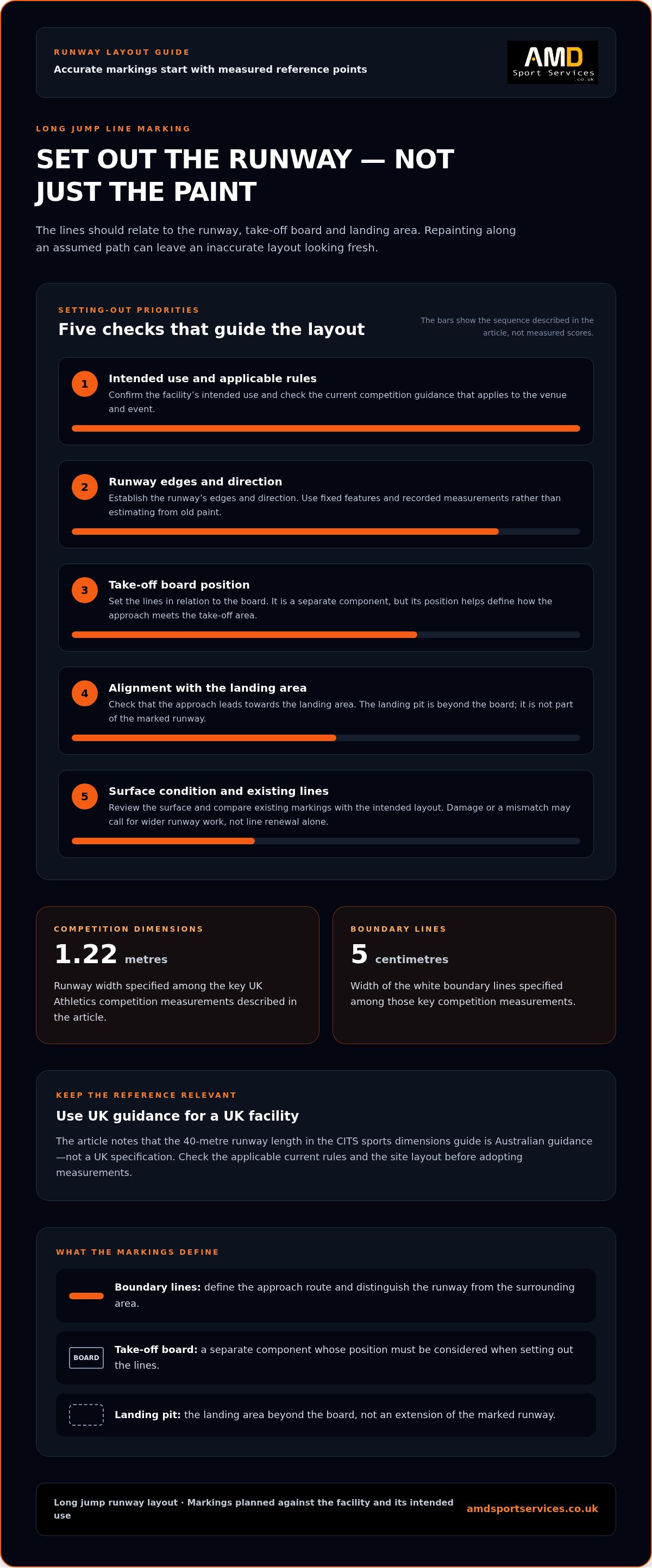
When markings have faded or a runway is being refurbished, the first decision is which layout to use. For competition facilities, UK Athletics rules set out key specifications, including a runway width of 1.22 metres and white boundary lines 5 centimetres wide. These measurements need to be set out in relation to the runway and take-off board, rather than estimated by eye or copied from old paint.
This guide explains what the runway lines define, how to plan their position and when repainting may not be enough. It also covers the practical difference between renewing markings on a suitable surface and including them in a wider runway installation or refurbishment.
What long jump line marking does for a runway
Long jump line marking defines the competition runway on the surface. Its boundary lines show the approach route and distinguish the runway from the surrounding track or field area. They give athletes, coaches and officials a clear visual reference.
The runway, take-off area and landing area need to work together. The marked approach leads towards the landing pit. If the lines do not match the runway’s direction, a neat-looking finish can still leave the layout confusing to use.
Which parts of a long jump facility are marked?
Runway markings generally comprise boundary lines that define the approach route. They lead towards the take-off area at the end nearest the landing pit. The pit is the landing area beyond the approach route.
The layout depends on the facility and its intended use. For competition work, check the current UK guidance that applies to the venue and event before setting out measurements. Don’t copy another facility’s layout without confirming that it suits the project. A school training runway, for example, may have different project requirements from a competition facility.
Why accuracy matters to facility operators
Clear, correctly positioned lines help athletes identify the approach route and give officials a shared reference. They also make the runway easier to distinguish within a multi-use athletics area. Faded or uneven lines, or lines that do not align with the runway, can make the layout harder to interpret and give a poorly organised impression even when the surface remains suitable.
Good marking work is more than painting along an assumed path. The layout should be set out in relation to the runway and take-off area, with the surface condition and any other event markings taken into account. AMD Sport Services’ long jump runway refurbishment work has included marking seven runway lanes, showing how line marking can form part of a wider facility project.
Marking renewal can be a separate task or part of a wider runway installation or refurbishment, depending on the facility. The Long Jump Rules and History overview explains the event’s basic components. For a UK facility, use the relevant current UK guidance to inform competition marking decisions.
How long jump runway markings are set out against applicable standards
Accurate setting-out starts with the intended competition use, then considers the physical layout on site. A line plan should relate to the runway edges, take-off area and landing area. Applying a standard measurement without checking these reference points can leave markings that look tidy but do not align with the intended runway.
What needs measuring before lines are applied?
Assess the layout as a whole before marking begins. Establish the runway’s edges and direction, locate the take-off area and check that the approach is aligned with the landing area. Compare existing lines with the intended layout rather than relying on them as accurate references, especially if they have faded, been repainted or no longer correspond with the facility.
This assessment can reveal whether the issue is limited to the markings. If the surface is damaged or the runway alignment needs attention, repainting alone may not resolve the mismatch. The scope can then be planned as line renewal or as part of a wider runway installation or refurbishment.
Record measurements against fixed features rather than estimating from old paint. Use the dimensions in the current competition guidance that applies to the facility, particularly where it hosts different levels of competition or has a project-specific layout. This helps avoid carrying forward inaccuracies from previous markings.
How to handle UK and international requirements
For domestic competition, the current UK Athletics competition and technical rules are the relevant reference. World Athletics publishes international technical rules that provide a wider context for the event. Its World Athletics Long Jump Specifications page is useful for understanding the event’s equipment and take-off requirements, while the applicable competition rules should guide measurements for a UK project.
The project layout needs to fit the existing construction while meeting competition requirements where the runway is intended for regulated events. Professional long jump line marking brings the applicable UK requirements together with measured site conditions. The layout is reviewed, reference points are established, and the proposed lines are checked against the runway and landing-area alignment before application. AMD Sport Services can include this assessment in long jump runway installation, so the finished layout is planned for both the facility and its intended use.
How professional long jump line marking is applied
Professional long jump line marking follows a measured sequence: assess the runway surface, confirm the intended layout, set out the lines from reliable reference points, then apply them to the agreed plan. Repainting without reviewing the layout can preserve an existing error. Applying new markings without considering the surface can also miss the need for wider work.
Assessment and setting out
Start by reviewing the runway and its current markings. Check whether the lines remain legible and match the facility’s intended layout, and consider the condition of the surface. Faded paint may need renewal, while issues with the runway itself may mean the work should be planned as refurbishment rather than marking alone.
Next, check the layout against fixed reference points. The runway edges and the direction of the landing area inform where the lines belong. The plan should establish the relationship between the approach and landing area, so it is not based solely on old paint or an assumed centre line.
Compare existing markings with the intended plan before using them as a guide. This gives the team a chance to account for differences in the current layout and agree where renewed lines should go before application begins.
Surface preparation and line application
The application approach depends on the runway surface and the project scope. Renewing markings on an existing runway differs from including them in a new installation or refurbishment. Preparation and application should be selected for the actual facility, rather than assuming the same method will suit every surface.
Once the setting-out is complete, the lines are applied in the agreed positions. The finished layout is then considered as a whole, so the markings remain consistent with the planned runway arrangement.
Where marking is part of a new facility, AMD’s long jump runway installation work brings the lines into the wider project scope. This helps coordinate marking with the installation or refurbishment work taking place on site.
When faded or inaccurate markings need more than repainting
Fresh paint can restore visibility, but it will not solve every runway problem. If the surface is suitable and the layout is accurate, renewing faded markings may be enough. If the lines no longer match the runway layout or the surface is deteriorating, assess the wider issue before applying new paint. The aim is to address the cause, not just cover the visible signs.
Signs that markings may need renewal
Faint, broken or hard-to-distinguish lines can make the approach route unclear. Inconsistent edges or markings that seem to diverge from the runway’s alignment are also worth investigating. These signs indicate that the layout needs assessment, but do not establish by themselves whether repainting is the right solution.
Before renewal, compare the existing layout with the intended plan and applicable competition requirements. Old paint can be an unreliable reference if it has shifted, been altered or no longer reflects how the facility is used. If the condition or location of the take-off area is part of the problem, consider it separately from the line work.
There is no single repainting interval for every runway. Timing depends on the visibility and accuracy of the markings and the condition of the surface. An assessment helps determine whether the job is straightforward line renewal or needs additional work.
When runway refurbishment is part of the solution
Surface deterioration can make repainting alone unsuitable. Cracking, crumbling or other visible damage may affect the surface on which new markings would be applied. In that case, the work may need to address the runway as well as its lines. The right scope depends on the surface and facility, not simply on how the paint looks.
If the surface remains suitable, line renewal may be all that is needed. If it needs wider work, refurbishment can bring surface improvements and new markings together in one project. This distinction helps facility managers plan according to the runway’s condition and intended use, rather than treating every fading or alignment issue in the same way.
AMD Sport Services carries out long jump runway installation and refurbishment, with the scope planned around the facility. Where a project involves changes to the runway as well as its markings, installation and refurbishment work can be included in the overall plan.
Long jump line marking with AMD Sport Services
AMD Sport Services installs and refurbishes long jump runways across the UK and beyond. Marking can be planned for a new runway or included in refurbishment, with the scope shaped around the facility and its intended use. This connects the line work to the wider requirements of the runway.
Marking within a wider runway project
For a new facility, consider marking as part of runway installation. On an existing runway, the project may combine renewed lines with other refurbishment work, depending on the surface condition and required layout. The scope is planned for the specific project, rather than assuming every runway needs the same work.
For a new runway, AMD’s installation work provides a way to plan the facility and its markings together. For an existing one, assessing the layout and surface helps establish whether the requirement is line renewal, refurbishment or both.
Discussing a runway marking project
Customers speak directly with AMD’s engineers and installers about the runway, existing lines and intended scope. This makes it easier to discuss the practical details with the people involved in the work and distinguish between line renewal, refurbishment and a new installation.
AMD Sport Services has over 20 years of experience delivering long jump runway installation and refurbishment work. Its specialist teams support facilities across the UK and beyond.
Project information is available on the AMD Sport Services website.
Plan the next stage of your runway project
A clear scope starts by considering the runway’s intended use, the accuracy of the existing layout and the condition of the surface and equipment. These details help determine whether the project needs new markings, refurbishment or a new installation. They also keep the work focused on the facility’s actual requirements.
For long jump line marking, discuss the runway’s current condition, layout and project aims with the people carrying out the work. AMD Sport Services’ engineers and installers can talk through these practical details directly, drawing on experience with runway projects across the UK and beyond.
Share your project requirements with AMD Sport Services and request a free, no-obligation quotation.
Frequently Asked Questions
What are the dimensions of a long jump runway in the UK?
For competition layouts, the applicable specification gives a minimum runway length of 40 metres from its start to the take-off line, and a width of 1.22 metres with a tolerance of ±0.01 metres. Check these figures against the current UK Athletics rules for the facility’s competition level before specifying the work. A school training runway or a project with a different intended use may need its own layout assessment.
How wide should long jump runway lines be?
The competition specification gives a line width of 5 centimetres. This figure should not be applied automatically to every existing facility without checking the relevant rules. For a renewal project, consider the line width alongside the runway’s overall layout and surface condition. If existing lines differ, measure them and compare them with the intended specification to establish the work required.
Can a long jump runway be remarked without replacing its surface?
Yes. Remarking may be suitable if the surface is appropriate for the work and the layout can be accurately re-established. A facility may need only renewed lines where they have become difficult to see and no wider surface work is required. If the surface is deteriorating or the runway layout is inaccurate, repainting alone may not resolve the issue. The scope should reflect the condition found during assessment.
What type of paint is used for long jump runway marking?
The right marking material depends on the runway surface, its existing finish and the project requirements. A product used on one facility should not automatically be assumed suitable for another. A professional marking plan takes this compatibility into account and selects the approach for the actual runway, rather than treating one paint system or application method as a universal standard.
How many lanes can be marked on a long jump runway?
There is no single lane count that applies to every long jump facility. The number depends on the runway design, available space and project layout. If several approach lanes are planned, coordinate their positions with the take-off area and the facility’s intended use. Plan a multi-lane refurbishment as a complete layout, rather than adding lines solely according to how many appear to fit.
Is long jump line marking different from triple jump runway marking?
The events share a runway approach, but their take-off arrangements and competition layouts are not necessarily interchangeable. A facility intended for both events needs markings and equipment positions that reflect the requirements for each use. Assess the layout against the rules for the intended competition and plan any shared-use arrangement for the specific facility.
How often should long jump runway markings be renewed?
There is no universal renewal interval for every runway. Markings may need attention when they become hard to distinguish, appear inconsistent or no longer align with the facility layout. Timing depends on their condition and the runway’s use, rather than a fixed period. A review can establish whether the lines need renewal or whether the surface or layout also needs attention before new markings are applied.
Comments