
Professional Motorised Basketball Goals: Installation and Maintenance Guide

Table of Contents
What are Motorised Basketball Goals and Why are They Essential?
Motorised basketball goals are professional, sports hall-grade systems, typically mounted to a roof structure or high wall, that are raised and lowered using an electric winch. Unlike traditional systems that rely on a manual hand-crank, these advanced units are operated effortlessly via a wall-mounted key switch or a wireless remote control. This technology represents a significant evolution in sports facility management, driven by the need for greater safety, efficiency, and versatility.
The primary benefit of motorising basketball goals is the complete elimination of risks associated with manual handling. Raising and lowering heavy, ceiling-mounted backboards is a physically demanding task that can expose facility staff to the risk of musculoskeletal injury. By automating this process, schools, leisure centres, and sports arenas can protect their employees and meet their duty of care obligations. Furthermore, in busy multi-use sports halls, the ability to retract or deploy basketball goals in seconds is crucial. Motorised systems facilitate swift, seamless transitions between sports like basketball, badminton, and indoor football, maximising the venue's usability and timetable efficiency.
The Shift from Manual to Electric Winching
The transition from manual hand-winches to electric systems addresses two fundamental challenges in facility management: physical strain and operational downtime. Manually winching a heavy backboard structure, which can weigh over 200kg, requires considerable physical effort and introduces potential for operator error or injury. It is a slow, laborious process that is often impractical during the tight changeover periods between scheduled activities.
Electric winching transforms this task into a simple, safe, and quick operation. At the turn of a key or the press of a button, the goals can be smoothly moved into their play or storage position in under a minute. This concept of "effortless transition" is a game-changer for multi-sport venues, allowing staff to reconfigure the hall safely and rapidly. This efficiency not only streamlines operations but also enhances the professional presentation of the facility, ensuring equipment is always correctly and safely positioned for the next user group.
Key Components of a Motorised System
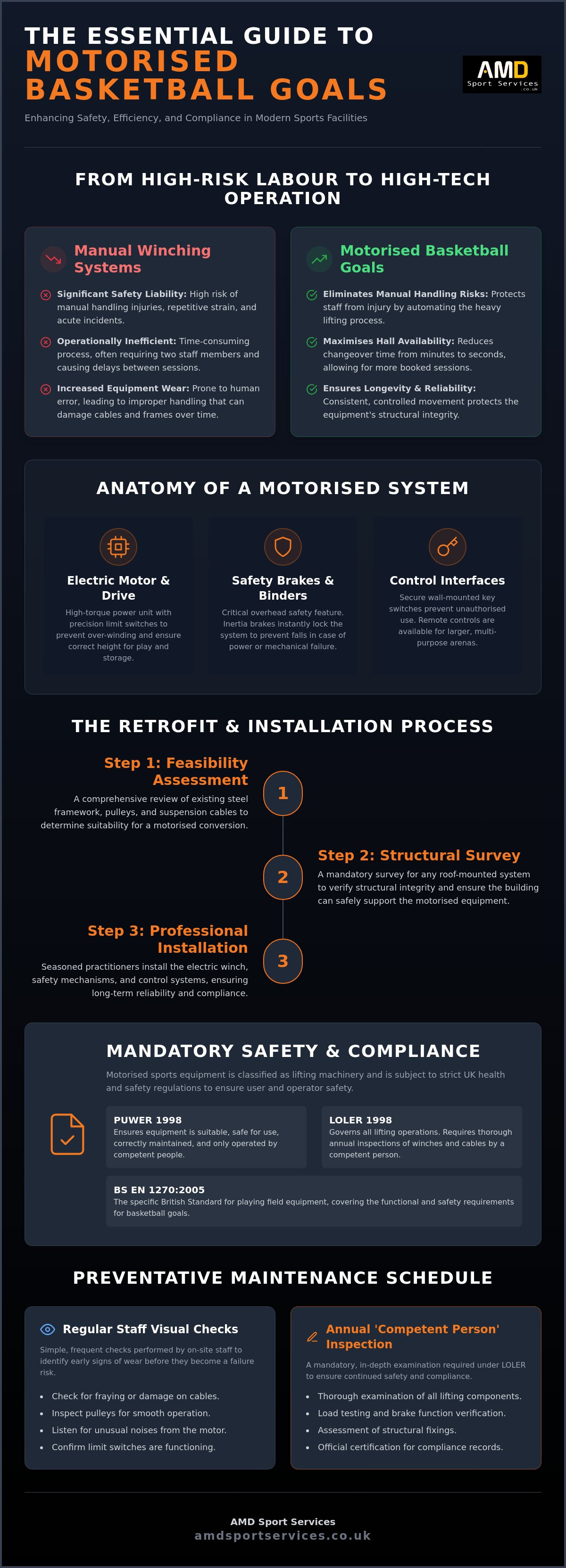
A professional motorised basketball goal system is an assembly of precision-engineered components designed for safety and long-term reliability. Understanding these parts is key to appreciating the system's operational integrity.
The Electric Motor and Drive Assembly: This is the core of the system. A high-torque electric motor, connected to a robust gearbox, provides the power to lift and lower the goal. The motor is specifically chosen to handle the weight of the backboard and supporting steelwork with a significant safety margin.
Safety Load Binders and Inertia Brakes: These are critical, non-negotiable safety features for any equipment lifted overhead. A safety load binder, or safety strap, acts as a secondary support, designed to catch the load in the unlikely event of a primary cable failure. An inertia brake is a mechanical device that automatically locks the winch if it detects a sudden, uncontrolled descent, preventing a catastrophic drop.
Control Interfaces: The system is operated via a secure control interface. The most common type is a wall-mounted key switch, which ensures that only authorised and trained personnel can operate the goals. For added convenience, particularly in large halls with multiple courts, wireless remote-control systems can be installed, allowing for individual or group operation of the goals from a single point.
Motorising Roof-Mounted Basketball Goals: The Retrofit Process
Many sports halls are equipped with older, manually operated basketball goals. The good news is that these existing systems can often be upgraded to full motorised operation. A retrofit project allows facilities to gain all the benefits of motorisation without the cost and disruption of a complete replacement. However, the process requires careful planning and specialist technical expertise.
The first step is always a thorough structural survey. A qualified engineer must assess the existing roof structure or mounting points to confirm they can safely support the additional dynamic loads imposed by an electric motor. This survey will determine the feasibility of the project and inform the design of any necessary brackets or reinforcements. Once the structure is approved, the electric winch can be integrated with the goal's existing cabling and pulley system, provided they are in good condition. Bespoke steel brackets are often fabricated to ensure the motor is mounted securely and in perfect alignment with the cable run, guaranteeing smooth and reliable operation for years to come.
Converting Manual Winches to Electric
The physical conversion process involves the careful removal of the existing manual winch or gearbox. In its place, a purpose-built, high-torque electric motor and drive assembly is installed. For a standard 225kg backboard assembly, a high-torque motor, typically rated around 0.55kW, is required to provide controlled and safe operation. It is crucial that the existing wire rope cables are inspected for any signs of wear, fraying, or "bird-caging" (where strands have unravelled and bunched up). If the cables are not in perfect condition, they must be replaced to handle the consistent tension applied by a motorised system. The new motor is then connected to the drive shaft, ensuring a seamless transfer of power to lift the goal.
Electrical Requirements and Control Wiring
A safe and compliant electrical installation is fundamental to a motorised goal system. Depending on the size and power of the motor, a dedicated 240v single-phase or 415v three-phase power supply will be required, installed by a qualified electrician. This installation must include appropriate circuit protection.
Crucially, the system must incorporate limit switches. These are small but vital safety devices that automatically cut power to the motor when the goal reaches its fully raised (storage) or fully lowered (play) positions. This prevents the motor from over-winding the cable, which could cause severe damage to the goal, the motor, or the building's structure. In addition to limit switches, the control system should include a lockable isolator switch and, in some cases, an emergency stop button, providing multiple layers of safety and control.
Safety Compliance: LOLER and Best Practices for Motorised Sports Equipment
Operating heavy, overhead equipment in a public space like a school or leisure centre comes with significant legal responsibilities. While various health and safety regulations apply, the most directly relevant for motorised goals are the Lifting Operations and Lifting Equipment Regulations 1998 (LOLER).
LOLER applies because a motorised basketball goal is classified as lifting equipment—it lifts and lowers a heavy load (the backboard) over an area where people may be present. Under these regulations, the owner or operator of the equipment has a legal duty to ensure it is fit for purpose, correctly installed, and maintained in a safe condition. This includes subjecting the equipment to regular, thorough examinations by a competent person. For schools and leisure centres, this means that an annual or bi-annual professional safety inspection is not just good practice; it is a legal requirement to ensure compliance and user safety.
The Role of Inertia Brakes and Safety Straps
Beyond the motor itself, the most important components of a motorised system are its independent safety backups. These devices are designed to prevent an accident in the event of a primary system failure and are non-negotiable for any overhead equipment.
Safety Straps/Load Binders: This is a secondary, load-rated strap or chain that is installed alongside the main lifting cable. It runs slack during normal operation but is engineered to immediately take the full weight of the backboard if the primary cable were to break, preventing it from falling.
Inertia Brakes: Also known as a fall-arrest device, an inertia brake is a centrifugal mechanism built into the winch system. It constantly monitors the speed of descent. If the goal begins to lower too quickly—far faster than the motor's controlled speed—the brake automatically engages, locking the winch drum and halting the descent instantly.
These two components work together to provide a fail-safe system, ensuring that even in a worst-case mechanical scenario, the risk to people below is effectively neutralised.
Documentation and Compliance Audits
Maintaining a clear and comprehensive service log for each piece of motorised equipment is a critical part of responsible facility management. This log should record the date of installation, all scheduled maintenance, any repairs carried out, and, most importantly, the reports from each professional inspection. This documentation serves as a formal record of the equipment's history and condition.
In the event of an incident or a health and safety audit, this service log provides a powerful "defence of due diligence." It demonstrates that the facility manager has taken reasonable and proactive steps to ensure the equipment is safe and compliant with regulations like LOLER. Professional inspections, such as those provided through our indoor inspection and maintenance services, result in a detailed report and a certificate of compliance, forming the cornerstone of this essential safety documentation.
Maintenance and Servicing for Motorised Basketball Goals
Like any mechanical system, motorised basketball goals require regular maintenance to ensure their long-term safety and reliability. Establishing a preventative maintenance schedule is the most effective way to avoid unexpected failures, operational downtime, and costly emergency repairs. This schedule should combine routine visual checks by in-house staff with periodic professional servicing.
Before each use, designated staff should perform a quick visual and auditory check. They should look for any obvious signs of damage and listen for any unusual noises during operation. Key maintenance tasks like lubricating pulleys and winch cables, and testing the limit switches and safety cut-outs, are essential for extending the operational life of the system's components and should be carried out according to the manufacturer's recommendations.
Routine Inspection Checklist
Facility staff can play an active role in monitoring the health of their motorised goals by following a simple pre-use checklist. This is not a substitute for a professional inspection but can help identify developing issues early.
Check for Cable Fraying: Visually inspect the visible sections of the steel wire rope. Look for any broken strands, kinks, or areas of "bird-caging," which indicate the cable is damaged and needs immediate professional attention.
Listen for Unusual Motor Noise: During operation, listen for any grinding, clunking, or high-pitched whining sounds from the motor. These can be early indicators of gearbox wear or motor strain. The movement should be smooth and consistent.
Inspect Mounting Bolts and Attachments: Visually check that all mounting bolts on the goal's support structure and the motor bracket are secure. Look for any signs of stress, cracking, or movement in the surrounding wall or ceiling structure.
Professional Servicing Requirements
An annual deep-service by a specialist contractor is essential for ensuring compliance and long-term performance. This goes far beyond a simple visual check and involves a comprehensive technical examination.
Detailed Component Inspection: The engineer will inspect all critical components, including the motor internals, gearbox, drive shaft, pulleys, and electrical connections. They will perform a load test to ensure the system is operating within its safe working limits.
Adjustment and Re-tensioning: Over time, cables can stretch slightly. The service includes re-tensioning the winch cables to ensure the goal hangs level and moves smoothly. The upper and lower limit switches will also be tested and finely adjusted to ensure they stop the goal in the precise, correct positions.
Lubrication and Certification: All moving parts are lubricated according to manufacturer specifications to reduce wear and tear. Upon completion, a full safety report and compliance certificate are issued, updating the facility's service log.
This level of professional care is consistent with the standards required for other high-use sports equipment, as detailed in guides like our commercial trampoline maintenance checklist, where safety is paramount.
Professional Installation and Support with AMD Sport Services
The installation or retrofitting of motorised basketball goals is a specialist task that should only be undertaken by experienced contractors. It requires a combination of structural engineering knowledge, mechanical expertise, and certified electrical skills. Using a non-specialist builder or a general maintenance company can lead to incorrect installation, non-compliance with safety standards, and long-term reliability issues.
At AMD Sport Services, we provide an end-to-end solution for bespoke motorisation projects. Our approach begins with a detailed site survey and consultation to understand the unique requirements of your facility. We manage the entire process, from structural assessments and bespoke bracket fabrication to the final electrical commissioning and staff training. The key benefit of using a single provider is seamless accountability; we are responsible for both the quality of the installation and the ongoing safety inspections, ensuring your equipment remains compliant and in perfect working order throughout its lifespan. We offer this specialist service to schools, councils, and leisure centres across the UK.
Bespoke Solutions for Unique Sports Halls
No two sports halls are identical. We frequently encounter challenges such as complex or non-standard roof structures, exceptionally high ceilings, or obstructions from other building services. Our team specialises in overcoming these obstacles. We design and fabricate custom mounting solutions and cable-run configurations to ensure a safe and effective installation in any environment. For larger facilities with multiple courts, we can design and install customised control systems that allow for the operation of individual goals, pairs, or entire banks from a single, user-friendly panel. With over 20 years of experience in delivering technical sports hall solutions, AMD Sport Services has the practical knowledge to engineer a system that is perfectly tailored to your venue.
Ensuring Long-Term Reliability
Our commitment to our clients extends far beyond the initial installation. We understand that sports facilities rely on their equipment to be available and safe at all times. As an established specialist, we provide long-term support, including access to a full range of spare parts for the systems we install, ensuring that any issues can be resolved quickly and efficiently. Our rapid-response repair services minimise downtime and disruption. Following every installation or major service visit, we provide comprehensive safety certification and documentation, giving you complete peace of mind. To begin transforming your sports hall's safety and efficiency, contact AMD Sport Services for a professional motorised basketball goal consultation.
Frequently Asked Questions
Can any manual basketball goal be motorised?
Most professionally installed, roof- or wall-mounted manual basketball goals can be retrofitted with a motorised system. The feasibility depends on the condition of the existing support structure, the goal's folding mechanism, and the cable/pulley system. A structural survey by a specialist is the essential first step to confirm that the structure can safely handle the loads of an electric winch.
How much does it cost to motorise a roof-mounted basketball goal?
The cost varies significantly based on several factors, including the height of the roof, the existing structure, the weight of the backboards, and the complexity of the electrical wiring required. A project can range from a few thousand pounds for a straightforward single-goal conversion to a much larger sum for a multi-court facility with bespoke structural work. A detailed site survey is necessary to provide an accurate quotation.
What are the electrical requirements for motorised basketball winches?
Most winches for standard basketball goals operate on a 240v single-phase power supply, which is readily available in most commercial buildings. For very heavy-duty systems or banks of multiple goals, a more powerful 415v three-phase supply may be required. In all cases, a dedicated, isolated circuit installed by a qualified electrician is mandatory for safety and compliance.
How often do motorised basketball goals need a safety inspection?
Under LOLER regulations, motorised basketball goals, as lifting equipment, require a formal, documented safety inspection by a competent person at least once every 12 months. However, for equipment in high-use environments like schools and busy leisure centres, a bi-annual (6-monthly) inspection is often recommended as best practice to ensure maximum safety.
Are motorised basketball goals safer than manual ones?
Yes, when correctly installed and maintained, motorised goals are significantly safer. They eliminate the primary risk associated with manual systems: the physical strain and potential for injury from manual handling. Furthermore, they are equipped with mandatory safety features like inertia brakes and safety straps, which are often absent on older manual winches, providing a superior level of protection against equipment failure.
What happens if the power fails whilst the goals are being lowered?
If a power failure occurs, the motor's electromagnetic brake will automatically engage, holding the goal securely in its current position. The goal will not drop. Once power is restored, the operation can be resumed as normal. For emergency situations, most systems can be fitted with a manual override that allows the goal to be safely raised or lowered using a hand crank.
Do I need a structural survey before installing motorised goals?
Absolutely. A structural survey is a mandatory and critical first step. An electric motor imparts different forces (dynamic loads) onto the support structure compared to a manual winch. A qualified engineer must verify that the roof trusses or wall can safely support the motor and the operational load of the system to prevent any risk of structural failure.
What is the lifespan of an electric winch for sports hall equipment?
A high-quality, professionally installed electric winch should have an operational lifespan of 15 to 20 years or more, provided it is subject to regular professional maintenance and servicing. The motor itself is a very robust component; the parts that may require replacement over time include the wire rope cable, pulleys, and electrical contactors, all of which are checked and managed during annual servicing.


Comments