
Professional Sports Hall Netball Post Installation: A Technical Guide

A sports hall floor is often the most expensive asset in a leisure facility, yet it's frequently compromised by poorly executed equipment fittings. You understand that professional sports hall netball post installation requires more than just drilling a hole; it demands a precise balance between structural stability and the integrity of the playing surface. Whether you're managing a school hall or a national-standard centre, the pressure to get the socket depth and alignment right is significant, especially when balancing the requirements of multi-use environments and strict governing body regulations.
We recognise the challenge of ensuring your facility meets England Netball standards without risking permanent damage to timber or synthetic floors. This guide provides a technical breakdown of the installation process, from achieving the required 300mm socket depth to selecting flush-fitting lids that eliminate trip hazards. You'll discover the specific requirements for competitive play, the differences between Sport England and England Netball dimensions, and how a professional fitting ensures long-term safety for every player on the court.
Table of Contents
Understanding Sports Hall Netball Post Installation Standards
Compliance isn't a luxury; it's a fundamental requirement for any facility hosting organised play. The official rules of netball dictate precise specifications for court layout and equipment, which vary depending on whether you're hosting local club matches or international fixtures. For school environments, the standards focus on versatility and age-appropriate heights, whereas professional venues must adhere to rigid stability and dimension criteria. Getting the sports hall netball post installation right from the outset prevents costly remedial work and ensures the facility remains fit for purpose for years.
England Netball and Sport England provide the framework for these standards. They specify that for competitive play, posts must be stable, vertical, and capable of withstanding high-impact play without shifting. Professional installation ensures these dimensions are met with millimetre precision, protecting the facility from the liability risks associated with equipment failure. Maintaining these standards requires regular sports equipment safety inspections to identify wear in the sockets or uprights before they become a hazard.
Stability is governed by BS EN standards for sports equipment. These mandate that posts shouldn't tip or wobble during use, which is a common failure point in poorly fitted systems. Meeting these standards requires a deep understanding of floor loading and the mechanical forces exerted on the ground sockets during a match.
Key Components of a Professional System
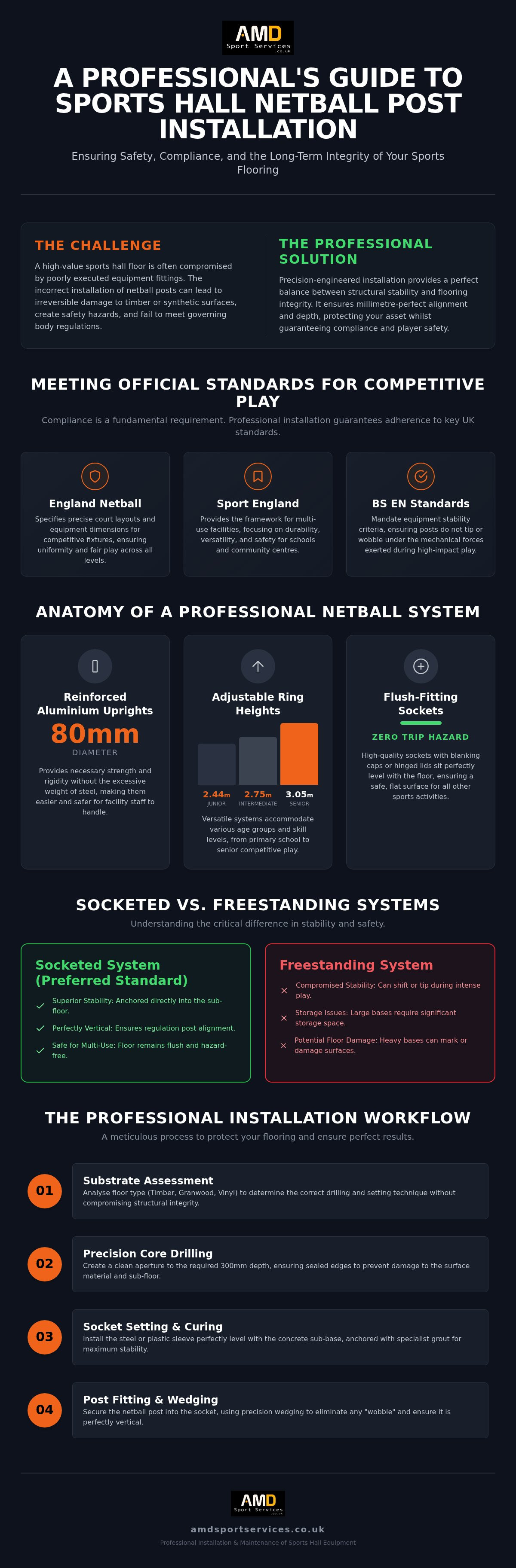
Reinforced Aluminium Uprights: Typically 80mm in diameter, these provide the necessary strength without the excessive weight of traditional steel, making them easier for staff to handle.
Adjustable Ring Heights: Systems must accommodate different age groups, with settings at 2.44m (8ft) for juniors, 2.75m (9ft), and the regulation 3.05m (10ft) for seniors.
Flush-Fitting Sockets: High-quality sockets include blanking caps or hinged lids that sit perfectly level with the floor surface when the posts are removed, preventing trip hazards during other sports.
Safety and Compliance Considerations
Safety isn't just about the post itself; it's about how it interacts with the floor. Precision socket wedging is essential to prevent post "wobble," which can distract players and cause uneven wear on the floor substrate. In high-level competitive environments, protective padding is also a requirement. This padding must be of uniform thickness, not exceeding 50mm, to protect players during fast-paced movement around the goal circle.
A socketed installation involves the precision fitting of a steel or plastic sleeve into the sports hall floor to provide a rigid, vertical anchor point for the post whilst ensuring the surface remains flush and safe for other activities. This method is the preferred standard for sports hall netball post installation because it offers superior stability compared to freestanding units, which can shift during play and require significant storage space.
Technical Requirements for Socketed Netball Post Installation
Socketed systems are the industry standard for a reason. They provide a level of stability that freestanding units cannot match, but a successful sports hall netball post installation depends entirely on the preparation of the floor substrate. Each surface, from traditional timber to modern vinyl, presents unique challenges during the core drilling and socket setting phases. We approach every floor with a focus on structural integrity, ensuring that the installation doesn't compromise the long-term health of the playing surface.
When working with Granwood or synthetic surfaces, the priority is maintaining a clean, sealed edge around the aperture. For vinyl or point-elastic floors, the socket must be set perfectly level with the concrete sub-base to prevent the material from tearing or lifting over time. Adhering to World Netball equipment standards ensures that these technical details aren't just about aesthetics; they're about the safety and longevity of the equipment under the stress of competitive matches. Precision is the only way to avoid the common issues of loose sockets or damaged floor finishes.
Installing Sockets in Suspended Timber Floors
Fitting sockets into suspended hardwood systems, such as Junckers, requires specialist techniques to avoid compromising the floor's structural integrity. We use precision core drilling to create a perfectly circular aperture without splintering the timber. It's vital to remember that timber is a "live" material. The installation must allow for natural expansion and contraction, which usually involves fitting a tailored trim or expansion sleeve around the socket head. This prevents the floor from buckling against the rigid steel socket during seasonal humidity changes.
Structural support is equally critical. Once the hole is cut, the surrounding joists or battens often require reinforcement to distribute the load of the netball post. This ensures the floor doesn't dip or flex when the post is under tension during high-intensity play.
Sub-floor Preparation and Concrete Work
The foundation of any secure post is the concrete pocket. For a standard 80mm socket, a depth of 300mm is typically required to provide sufficient leverage and stability. In retrofit scenarios, this involves excavating the existing sub-floor with minimal disruption to the surrounding area. The socket is then positioned using precision levelling tools to ensure absolute vertical alignment. Even a two-degree deviation at the base results in a significantly leaning post at the 3.05m ring height.
Once the concrete has cured, the interface between the socket and the finished floor is managed with blanking caps or hinged lids. These must sit perfectly flush. Anything else creates a trip hazard for basketball, five-a-side football, or gymnastics. You can learn more about our indoor maintenance services to see how we keep these components in working order. If you're planning a facility upgrade, our team provides technical guidance on netball post installation to ensure your project meets all regulatory benchmarks from day one.
Comparing Netball Post Systems: Socketed vs. Freestanding
Selecting the right equipment for your facility depends on the frequency of play and the specific constraints of your storage areas. Whilst freestanding posts offer the advantage of mobility, they lack the absolute rigidity required for high-level competition. For facilities prioritising a professional environment, sports hall netball post installation usually focuses on socketed systems. These provide a permanent, secure anchor point that eliminates the risk of the post shifting during play, ensuring the ring remains at the precise regulation height and position throughout the match.
Freestanding systems are often considered for multi-use spaces where floor drilling isn't an option. However, these units have a significant storage footprint. A standard pair of weighted freestanding posts requires substantial cupboard space, which is often at a premium in school halls or local leisure centres. Floor-anchored systems offer a hybrid alternative; they use a shallow bolt-down plate rather than a deep socket. These are useful in halls with thin floor slabs where a 300mm deep concrete pocket isn't structurally feasible, providing more stability than a freestanding unit without the depth requirements of a full socketed fitting.
When to Choose Socketed Posts
Socketed posts are the preferred choice for high-use environments. The setup time is significantly faster than weighted alternatives; staff simply remove the blanking caps and drop the posts into the pre-installed sleeves. This efficiency is vital during tight equipment changeovers between different sports sessions. From a safety perspective, socketed systems also reduce the risk of manual handling injuries. Because the stability comes from the floor socket rather than a heavy, weighted base, the posts themselves are lighter and easier for facility staff to manoeuvre.
For leagues and regional competitions, the rigidity of a socketed post is non-negotiable. It ensures that the goal doesn't sway when the ball hits the ring, maintaining the integrity of the game. If your hall is expected to host club-level matches, the investment in a professional sports hall netball post installation is essential for meeting governing body standards.
Wall-Mounted and Bespoke Solutions
In facilities where floor space is exceptionally limited, wall-mounted goals provide an effective solution for practice sessions and training drills. These are often installed along the sides of the hall, allowing multiple groups to practice shooting simultaneously without cluttering the main court area. We frequently design these systems to work in tandem with other equipment, such as professional basketball goal installation. Integrating these systems requires careful planning to ensure that netball rings and basketball backboards don't obstruct one another.
Bespoke brackets and custom mounting solutions can also be engineered for halls with non-standard configurations, such as those with low-hanging beams or ventilation ducting. This tailored approach ensures that even the most challenging structural layouts can accommodate regulation-standard play whilst maintaining the safety of the facility.
The Professional Installation Process: From Floor Sockets to Safety Testing
A successful sports hall netball post installation follows a methodical, five-step workflow designed to protect the facility's infrastructure whilst ensuring player safety. The process begins with a comprehensive site survey to assess the floor's sub-structure. We identify potential obstacles such as underfloor heating pipes, electrical conduits, or structural voids that could interfere with the 300mm excavation required for the sockets. This initial assessment ensures the installation is technically feasible before any physical work commences.
Once the survey is complete, the physical installation moves through precise core drilling and structural setting. Using diamond-tipped core drills, we create clean, vertical apertures through the playing surface. This action results in a perfect fit for the heavy-duty floor sockets, which are then set in high-strength concrete. We monitor the curing process closely to ensure the sockets remain perfectly vertical. Finally, we fit flush-access panels or blanking caps, followed by rigorous load testing to confirm the system meets BS EN stability requirements.
Precision Marking and Alignment
Accuracy in court layout is non-negotiable. We ensure that every post is perfectly centred within the goal circle to maintain the integrity of the game. This often involves coordinating with court marking renewal services to ensure that new socket positions align exactly with the painted lines. By synchronising these tasks, we avoid the problem of "ghost lines" or redundant markings that can confuse players and officials during multi-sport use. If your court lines are faded, we recommend a full renewal alongside the post fitting to ensure a professional finish.
Testing and Handover
The final phase is the safety handover. We perform a verticality check under tension to ensure the posts don't lean when a ball strikes the ring. This is followed by a practical training session for your facility staff, where we demonstrate the correct method for inserting, removing, and securing the posts. We also provide comprehensive O&M (Operation and Maintenance) documentation, including safety certificates and maintenance schedules, to support your facility's health and safety audits.
Don't risk the integrity of your sports hall floor with an unverified fitting. You can book a professional sports hall netball post installation with our expert team to ensure your facility remains safe and compliant for the long term.
Ensuring Long-Term Compliance with AMD Sport Services
A successful installation is merely the beginning of a post's operational life. To maintain the standards achieved during the initial sports hall netball post installation, facility managers must implement a robust maintenance regime. Neglecting the equipment leads to more than just aesthetic wear; it creates genuine safety risks and potential liability issues. We provide national coverage across the UK, supporting schools, local authorities, and private leisure centres in keeping their facilities compliant and safe for every participant.
The foundation of this compliance is regular sports equipment safety inspections. These annual checks are essential for identifying structural fatigue in the uprights or wear in the floor sockets that might not be visible during daily use. Proactive inspections allow for minor repairs, such as replacing worn nets or adjusting ring tension, before they escalate into equipment failure. We focus on the technical integrity of every component to ensure your hall remains fit for purpose.
Floor sockets require specific attention to prevent long-term operational issues. Debris, such as dust from floor sanding or grit from outdoor footwear, easily accumulates within the sleeve. If left uncleaned, this buildup can cause the posts to seize or prevent the blanking caps from sitting flush. We recommend a regular cleaning schedule for all floor apertures to ensure the system remains functional and the floor surface remains safe for other sports activities.
A Holistic Approach to Facility Maintenance
Managing a sports hall involves coordinating various technical systems. We often find that clients benefit from combining their netball requirements with other essential upgrades, such as sports hall netting systems. This integrated approach ensures that all equipment, from goalposts to division nets, operates within the same safety framework. You can view our latest installation projects to see how we've transformed multi-use spaces into high-performance environments.
Proactive servicing extends the life of your assets and reduces the need for emergency repairs. By addressing issues like frayed padding or chipped paint on rings early, you maintain a professional image and ensure the equipment remains inviting for players. Our maintenance programmes are designed to be methodical and efficient, minimising downtime for your facility.
Book Your Site Survey
If you're planning a new sports hall netball post installation or need to upgrade an ageing system, a technical assessment is the first step. Our team of "Seasoned Practitioners" will visit your site to evaluate your floor type, sub-structure, and storage capacity. We provide detailed, customised quotes that reflect the specific needs of your facility, whether you require a single pair of club-standard posts or a full international-specification setup.
Direct communication and technical honesty are the pillars of our service. We don't rely on sales pitches; instead, we offer pragmatic advice based on over 20 years of industry experience. Contact us today to arrange your survey and ensure your sports hall meets the highest standards of safety and workmanship.
Securing Professional Standards for Your Sports Hall
A professional sports hall netball post installation is a technical investment that demands precision from the initial core drill to the final safety certification. You've seen that balancing the requirements of England Netball with the structural needs of your flooring is vital for long-term facility health. By prioritising flush-fitting sockets and regular maintenance, you eliminate trip hazards and ensure your equipment remains league-compliant for every match. It's about more than just equipment; it's about creating a safe, professional environment for all players.
With over 20 years of technical expertise across the UK, we specialise in both high-precision equipment installation and comprehensive safety inspections. Our team provides national coverage for schools and leisure centres, ensuring every fitting meets the highest standards of workmanship. We're ready to help you upgrade your facility with a solution that prioritises safety and durability. Contact AMD Sport Services for a Professional Netball Post Installation Quote and take the first step towards a more secure, compliant sports environment.
Frequently Asked Questions
How deep do netball post floor sockets need to be?
Standard ground sockets require a depth of 300mm to ensure structural stability. This depth provides the necessary leverage to keep the post vertical under the tension of competitive play. Sockets must be set in high-strength concrete to prevent any movement or "wobble" over time, ensuring the ring remains at the regulation height.
Can netball posts be installed on a suspended timber floor?
Yes, we frequently perform installations on suspended timber systems like Junckers. This requires precision core drilling and often involves reinforcing the sub-floor joists to distribute the load effectively. We also use specialised trims to allow for the natural expansion and contraction of the wood, preventing the floor from buckling against the rigid socket.
How long does a professional netball post installation take?
A typical sports hall netball post installation is usually completed within one to two days. The first day focuses on site surveys, marking, and core drilling, whilst the second day involves setting the sockets and fitting blanking caps. You should allow additional time for concrete foundations to cure fully before the posts are used for matches.
Do we need to renew our court markings when installing new sockets?
Whilst not strictly mandatory, we highly recommend a court marking renewal during the installation process. This ensures that the new sockets align perfectly with the goal circle lines. Accurate markings are essential for official matches and help avoid the confusion caused by faded or misaligned lines on a multi-sport surface.
Are socketed netball posts safer than freestanding ones?
Socketed posts are considered the gold standard for safety and are the preferred choice for England Netball. Because they're anchored directly into the floor, they can't tip or shift during high-intensity play. This eliminates the risk of heavy weighted bases moving across the floor or causing manual handling injuries for facility staff.
How often should netball posts and sockets be inspected for safety?
You should arrange for a professional safety inspection at least once every twelve months. These annual checks identify structural fatigue, worn rings, or debris buildup in the sockets that could cause the posts to seize. Regular maintenance ensures your equipment remains compliant with BS EN standards and safe for all users.
Can you install netball posts in an existing sports hall floor?
Yes, we specialise in retrofitting sockets into existing surfaces, including Granwood, vinyl, and timber. We use diamond-tipped core drills to create clean apertures with minimal disruption to the surrounding area. This process allows older facilities to upgrade to professional-standard equipment without the need for a full floor replacement.
Do the installed posts meet England Netball international standards?
Our professional sports hall netball post installation services use equipment that meets or exceeds international standards. This includes using reinforced 80mm diameter uprights and adjustable rings that can be set to the regulation height of 3.05m. Every fitting is checked for verticality to ensure it meets the rigid requirements of competitive play.


Comments